Roles in Consulting: A Practical Guide to Building Impactful Teams

Assembling the right team is the foundation of a successful cloud project. Each expert has a specialized role, and their coordinated effort determines the outcome. A successful cloud transformation depends on having the right experts in place from strategy through execution.
Assembling Your Cloud Transformation Team

A cloud initiative is a fundamental business shift that requires a diverse skillset. Without a clear understanding of who is responsible for what, projects suffer from scope creep, budget overruns, and a failure to deliver business value.
The key is to look past generic job titles and understand the specific value each role brings to the project. Every consulting role is a critical component of a successful engagement.
The Strategic Value of a Well-Defined Team
A well-structured team provides clarity and accountability. Each member knows their responsibilities, which reduces confusion and improves operational efficiency. This structure is essential for navigating the complexity of modern cloud environments, from initial strategy to long-term optimization.
Specialized expertise is non-negotiable. The Cloud Consultant is your strategic guide for navigating platforms like AWS, Azure, and Google Cloud. The global market for these services, valued at over USD 30 billion, is projected to grow at a CAGR of 16.5% through the next decade. This growth underscores the critical need for experts who can prevent common issues like budget overspending—a problem for 33% of large organizations. You can read more about the growth of the cloud consulting market to understand how these professionals drive financial efficiency.
A successful cloud initiative requires a cohesive unit, not just a group of individuals. The team must handle deep technical complexity while remaining focused on achieving specific business outcomes.
Your Guide to Consulting Roles
This guide provides a practical framework for building a high-performing team. We will break down the essential roles in consulting for any cloud engagement. From the high-level vision of an Engagement Manager to the hands-on execution of a DevOps Engineer, you will learn how to:
- Identify the mandatory roles for your project’s scope.
- Differentiate between similar but distinct titles, such as Cloud Architect and Solutions Architect.
- Align team members with the appropriate phases of the project lifecycle.
- Evaluate a consulting partner’s proposed team for completeness and expertise.
This knowledge enables you to de-risk your cloud investment and build a team that accelerates business goals.
Decoding the Core Cloud Consulting Roles
To maximize the value of a cloud consulting engagement, you must understand who does what. Understanding these core roles in consulting is essential for selecting the right team and ensuring the right expertise is available at each project phase.
The Engagement Manager (EM) is the primary point of contact, responsible for aligning technical execution with your business objectives. The EM oversees the budget, timeline, and client relationship, ensuring the consulting firm delivers on its commitments.
Working closely with the EM, the Project Manager (PM) manages daily operations. While the EM focuses on the strategic picture, the PM handles the details: running daily stand-ups, managing the project plan, and removing obstacles to keep the technical team productive.
The Architectural Visionaries
Every successful cloud project starts with a robust architectural blueprint. Two key architect roles are responsible for this, and it’s important to understand their distinct functions.
The Cloud Architect designs the foundational cloud environment. They make high-level decisions on networking, security posture, governance, and scalability. Their responsibility is to ensure the underlying platform is stable, secure, and capable of supporting long-term business needs.
This role is a technical visionary, and its importance is growing. The cloud computing market is projected to expand by USD 600.5 billion in the coming years, driven by the need for architects who can design systems for demanding AI and ML workloads. With public cloud spending approaching $1 trillion, a Cloud Architect’s ability to navigate major platforms like AWS, Google Cloud, and Microsoft Azure is critical. You can review the full market analysis on cloud computing growth to see how central this role has become.
The Solutions Architect focuses on specific business problems. If the Cloud Architect designs the city grid, the Solutions Architect designs individual buildings. They design application-level solutions, selecting the appropriate services and ensuring the software functions correctly within the broader cloud environment.
The Hands-On Builders and Guardians
With the architecture defined, the engineers and security professionals execute the plan.
- DevOps/Infrastructure Engineer: These are the builders who implement the architectural designs. Using Infrastructure as Code (IaC), they automate the provisioning of servers, databases, and networks. Their primary goal is to build a reliable, automated CI/CD pipeline for deploying code from development to production efficiently.
- Security/Compliance Lead: This role is responsible for securing the cloud environment and ensuring it meets regulatory requirements like HIPAA or PCI DSS. They implement security controls, monitor for threats, and work with architects from the start to integrate security into the project’s design.
A common mistake is treating security as a final checklist item. An effective Security Lead is involved from the first design meeting, embedding security throughout the process to prevent costly and dangerous vulnerabilities later.
The Data and Domain Experts
Modern cloud projects are about unlocking data value and solving specific industry challenges.
The Data Engineer builds and manages the data infrastructure. They create robust data pipelines that ingest, transform, and load data from various sources. They ensure data is clean, reliable, and available for analytics teams, machine learning models, and business intelligence dashboards.
The Subject Matter Expert (SME)/Industry Lead provides essential business context. This individual brings deep, real-world knowledge of your industry—whether it’s finance, healthcare, or retail—and ensures the technical solution solves a genuine business problem in a practical way.
Finally, the Account Director manages the long-term strategic relationship between your company and the consulting firm. They are less involved in daily project execution but focus on future planning to ensure the partnership continues to deliver value.
Cloud Consulting Roles At A Glance
This table provides a quick reference for the key roles, their core functions, and their primary deliverables. Use it to understand who is responsible for what on your consulting team.
| Role | Core Function (The ‘Why’) | Primary Deliverables (The ‘What’) |
|---|---|---|
| Engagement Manager | Owns the client relationship and ensures business goals are met. | SOW, budget reports, client status updates, overall project success. |
| Cloud Architect | Designs the high-level, foundational cloud infrastructure. | High-level architecture diagrams, platform strategy, security framework. |
| Solutions Architect | Designs specific application systems to solve business problems. | Detailed solution designs, application architecture, technology selection. |
| DevOps/Infra Engineer | Automates and builds the cloud environment and CI/CD pipelines. | IaC scripts, automated deployment pipelines, monitoring dashboards. |
| Security/Compliance Lead | Ensures the environment is secure and meets regulatory standards. | Security policies, compliance reports, vulnerability assessments. |
| Data Engineer | Builds and manages the flow and storage of data. | Data pipelines, ETL jobs, data warehouses/lakes. |
| SME/Industry Lead | Provides deep industry context to guide the technical solution. | Business requirements, user stories, domain-specific validation. |
| Project Manager | Manages daily tasks, timelines, and team coordination. | Project plan, sprint boards, risk logs, daily stand-ups. |
| Account Director | Manages the long-term strategic firm-client partnership. | Quarterly business reviews (QBRs), strategic roadmaps, contract renewals. |
This table helps map responsibilities and clarifies who to direct questions to as the project progresses.
Getting the Right Experts at the Right Time
The value of a consulting role changes as a project progresses. A common mistake is to staff a project with all roles from day one. A more effective and cost-efficient approach is to align the right roles with specific project phases.
A cloud project typically follows four distinct stages where certain experts take the lead.
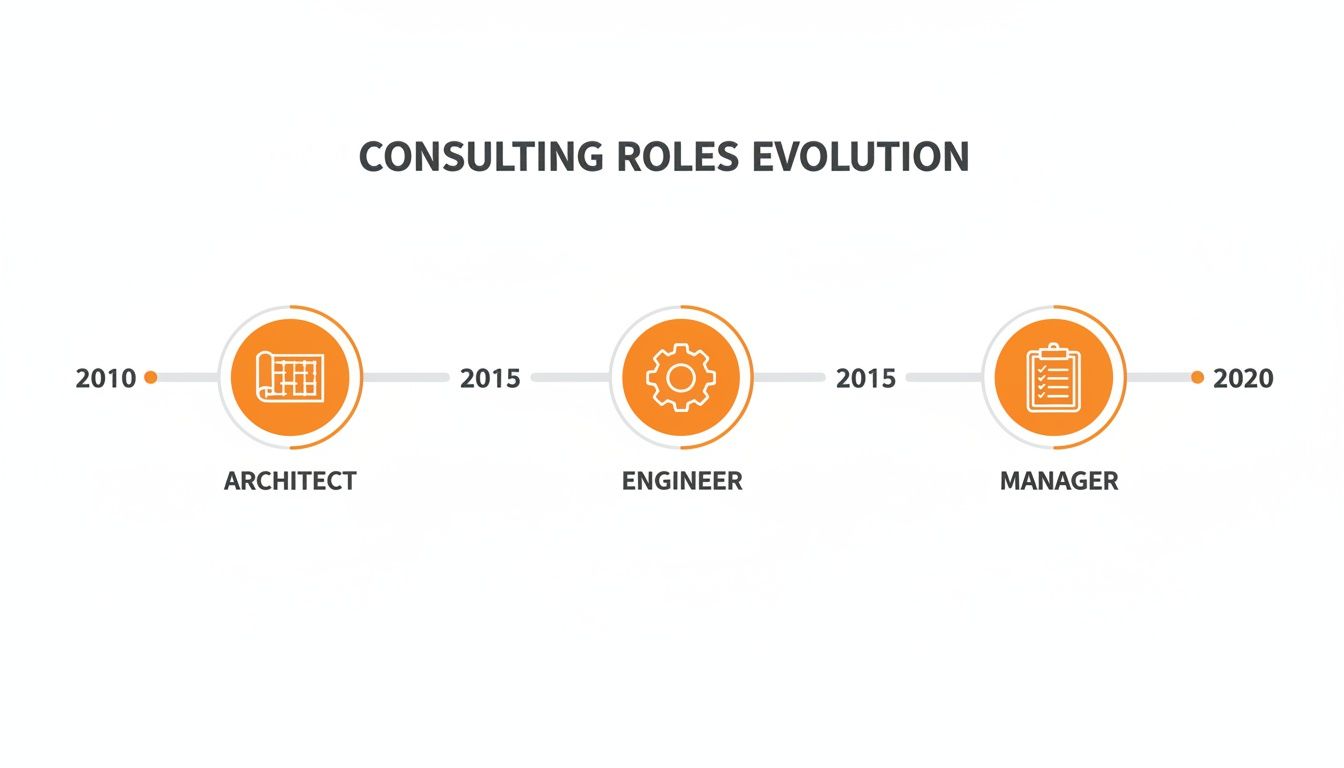
This timeline illustrates that project success depends not just on who is on your team, but when their skills are applied.
Phase 1: Discovery and Strategy
This initial phase focuses on defining business goals, assessing the current environment, and creating a high-level roadmap.
The Engagement Manager and the Cloud Architect lead this stage. The Engagement Manager ensures alignment with business needs, while the Architect analyzes the existing tech stack to design a core cloud strategy. A Subject Matter Expert (SME) is also critical here to ensure the proposed solution addresses real industry-specific challenges.
Phase 2: Design and Planning
With a strategy in place, the team creates detailed technical blueprints to turn the vision into an actionable plan.
The Cloud Architect and Solutions Architect are central to this phase. The Cloud Architect finalizes the infrastructure design, while the Solutions Architect details the specific applications and services. The Security Lead is also heavily involved, integrating security and compliance controls into the architecture from the outset.
A project’s success is often determined in the design phase. Rushing this step is like pouring a foundation without letting it cure—structural problems will appear during implementation.
The Project Manager’s involvement increases significantly, building out the detailed project plan, defining sprints, and allocating resources.
Phase 3: Implementation and Migration
This is the execution phase where the team builds the cloud environment, migrates applications and data, and automates workflows.
The DevOps and Infrastructure Engineers are the key contributors. They write the code to provision infrastructure and establish CI/CD pipelines for smooth and repeatable deployments. Data Engineers execute the data migration plan.
During this phase, the Project Manager coordinates all activities, manages risks, and keeps the project on schedule. The need for this role is amplified by the growth in complex cloud projects, a market expected to grow from $29.1 billion to $100.9 billion by 2033. For projects with high complexity, partnering with specialized project management consultant firms can be a decisive factor.
Phase 4: Optimization and Governance
After launch, the project enters an ongoing phase focused on performance tuning, cost management, and establishing long-term governance.
The focus returns to a strategic mix of roles. DevOps Engineers monitor and optimize the live environment, while the Security Lead conducts ongoing threat assessments. The Engagement Manager and Account Director re-engage to review business outcomes, plan future initiatives, and ensure the partnership continues to deliver value. This stage solidifies the ROI of the cloud investment.
How to Staff Your Team Based on Budget and Scope
Not every project requires a large team of consultants. Success depends on matching team size and expertise to your project’s budget and complexity. Overstaffing wastes money, while understaffing leads to missed deadlines and poor outcomes.
We have outlined three practical staffing models based on common budget tiers. Each model details the essential roles, team size, and expected outcomes. Use these as a guide to align your investment with your goals.
To understand the costs associated with these roles, refer to our guide on hourly IT consulting rates.
The Lean Team for Targeted Projects
For projects with a budget under $200,000, the focus is on speed and precision. This model is ideal for well-defined tasks like migrating a single application, setting up a new data pipeline, or automating a specific piece of infrastructure. The goal is to solve one problem effectively.
The team is small and execution-focused, minimizing management overhead.
- Essential Roles: A Solutions Architect to design the solution and one or two DevOps/Infrastructure Engineers to implement it. A part-time Project Manager can keep the project on track.
- Typical Team Size: 2-4 consultants.
- Primary Focus: Executing a single, clearly defined technical task that delivers immediate impact with a quick turnaround.
The Blended Agile Team for Mid-Range Initiatives
For budgets in the $200,000 to $1 million range, the project scope expands. This model is suited for more complex initiatives, such as modernizing a core business application, building a foundational data platform, or migrating several related systems.
The team is larger and more balanced, combining strategic design with deep execution skills. These teams typically operate in an agile framework, delivering value in iterative sprints.
This model is the standard for most mid-market companies, providing sufficient expertise for complex projects without the cost structure of a full enterprise transformation.
The Blended Agile Team includes more specialized roles in consulting, with dedicated functions for security and data.
- Essential Roles: A core team of a Cloud Architect, a Solutions Architect, and several DevOps Engineers. This is supported by a dedicated Security Lead, a Data Engineer, and a full-time Project Manager.
- Typical Team Size: 5-10 consultants.
- Primary Focus: Delivering a significant business capability that requires coordination across multiple technical domains, with a strong focus on security and data integrity.
The Enterprise Transformation Team for Large Programs
For strategic programs with budgets exceeding $1 million, the engagement is a large-scale transformation initiative. This could involve migrating entire data centers, modernizing a portfolio of legacy applications, or re-architecting a company’s core IT foundation.
This team is comprehensive, including senior strategic oversight and deep domain expertise to navigate complex organizational and technical challenges.
The team is a curated mix of technical experts, strategic leaders, and industry specialists.
- Essential Roles: All roles from the Blended Team, plus an Engagement Manager for executive-level oversight, multiple Subject Matter Experts (SMEs) to ensure business alignment, and potentially dedicated QA Testers and a long-term Account Director.
- Typical Team Size: 10+ consultants.
- Primary Focus: Executing a multi-faceted strategic program that reshapes a core part of the business, involving complex stakeholder management and deep industry-specific requirements.
Staffing Models By Cloud Project Budget
This table provides a comparative look at typical team compositions across different budget tiers. Use it as a quick reference to align your investment with the required level of expertise.
| Budget Tier | Typical Team Size | Essential Roles | Focus |
|---|---|---|---|
| < $200K | 2-4 | Solutions Architect, DevOps/Infra Engineer, part-time Project Manager | Quick execution of a single, well-defined technical task. |
| $200K - $1M | 5-10 | Cloud Architect, Solutions Architect, DevOps Engineers, Security Lead, Data Engineer, Project Manager | Delivering a complex business capability with a focus on security and data. |
| $1M+ | 10+ | Engagement Manager, Cloud Architect, SMEs, Security Lead, Data Engineers, DevOps Engineers, QA Testers, Project Manager, Account Director | Driving large-scale business transformation with deep strategic and industry-specific expertise. |
Choosing the right staffing model requires a realistic assessment of your budget and project complexity to build a team positioned for success.
How to Evaluate Consulting Roles in an RFP
Once you receive a Request for Proposal (RFP) or Statement of Work (SOW), you must evaluate whether the proposed team can deliver. Vague role descriptions and mismatched resumes are common issues that can derail projects.
To make an informed decision, you must ask targeted questions, set clear performance expectations, and identify potential red flags.
Asking the Right Questions
Generic questions yield generic answers. To accurately assess a consultant’s capabilities, ask specific, experience-based questions that require them to demonstrate their problem-solving skills.
Instead of “Tell me about your experience,” use these targeted questions for key roles in consulting:
-
For the Engagement Manager
- “Describe a time a project was significantly over budget. What specific actions did you take to correct its course?”
- “How do you manage a key client stakeholder who is resistant to the project’s strategic goals?”
-
For the Cloud Architect
- “Describe an architecture you designed that failed to meet performance requirements post-launch. What was the root cause, and how did you resolve it?”
- “Explain your decision-making process for selecting between two similar cloud services for a mission-critical workload. What were the primary trade-offs?”
-
For the DevOps Engineer
- “Detail the most complex CI/CD pipeline you have built. What were the most significant automation challenges you overcame?”
- “You receive an alert for a major production outage at 3 AM with minimal information. What is your immediate course of action?”
These types of questions reveal how an individual solves problems, communicates under pressure, and handles real-world challenges.
Defining Key Performance Indicators
To objectively measure performance during the project, establish clear Key Performance Indicators (KPIs) for each role. This practice ensures accountability and aligns the team around shared goals.
Define KPIs for each role in the SOW before the project begins. This ensures everyone understands the definition of success from day one.
Here are examples of role-specific KPIs:
- Project Manager: On-time sprint completion rate (>90%), budget variance (<10%), number of identified risks resolved proactively.
- Security Lead: Mean time to remediate critical vulnerabilities (<24 hours), number of post-launch security incidents (zero), percentage of compliance controls passed during audit.
- Data Engineer: Data pipeline uptime (>99.9%), data processing latency meets SLA, data ingestion error rate (<0.1%).
Defining these metrics upfront transforms subjective expectations into measurable outcomes, which is crucial for effective vendor management and finding the right team of cloud migration consultants.
Spotting Critical Red Flags
Identifying red flags in an RFP response can help you avoid quality issues, communication breakdowns, and poor project management.
Look for these common warning signs:
- Vague Role Descriptions: Proposals using generic, non-customized job descriptions indicate a lack of thorough consideration for your specific project needs.
- The “One-Size-Fits-All” Team: A proposal that recommends the same team structure used for a project of a different scale or in a different industry suggests a formulaic, rather than tailored, approach.
- Heavy Reliance on Subcontractors: While not always negative, a heavy reliance on third-party contractors for core roles can create communication gaps and accountability issues. Clarify who is a direct employee.
- Bait-and-Switch Tactics: If senior experts from the sales process are absent from the SOW, push back. Insist on interviewing the actual team members who will be assigned to your project.
Combining targeted questions, clear KPIs, and vigilance for red flags creates a robust, data-driven evaluation process. This is your best defense against budget overruns and project failures.
Bringing It All Together: From Blueprint to a Winning Team
Building an effective cloud practice is about assembling a cohesive team where every role has a clear purpose. We have detailed the key roles in consulting, moving beyond generic titles to explain the specific value each expert provides. This clarity, from the Engagement Manager’s strategic oversight to the DevOps Engineer’s technical execution, is essential for mitigating project risk.
When you understand these roles, you can strategically manage risk and make a smarter cloud investment. This means matching the right talent to the right project phase and budget, preventing overstaffing in early stages and understaffing when technical challenges arise.
Putting Knowledge into Practice
The most important takeaway is to ask probing questions during the procurement process. Using experience-based questions and setting firm KPIs for each role transforms your selection process from a guess into a calculated decision. You stop hoping for a great team and start building one.
Use this guide as a playbook to hold consulting partners to a higher standard. True partnership begins when all parties agree on roles, responsibilities, and the definition of a successful business outcome.
Use this knowledge as your new baseline. Challenge vague SOWs. Demand to speak with the actual project team, not just the sales representatives. Reject cookie-cutter team structures. By doing so, you are not just hiring a vendor; you are building an extension of your own team—one equipped to deliver tangible results. You now have the insight to select and manage the right team with confidence.
Common Questions About Cloud Consulting Roles
Even with a solid understanding of the primary roles, several questions commonly arise when assembling a cloud project team. Addressing these early can prevent significant issues down the line.
Cloud Architect vs. Solutions Architect: What’s the Real Difference?
This is the most frequent point of confusion. The simplest way to differentiate them is by scope.
The Cloud Architect is like a city planner. They design the foundational infrastructure—the networking, high-level security policies, and account structure—that will host all applications.
The Solutions Architect is like the architect of a specific building within that city. They focus on solving a single business problem by designing an application’s architecture and selecting the right cloud services to ensure it functions effectively within the broader environment created by the Cloud Architect.
How Can We Make Sure Consultants Actually Transfer Their Knowledge to Our Team?
Hiring experts accelerates projects, but without knowledge transfer, you create long-term vendor dependency. Make knowledge transfer a formal, contractual requirement.
Actionable methods to ensure this happens:
- Mandatory Paired Programming: Require consultants to work directly alongside your engineers for a set number of hours each week, sharing a screen to solve problems collaboratively.
- Co-owned Documentation: Mandate that all technical documentation is a joint effort. When your team contributes to writing it, they are compelled to understand it.
- Internal Demos and Training: Contractually require consultants to conduct regular training sessions to explain the new architecture and tools to your wider team.
What Are the Most Common Team-Related Points of Failure?
Projects rarely fail due to technology alone; people-related issues are often the root cause. Two problems are particularly common: the absence of a dedicated Project Manager and inadequate attention to security.
Without a dedicated Project Manager to manage operations, communication breaks down, priorities become muddled, and minor issues escalate into major blockers. It is the single most preventable cause of project derailment.
Similarly, treating security as an afterthought or a part-time responsibility for a DevOps engineer is a significant risk. For any project involving sensitive data or compliance requirements, a dedicated Security Lead involved from the start is not optional—it is essential.
Finding the right experts is the most critical step in your cloud journey. At CloudConsultingFirms.com, we provide the independent, data-driven insights you need to build the perfect team. Compare top AWS, Azure, and Google Cloud partners based on verified reviews, certifications, and real-world project outcomes to ensure your next engagement is a success. Visit CloudConsultingFirms.com to find your ideal consulting partner today.