A Guide to Regulatory Compliance Consulting Services
Regulatory compliance consulting services translate dense legal regulations into a practical, technical roadmap for your cloud environment. Instead of just telling you what to do, they show you how to build a secure and compliant architecture on platforms like AWS, Azure, or GCP.
This process transforms compliance from a reactive, expensive task into a tangible competitive advantage.
What Are Cloud Regulatory Compliance Consulting Services?
Navigating digital regulations is complex. The rules are constantly changing, and a misstep can lead to significant penalties. This is where regulatory compliance consulting services provide value—they are expert guides for achieving and maintaining compliance in the cloud.
These specialists are not just auditors; they are architects and strategists. Their primary function is to connect the abstract legal requirements of frameworks like SOC 2, HIPAA, or ISO 27001 to the specific technical controls within your cloud infrastructure.
For example, a regulation might mandate that data must be protected “at rest.” A consultant translates that requirement into a specific, actionable task, such as implementing an AWS Key Management Service (KMS) policy or configuring Azure Disk Encryption.
Moving Beyond a Simple Checklist
A common mistake is treating compliance as a one-time project aimed at passing an audit. Effective compliance is an ongoing state of operational readiness, not a finish line.
A strong consulting partner helps integrate security and compliance into your daily operations and system architecture. This “compliance by design” approach delivers several key benefits:
- Proactive Risk Mitigation: They identify weaknesses in your cloud configuration before they can be exploited by attackers or flagged by auditors, helping prevent costly breaches and fines.
- Operational Efficiency: They help establish automated evidence collection and monitoring, freeing up engineers from manual, time-consuming audit preparation so they can focus on product development.
- Market Advantage: Demonstrable proof of security and compliance builds trust with customers, which can shorten sales cycles, particularly with enterprise clients who have stringent security requirements.
The objective is not just to pass an audit. It is to build a cloud foundation that is inherently resilient, secure, and trustworthy. A consultant helps shift your organization from a reactive, audit-driven mentality to one of proactive, continuous risk management.
This approach strengthens the core pillars of a healthy cloud environment.
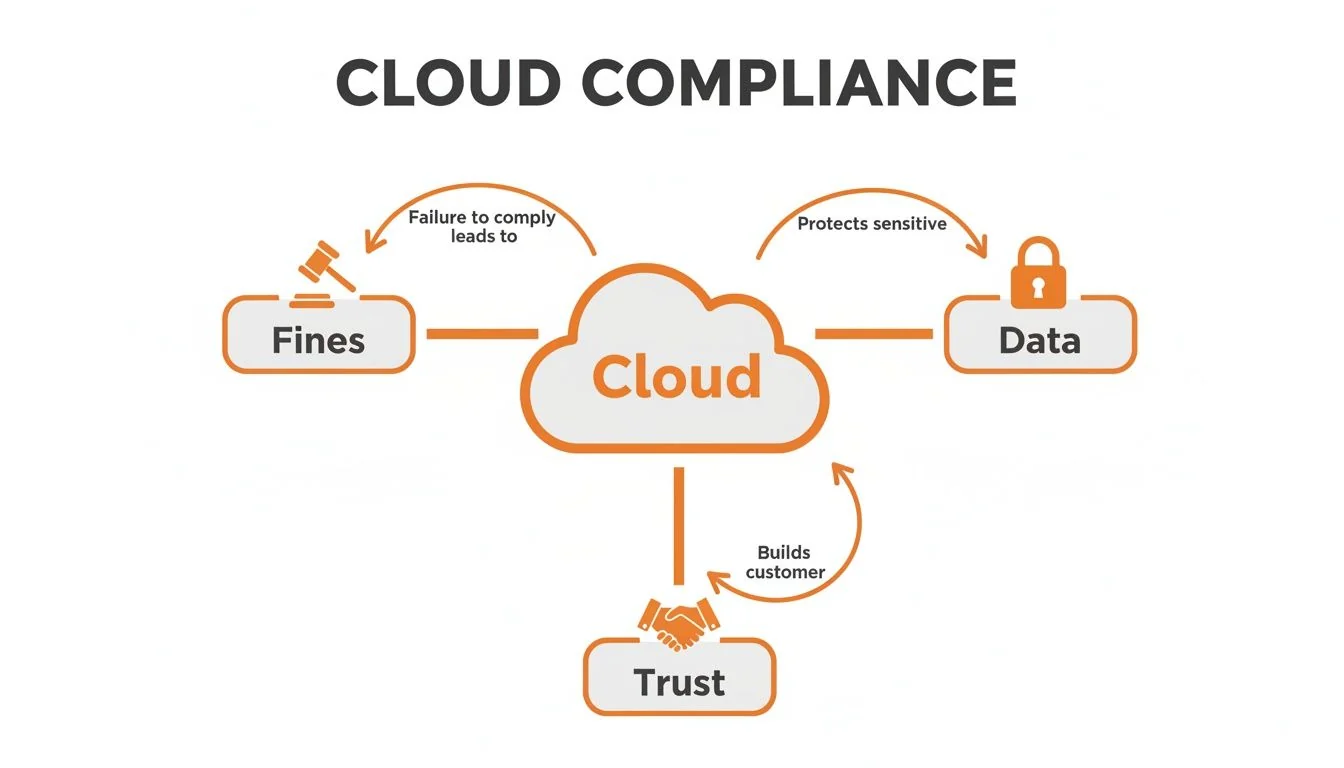
A robust cloud compliance strategy is your primary defense against financial penalties. More importantly, it is the mechanism for protecting your data and earning customer trust. Engaging these experts is a strategic investment in your company’s reputation and long-term viability.
How Consulting Services Map to Major Compliance Frameworks
The value of a compliance consultant becomes clear when they translate dense regulatory standards into concrete, audit-ready actions within your cloud environment. Each framework has unique priorities, and an effective consultant knows how to address them with technical precision.
The demand for this specialized expertise is growing. The global regulatory compliance consulting market is significant and expanding as the stakes for non-compliance rise. For example, GDPR has resulted in thousands of fines totaling billions of euros, demonstrating the high cost of getting it wrong.
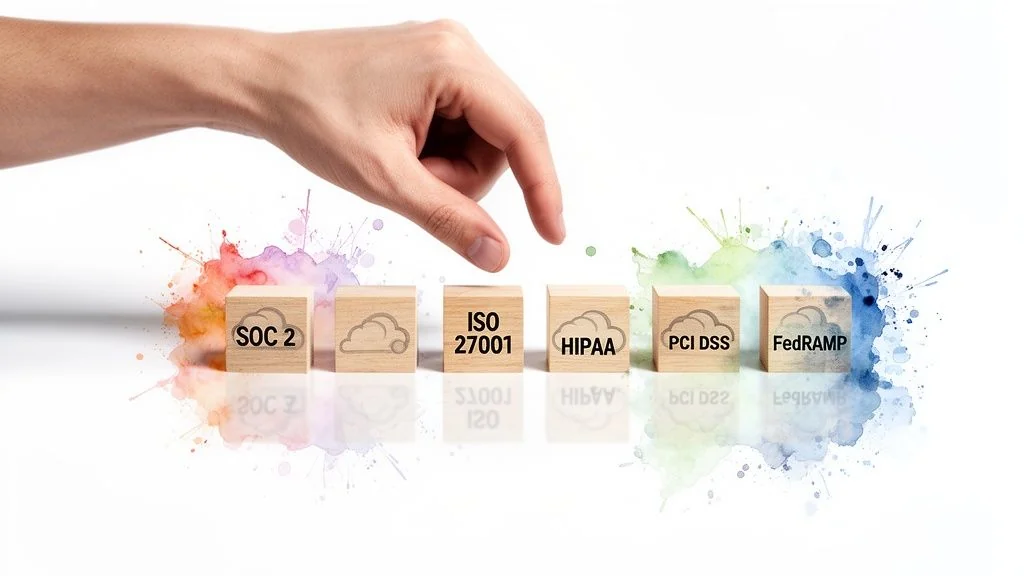
SOC 2: The Trust Services Criteria
SOC 2 is a flexible framework built around five Trust Services Criteria: Security, Availability, Processing Integrity, Confidentiality, and Privacy.
A consultant’s first action is to help you determine which criteria apply to your customer commitments. This scoping phase is critical; over-scoping can lead to an unnecessarily long and expensive audit process.
From there, the focus shifts to evidence collection. A consultant will:
- Translate Principles into Controls: Map your existing cloud configurations—like AWS IAM policies or Azure network security groups—directly to the specific SOC 2 criteria under audit.
- Automate Evidence Collection: Implement tools to automatically pull logs and configuration data, replacing weeks of manual screenshotting and saving hundreds of man-hours.
- Craft the Narrative: Guide you in writing the system description, a core document that explains to auditors how your systems are designed to meet the criteria.
ISO 27001: Building Your ISMS
ISO 27001 requires you to establish and maintain a formal Information Security Management System (ISMS). A consultant acts as the architect for this system.
Their role is to help construct the core components of the ISMS, such as the Statement of Applicability, the risk assessment methodology, and the internal audit program. They work with you to develop security policies aligned with the 114 controls in Annex A, ensuring they are practical for a modern cloud environment.
An ISMS is the central nervous system of your security program. A consultant ensures every component is correctly implemented, from high-level policy down to the technical details of a specific cloud firewall rule.
HIPAA: Protecting Health Information (ePHI)
For organizations handling protected health information (ePHI), HIPAA compliance is mandatory. The primary challenge is applying its regulations, like the Security Rule and Privacy Rule, to a dynamic cloud infrastructure.
A HIPAA consultant focuses on protecting ePHI. They begin by conducting the required Risk Analysis to identify where ePHI is stored, how it moves, and what threats it faces in your cloud environment.
They then provide hands-on guidance for configuring cloud services like Amazon S3 or Azure Blob Storage with appropriate encryption, access controls, and logging. They also ensure the proper Business Associate Agreements (BAAs) are in place with your cloud provider and other vendors. Our guide on selecting HIPAA compliant cloud providers offers more detail.
PCI DSS: Locking Down Payment Card Data
The Payment Card Industry Data Security Standard (PCI DSS) is known for its strict, specific requirements for any company handling cardholder data. Here, a consultant’s most valuable contribution is scope reduction.
They achieve this by helping you re-architect your cloud environment to isolate the Cardholder Data Environment (CDE). This could involve using tokenization services or designing a segmented VPC network. The goal is to ensure only a small, heavily fortified part of your infrastructure ever interacts with sensitive payment data, which dramatically reduces the audit surface area.
FedRAMP: Earning the Right to Work with the Government
Obtaining a FedRAMP Authority to Operate (ATO) is one of the most demanding compliance challenges. It is the mandatory security clearance for any cloud service sold to the U.S. federal government.
A FedRAMP consultant is an essential guide through this process. They are instrumental in developing the System Security Plan (SSP)—a document that can exceed 1,000 pages—and detailing how you meet hundreds of specific security controls. They also act as the primary liaison between your team, the sponsoring agency, and third-party auditors (3PAOs), ensuring technical details align with stringent government requirements.
Compliance Frameworks and Consultant Deliverables
The table below summarizes the key deliverables you should expect from a regulatory compliance consultant for each major cloud framework.
| Framework | Primary Goal | Key Consultant Deliverables |
|---|---|---|
| SOC 2 | Demonstrate trust and security to customers. | Scoped Trust Services Criteria, control mapping documentation, automated evidence collection setup, system description narrative. |
| ISO 27001 | Establish a formal, continuous security management program. | Information Security Management System (ISMS) framework, Statement of Applicability (SoA), risk assessment reports, internal audit plans. |
| HIPAA | Protect patient health information (ePHI). | Cloud risk analysis, ePHI data flow diagrams, cloud service configuration guides, Business Associate Agreement (BAA) review. |
| PCI DSS | Secure cardholder data to prevent fraud. | Cardholder Data Environment (CDE) scoping and network segmentation design, scope reduction strategies, Report on Compliance (RoC) support. |
| FedRAMP | Gain authority to sell cloud services to the U.S. government. | System Security Plan (SSP) development, control implementation guidance, continuous monitoring strategy, 3PAO audit preparation. |
An effective consultant delivers the actual documents, configurations, and strategic plans needed to pass an audit and maintain long-term compliance.
How to Choose the Right Compliance Consulting Partner
Selecting the right partner is a critical decision. A poor choice can result in wasted budget, prolonged audit cycles, and a false sense of security. A great partner becomes an extension of your team, helping build a durable compliance foundation.
You need a guide who understands both the compliance frameworks and your specific cloud environment.

Verify Deep Cloud-Specific Expertise
General compliance knowledge is insufficient. Your partner must demonstrate deep, practical expertise in your specific cloud platform—AWS, Azure, or Google Cloud.
A knowledgeable consultant understands the nuances of the shared responsibility model for that cloud. They can delineate which security controls are managed by the provider and which are your responsibility to configure, manage, and monitor. This is essential for accurate audit scoping and preventing security gaps.
When vetting partners, demand proof of their cloud-native skills:
- Advanced Certifications: Look for credentials like AWS Certified Security - Specialty or Azure Security Engineer Associate, which indicate deeper technical knowledge.
- Platform-Specific Tools: Ask how they use tools like AWS Config, Azure Policy, or Google Cloud Security Command Center for continuous monitoring and evidence collection.
- Real-World Scenarios: Inquire about their experience with modern architectures, such as serverless, container security (Kubernetes), or infrastructure-as-code.
Scrutinize Relevant Case Studies and References
The best indicator of a firm’s capability is its past performance. Request case studies from companies similar to yours in size, industry, and compliance objectives.
If you are a mid-sized SaaS company pursuing SOC 2 on AWS, a case study about a large bank achieving PCI DSS on Azure is not relevant. You need proof that they understand the challenges and resource constraints of a business like yours.
Once you have relevant case studies, ask to speak with those clients. A direct conversation with a past customer provides more insight than any marketing presentation.
Evaluate Cultural Fit and Knowledge Transfer
The best consultants act as mentors, focused on empowering your team. The goal should be to become less dependent on them over time.
A successful consulting engagement concludes with your internal team being more capable than when they started. The ultimate deliverable is not just a passed audit, but a more resilient and self-sufficient organization.
Investigate their approach to knowledge transfer. Do they offer team training? Is their documentation clear and usable? Do they partner with your engineers during implementation, or do they operate in isolation? The right partner invests in upskilling your team, ensuring compliance becomes part of your organization’s culture.
Understanding Pricing Models and Calculating Your ROI
Engaging a compliance consultant is a strategic investment that protects your business, builds customer trust, and enables growth. To make an informed decision, you must understand how firms charge for their services and how to calculate the return on that investment.
Most consulting firms use one of three common pricing models. The best fit depends on your project’s scope and whether you prioritize budget predictability or flexibility.
Common Consulting Pricing Models
Proposals typically fall into one of these categories:
-
Fixed-Fee Projects: A single, upfront price for a well-defined scope of work, such as a SOC 2 gap analysis or an ISO 27001 readiness assessment. This model is ideal for projects with clear requirements and the need for budget certainty.
-
Hourly Rates (Time & Materials): You pay for the actual hours consultants work. This flexible option is suitable for projects with evolving or unclear scopes. It requires careful monitoring of hours to control costs.
-
Retainer-Based Agreements: A monthly fee for a set number of hours, providing ongoing access to compliance expertise. This is ideal for continuous advice, ad-hoc support, or maintaining compliance posture post-audit.
Our pricing strategy for consulting services guide explains how firms set their rates, which is valuable information for negotiations.
Sample Pricing Tiers for Compliance Consulting Services
This table provides a general overview of what to expect at different budget levels, illustrating the relationship between scope and investment.
| Budget Tier | Typical Scope | Best For |
|---|---|---|
| $15k - $30k | Focused readiness assessment or gap analysis for a single framework (e.g., SOC 2, ISO 27001). | Startups or small businesses needing a clear roadmap and validation of their current state before a full audit. |
| $30k - $75k | End-to-end audit preparation and management for one framework, including policy development and evidence review. | Mid-sized companies ready to achieve their first major certification and needing hands-on guidance. |
| $75k+ | Comprehensive program management for multiple frameworks, ongoing advisory (retainer), or complex environments like FedRAMP. | Larger enterprises or companies in highly regulated industries needing continuous, multi-faceted compliance support. |
These tiers demonstrate that solutions exist for various stages of maturity, from initial assessments to managing complex, multi-framework compliance programs.
Calculating the Real Return on Investment
The ROI of a compliance engagement extends beyond avoiding fines. The primary value lies in the business opportunities that a strong compliance posture enables.
Frame compliance as an investment by looking beyond the engagement cost. The true ROI is found in accelerated sales cycles, reduced operational drag, and fortified brand trust.
Factor these financial benefits into your ROI calculation:
-
Faster Sales Cycles: A SOC 2 report or ISO 27001 certificate can immediately satisfy the security requirements of enterprise clients, building trust and shortening the time to close high-value deals.
-
Lower Insurance Premiums: A mature, well-documented security program, demonstrated by formal certification, is viewed favorably by cyber insurance underwriters and can lead to lower annual premiums.
-
Reduced Engineering Drag: A consultant leads evidence collection and audit preparation, freeing senior engineers from hundreds of hours of non-revenue-generating work so they can focus on product development.
Asking the Right RFP Questions to Find Your Ideal Partner
A generic Request for Proposal (RFP) yields generic answers. To identify a true cloud-native expert, you must ask questions that cut through marketing language and test practical knowledge.
Your RFP should function as a practical exam to assess how a potential partner solves real-world problems in a modern cloud environment.
Probing Their Cloud-Native and Architectural Expertise
Test their understanding of how compliance operates in a dynamic, automated environment where evidence resides in API logs, configuration states, and code.
- Evidence Collection: “Describe your process for continuous evidence collection in a serverless architecture using services like AWS Lambda or Azure Functions. What specific tools or cloud-native services do you use?”
- Infrastructure-as-Code (IaC): “How do you integrate compliance checks into a CI/CD pipeline that uses Terraform or CloudFormation? Provide an example of a control you would test pre-deployment.”
- Container Security: “What is your approach to assessing and documenting compliance for a containerized application running on Amazon EKS or Azure Kubernetes Service?”
These technical questions quickly filter out firms that lack hands-on cloud skills. Our vendor due diligence checklist can provide a structured framework for this evaluation.
Uncovering Their Strategic Thinking
Shift your focus to their strategic mindset. Compliance is an ongoing program, not a one-time project. The best consultants are proactive strategists who help you maintain compliance long after the audit.
A great partner’s value is measured not just by a successful audit, but by how well they prepare your organization to manage and maintain compliance independently. Their goal should be to make you self-sufficient.
These questions reveal their long-term vision and client empowerment approach:
- Compliance Drift: How do you help clients monitor and remediate “compliance drift” after an audit? What is your strategy for maintaining a continuously compliant state?
- Scope Reduction: Describe a time you helped a client significantly reduce their audit scope (e.g., for PCI DSS or HIPAA). What architectural changes or technologies did you recommend?
- Knowledge Transfer: What specific methods and deliverables do you use to ensure our internal team is fully equipped to manage our compliance program post-engagement?
By asking pointed, scenario-based questions, you move the conversation from what a consultant claims they can do to what they have done, providing a clear picture of their technical expertise, strategic thinking, and commitment to your success.
Common Questions About Compliance Consulting Services
Understanding the specifics of what a regulatory compliance consultant does helps set clear expectations and ensures a successful partnership. Here are answers to common questions.
Can a Consulting Service Guarantee We Pass Our Audit?
No reputable firm will guarantee you pass an audit. Such a guarantee is a significant red flag.
Consultants are expert guides who prepare your cloud environment, documentation, and team for the audit. However, the audit itself is conducted by an independent third party who makes the final determination. A consultant prepares you for the assessment, but your organization must demonstrate that its controls are operating effectively.
A consultant is like a coach who provides the strategy, training, and tools for success, but they cannot run the race for the athlete. The consultant prepares you, but your organization must perform for the auditors.
How Long Does a Typical Engagement Take?
The timeline for a compliance project varies based on several factors:
- Your Starting Point: A company building its security program from scratch will require a longer engagement than one with mature security practices.
- Framework Complexity: Preparing for a focused PCI DSS audit is a different undertaking than pursuing a full FedRAMP ATO, which can take over a year.
- Environment Scale: A small startup with a single application has a shorter path than a large enterprise with a complex, multi-cloud architecture.
As a general guideline, a gap analysis might take several weeks. Preparing for a first-time SOC 2 or ISO 27001 audit often requires 6 to 12 months of dedicated effort. A reliable consultant will provide a detailed project plan with clear milestones after an initial discovery phase.
Is Software a Replacement for a Consultant?
No, software is a complement to a consultant, not a replacement. An effective strategy uses both.
Compliance automation software is excellent for continuous monitoring, automated evidence gathering, and tracking control status. It handles the “what.”
A human consultant provides the strategic “why” and “how.” They interpret ambiguous framework requirements, assist with critical scoping decisions, and manage interactions with auditors. The software is the tool; the consultant is the expert who knows how to use it effectively.
What Is the Difference Between a Consultant and an Auditor?
This is a critical distinction based on the need for independence and objectivity.
- A Consultant is your advisor. They are part of your team, working with you to design, implement, and improve security controls in preparation for an audit.
- An Auditor is an independent evaluator. They work for an external certifying body to test the implemented controls and provide an unbiased opinion on whether you meet the standard.
To avoid a conflict of interest, the same firm cannot both consult on and audit the same framework for your company. These roles must be filled by two separate entities.
Finding the right expert is crucial for navigating these complexities. At CloudConsultingFirms.com, we provide a data-driven guide to help you select the perfect cloud consulting partner for your compliance needs. Compare top firms based on certifications, reviews, and project outcomes to make your choice with confidence. Start your search at https://cloudconsultingfirms.com.
Frequently Asked Questions
How do you move beyond a simple checklist?
A common mistake is treating compliance as a one-time project aimed at passing an audit. Effective compliance is an ongoing state of operational readiness, not a finish line.
What is SOC 2?
SOC 2 is a flexible framework built around five Trust Services Criteria: Security, Availability, Processing Integrity, Confidentiality, and Privacy.
What is ISO 27001?
ISO 27001 requires you to establish and maintain a formal Information Security Management System (ISMS). A consultant acts as the architect for this system.
What is HIPAA?
For organizations handling protected health information (ePHI), HIPAA compliance is mandatory. The primary challenge is applying its regulations, like the Security Rule and Privacy Rule, to a dynamic cloud infrastructure.
What is PCI DSS?
The Payment Card Industry Data Security Standard (PCI DSS) is known for its strict, specific requirements for any company handling cardholder data. Here, a consultant's most valuable contribution is scope reduction.
Peter Korpak
Founder
Data-driven market researcher with 15+ years helping software agencies and IT organizations make evidence-based decisions. Former market research analyst at Aviva Investors and Credit Suisse. Built the 50 cloud consulting firm profiles published on cloudconsultingfirms.com from publicly available evidence.
Connect on LinkedInContinue Reading
View all insights →Cloud Security
Browse cloud security profiles and verify current credentials directly
10 Actionable Cloud Security Best Practices for 2026
Cut through the noise. Discover 10 technical, actionable cloud security best practices for 2026 covering IAM, encryption, and zero-trust networking.
A CIO's Guide to PCI Compliant Hosting
A definitive guide to PCI compliant hosting. Learn how to navigate PCI DSS 4.0, manage shared responsibility, and choose the right secure cloud partner.
Stay ahead of cloud consulting
Quarterly directory updates, pricing benchmarks, and new research — delivered to your inbox.
No spam. Unsubscribe anytime.