Decisive Guide to Legacy System modernization Approaches
Choosing the right path for a legacy system modernization project is a critical business decision. The options range from a simple lift-and-shift rehost to a complete rebuild, with guidance available through cloud migration consulting. The objective is to migrate from high-risk, inefficient platforms to a foundation that supports future business growth and agility.
The Hidden Costs of an Aging System
Legacy systems often appear functional but accrue significant hidden costs. An outdated system consumes excessive resources, requires specialized and expensive maintenance, and poses a constant risk of catastrophic failure. Deferring modernization is not just an IT issue; it’s a direct business liability.

This is a widespread challenge. A recent poll of IT professionals revealed that 62% of organizations remain heavily dependent on legacy software. Half of them delay modernization because “the current system still works.” This complacency is high-risk, especially when 43% of the same leaders identify security vulnerabilities as their top concern. You can explore the full survey findings on legacy software modernization for a closer look.
Consequences of Inaction
Relying on outdated technology creates cascading problems that impact the entire business. The damage directly hinders an organization’s ability to compete and scale.
Key risks include:
- Crippling Security Breaches: Old, unpatchable code is an open invitation for cyberattacks, which can lead to severe data loss and reputational damage.
- Market Share Erosion: An inability to integrate with modern tools, particularly AI platforms across multiple cloud environments, prevents the delivery of services and user experiences that customers now expect—a challenge addressed by multi-cloud management platforms.
- Operational Inefficiency: Manual workarounds, frequent downtime, and slow performance reduce team productivity and inflate operating costs.
The core challenge is not merely replacing old technology. It is about unlocking future growth, increasing agility, and building a sustainable competitive advantage. Modernization has shifted from an IT project to a fundamental business imperative.
Ultimately, the choice is not if to modernize, but when. Every day of delay increases technical debt and widens the gap with competitors. This guide provides a structured overview of modernization approaches to help you map a clear, strategic path forward.
Decoding the 7 R’s of Application Modernization
Selecting a legacy system modernization approach is a strategic decision dependent on budget, timeline, and desired business outcomes, similar to choosing a cloud provider. The “7 R’s” framework provides a clear set of options, ranging from minimal-effort migrations to complete, ground-up rebuilds.

Each strategy offers a different balance of speed, cost, and long-term value.
The Low-Effort Strategies
These approaches prioritize speed and minimal disruption over fundamental architectural change. They are tactical moves designed for quick wins.
1. Rehost (Lift-and-Shift) Rehosting is the fastest and most direct method. It involves moving an application from on-premise servers to a cloud infrastructure with minimal to no code changes. This is an effective first step for organizations seeking immediate reductions in hardware and maintenance costs. A well-defined cloud migration strategy is essential for a successful rehosting project.
2. Replatform (Lift-and-Tinker) Slightly more involved than rehosting, replatforming involves making targeted optimizations to an application to better leverage cloud-native features. This might include moving to a managed database service or implementing auto-scaling. The core architecture remains unchanged, but the application gains immediate performance and scalability benefits.
3. Repurchase (Drop-and-Shop) Repurchasing involves replacing a legacy application with a modern Software-as-a-Service (SaaS) solution. This is the optimal choice when a commercial off-the-shelf product can meet business requirements without extensive customization. This approach shifts the burden of maintenance, updates, and security to the vendor, freeing internal IT resources for strategic initiatives.
The High-Effort, High-Reward Strategies
These options require a significant investment of time, resources, and capital. The return is substantial, long-term business value derived from addressing the application’s core architecture and functionality.
4. Refactor Refactoring involves restructuring an application’s existing code without changing its external behavior. The objective is to improve nonfunctional attributes, such as code readability and maintainability. This process reduces technical debt and makes the system easier for developers to update and enhance in the future.
Key Insight: The modernization decision is rarely just about technology. A recent survey found that 38% of leaders see integration problems as a primary pain point with their old systems. This makes refactoring or rearchitecting a strategic necessity, not just a nice-to-have.
5. Rearchitect This approach involves fundamentally altering the application’s architecture to enable new capabilities. A common strategy is to break down a monolithic application into a collection of independently deployable microservices. Rearchitecting is a major undertaking that unlocks significant agility, scalability, and resilience.
6. Rebuild A rebuild entails rewriting an application from the ground up while preserving its original scope and specifications. This is the most intensive approach, reserved for applications that are business-critical but whose existing codebase is unsalvageable. It allows the organization to leverage modern development paradigms and technologies fully.
7. Retire Retiring an application means decommissioning it permanently. This is the appropriate action when the application’s functionality has become obsolete, is redundant, or has been absorbed by other systems. Retiring non-essential applications frees up budget and personnel for value-generating projects.
So, Which Modernization Strategy is Right for You?
After understanding the 7 Rs of modernization, the next step is to select the path that aligns with your specific business context. This is not about choosing the “best” strategy in theory but about making a calculated trade-off based on your goals, budget, and risk tolerance.
For example, a fintech startup aiming to out-innovate competitors might choose a Rebuild, viewing the high cost as a strategic investment in market leadership. Conversely, an established manufacturing firm focused on cost reduction might opt for a simple Rehost to lower data center expenses with minimal disruption to core factory operations.
Each option presents a different balance of cost, time, and potential return.
Evaluating the Strategic Trade-Offs
Your decision will be guided by five critical factors. Evaluating how each of the 7 Rs performs against these criteria is key to building a solid business case and setting realistic stakeholder expectations.
The factors are:
- Total Cost: This includes initial development, licensing fees, infrastructure spend, and long-term maintenance costs.
- Project Timeline: The duration from project kickoff to go-live, which is critical when market windows are tight.
- Business Disruption: The potential interference with daily operations during the modernization project.
- Innovation Potential: The ability to add new features, integrate with modern tools, and create a sustainable competitive advantage.
- Technical Debt Impact: Whether the approach resolves underlying technical issues or simply relocates them.
A quick Rehost is fast and low-disruption, but it typically shifts technical debt from an on-premise server to a cloud environment without resolving it. In contrast, a full Rearchitect requires a significant investment but addresses deep-seated architectural flaws, yielding long-term benefits in agility and reduced maintenance costs.
The real objective here is to avoid “modernization theater”—projects that appear impressive but fail to solve fundamental problems. A successful modernization doesn’t just change a system’s location; it reduces complexity and positions the business for future success.
Legacy Modernization Approaches Trade-Off Matrix
This matrix provides a concise overview for comparing the 7 Rs. It helps visualize the trade-offs and identify the approaches that align with your organization’s strategic priorities. It is a useful tool for aligning technical teams and executive leadership.
| Approach | Typical Cost | Project Timeline | Associated Risk | Business Impact | Effect on Technical Debt |
|---|---|---|---|---|---|
| Rehost | Low | Very Short (Weeks) | Low | Low (Cost Savings) | None; Debt is moved |
| Replatform | Low-Medium | Short (Months) | Low | Low-Medium | Minor Reduction |
| Repurchase | Medium | Medium | Low-Medium | High (New Features) | Eliminated (Vendor Managed) |
| Refactor | Medium | Medium | Medium | Significant Reduction | |
| Rearchitect | High | Long (Months-Year) | High | High | Major Reduction |
| Rebuild | Very High | Very Long (Year+) | Very High | Very High | Completely Eliminated |
| Retire | Very Low | Short (Weeks-Months) | Low | Variable | Eliminated |
There is a direct correlation between investment and outcome. Lower investments in time and money limit the ability to change the application’s underlying architecture and resolve the associated technical debt.
The key is to match the level of investment to the application’s strategic value. This matrix is the first step in making that determination, creating a solid foundation for more detailed planning.
How to Build Your Modernization Decision Framework
Knowing the modernization options is not enough; selecting the right one requires a structured, objective analysis of your legacy application. A solid decision framework moves the process from discussion to action by forcing clear answers about the system’s role, health, and future potential.
This is a strategic exercise, not just a technical checklist. It involves balancing the business value of an application against its technological reality.
The core of a strong framework is an evaluation along two key axes: business value and technical health. How critical is the application to revenue generation or customer satisfaction? Simultaneously, how stable, secure, and maintainable is its codebase? Answering these two questions provides a logical path forward.
Assessing Your Application’s Current State
Before planning for the future, you must have a clear understanding of your current position. This requires a deep analysis of the factors that define an application’s true cost and potential. This internal audit is the foundation of your modernization strategy.
Begin by asking pointed questions:
- Business Alignment: Does this application directly support a core revenue stream or provide a competitive advantage, or is it a background utility?
- Architectural Health: Is the application a monolith with tightly coupled components, or does it have a modular design? How difficult is it to make changes without introducing new bugs?
- Skill Set Availability: Do we have in-house expertise for this system, or are we dependent on a diminishing pool of specialists?
- Risk Appetite: How much operational disruption can the business tolerate? A thorough cloud migration risk assessment is essential for setting realistic expectations.
Charting Your Path with a Decision Matrix
Once you have assessed your application’s business value and technical condition, the appropriate modernization approach often becomes clear. The goal is to align the level of investment and effort with the application’s strategic importance.
This decision tree provides a simplified model for this process. It helps you choose between a rapid Rehost for quick wins and a high-impact Rebuild for mission-critical systems.
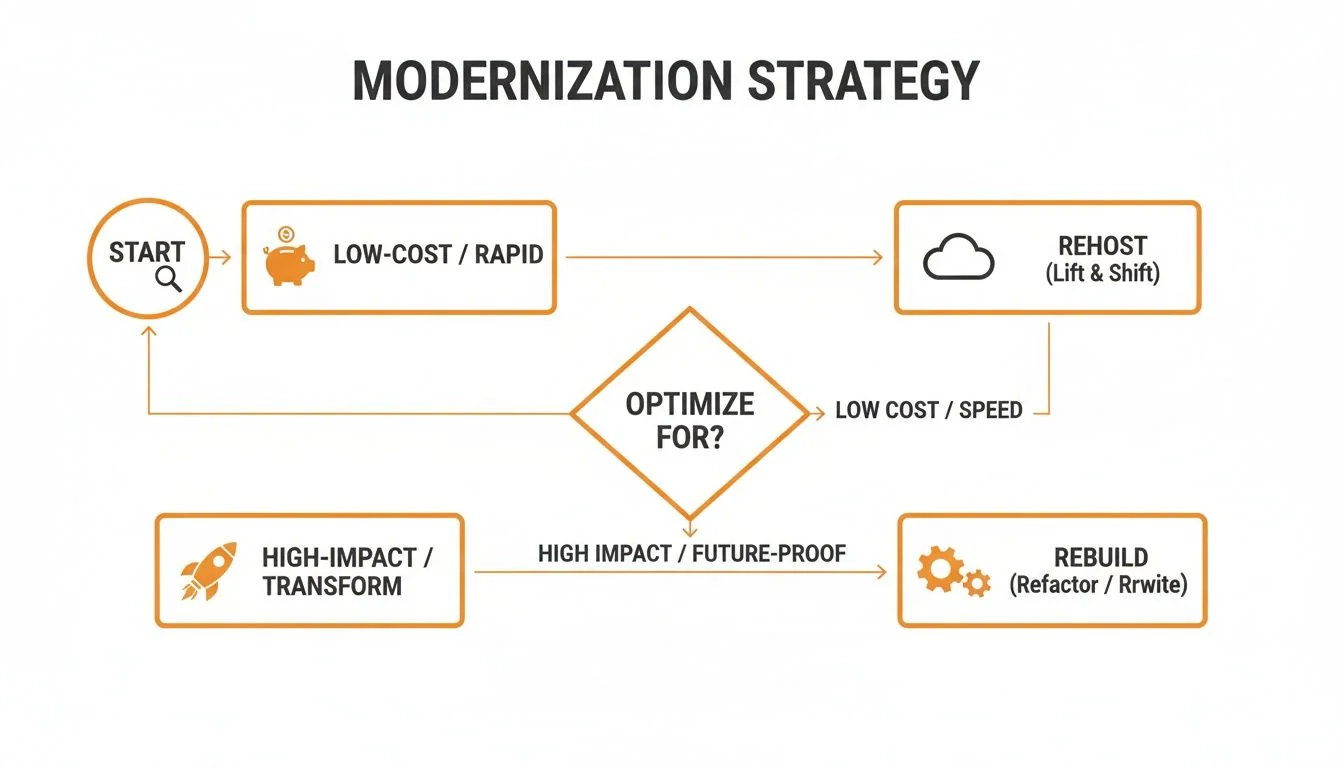
The flowchart shows that the optimal path depends on your primary driver: speed and cost-effectiveness, or business impact and future innovation.
High Business Value + Poor Technical Health = Rebuild or Rearchitect. When an application is vital but technically unstable, a major investment is not only justified but necessary to protect a core business asset and enable future growth.
Low Business Value + Poor Technical Health = Retire. If an application provides minimal value and is difficult to maintain, the most prudent action is to decommission it and reallocate resources to more strategic initiatives.
This structured thinking removes emotion from the decision-making process and aligns stakeholders on a logical, data-driven strategy. The industry is moving toward continuous modernization and “evergreen” strategies to avoid large, high-risk projects. The top drivers for this shift are 42% for security vulnerabilities, 38% for integration challenges, and 36% for scalability limits. These insights underscore the urgency of having a framework that produces predictable, valuable outcomes.
Choosing the Right Cloud Modernization Partner
Undertaking a major modernization project without an experienced partner is a high-risk endeavor. The right consulting partner does more than execute a plan; they challenge assumptions, identify unforeseen risks, and ensure the project delivers on its business objectives. Selecting this partner is one of the most critical decisions in the process.
When evaluating potential partners, look beyond the price. You need a team with a proven track record that aligns with your project’s goals. Deep expertise with major cloud platforms like AWS, Azure, and GCP is a baseline requirement. The real differentiator is a portfolio of successful modernization projects within your industry.
Crafting an RFP That Gets Results
A generic Request for Proposal (RFP) will elicit generic responses. To gain real insight, your RFP must ask sharp, targeted questions that compel potential partners to demonstrate their thought process, not just list their capabilities.
Go beyond questions about team size and certifications. Dig deeper to understand their methodology:
- Their Playbook: “Describe your process for managing risk and ensuring business continuity during a phased rollout.”
- Teaching You to Fish: “What is your methodology for knowledge transfer and training our team for long-term self-sufficiency?”
- When Things Go Wrong: “Provide an example of a modernization project that encountered significant obstacles and explain the specific steps you took to resolve the issues.”
Questions like these penetrate marketing claims and reveal a firm’s problem-solving capabilities and commitment to your success.
A partner’s true value is measured not just by the work they deliver, but by the costly mistakes they help you avoid and the speed at which you achieve a return on investment. They should function as a genuine extension of your team.
Red Flags to Watch For in a Partner
Identifying what to avoid is as important as knowing what to look for. Certain behaviors indicate a firm is not suited for a strategic, complex project. For a detailed guide, you can learn how to evaluate and select the best cloud migration consultants for your requirements.
Be cautious of these common red flags:
- The “One-Size-Fits-All” Pitch: If a firm promotes a specific technology or approach before understanding your business goals, they are selling a solution, not solving your problem.
- A Lack of Transparency: Vague answers regarding timelines, costs, or the specific team members assigned to the project are significant warning signs. A trustworthy partner is transparent from the initial engagement.
- The Subcontractor Shuffle: While using specialists is common, you must know who is performing the core work. If the team consists primarily of freelancers or subcontractors, you may not receive the dedicated expertise you are paying for.
Ultimately, the goal is to find a partner who understands your business culture, aligns with your objectives, and has the experience to guide you through the complexities of modernization. Prioritize long-term value over the lowest initial cost.
Measuring the True ROI of Your Modernization Project
Completing a modernization project is a milestone, but demonstrating its value is the ultimate goal. Without a clear return on investment, the project is merely a costly technical exercise. To justify the expenditure and secure support for future initiatives, you must measure its impact beyond the go-live date.
This requires defining and tracking key performance indicators (KPIs) before and after implementation.

Group your metrics into four key areas to communicate the project’s impact across the organization, from IT operations to the executive suite.
Financial and Operational KPIs
Financial and operational metrics provide the most direct evidence of cost savings and efficiency gains, forming the foundation of your business case.
-
Financial Metrics: Track the Total Cost of Ownership (TCO). Modernization should lead to a significant reduction driven by lower infrastructure costs, reduced licensing fees, and eliminated maintenance contracts. The financial burden of legacy technology is substantial; the U.S. government’s ten most critical legacy systems cost $337 million annually in maintenance alone. You can find more data in these legacy system modernization statistics.
-
Operational Metrics: Measure improvements in system and team performance. Look for quantifiable gains such as reduced system downtime, faster mean time to resolution (MTTR) for bugs, and shorter deployment cycles. A modern system should make the entire IT organization more agile and responsive.
A successful modernization project doesn’t just cut costs—it reallocates resources from simply “keeping the lights on” to driving genuine business innovation. One organization reported €23 million in annual savings, freeing up capital for strategic growth.
Business and Security KPIs
While financial gains are important, the strategic value of modernization is often realized through enhanced business agility and a stronger security posture. These metrics demonstrate that the project was not just about saving money but about enabling growth and protecting the business.
-
Business Metrics: Measure how the new system helps the business operate more effectively. Track metrics like faster time-to-market for new features, improved customer satisfaction (CSAT) scores, and the ability to launch new products or services that were previously impossible.
-
Security Metrics: Quantify the reduction in risk. Track the number of patched vulnerabilities, the time required to resolve security incidents, and the reduced cost of compliance with regulations like GDPR or HIPAA. This reframes security from a cost center to a measurable business advantage.
Common Questions We Hear About Modernization
Even well-structured plans encounter practical questions. When discussing a major modernization initiative, several key concerns consistently arise. Here are actionable answers to the most common ones.
Where Do I Even Start With a Modernization Project?
The first step, before selecting a strategy, is a thorough assessment. You must gain a deep understanding of the system’s business function and its technical condition.
This discovery phase involves mapping every business process the system supports. Identify key user groups and quantify the value it generates. On the technical side, document the application’s architecture, assess its code quality objectively, and untangle its dependencies with other systems.
This assessment is the foundation of your business case. Rushing or skipping this step is the most common cause of choosing the wrong strategy, leading to budget overruns and project failure.
How Can We Do This Without Breaking Everything?
The fear of disrupting daily operations is a primary reason legacy systems persist. The key is to avoid a “big bang” cutover, where the old system is turned off and the new one is turned on simultaneously. This approach is extremely risky.
A safer, more effective method is a phased or incremental rollout. The strangler fig pattern is a proven technique. You gradually build new, modern services around the legacy system’s core. As each new service is tested and validated, you redirect traffic to it. Over time, the new system completely envelops and replaces the old one, which can then be safely decommissioned.
This incremental method offers several advantages:
- It dramatically lowers risk. The team can learn and adapt without the pressure of a single, high-stakes launch.
- You start delivering value sooner. New features are released to users incrementally, not after years of development.
- It builds momentum. Each successful phase keeps stakeholders engaged and confident in the project’s progress.
This approach must be supported by continuous communication with business users and rigorous testing at every stage.
Is This Possible on a Tight Budget?
Yes, modernization is achievable on a tight budget. The solution lies in creating a strategic, phased roadmap.
The key is to prioritize initiatives that deliver the greatest return for the least investment. For many organizations, this is Rehosting (lift-and-shift). Moving an application to a cloud environment can immediately reduce infrastructure costs and provide a more flexible platform for future enhancements.
Another effective starting point is to Refactor one or two of the most problematic or high-impact components of the application. Resolving a single module that causes frequent issues can provide a quick, tangible win. This early success makes it easier to secure buy-in and funding for subsequent phases. The goal is to build a multi-year plan that delivers steady, predictable progress without requiring a massive upfront capital expenditure.
Choosing the right modernization path is one thing; having the right team to guide you is another. At CloudConsultingFirms.com, we’ve built a data-driven guide to connect you with the cloud consulting partner that fits your exact needs. You can compare top firms—from specialized boutiques to global powerhouses—and find the right fit for your project, budget, and timeline. Begin your search at https://cloudconsultingfirms.com.
Frequently Asked Questions
What is consequences of inaction?
Relying on outdated technology creates cascading problems that impact the entire business. The damage directly hinders an organization's ability to compete and scale.
What are the low-effort strategies?
These approaches prioritize speed and minimal disruption over fundamental architectural change. They are tactical moves designed for quick wins.
What are the high-effort, high-reward strategies?
These options require a significant investment of time, resources, and capital. The return is substantial, long-term business value derived from addressing the application's core architecture and functionality.
How do you evaluate the strategic trade-offs?
Your decision will be guided by five critical factors. Evaluating how each of the 7 Rs performs against these criteria is key to building a solid business case and setting realistic stakeholder expectations.
What are legacy modernization approaches trade-off matrix?
This matrix provides a concise overview for comparing the 7 Rs. It helps visualize the trade-offs and identify the approaches that align with your organization's strategic priorities. It is a useful tool for aligning technical teams and executive leadership.
Peter Korpak
Founder
Data-driven market researcher with 15+ years helping software agencies and IT organizations make evidence-based decisions. Former market research analyst at Aviva Investors and Credit Suisse. Analyzed 200+ verified cloud projects (migrations, implementations, optimizations) to build Cloud Intel.
Connect on LinkedInContinue Reading
Cloud Migration
Cloud migration consulting firms evaluated on documented outcomes and pricing transparency
AWS vs Azure vs GCP: A Strategic Comparison
Explore our strategic comparison of AWS vs Azure vs GCP. This guide provides actionable insights for choosing the right cloud platform for your business needs.
The 12 Best Multi Cloud Management Platforms for 2026 and Beyond
Discover the best multi cloud management platforms for 2026. Get an actionable, no-fluff comparison of features, pricing, and use cases.
Stay ahead of cloud consulting
Quarterly rankings, pricing benchmarks, and new research — delivered to your inbox.
No spam. Unsubscribe anytime.