Vendor Lock In Cloud Computing: A CIO's Guide
When your business is so deeply integrated with a single cloud provider that leaving would be a financial and operational disaster, you’re experiencing vendor lock-in. It’s a state where switching to a competitor is so costly and complex that you are effectively trapped. This dependency compromises strategic flexibility and inflates your budget.
The Real Cost of Vendor Lock In

Imagine building a house with custom bricks and windows made by a single manufacturer. If you need a repair or want to build an addition, you have no choice but to use that supplier, pay their price, and accept their timeline. No other parts will fit.
That is the essence of vendor lock-in in cloud computing. It is a tangible business problem that erodes your operational freedom and inflates long-term costs.
Lock-in extends beyond technical migration challenges. It shifts negotiating power to the vendor, tying your company’s future to their product roadmap. The more you build on their proprietary tools, the more exposed you are to price hikes and service changes.
The True Dimensions of Cloud Dependency
The risk of vendor lock-in has evolved from a secondary concern to a primary obstacle for cloud adoption. For years, organizations have deliberately slowed cloud migration plans due to this risk. Studies have shown that a significant percentage of companies keep the majority of their applications on-premises, citing lock-in as a key deterrent despite executive pressure to migrate faster.
To build a defense across AWS, Azure, and GCP, you must understand the different forms of lock-in:
- Technical Lock-In: Occurs when applications are built on a provider’s unique, proprietary services, such as specialized databases like Amazon DynamoDB or serverless functions like AWS Lambda. Migrating these systems requires a complete and costly re-architecture.
- Data Lock-In: Also known as “data gravity,” this happens when your data volume makes migration prohibitively slow and expensive. Providers often impose high data egress fees—the cost to transfer your data out of their network—which can turn a migration into a seven-figure project. You can model these expenses with a cloud migration cost calculator.
- Contractual Lock-In: Long-term contracts, bundled service discounts, and ambiguous exit clauses create powerful financial and legal barriers. These agreements are often structured to penalize you for reducing your spend or using a competitor’s services.
Vendor lock-in is the loss of control over your own digital strategy. It forces you to make decisions based on your vendor’s limitations, not your business’s opportunities.
How Technical and Business Decisions Create Dependency

Vendor lock-in is the cumulative result of many small, seemingly rational decisions made over time. These choices, which span technical architecture and business agreements, create a web of dependency that becomes difficult and expensive to untangle.
Each individual decision might appear to offer a tactical advantage—speed, performance, or a cost reduction. Collectively, however, they construct the constraints that limit your future options.
The Lure of Proprietary Technology
The most common path to technical lock-in starts with a provider’s unique, high-performance services. A cloud platform’s ecosystem is an integrated toolkit where proprietary tools work seamlessly together but are not designed to integrate with competitors.
A service like AWS Lambda is a powerful serverless tool, but it is deeply integrated with the AWS ecosystem. An application built on Lambda cannot be lifted and shifted to another cloud; it requires a ground-up rewrite for the new provider’s architecture.
The same is true for specialized databases. A solution like Google Cloud Spanner or Amazon DynamoDB offers significant scale and performance, but replacing one with a standard open-source alternative is a major engineering project.
This dependency is more pronounced with advanced AI and machine learning platforms. Using a provider’s unique ML services accelerates projects but also ties your models, data pipelines, and intellectual property directly to their platform. The custom code and specific integrations become the digital threads that bind you.
The Force of Data Gravity
Beyond specific services, the sheer volume of your data creates its own form of lock-in, a concept known as data gravity. As your dataset grows, it develops inertia, making any move slow, complex, and expensive.
Cloud providers often make it inexpensive to import data but charge significant data egress fees for exporting it. These costs can escalate into the hundreds of thousands or even millions of dollars, effectively holding your data hostage.
Your data is your most valuable asset, but its location can become your biggest liability. The cost to move it can negate the benefits of switching to a better or more affordable provider.
How Contractual Clauses Create Financial Barriers
While engineering teams make technical choices, procurement teams can inadvertently build contractual walls. These traps are often disguised as attractive discounts and long-term commitments that appear financially prudent at signing.
Be aware of these common contractual patterns:
- Long-Term Commitments: A three-year contract with a steep discount reduces initial costs but eliminates the flexibility to pivot if a better solution emerges or your business needs change.
- Bundled Service Discounts: Providers offer “all-in” discounts for committing a certain level of spend across their entire portfolio. This financially penalizes you for choosing a best-of-breed solution from a competitor, as doing so could void your discount structure.
- Vague Exit Clauses: Many contracts lack clear terms for data repatriation and service transition. Without a pre-defined exit plan, you have no leverage when leaving, forcing you to negotiate from a weak position.
This table breaks down the common sources of vendor lock-in.
Common Sources of Vendor Lock In
| Category | Type of Lock In | Example | Mitigation Strategy |
|---|---|---|---|
| Technical | Proprietary Services | Using a provider-specific database like Amazon DynamoDB or a serverless function like AWS Lambda. | Adopt open-source alternatives (e.g., PostgreSQL, Kubernetes). |
| Technical | Data Gravity | Accumulating petabytes of data, making migration slow and subject to high egress fees. | Implement a multi-cloud data strategy; regularly model egress costs. |
| Technical | Platform APIs | Building core application logic around a vendor’s unique APIs for services like storage or messaging. | Use API abstraction layers or open standards to reduce direct dependency. |
| Business | Long-Term Contracts | Signing a 3-year enterprise agreement for a discount, losing the flexibility to switch providers. | Negotiate shorter, 1-year terms; build in clauses for early termination. |
| Business | Bundled Discounts | Committing to a high spend across a vendor’s entire service portfolio to secure a lower price. | Unbundle services and negotiate pricing for individual components. |
| Business | Lack of Portability | Relying on a vendor’s proprietary infrastructure, making it impossible to move workloads without a rewrite. | Use containerization (e.g., Docker) and orchestration (e.g., Kubernetes). |
Recognizing how technical dependencies and business concessions intersect is the first step toward maintaining control. Every decision to use a proprietary tool or sign a restrictive contract reinforces the constraints on your business.
The Multi-Million Dollar Impact of Getting Locked In
The cost of cloud vendor lock-in is a multi-million-dollar liability that can stifle your business strategy. When the theoretical risk of vendor dependency becomes a financial reality, the damage is significant.
This problem manifests in lost negotiation leverage, inflated invoices, and an inability to innovate. The longer you are tethered to a single cloud provider, the more power you concede.
The Hidden Lock-In Premium
Every organization deeply embedded with one cloud provider pays a hidden tax: the “lock-in premium.” This is the gap between what you currently pay and what you could pay in a competitive market. Without a credible threat of leaving, providers have little incentive to offer their best terms.
This is where the financial damage begins. Annual price hikes become non-negotiable. The attractive discounts that drew you in expire, replaced by rates that reflect your inability to leave.
This financial pressure appears in several ways:
- Unchecked Price Increases: A provider can raise prices on critical services, knowing the cost of migrating your infrastructure makes it easier to accept the new fees.
- Forced Upgrades: You may be pushed into more expensive service tiers or newer product versions you don’t need because the ones you use are being deprecated.
- Eroding Discounts: Volume discounts from your original business case can be altered or removed during contract renewals, creating a sudden budget shortfall.
Quantifying the Cost of Inflexibility
Vendor lock-in has moved from a technical concern to a board-level cost driver. For example, Basecamp publicly estimated it would save $7 million over five years by moving off a major cloud provider—an annual savings of over $1.4 million.
This is not an isolated case. The UK’s Cabinet Office calculated that over-reliance on a single cloud vendor could result in unnecessary spending of up to £894 million for government departments. You can learn more about how these dependencies create enormous financial risks.
These figures demonstrate a critical point: money spent due to lock-in is capital that cannot be invested in growth, innovation, or competitive advantage.
When Strategic Agility Is Lost
Beyond the direct financial impact, the strategic consequences are more damaging. Your business becomes rigid when the market demands flexibility. Innovation slows not from a lack of ideas, but because your toolkit is limited by your vendor.
Consider these strategic roadblocks:
- Stunted Innovation: Your team identifies a game-changing AI service on a competitor’s cloud. Because your core systems are locked in, using that superior tool is either technically infeasible or cost-prohibitive. Your innovation roadmap is now dictated by your vendor’s release schedule.
- Inability to Pivot: The market shifts, requiring expansion into a new region where a different cloud provider has better local presence and lower latency. Lock-in prevents this move, allowing more agile competitors to capture the market.
The true impact of lock-in is measured in lost opportunities: the product you couldn’t build, the market you couldn’t enter, and the savings you couldn’t realize. This is the business case for investing in cloud portability and strategic freedom before it becomes a crisis.
Actionable Strategies to Maintain Cloud Freedom
Avoiding vendor lock-in requires a defensive strategy built into your architecture, tooling, data management, and contracts. By designing for flexibility from the start, you gain the benefits of the cloud without sacrificing control over your company’s future.
This does not mean avoiding powerful proprietary cloud services. It means making conscious trade-offs and always maintaining a viable exit path. It is like building a house with standard-sized doors and windows; you can choose a custom front door, but you retain the option to replace it later without demolishing the wall.
Design a Portable Cloud Architecture
Your best defense against lock-in is a portable system architecture. This design acts as an insurance policy, ensuring your core business logic is not permanently tied to one provider’s implementation.
Focus on open-source technologies with broad support across major cloud providers.
- Orchestrate with Kubernetes: Kubernetes is the industry standard for container orchestration. Building applications to run on Kubernetes creates a consistent, portable environment that can be deployed on AWS (EKS), Azure (AKS), GCP (GKE), or on-premises with minimal changes.
- Containerize with Docker: Docker containers package your application and its dependencies into a self-contained unit. This ensures your application runs identically regardless of the environment, making it the ideal building block for a portable architecture.
Certain design patterns also provide a buffer. The anti-corruption layer, for example, is a pattern that isolates your system from an external one by translating requests. This prevents the external system’s design from influencing your own, making it easier to replace a proprietary service later.
Use Agnostic Tooling and Infrastructure as Code
Your daily tools can either bind you to a vendor or enable your freedom. Choosing cloud-agnostic tools is a critical step toward maintaining options.
Infrastructure as Code (IaC) is a prime example. Instead of using a provider’s web console to configure your environment, IaC allows you to define everything in code.
By defining your infrastructure in files, you create a repeatable, version-controlled blueprint of your entire setup. This automates deployment and makes your architecture transparent and adaptable for different environments.
Tools like Terraform are designed to be cloud-agnostic. You can use the same workflow to manage resources on AWS, Azure, and GCP, significantly reducing the effort required to move or replicate your setup. This contrasts with provider-specific tools like AWS CloudFormation, which hardwire your infrastructure definitions to a single ecosystem.
Manage Data Gravity and Egress Costs
Data accumulates gravity; the more you have in one location, the harder and more expensive it is to move. This is a primary driver of vendor lock-in, exacerbated by high data egress fees charged by providers for data extraction.
The hidden costs of lock-in impact your budget and your ability to innovate.
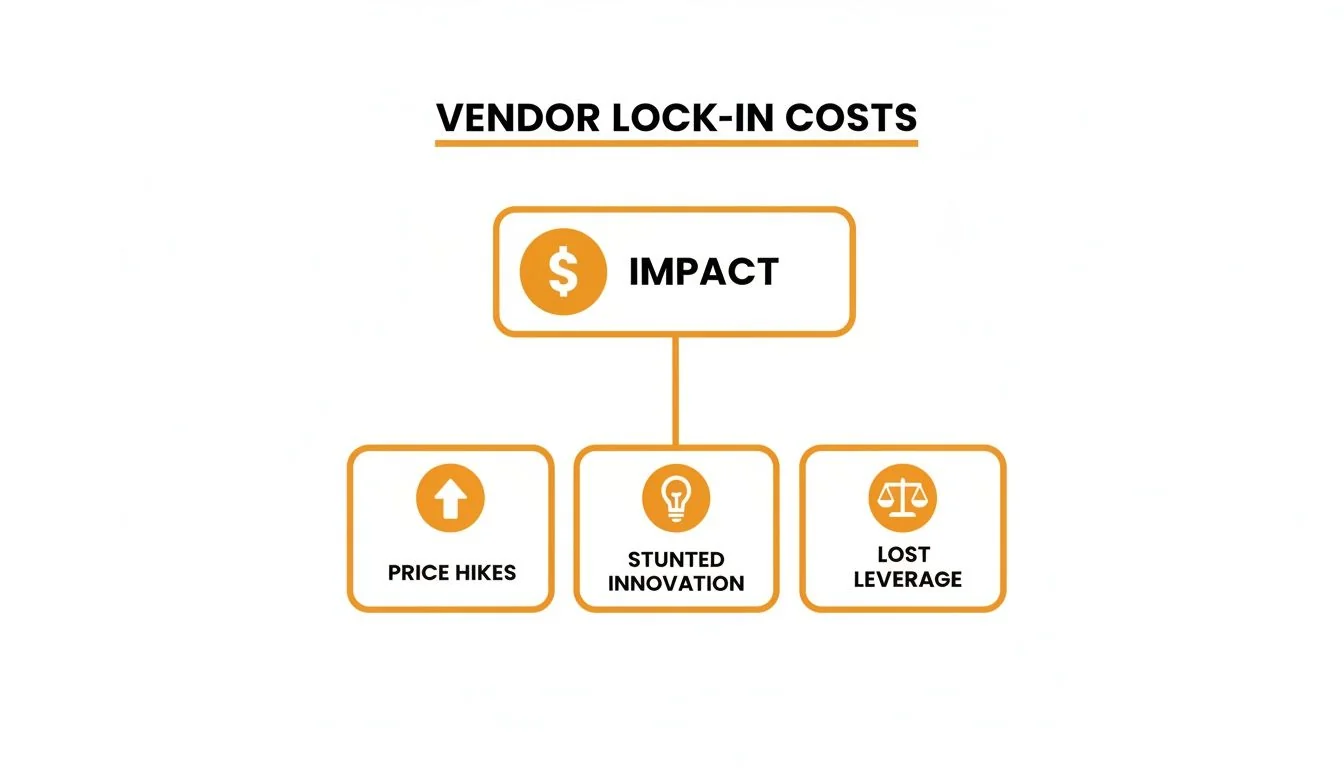
As shown, being locked in leads directly to price hikes, stalled innovation, and a complete loss of negotiation leverage, causing tangible damage to your bottom line and competitive position.
To avoid this trap, model potential data egress costs before committing. Do not be swayed by low storage prices. Calculate the cost of moving petabytes of data if you decide to leave. Strategies like multi-region data replication or using cloud-agnostic storage solutions can help keep your data and your business mobile.
Fortify Your Position with Smart Contracts
Your final line of defense is the legal agreement. Contracts can be powerful tools for protecting your freedom if you negotiate the right terms upfront.
Insist on clear language covering these areas:
- Clear Exit Clauses: The contract must explicitly define the process for data migration upon termination, including timelines, responsibilities, and the format for data return.
- Caps on Price Increases: Negotiate limits on annual price increases. This prevents the provider from exploiting your dependency with a massive price hike after you are fully integrated.
- Data Repatriation Guarantees: Obtain a written guarantee that you can retrieve 100% of your data in a standard, usable format without punitive fees. Any ambiguity is a red flag.
Scrutinizing a vendor’s contract is non-negotiable. Use a structured approach, such as a comprehensive vendor due diligence checklist, to ensure you ask the right questions before signing.
Building a Pragmatic Multi-Cloud Strategy
Multi-cloud is often presented as the ultimate solution for vendor lock-in, but a poorly executed strategy can increase complexity, costs, and create multiple points of dependency. An effective strategy must be deliberate.
Many organizations adopt “multi-cloud by accident,” where different teams independently select cloud providers. This results in siloed, disconnected environments that are not interoperable, increasing security risks and operational overhead. This is not a strategy; it is a symptom of chaos.
The alternative is “multi-cloud by design.” This is a pragmatic approach where you use each cloud for its best-of-breed services while ensuring your application layer remains portable and independent of any single vendor’s ecosystem.
Choosing Providers for Their Strengths
A smart multi-cloud strategy is not about running the same application on two different clouds. It is about strategically placing workloads where they perform best.
For example, you might:
- Use Google Cloud Platform (GCP) for its AI and machine learning services.
- Run core enterprise applications on Microsoft Azure for its integration with Office 365 and Active Directory.
- Leverage Amazon Web Services (AWS) for its mature and extensive IaaS offerings.
This approach lets you use the best tool for each job. The key to avoiding vendor lock in cloud computing is ensuring your application’s core—the business logic and data—remains mobile. When your architecture is portable, replacing an underlying cloud service becomes a manageable task, not a massive re-engineering project. You can explore this further in our guide to compare cloud service providers.
The Deciding Factor: Architectural Freedom
True cloud freedom comes from architectural choices that enable workload mobility, not from having accounts with multiple providers. This requires investing in technologies like containers and orchestration platforms that create a buffer between your application and the underlying infrastructure.
Market data supports this approach. While approximately 89% of organizations use a multi-cloud strategy to avoid lock-in and enhance resilience, AWS, Azure, and Google Cloud still control about two-thirds of the cloud market.
This indicates that mitigating lock-in is less about the number of providers you use and more about how many critical workloads you can realistically move within 3–6 months without incurring prohibitive costs.
The goal is not to be 100% vendor-agnostic, which is often impractical. The goal is to maintain strategic control, ensuring you have the ability to move key workloads when a compelling business or technical reason arises.
A Framework for Choosing Services
When building a multi-cloud architecture, teams must constantly decide between a provider’s proprietary managed service and a more portable open-source alternative. A simple decision framework can provide clarity.
For each critical service, ask these three questions:
- What is the real switching cost? Quantify the time, effort, and money required to migrate away from this service. Is it a few weeks of engineering work or a year-long project?
- Does this proprietary service provide a real competitive advantage? If a managed AI service accelerates your product-to-market by six months, the lock-in risk may be an acceptable trade-off.
- Can we isolate the dependency? Can you build an abstraction layer around the service so the rest of your application is not directly integrated with it? This single action can simplify a future replacement.
By pragmatically weighing each choice, you can build a multi-cloud strategy that delivers both the power of specialized cloud services and the freedom to control your own destiny.
Your Cloud Freedom Checklist
This checklist is designed for CIOs and technical leaders to audit their current setup and make better decisions moving forward. Use these points to identify your vulnerabilities to vendor lock in cloud computing and build a more resilient foundation.
Step 1: Analyze Your Architecture and Tech Stack
Your architecture is your first line of defense. Portability must be a design principle from day one.
- Audit Proprietary Service Dependencies: List every critical application dependent on a vendor-specific service like AWS Lambda or Google BigQuery. Quantify the engineering hours required to migrate each one.
- Check Your Container and Orchestration Strategy: Are your most important applications running in Docker containers and managed with an open standard like Kubernetes? If not, this shift should be a top priority.
- Analyze Your IaC: Review your Infrastructure as Code. Are you using a cloud-agnostic tool like Terraform, or are you tied to a provider-specific solution like AWS CloudFormation? The answer determines your ability to replicate your environment elsewhere.
- Evaluate Data Portability: Calculate the cost in time and money to move your primary datasets to another provider. You must have a clear understanding of data egress fees and the technical complexity involved.
A technical audit is not about eliminating all proprietary tools. It is about understanding the trade-offs and ensuring you have a realistic, tested exit path for mission-critical systems.
Step 2: Review Your Contracts and Team Skills
After assessing the technology, examine the legal agreements and personnel. Your contracts and your team’s skills are equally critical for maintaining flexibility.
- Scrutinize Your Cloud Agreements: Examine the fine print for vague exit clauses, aggressive auto-renewal terms, or hidden penalties. Flag any language that makes data retrieval difficult or expensive.
- Assess Your Team’s Skills: Does your engineering team specialize in one provider’s ecosystem, or do they have experience with open-source alternatives and multi-cloud tools? Invest in training to build a more adaptable, vendor-neutral skillset.
- Create a Formal Exit Plan: For every major cloud service you use, document an exit plan. This is a practical playbook detailing the technical steps, required resources, and a realistic timeline for migrating to an alternative.
Frequently Asked Questions About Vendor Lock-In
Here are answers to common questions from IT leaders dealing with cloud vendor lock-in.
Is Some Vendor Lock-In Unavoidable?
Some level of dependency on a cloud provider is inevitable, particularly when using advanced services. However, complete lock-in is avoidable.
The key is to make deliberate trade-offs. You can use powerful, cloud-native services while maintaining options by building on open standards, using containers, and designing for portability. The goal is not 100% vendor-agnosticism, but keeping switching costs low enough to maintain a credible alternative.
How Much Should We Budget For a Mitigation Strategy?
Investing in portability is an insurance policy against future price hikes and loss of strategic control.
A solid lock-in mitigation strategy can add an initial overhead of 5-15% to a project’s development cost. This budget covers the engineering effort for service abstraction or integrating open-source tools.
Do not be deterred by the upfront cost. This investment is small compared to the long-term savings. It prevents a vendor from increasing prices by millions and provides leverage during contract renegotiations. The ROI is almost always positive.
Can a Multi-Cloud Strategy Actually Increase Lock-In?
Yes, if implemented incorrectly. A “siloed” multi-cloud setup, where different applications become deeply embedded in different proprietary ecosystems, does not solve lock-in; it creates multiple, separate lock-in problems.
A smart multi-cloud strategy creates a portable application layer that runs consistently on any cloud. A common orchestration platform like Kubernetes is essential for this approach. This allows you to select the best services from each provider without getting trapped, achieving both top-tier capabilities and strategic freedom.
Navigating the world of cloud partnerships is the first step to avoiding lock-in. At CloudConsultingFirms.com, we’ve done the homework for you, providing data-driven comparisons of top AWS, Azure, and Google Cloud partners.
Find the right team for your strategy by exploring our 2025 guide: https://cloudconsultingfirms.com
Frequently Asked Questions
What is the true dimensions of cloud dependency?
The risk of vendor lock-in has evolved from a secondary concern to a primary obstacle for cloud adoption. For years, organizations have deliberately slowed cloud migration plans due to this risk. Studies have shown that a significant percentage of companies keep the majority of their applications on-premises, citing lock-in as a key deterrent despite executive pressure to migrate faster.
What is the lure of proprietary technology?
The most common path to technical lock-in starts with a provider’s unique, high-performance services. A cloud platform's ecosystem is an integrated toolkit where proprietary tools work seamlessly together but are not designed to integrate with competitors.
What is the force of data gravity?
Beyond specific services, the sheer volume of your data creates its own form of lock-in, a concept known as data gravity. As your dataset grows, it develops inertia, making any move slow, complex, and expensive.
How contractual clauses create financial barriers?
While engineering teams make technical choices, procurement teams can inadvertently build contractual walls. These traps are often disguised as attractive discounts and long-term commitments that appear financially prudent at signing.
What is common sources of vendor lock in?
Recognizing how technical dependencies and business concessions intersect is the first step toward maintaining control. Every decision to use a proprietary tool or sign a restrictive contract reinforces the constraints on your business.
Peter Korpak
Founder
Data-driven market researcher with 15+ years helping software agencies and IT organizations make evidence-based decisions. Former market research analyst at Aviva Investors and Credit Suisse. Analyzed 200+ verified cloud projects (migrations, implementations, optimizations) to build Cloud Intel.
Connect on LinkedInContinue Reading
Cloud Migration
Cloud migration consulting firms evaluated on documented outcomes and pricing transparency
AWS vs Azure vs GCP: A Strategic Comparison
Explore our strategic comparison of AWS vs Azure vs GCP. This guide provides actionable insights for choosing the right cloud platform for your business needs.
The 12 Best Multi Cloud Management Platforms for 2026 and Beyond
Discover the best multi cloud management platforms for 2026. Get an actionable, no-fluff comparison of features, pricing, and use cases.
Stay ahead of cloud consulting
Quarterly rankings, pricing benchmarks, and new research — delivered to your inbox.
No spam. Unsubscribe anytime.