The Top 12 HIPAA Compliant Cloud Providers
Selecting a HIPAA compliant cloud provider requires more than signing a Business Associate Agreement (BAA). A BAA is a starting point, not a guarantee. It initiates a shared responsibility model where your organization must correctly configure services and implement rigorous safeguards for Protected Health Information (PHI). Misunderstanding this is a common and costly error.
This guide provides actionable intelligence for technical and compliance leaders. We analyze the leading hyperscalers (AWS, Azure, GCP) alongside specialized managed providers and niche services. The goal is a clear view of the cloud compliance ecosystem to support informed decisions that protect your data.
This listicle delivers:
- Provider Breakdowns: Analysis of 12 top providers, examining which services fall under their BAA and potential configuration pitfalls.
- Implementation Insights: Real-world use cases, limitations, and the technical controls you are responsible for implementing.
- Strategic Selection Tools: A checklist and targeted RFP questions to evaluate partners and their BAA terms.
- Direct Resources: Links to provider documentation for immediate due diligence.
This guide equips you to select the right partner, configure your environment securely, and maintain continuous HIPAA compliance.
1. Amazon Web Services (AWS) — HIPAA on AWS
Amazon Web Services is a dominant cloud provider with mature offerings for healthcare. AWS provides a formal Business Associate Agreement (BAA) that covers a well-documented list of HIPAA-eligible services. This allows covered entities to build applications that store, process, and transmit protected health information (PHI) in a secure, scalable environment.
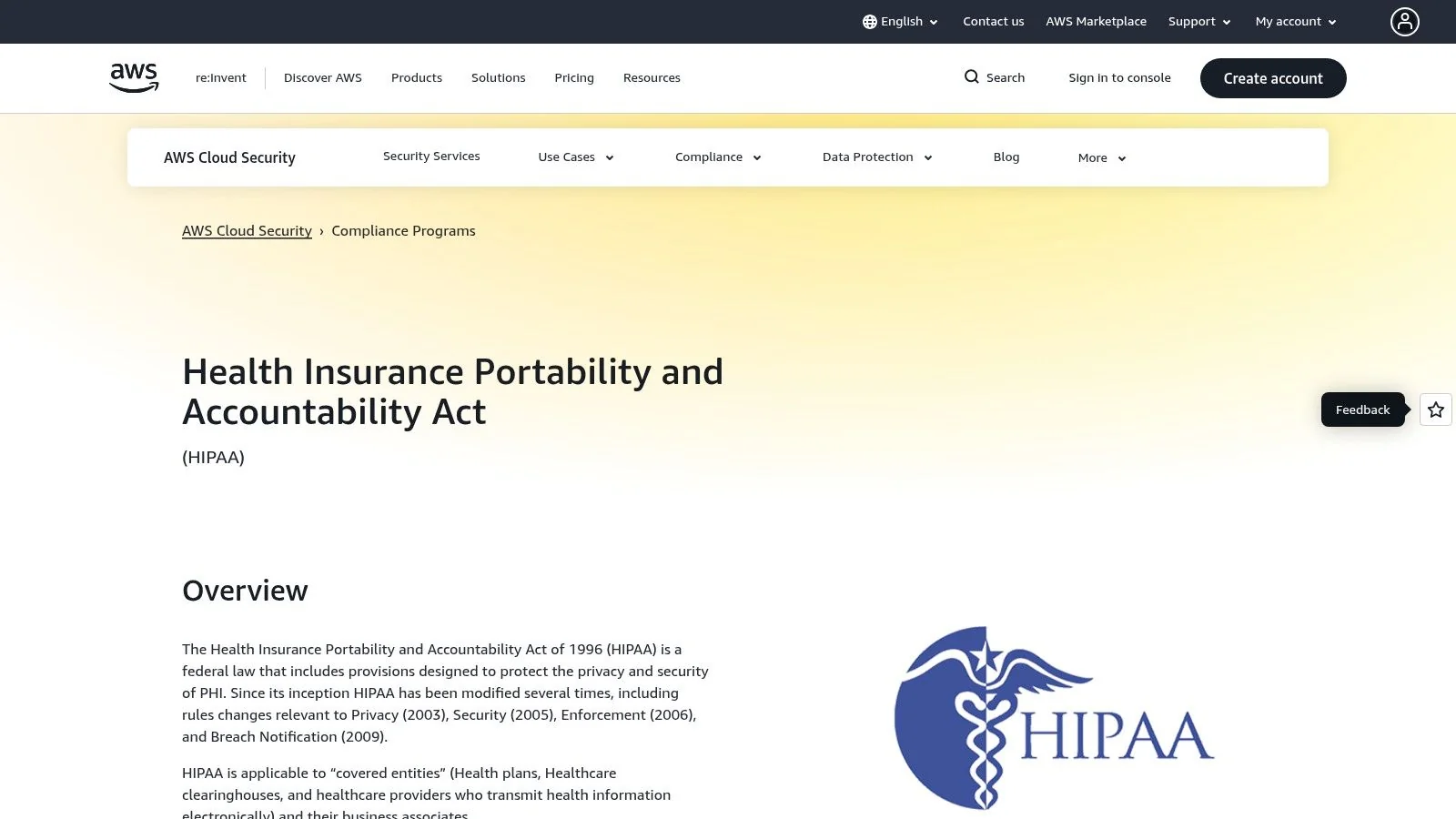
AWS operates on a shared responsibility model: they secure the cloud infrastructure, while the customer must securely configure services and applications. This requires careful management to ensure PHI only resides within BAA-covered services. The platform’s strength is its extensive documentation, reference architectures, and a large ecosystem of healthcare compliance partners.
Key Considerations and Features
- Executable BAA: AWS offers a self-service BAA through the AWS Artifact console, covering a list of HIPAA-eligible services.
- Implementation Guidance: AWS provides whitepapers, such as “Architecting for HIPAA Security and Compliance on AWS,” with concrete best practices.
- Security Tooling: Leveraging services like AWS Identity and Access Management (IAM), AWS CloudTrail for logging, and Amazon GuardDuty for threat detection is critical for meeting Security Rule requirements.
- Cost Management: The pay-as-you-go model requires rigorous governance using tools like AWS Budgets and Cost Explorer to control costs. For a feature comparison, explore this guide to choosing the right cloud provider.
AWS is ideal for organizations with the technical expertise to manage its complexity or those engaging a certified managed service partner. Its comprehensive tooling and robust infrastructure make it a top-tier platform for telehealth, medical research, and other healthcare applications. To find a partner with deep AWS and healthcare compliance expertise, browse our AWS consulting partner rankings.
Website: https://aws.amazon.com/compliance/hipaa-compliance/
2. Microsoft Azure — HIPAA on Azure
Microsoft Azure is an enterprise-grade platform and a leading choice among HIPAA compliant cloud providers. Azure simplifies the legal groundwork by incorporating HIPAA Business Associate Agreement (BAA) provisions directly into its standard Product Terms and Data Protection Addendum (DPA). This streamlines the process for covered entities to build and manage healthcare solutions handling protected health information (PHI).
Like other major clouds, Azure follows a shared responsibility model. Microsoft secures the infrastructure, while the healthcare organization is responsible for configuring services, applications, and data controls to meet HIPAA requirements. Azure’s strength is its tight integration with enterprise tools like Microsoft Entra ID (formerly Azure Active Directory), providing a robust framework for managing access controls and enforcing security policies.
Key Considerations and Features
- Integrated BAA: The BAA is part of the standard contractual terms, simplifying procurement for existing Microsoft enterprise customers.
- Compliance Blueprints: Azure Blueprints provide pre-configured architectures and policy templates to accelerate the deployment of HIPAA-compliant environments.
- Robust Security Services: Essential tools include Azure Policy for governance, Azure Monitor for logging and auditing, and Microsoft Defender for Cloud for threat protection.
- Hybrid Cloud Capabilities: Azure Arc extends Azure’s management and security services to on-premises and multi-cloud environments, a key benefit for phased migrations.
Azure is well-suited for enterprises invested in the Microsoft stack or those prioritizing a hybrid cloud strategy. Its compliance documentation and governance tooling provide a solid foundation for secure healthcare applications.
Website: https://learn.microsoft.com/azure/compliance/offerings/offering-hipaa-us
3. Google Cloud Platform (GCP) — HIPAA on Google Cloud
Google Cloud Platform is a leading choice among HIPAA compliant cloud providers, particularly for organizations focused on data analytics and machine learning. GCP offers a Business Associate Agreement (BAA) that covers a well-defined list of “HIPAA Covered Products,” enabling healthcare developers to build applications that handle PHI securely.
GCP operates on a shared responsibility model, requiring customers to correctly configure services and manage access controls. A key differentiator is Google’s investment in healthcare-specific services, like the Cloud Healthcare API, which simplifies managing clinical data standards such as DICOM and FHIR. This makes GCP an attractive option for innovators in digital health and medical research.
Key Considerations and Features
- Google Cloud BAA: The BAA outlines covered services and customer responsibilities and is available to all customers without a pricing premium.
- Healthcare-Specific Services: Tools like the Healthcare API and BigQuery provide an integrated stack for processing, analyzing, and de-identifying PHI at scale.
- Implementation Guides: Google provides detailed documentation and architecture guides to help customers configure their environment to process PHI only within covered services.
- Security and Transparency: GCP maintains a strong security posture with robust controls and third-party audits (ISO/IEC, SOC 2/3).
GCP is an excellent platform for healthcare organizations that prioritize data-driven insights. Diligent initial setup to segregate PHI workloads within the BAA scope is critical for success.
Website: https://cloud.google.com/security/compliance/hipaa
4. IBM Cloud — HIPAA on IBM Cloud
IBM Cloud targets enterprise clients in regulated industries, positioning itself as a strong choice among HIPAA compliant cloud providers. IBM provides a straightforward path to obtaining a Business Associate Agreement (BAA) covering a curated set of cloud services. This allows healthcare organizations to build and manage applications handling protected health information (PHI) in a controlled environment.
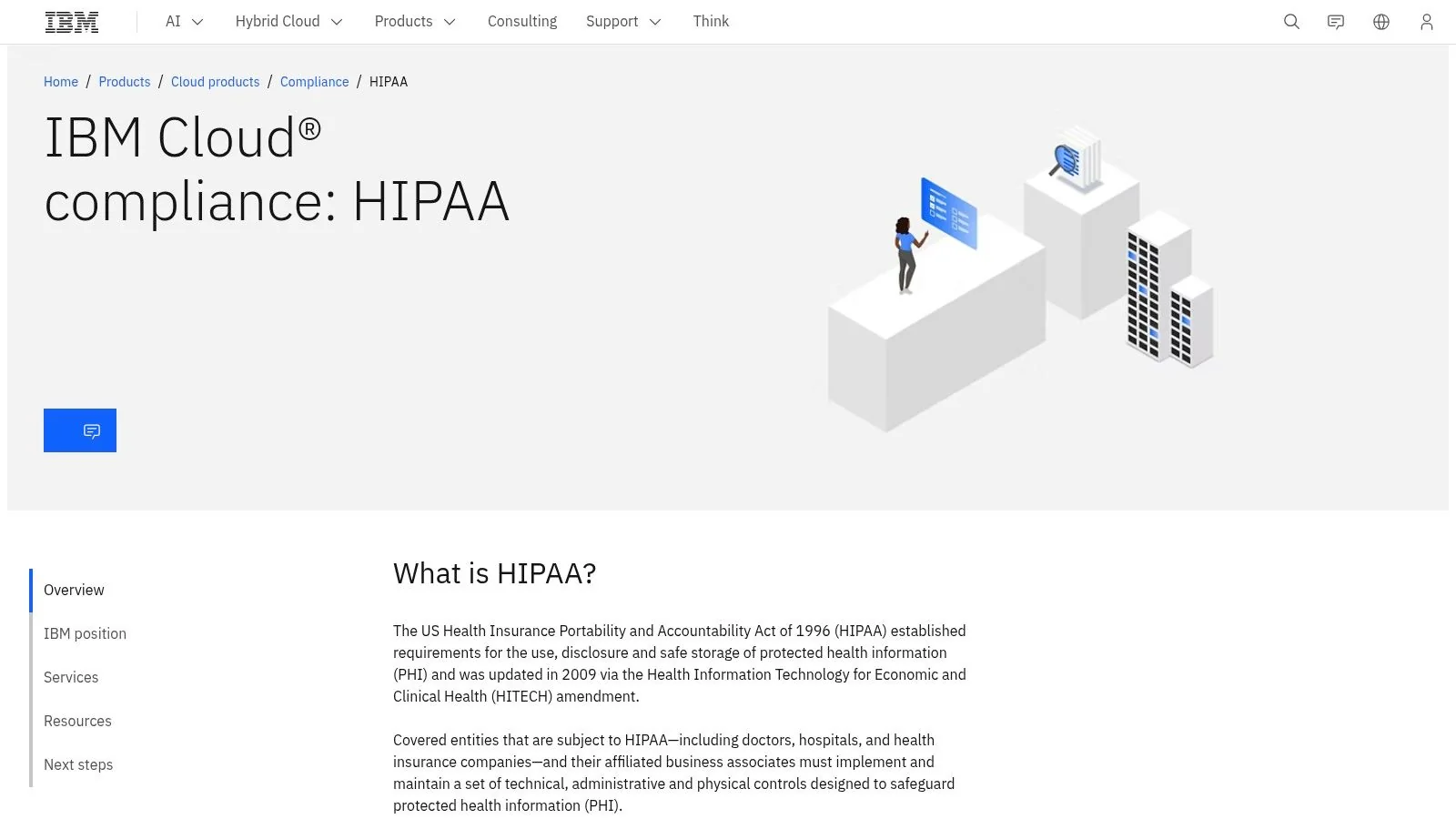
The platform’s key differentiator is its focus on hybrid cloud scenarios, integrating with existing on-premises infrastructure. IBM’s Cloud Catalog explicitly flags services as “HIPAA-ready,” which simplifies identifying compliant components for a solution architecture. This transparency helps organizations avoid using non-compliant services for PHI workloads.
Key Considerations and Features
- Executable BAA: IBM executes a BAA with covered entities, outlining shared responsibilities for protecting PHI.
- HIPAA-Ready Service Catalog: The catalog clearly identifies services within the BAA’s scope, helping technical teams design compliant applications.
- Hybrid Cloud Strength: IBM Cloud excels in supporting hybrid deployments, fitting established enterprises extending legacy systems to the cloud.
- Enterprise Security Focus: The portfolio includes robust security offerings like Hardware Security Modules (HSMs), reflecting its heritage in serving regulated industries.
IBM Cloud is a compelling option for large organizations, especially those with existing IBM investments or complex hybrid cloud requirements. Its focused approach provides a reliable foundation for sensitive healthcare applications.
Website: https://www.ibm.com/products/cloud/compliance/hipaa
5. Oracle Cloud Infrastructure (OCI) — HIPAA on OCI
Oracle Cloud Infrastructure is a significant contender among hipaa compliant cloud providers, particularly for organizations using Oracle’s database technologies. OCI offers a Business Associate Agreement (BAA) and has third-party attestations for HIPAA compliance across a growing list of core services. This allows healthcare entities to migrate and build applications handling protected health information (PHI) on a high-performance platform.
OCI’s key differentiator is its deep integration with Oracle Database services, including Exadata, making it a natural fit for migrating complex, performance-sensitive healthcare workloads. OCI operates on a shared responsibility model, requiring customers to properly configure services, manage access controls, and architect applications to meet HIPAA safeguards.
Key Considerations and Features
- Executable BAA: Oracle provides a BAA covering specific OCI services independently assessed against HIPAA Security Rule requirements.
- Strong Database Pedigree: OCI is an excellent choice for PHI workloads that rely on Oracle databases, offering optimized performance.
- Compliance Documentation: Customers can access compliance documents and attestation reports directly through the OCI console.
- Expanding Service Scope: Oracle is continuously expanding the list of services covered by its HIPAA attestation.
OCI is best suited for organizations with existing Oracle investments or those seeking a high-performance cloud for database-intensive healthcare applications. Diligence is required to ensure PHI is only processed within the defined scope of HIPAA-assessed services.
6. Rackspace Technology — Managed HIPAA Hosting and Managed AWS
Rackspace Technology offers managed services for organizations that need more than raw infrastructure. As an experienced hipaa compliant cloud provider, Rackspace specializes in managed hosting and services for public clouds like AWS. They provide a HIPAA-ready environment and handle operational burdens like architecture, monitoring, and security management, all under a Business Associate Agreement (BAA).
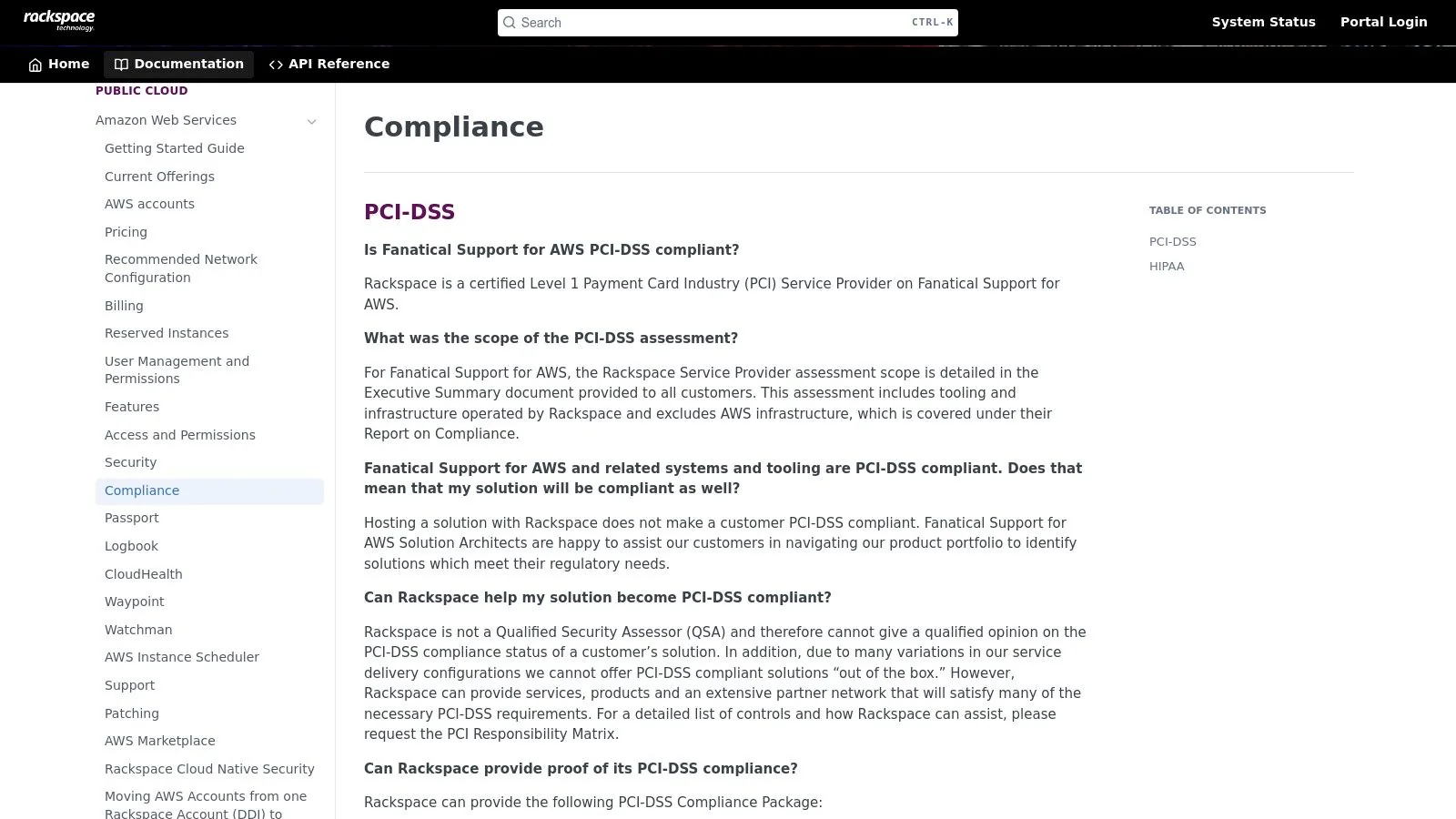
This model is valuable for healthcare providers and SaaS companies lacking extensive in-house cloud operations or security teams. By engaging Rackspace, organizations offload significant compliance and operational tasks. It is critical to clearly define shared responsibility boundaries to ensure no compliance gaps exist between Rackspace’s management and the customer’s application.
Key Considerations and Features
- Executable BAA and HITRUST Certification: Rackspace signs a BAA and offers HITRUST-certified environments.
- Managed Operations: Their service includes 24/7 architecture management, security monitoring, patching, and operational support. You can learn more about what managed cloud services entail to determine if it fits your needs.
- Dedicated Support: Customers often receive dedicated technical account management for complex inquiries.
- Premium Cost: The comprehensive management layer comes at a premium compared to self-managing infrastructure on a public cloud.
Rackspace is an excellent choice for organizations wanting the power of a major cloud but needing an expert partner to manage the underlying infrastructure and critical compliance tasks. It allows teams to accelerate cloud adoption without building a large, specialized DevOps and security team.
Website: https://docs.rackspace.com/docs/compliance
7. Atlantic.Net — HIPAA-Compliant Hosting (Managed VPS/Cloud)
Atlantic.Net provides turnkey managed hosting solutions specifically designed for healthcare. It distinguishes itself from hyperscale hipaa compliant cloud providers by bundling necessary security controls and a Business Associate Agreement (BAA) into clear, fixed-price plans. This makes it an accessible option for smaller healthcare providers, clinics, and health-app developers who need a compliant environment without architectural complexity.
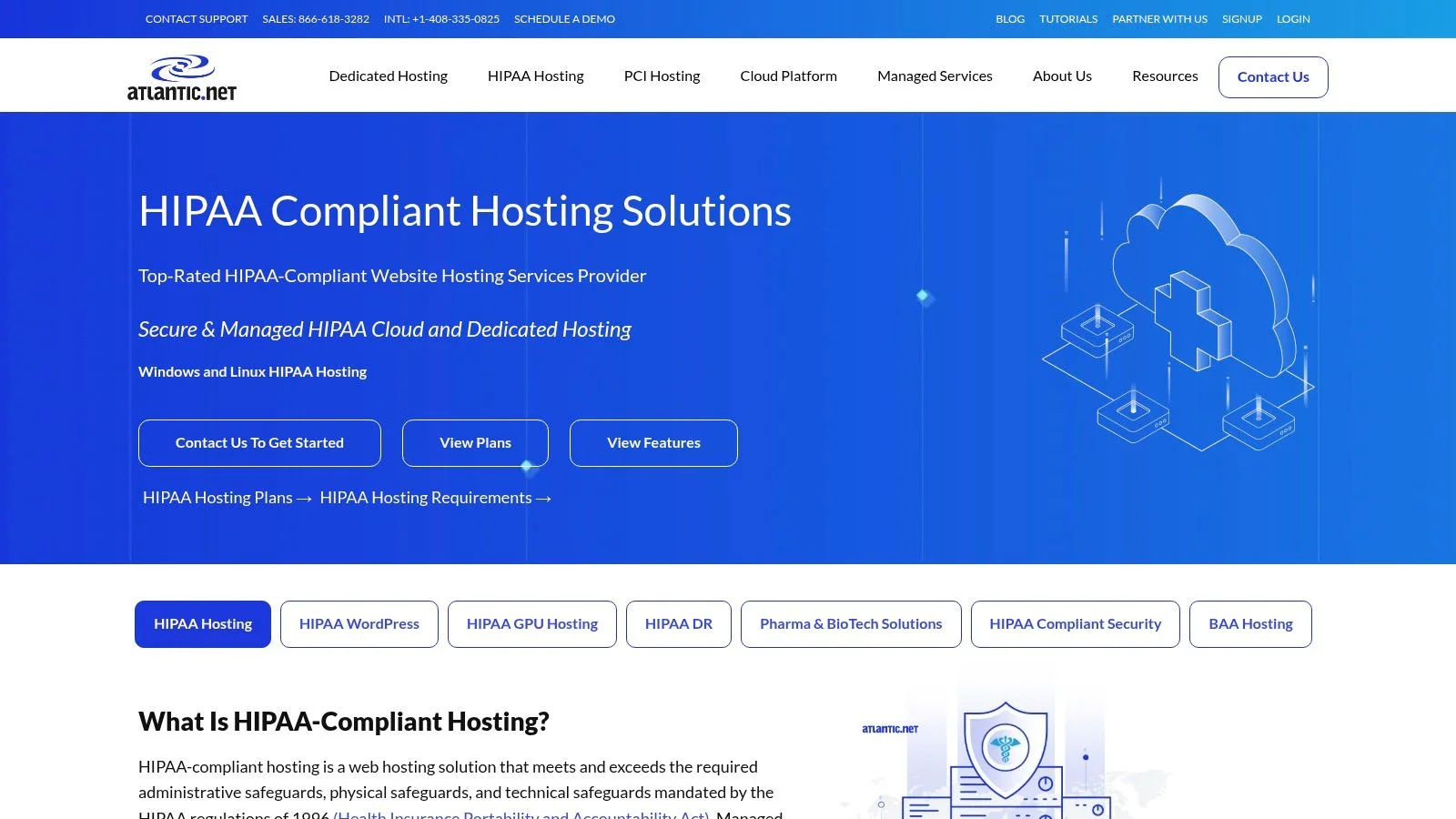
The platform’s strength is its simplicity. Instead of requiring users to assemble a compliant architecture from a menu of services, Atlantic.Net pre-configures the environment. This lowers the barrier to entry and reduces administrative overhead. While it lacks the elastic scalability of AWS or Azure, it provides a solid, secure foundation for websites, patient portals, and applications handling PHI.
Key Considerations and Features
- Turnkey HIPAA Bundles: Atlantic.Net offers transparent monthly pricing for its HIPAA-compliant plans, which include a signed BAA, managed firewall, backups, and intrusion detection.
- Included Security Controls: Core packages feature essential measures like multi-factor authentication (MFA), vulnerability scanning, and daily offsite backups.
- Rapid Deployment: The service offers a “one-click” HIPAA deployment option, accelerating the timeline for getting a compliant environment operational.
- Predictable Costs: The fixed-pricing model is ideal for organizations with smaller budgets, avoiding the potential for cost overruns common with pay-as-you-go services.
Atlantic.Net is a strong choice for organizations that prioritize speed to market and predictable operational costs. It is well-suited for hosting EMR/EHR systems, telehealth applications, and secure websites that process PHI.
Website: https://www.atlantic.net/hipaa-compliant-hosting/
8. Aptible — Compliance‑Focused PaaS for HIPAA
Aptible is a Platform-as-a-Service (PaaS) designed for healthtech companies needing a faster path to compliance. As a specialized HIPAA compliant cloud provider, Aptible offers a BAA and requires customers to use its Dedicated Stacks to process PHI. This architecture provides the necessary isolation and security controls required under HIPAA, abstracting away much of the underlying infrastructure complexity.
The platform’s core value is its built-in automation for critical security and compliance tasks, including logging, encryption, and vulnerability scanning. This purpose-built approach allows development teams to focus on building applications rather than managing complex compliance configurations. It’s an ideal solution for lean teams that lack deep in-house DevOps or security expertise.
Key Considerations and Features
- Dedicated Infrastructure: HIPAA compliance requires the use of dedicated, isolated stacks which incur a fixed monthly platform fee on top of usage-based resource pricing.
- Security Automation: The platform automates numerous controls required for HIPAA, SOC 2, and HITRUST, reducing the manual compliance burden. This is a key factor when performing a vendor due diligence assessment.
- Deployment Flexibility: Aptible offers both a hosted PaaS and a self-hosted model where the platform runs within your own AWS account.
- PaaS Limitations: While excellent for accelerating development, Aptible has less service breadth than hyperscalers. You build applications on top of the platform, not with a vast catalog of a-la-carte cloud services.
Aptible is best suited for organizations prioritizing speed-to-market and compliance rigor over granular infrastructure control. Its secure-by-default environment is a powerful accelerator for teams building applications that handle sensitive health data.
Website: https://www.aptible.com/docs/achieve-hipaa
9. ClearDATA — Healthcare‑Only Cloud Security/Compliance and Managed Services
ClearDATA operates as a specialized compliance and security layer on top of the major public clouds (AWS, Azure, and GCP). This makes it a unique choice among HIPAA compliant cloud providers, focusing exclusively on the healthcare sector. Organizations leverage ClearDATA’s platform and managed services to enforce compliance and manage security for applications handling PHI.
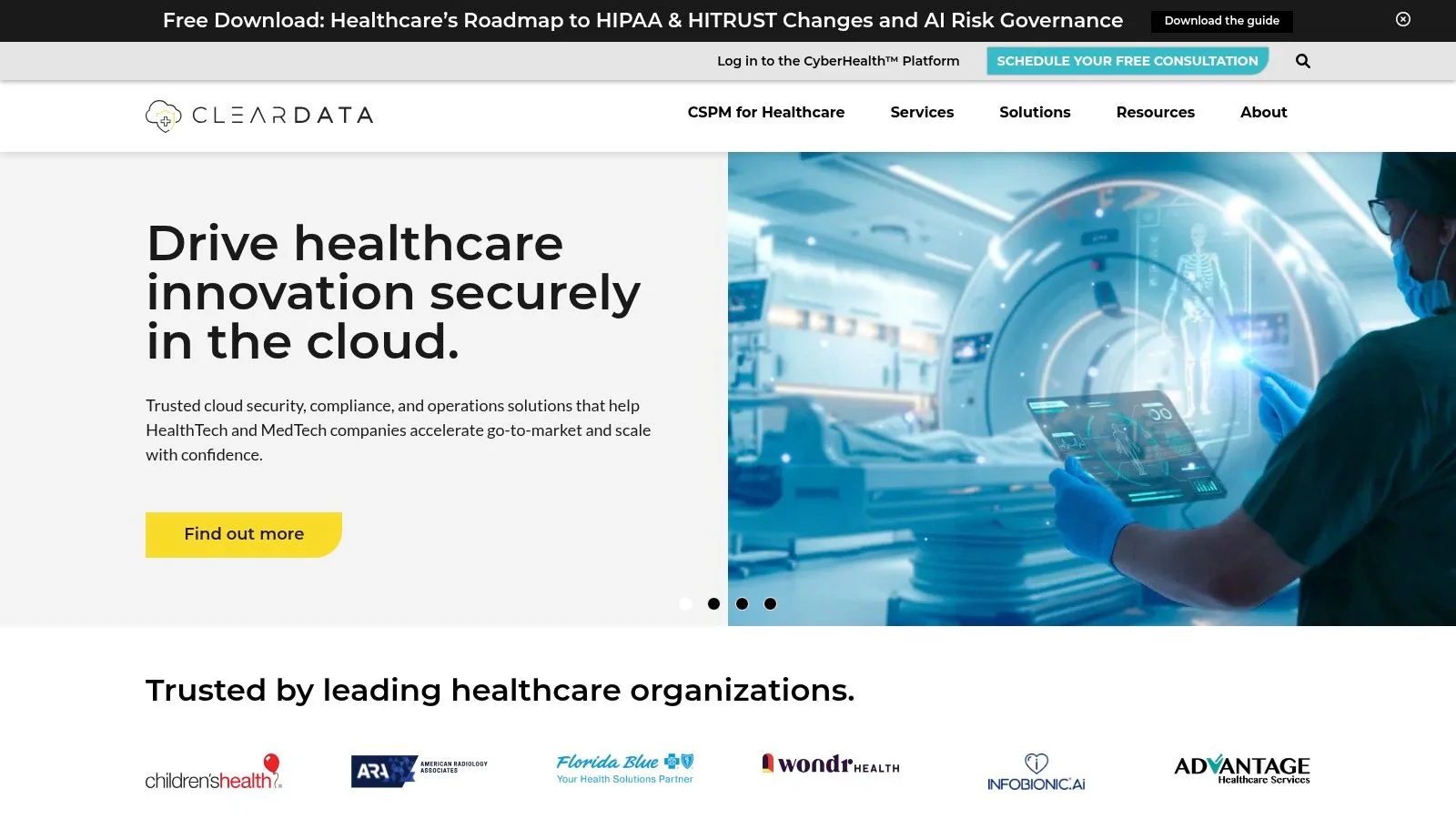
The company’s core offering is its CyberHealth platform, a Cloud Security Posture Management (CSPM) tool built for healthcare regulations. It provides continuous monitoring and automated remediation of misconfigurations. This approach is ideal for healthcare organizations that want the power of a hyperscale cloud but lack the deep, in-house expertise to manage its complex compliance requirements.
Key Considerations and Features
- Healthcare-Native CSPM: The CyberHealth platform includes hundreds of technical safeguards mapped directly to HIPAA, HITRUST, and NIST standards.
- Managed Services: ClearDATA offers services including managed compliance, Managed Detection and Response (MDR), and cloud operations.
- Audit Readiness: The platform provides audit-ready dashboards and reporting, which can accelerate preparations for HITRUST certification and other compliance audits.
- Multi-Cloud Expertise: As a partner for AWS, Azure, and GCP, ClearDATA allows organizations to choose the best underlying cloud while maintaining a consistent compliance framework. Pricing is a premium layer on top of standard cloud costs.
ClearDATA is best suited for healthcare organizations that prioritize deep compliance expertise and want to accelerate their time-to-market without building a large security team. Its premium cost reflects its value in simplifying and de-risking cloud adoption for PHI workloads.
Website: https://www.cleardata.com/
10. Wasabi Hot Cloud Storage — S3‑Compatible Object Storage with BAA
Wasabi is a cost-effective, S3-compatible object storage provider, and it acts as a focused HIPAA compliant cloud provider for data archiving and backup. The company signs a Business Associate Agreement (BAA), enabling covered entities to store protected health information (PHI). This makes it an excellent choice for off-site backups, disaster recovery, and large-scale data lakes where compute is handled separately.
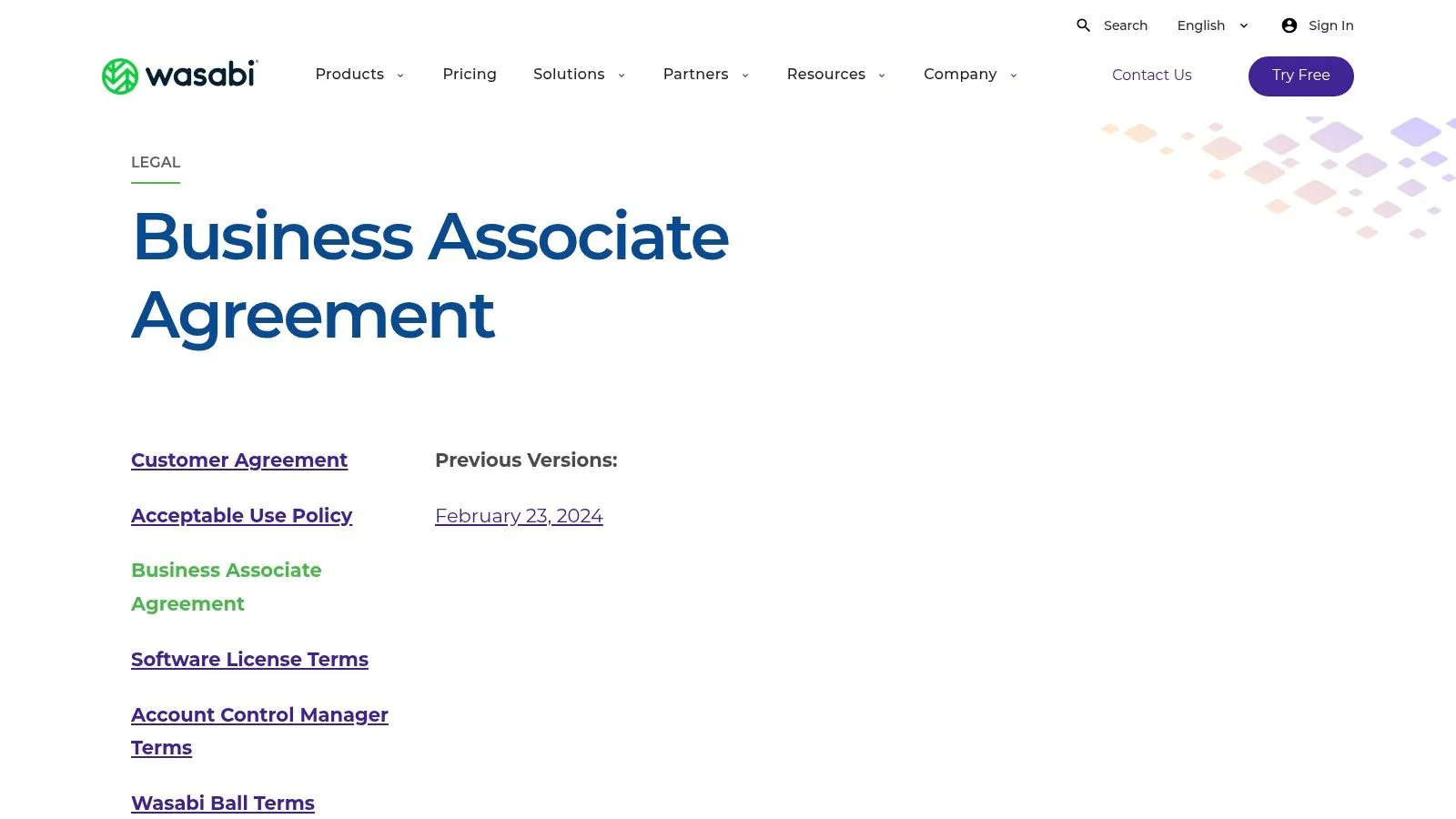
The platform’s primary appeal is its simple, predictable pricing model that eliminates egress fees and complex API call charges. However, Wasabi is strictly a storage service; customers are responsible for implementing the necessary encryption, access controls, and auditing on their end to meet HIPAA Security Rule requirements. It’s a component, not a complete solution.
Key Considerations and Features
- Executable BAA: Wasabi offers a BAA covering its hot cloud storage service, which customers must execute to establish HIPAA compliance.
- Simple Pricing: Its predictable, low-cost storage pricing with no egress fees is ideal for organizations managing large volumes of PHI.
- S3-Compatible API: High compatibility with the S3 API means a vast ecosystem of third-party backup and data management tools can be used with Wasabi with minimal configuration changes.
- User-Controlled Security: Compliance depends heavily on the customer. You must manage encryption keys, configure access policies correctly, and integrate logging tools to secure PHI.
Wasabi is best suited for healthcare organizations looking for a pure storage solution to augment their existing infrastructure. It’s an ideal, budget-friendly destination for PHI backups and archives for teams with the expertise to manage the surrounding security controls.
Website: https://wasabi.com/legal/business-associate-agreement/
11. Backblaze B2 Cloud Storage — Object Storage with BAA
Backblaze B2 offers S3-compatible object storage that is a highly cost-effective option among HIPAA compliant cloud providers. While not a full-stack platform, it provides a crucial service for healthcare organizations needing to store, back up, or archive PHI securely. Backblaze executes a Business Associate Agreement (BAA), making its B2 Cloud Storage a viable component for a broader HIPAA-compliant architecture.
The platform’s appeal is its transparent, low pricing, especially for data egress. This makes it an excellent choice for disaster recovery and long-term PHI archives. It is critical to understand that Backblaze only covers the storage component; all compute, application logic, and access controls must be architected and secured on a separate platform, with PHI encrypted before it is sent to B2.
Key Considerations and Features
- Executable BAA: Backblaze provides a BAA covering its B2 Cloud Storage service.
- Transparent Pricing: Features a simple, public pricing model with a generous free egress policy.
- Enterprise-Ready Storage: Supports key features needed for data governance, including object versioning, legal holds, and lifecycle policies.
- Broad Integrations: Its S3 compatibility ensures it works seamlessly with a vast ecosystem of backup software and data transfer tools.
Backblaze is ideal for organizations prioritizing cost-efficiency for PHI backups and archives. It is a specialized tool that requires technical teams to build the surrounding HIPAA-compliant compute and security infrastructure elsewhere.
Website: https://www.backblaze.com/cloud-storage/pricing
12. Box — Enterprise Content Platform with HIPAA BAA
Box is a leader in enterprise content management, offering a secure platform for file sharing that can be configured for HIPAA compliance. For covered entities, Box provides a Business Associate Agreement (BAA) for its higher-tier enterprise plans, making it one of the go-to hipaa compliant cloud providers for content and document lifecycle management.
The platform’s value for healthcare lies in its granular governance, security, and auditing controls. Administrators can apply security classifications, set retention policies, and generate detailed audit trails to monitor access to PHI. However, the BAA is limited to specific plans and does not automatically extend to third-party applications integrated with Box, requiring separate due diligence.
Key Considerations and Features
- BAA Availability: Box signs a BAA for customers on its Enterprise, Enterprise Plus, or Enterprise Advanced plans.
- Detailed Guidance: The company provides a comprehensive HIPAA and HITECH FAQ and a clear administrative workflow for requesting the BAA.
- Advanced Governance: Features like Box Governance allow for automated retention policies, and Box Shield provides threat detection and content classification.
- Integration Risks: Each third-party app connected to the platform falls outside the scope of Box’s BAA and must be independently vetted for HIPAA compliance.
Box is an excellent choice for healthcare organizations needing a mature solution for secure PHI document collaboration and file sharing on an eligible enterprise plan.
Website: https://support.box.com/hc/en-us/articles/360044194833-Box-HIPAA-and-HITECH-Overview-and-FAQ
HIPAA-Compliant Cloud Providers — 12-Provider Comparison
| Provider | Core HIPAA capabilities | Target audience / Best for | Value / Key advantages | Primary trade-offs / Pricing notes |
|---|---|---|---|---|
| Amazon Web Services (AWS) — HIPAA on AWS | Executable BAA, maintained HIPAA‑eligible services list, fine‑grained IAM, logging, FedRAMP/NIST alignment | Healthcare orgs needing broad IaaS/PaaS and partner ecosystem | Mature reference architectures, extensive security/audit tooling, large partner marketplace | Complex platform; must confine PHI to eligible services; cost governance needed |
| Microsoft Azure — HIPAA on Azure | BAA via Product Terms/DPA, extensive compliance docs, enterprise governance (M365/Entra) | Enterprises with MS ecosystem and governance needs | Streamlined BAA process, strong governance tooling, broad US datacenter coverage | Service eligibility nuances; some pricing opaque for new teams |
| Google Cloud Platform (GCP) — HIPAA on Google Cloud | Google BAA, covered‑product list, Healthcare API, BigQuery analytics | Analytics‑heavy health workloads and data teams | Strong analytics stack, clear covered‑product guidance, same pricing for HIPAA | Must exclude non‑covered products; initial guardrails require diligence |
| IBM Cloud — HIPAA on IBM Cloud | IBM BAA, HIPAA‑ready catalog flags, VMs/DBs/HSMs, hybrid support | Large enterprises, hybrid/mainframe healthcare environments | Clear BAA path, strong security heritage, hybrid integration strengths | Smaller third‑party ecosystem; verify service HIPAA flags per catalog |
| Oracle Cloud Infrastructure (OCI) — HIPAA on OCI | HIPAA attestation, BAA availability, audited DB services (Exadata), compliance artifacts | DB‑centric enterprises and Oracle customers | Strong database pedigree, audited services, competitive performance | Smaller ecosystem vs hyperscalers; compliance details dispersed across docs |
| Rackspace Technology — Managed HIPAA Hosting | BAA, HITRUST‑certified environments, managed ops, 24/7 support, TAM | Mid‑market SaaS, health systems lacking in‑house ops | Offloads day‑2 operations, consolidated compliance management, monitoring/patching | Premium managed cost; requires clear shared‑responsibility RACI |
| Atlantic.Net — HIPAA‑Compliant Hosting | BAA included, managed VPS/cloud, firewall, backups, MFA, IDS, published plans | Small providers, PHI websites/apps needing turnkey hosting | Posted HIPAA pricing packages, one‑click deployments, quick time‑to‑live | Less elastic for cloud‑native apps; add‑ons can raise monthly spend |
| Aptible — Compliance‑Focused PaaS for HIPAA | BAA, Dedicated Stacks for HIPAA, security automation (logging/encryption/scanning) | Regulated startups and healthtech using PaaS | Fast path to compliance, purpose‑built controls, clear Dedicated Stack pricing | Additional platform fee for Dedicated Stacks; narrower service breadth |
| ClearDATA — Healthcare‑Only Compliance & Managed Services | Healthcare CSPM (CyberHealth), managed compliance/MDR, audit‑ready reporting, multi‑cloud | Healthcare orgs seeking continuous compliance and HITRUST readiness | Deep healthcare specialization, continuous posture management, audit acceleration | Sales‑driven pricing (premium); still pay underlying cloud costs |
| Wasabi Hot Cloud Storage — S3‑Compatible | BAA available, S3‑compatible object storage, predictable pricing, reserved capacity | PHI backups, archives, data lakes needing low‑cost storage | Very low predictable storage costs, strong backup ecosystem integrations | Storage‑only service; must architect remaining HIPAA controls |
| Backblaze B2 Cloud Storage — Object Storage with BAA | BAA, S3‑compatible API, transparent pricing, versioning/legal hold | Backup/DR and active archives for PHI | Price‑competitive storage, favorable egress policy, simple billing | Storage‑only; some advanced enterprise features in specific SKUs |
| Box — Enterprise Content Platform with HIPAA BAA | BAA for enterprise tiers, governance, retention, audit controls, APIs | Enterprise document management and PHI collaboration | Mature admin controls, compliance docs, integrations for workflows | BAA limited to specific plans; third‑party integrations may not be covered by BAA |
Your Next Step: From Selection to Secure Implementation
Selecting a HIPAA compliant cloud provider is a foundational step, but defensible compliance requires continuous effort. No provider offers “HIPAA compliance in a box.” Compliance is earned through meticulous architecture, continuous monitoring, and a commitment to the shared responsibility model.
Your choice of vendor shapes your compliance posture. A large enterprise may leverage the granular control of AWS or Azure for scalable applications. A startup may accelerate time-to-market and reduce overhead by partnering with a managed provider like Atlantic.Net or a PaaS like Aptible, which bake in many security controls.
Actionable Takeaways
As you move from evaluation to implementation, keep these critical points in mind:
- The BAA is the Beginning, Not the End: A signed Business Associate Agreement is a non-negotiable prerequisite, but it only covers specific services. Your team remains responsible for correctly configuring those services, managing encryption keys, implementing access controls, and monitoring for threats. The BAA is a legal document, not a technical safeguard.
- Shared Responsibility is Not Optional: You retain ultimate responsibility for how you configure the environment, manage user access, and secure the applications and data within it. Documenting these responsibilities is crucial for audits.
- Configuration is King: Misconfiguration is one of the greatest risks to PHI in the cloud. A public S3 bucket, a permissive IAM role, or an unencrypted database backup can lead to a catastrophic data breach. Prioritize security-first configurations and regular audits.
- Tooling Extends Beyond the Platform: While providers offer native security tools (e.g., AWS GuardDuty, Azure Sentinel), your compliance toolkit should expand. Consider third-party solutions for Security Information and Event Management (SIEM) and vulnerability scanning to create a multi-layered defense.
A Practical Path Forward
Translate this knowledge into a structured plan tailored to your organization’s risk profile.
- Finalize Your Shortlist: Based on your scale, budget, and in-house expertise, narrow your list to two or three contenders. Determine if you are a “build” organization suited for a hyperscaler or a “buy” organization better served by a managed specialist.
- Conduct Deep Due Diligence: Engage with your shortlisted vendors. Go beyond marketing. Ask for proof of compliance programs, audit process details, and specifics on incident response procedures.
- Architect for Compliance: Before migrating data, design your cloud architecture with HIPAA principles in mind. This means network segmentation (VPCs), implementing the principle of least privilege, and enforcing encryption everywhere—at rest and in transit.
- Develop a Continuous Monitoring Strategy: Compliance is not a one-time event. Establish automated processes and alerts for monitoring system logs, access patterns, and configuration changes.
Choosing from the top HIPAA compliant cloud providers has long-term consequences for your organization’s security and innovation. By treating this process with rigor and understanding that the platform is merely the foundation, you can build a secure, resilient, and compliant cloud environment for modern healthcare.
Navigating cloud architecture and HIPAA compliance can be daunting. To ensure your implementation is secure and optimized, consider engaging an expert partner through CloudConsultingFirms.com. Our platform helps you find and vet top-tier cloud consulting firms with proven experience in healthcare compliance, ensuring your project is built right, the first time.
Peter Korpak
Chief Analyst & Founder
Data-driven market researcher with 10+ years helping software agencies and IT organizations make evidence-based decisions. Former market research analyst at Aviva Investors and Credit Suisse. Analyzed 200+ verified cloud projects (migrations, implementations, optimizations) to build Cloud Intel.
Connect on LinkedInContinue Reading
Security
Resources for vetting information security consulting firms
10 Actionable Cloud Security Best Practices for 2026
Cut through the noise. Discover 10 technical, actionable cloud security best practices for 2026 covering IAM, encryption, and zero-trust networking.
Solving Modern Cloud Compliance Challenges
A technical guide to overcoming modern cloud compliance challenges. Learn to mitigate risks for GDPR, HIPAA, and PCI DSS in complex cloud environments.
Stay ahead of cloud consulting
Quarterly rankings, pricing benchmarks, and new research — delivered to your inbox.
No spam. Unsubscribe anytime.