Managed cloud services are the partial or complete outsourcing of cloud platform operations to a specialist provider. A managed cloud service provider (MCSP) takes agreed responsibility for running your cloud environment—monitoring, patching, incident response, backups, cost governance, and security operations—so your internal team can focus on applications and business outcomes.
The term also appears in a second, related sense: hyperscaler fully managed products such as Amazon RDS, Google Cloud SQL, and Azure SQL, where the cloud vendor operates the service layer. This guide covers both meanings, because procurement teams, architects, and finance leaders encounter them in the same conversation.
What are managed cloud services?
Managed cloud services are third-party operational contracts in which a specialist provider runs part or all of your cloud platform under a defined scope, service levels, and reporting cadence. The provider may manage infrastructure monitoring, patching, backups, identity hygiene, cost reviews, and security-event response while your organization retains ownership of applications, data, and business decisions.
IBM’s managed cloud definition describes the model as complete or partial management and control of a client’s cloud resources. Cognizant’s glossary adds deployment, migration support, and ongoing platform management. Both frame managed cloud services as an operating relationship, not a single product SKU.
Two meanings teams should not conflate
| Dimension | Third-party MCSP management | Hyperscaler fully managed services |
|---|---|---|
| Who operates it | External MSP/MCSP on your cloud accounts | AWS, Azure, or Google Cloud as the service operator |
| Typical scope | Cross-service operations, FinOps, security monitoring, runbooks | A specific managed product (database, cache, serverless platform) |
| Contract shape | Monthly retainer, % of spend, or tiered SLA package | Pay-per-use or committed-use product pricing |
| Best question to ask | ”What exactly do you operate in our tenant?" | "What does the vendor manage vs. what do we still own?” |
| Deeper reading | Top managed service providers | AWS vs Azure vs GCP |
Confusing the two leads to gaps in accountability. A team may assume “managed” means an MCSP owns security end to end, when the AWS shared responsibility model still leaves the customer responsible for data, identity, network configuration, and application security.
What does a managed cloud service provider (MCSP) actually do?
A managed cloud service provider operates agreed parts of your cloud estate against documented runbooks, escalation paths, and service levels. Scope should name the accounts, projects, services, environments, and exclusions—not a generic promise to “manage the cloud.”
| Service area | Common MCSP responsibilities | Usually stays with the customer |
|---|---|---|
| Monitoring and incidents | Alert triage, on-call response, escalation, post-incident summaries | Application-level root-cause analysis, product rollback decisions |
| Patching and maintenance | OS, platform, and managed-service update coordination | Application release timing, feature flags, change approval |
| Backup and recovery | Backup configuration, restore testing, runbook maintenance | RPO/RTO targets, business continuity sign-off |
| Security operations | Log review, vulnerability scanning coordination, policy enforcement support | Data classification, access approvals, threat modeling |
| Cost governance | Spend reporting, rightsizing recommendations, reservation planning support | Budget ownership, architectural tradeoffs, commit decisions |
| Compliance evidence | Control monitoring, evidence collection, audit packet preparation | Control ownership, regulator relationships, policy exceptions |
Platform-specific operating models differ. For Azure engagements, see Azure managed services for governance, identity, and co-managed vs full-MSP models. For Google Cloud data and GKE estates, see Google Cloud managed services for workload-scoped diligence questions.
What are examples of managed cloud services?
Managed cloud services examples span infrastructure operations, platform management, and specialized security or cost programs. Search demand clusters around monitoring, patching, backup, cost optimization, and multi-cloud operations—the scope items MCSPs most often contract for.
Third-party MCSP examples
- Cloud infrastructure management: 24/7 monitoring, incident response, and capacity coordination across EC2, Azure VMs, or Compute Engine.
- Managed Kubernetes operations: Cluster upgrades, node pool management, and control-plane incident response on Amazon EKS, Azure AKS, or Google GKE—with application deployments typically retained by the customer.
- Managed security services: Continuous threat detection, compliance monitoring, and security-event triage—Mordor Intelligence identifies managed security as the fastest-growing cloud managed services segment, with a projected 10.52% CAGR through 2031.
- Cloud FinOps programs: Monthly spend reviews, anomaly detection, and optimization recommendations tied to a documented savings baseline.
Hyperscaler fully managed product examples
- Database as a service: Amazon RDS, Azure SQL, Google AlloyDB
- NoSQL and global databases: Amazon DynamoDB, Azure Cosmos DB, Google Cloud Spanner
- Serverless application platforms: AWS Lambda, Google Cloud Run, Azure Container Apps
Use the first list when evaluating an MCSP contract. Use the second when choosing how much operational work the hyperscaler absorbs inside a product boundary.
How big is the managed cloud services market in 2026?
The cloud managed services market reached roughly USD 140.96 billion in 2025 and is estimated at USD 154.08 billion in 2026, according to Mordor Intelligence. The same source projects the market at USD 240.39 billion by 2031 (9.31% CAGR, 2026–2031).
| Metric | Value | Source | As of |
|---|---|---|---|
| 2025 market size | USD 140.96B | Mordor Intelligence | 2026 report |
| 2026 market size | USD 154.08B | Mordor Intelligence | 2026 report |
| 2031 forecast | USD 240.39B | Mordor Intelligence | 2026 report |
| Fastest-growing segment | Managed security services (~10.52% CAGR to 2031) | Mordor Intelligence | 2026 report |
Market sizing varies by research firm because definitions differ—some reports include broader managed IT services, others isolate cloud-only operations. Treat any single headline number as a directional estimate, not an audit figure.
Broader cloud adoption continues to pull managed services demand forward. Gartner’s public cloud services forecast (3Q25 update) projects 21.3% growth in 2026 as integration and AI workloads expand cloud footprints (Gartner public cloud forecast, September 2025).
How does the shared responsibility model affect managed services?
The shared responsibility model splits security and operations duties between the cloud provider and the customer. Managed services—whether delivered by an MCSP or embedded in a hyperscaler product—shift who performs specific tasks; they do not automatically transfer accountability for data, access, or application behavior.
AWS documents that the customer remains responsible for guest operating systems, application software, identity and access management, firewall configuration, and data classification—even when using managed services such as RDS. For AWS-managed services on shared-tenant architectures, AWS Well-Architected guidance assigns patch release to AWS and patch application scheduling to the customer.
For regulated workloads, the practical effect is narrower audit scope, not zero security work. Teams still need evidence for access reviews, encryption choices, logging retention, and application controls. Use a structured vendor due diligence checklist before handing operational access to an MCSP.
What is the difference between managed cloud services and outsourcing?
Managed cloud services and traditional IT outsourcing both use external specialists, but the contract logic differs. Outsourcing often sells labor hours or ticket volume. Managed cloud services sell operational outcomes tied to cloud environments—uptime, response times, recovery objectives, and cost targets.
| Attribute | Traditional outsourcing | Managed cloud services |
|---|---|---|
| Primary focus | Task completion (patching, backups, helpdesk) | Cloud operations outcomes (availability, MTTR, spend variance) |
| Metrics | Tickets closed, hours billed | SLA attainment, incident severity, cost vs. budget |
| Provider role | Staff augmentation or ticket queue | Cloud operations partner with runbooks and tooling |
| Contract basis | Per device, per user, or time and materials | Retainer, % of cloud spend, or tiered SLA package |
| Best fit | General IT support with variable cloud depth | Cloud-native estates needing 24/7 platform operations |
The distinction matters during procurement. A low hourly rate does not help if the provider lacks FinOps discipline, identity governance, or platform certifications for your stack. Conversely, a premium MCSP that measurably reduces incident frequency and cloud waste can pay for itself—evaluate outcomes, not just the rate card. For pricing benchmarks and shortlist mechanics, see top managed service providers.
When should you self-manage, use hyperscaler managed products, or hire an MCSP?
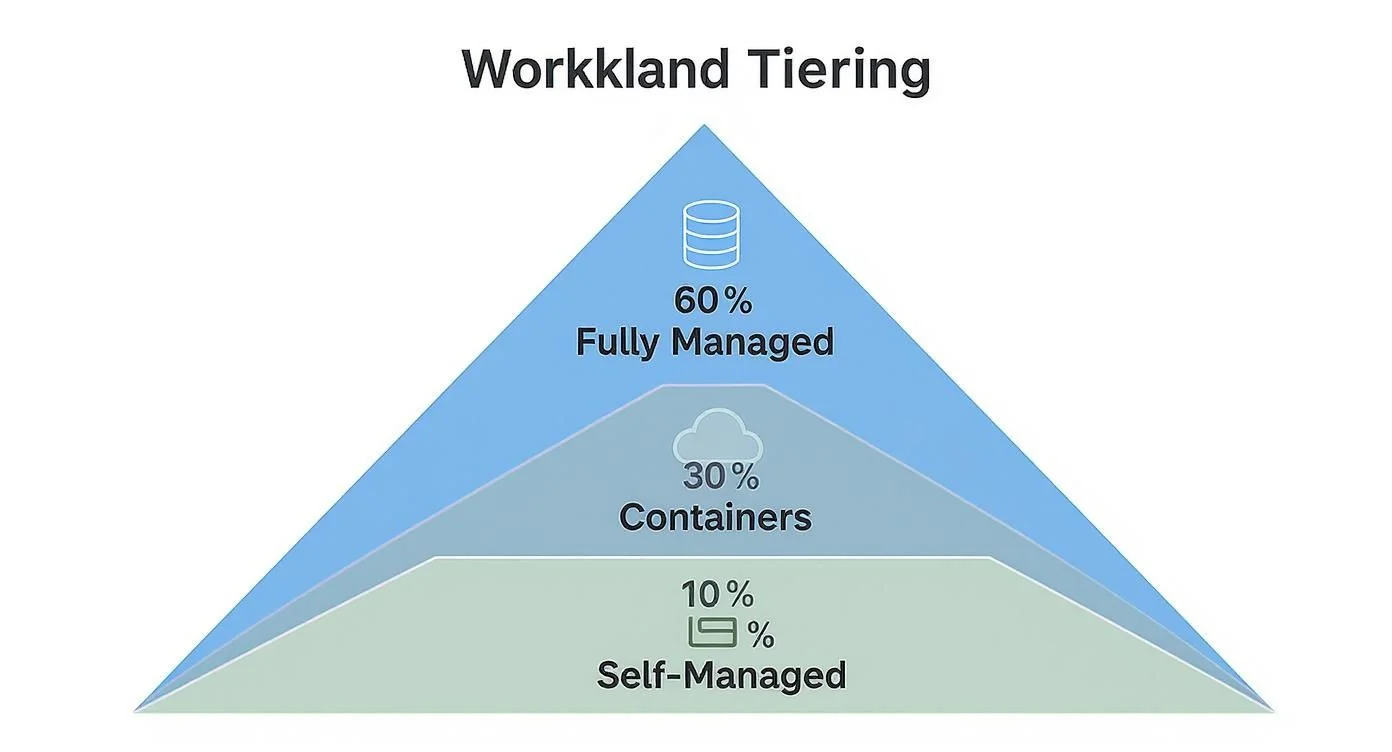
The decision is a workload question, not a brand question. A practical starting point is the 60/30/10 workload tiering model: run the majority of undifferentiated components on fully managed hyperscaler services, keep a middle tier on lightly managed platforms such as Kubernetes, and reserve self-management for workloads with unique IP or hard regulatory constraints.
| Tier | Share of workloads (rule of thumb) | Typical placement | Operational owner |
|---|---|---|---|
| Fully managed | ~60% | RDS, DynamoDB, Cloud SQL, ElastiCache, serverless APIs | Hyperscaler product operations |
| Lightly managed | ~30% | Containerized apps on EKS, AKS, or GKE | Shared: provider runs control plane; customer owns images and releases |
| Self-managed | ~10% (exceptions only) | Custom data platforms, specialized HPC, unique licensing stacks | Internal platform team |
Choose hyperscaler fully managed services when the workload is undifferentiated, the service SLA matches your requirements, and your team would spend more time operating than improving the product.
Add an MCSP when operational complexity spans multiple accounts or clouds, on-call coverage is thin, compliance evidence must be continuous, or FinOps and security operations need dedicated capacity your team cannot hire quickly.
Stay self-managed when the workload carries defensible IP, needs hardware-level tuning, or regulatory rules require controls that managed offerings cannot satisfy.
This framework pairs well with migration planning. Teams assessing portfolio readiness should complete a cloud migration assessment checklist before outsourcing operations they have not yet documented.
What should you verify before signing an MCSP contract?
Before execution, require a written scope that survives the first production incident. At minimum, document:
- Tenant boundaries: accounts, subscriptions, projects, folders, environments, and excluded systems.
- Responsibility matrix: who owns identity, data, releases, backups, monitoring, incident command, and customer communication.
- SLA definitions: alert acknowledgement, restoration targets, maintenance windows, and reporting cadence—with remedies scoped to what the provider controls.
- Access model: break-glass procedures, privileged-access tooling, and audit logging for provider actions.
- Exit plan: documentation handoff, credential rotation, and transition assistance if the contract ends.
Managed cloud services work when scope is specific enough to audit. A contract that promises “24/7 cloud management” without naming services, environments, and escalation paths is a procurement risk, not an operating model.
For platform-specific diligence questions, use the Azure and Google Cloud managed services guides linked above. For independent MSP comparison, use the top managed service providers framework.
Frequently Asked Questions
What’s the real difference between managed services and outsourcing?
Traditional IT outsourcing transfers discrete tasks—patching servers, running backups, staffing a helpdesk—often billed by time or device count. Managed cloud services align provider incentives with cloud outcomes: availability, incident response, cost variance, and compliance evidence across your cloud estate. The conversation shifts from “Did you close the ticket?” to “Did we meet the agreed service level and stay inside budget?”
How will managed services affect my budget?
Managed services usually convert unpredictable engineering time into a recurring operating expense. MCSPs commonly price as a flat monthly retainer, a tiered package, or a percentage of cloud spend—often in the 10–20% range for cloud-native estates, with variation by scope and certifications (MSP pricing context).
Factor in both the retainer and the cloud bill. A provider that rightsizes idle resources or improves reservation coverage can offset part of its fee. A low-cost provider without FinOps discipline can increase total cost.
Are managed services secure enough for regulated industries?
Managed services can strengthen compliance posture when scope and evidence are explicit. Hyperscalers maintain broad certifications (PCI-DSS, HIPAA, SOC 2, ISO 27001) for infrastructure layers, and MCSPs can operationalize control monitoring—but your organization remains accountable for data handling, access decisions, and application security.
Treat compliance as a shared evidence problem: collect provider attestations for infrastructure controls, and maintain your own records for application and data controls.
Do I give up all control by using a managed service?
You trade low-level infrastructure control for more time on architecture, releases, and product work. You still govern architecture standards, access policies, release decisions, and vendor selection. Reduce lock-in risk by using open data formats (Apache Parquet, Iceberg), documenting data egress paths, and abstracting critical service APIs behind internal interfaces.
Where to compare managed service providers by platform
Once you define scope—what the MCSP operates, which SLAs apply, and what stays with your team—use the platform shortlist that matches your estate:
| Platform | Compare firms | Read first for operating-model context |
|---|---|---|
| Azure | Azure managed services shortlist | Azure managed services guide |
| AWS | AWS managed services hub | AWS consulting partners hub |
| Multi-platform | Firm directory | This guide for MCSP scope and shared-responsibility boundaries |
Shortlists compare named firms on published evidence. This guide defines what “managed” should mean in your contract before you evaluate any provider.
Finding the right cloud partner is the next step after you define the operating model. CloudConsultingFirms.com offers public profiles to support an initial longlist across AWS, Azure, and Google Cloud. Review partner designations, pricing signals, documented outcomes, and buyer-fit guidance in the firm directory, then verify the proposed team and scope directly.