Google Cloud Partner Directory: How to Find Top Partners
To find a qualified Google Cloud partner, start with the official Google Cloud Partner Directory. This is Google’s curated list of certified companies, designed to connect businesses with vetted experts for building and managing solutions on their platform.
Using the directory is the most direct way to identify qualified partners and de-risk your vendor selection process. Treat it as your single source of truth for certified expertise.
Why the Partner Directory Is a Strategic Starting Point
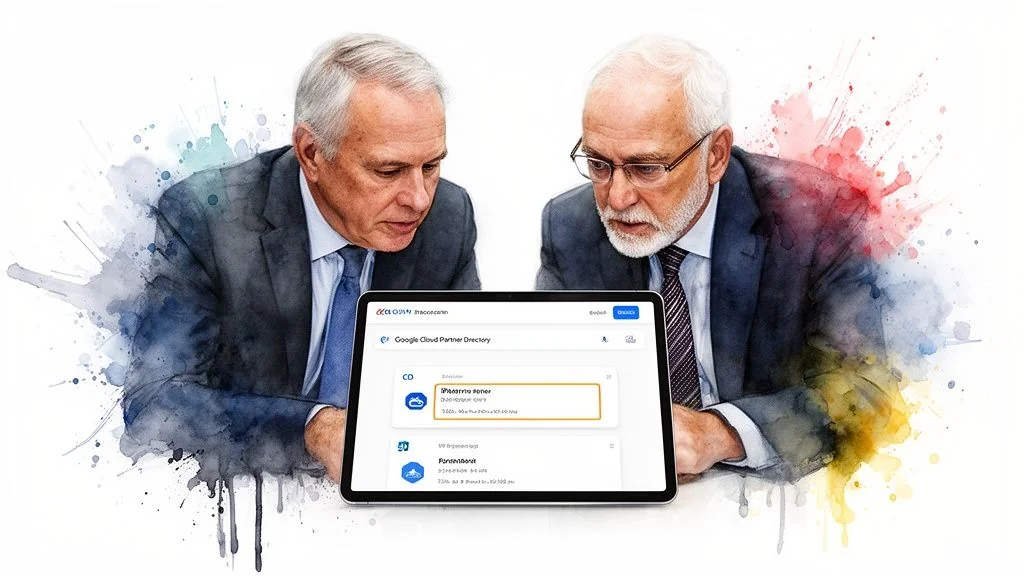
Understanding the directory’s structure is key to finding the right partner. It’s an ecosystem of proven talent, not just a business listing. For any CIO or engineering leader, navigating this resource efficiently separates true implementation specialists from generalist IT shops.
Every company listed has passed Google’s validation process, which requires technical certifications, documented customer success, and deep platform proficiency. This pre-vetting saves significant time and lowers the risk of selecting the wrong team for a critical project, such as a data warehouse migration or application modernization.
The Gateway to Vetted Expertise
The directory is the primary source for major industry analysis. For a company to be considered for a report like the ISG Provider Lens™ 2025 Google Cloud Partner Ecosystem, it must be listed in the Google Cloud Partner Directory.
That study evaluates partners across five critical areas:
- Google Cloud Professional Services (Consulting and Migration)
- Managed Services
- Enterprise Data Infrastructure Services
- GenAI and AI Services
- Google Workspace Services
This direct link means the partners in the directory are the same ones being scrutinized by top industry analysts. You can learn more about the methodology in the ISG Provider Lens™ report for 2025.
A Tool for Strategic Alignment
The directory is a strategic matching tool built to align your business goals with a partner capable of delivering on them. It allows you to move past generic web searches and focus on experts with a proven history in your industry and with the specific technologies you need.
By starting with the official directory, you are not just finding a contractor; you are initiating a partnership built on a foundation of verified skills and documented success. This first step is the most effective way to ensure your cloud investment delivers its promised value.
How to Use Directory Filters to Build Your Shortlist
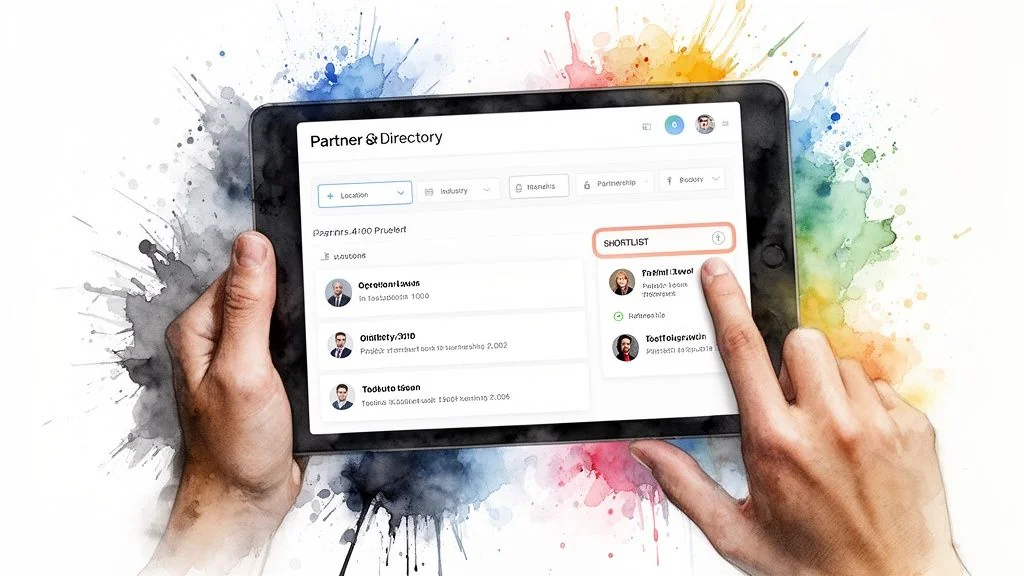
The filters in the Google Cloud Partner Directory for Products, Expertise, and Location are your primary tools for narrowing a list of thousands of potential partners to a qualified few.
The most effective method is to use the filters strategically by layering your criteria. This approach can transform an overwhelming list into a manageable shortlist in minutes. Think of it as a funnel: start with broad, non-negotiable criteria, then progressively narrow the field based on project specifics.
Start with Foundational Filters
First, lock in your non-negotiables. The two most common starting points are geography and partner tier.
If you require a team in your time zone or have data residency requirements, use the Location filter first. It is the fastest way to reduce the initial list to a relevant size.
Next, consider the Partnership Level. The options are “Partner” and “Premier.” While both are officially recognized, Premier status indicates a deeper investment in the Google Cloud platform. These firms typically have larger teams of certified professionals and a more extensive portfolio of successful projects. For a mission-critical, enterprise-level project, begin your search by filtering for Premier partners.
Refine Your Search with Expertise and Product Filters
After setting foundational filters, get more granular to match a partner’s skills to your project’s technical demands. The directory provides two filters for this: Expertise and Product.
-
Filter by Expertise: This is best for finding partners with relevant business context. Filtering by industry—such as “Healthcare and Life Sciences” or “Financial Services”—connects you with teams that understand your industry’s terminology and compliance requirements. You can also filter by solution expertise, such as “Cloud Migration” or “Security,” to find specialists. For more detail, our guide on top cloud migration consulting companies explains what to look for.
-
Filter by Product: This is the most direct route if your project centers on a specific Google Cloud tool. If you need data warehousing expertise, filter for “BigQuery.” For machine learning capabilities, filter for “Vertex AI.”
A common mistake is using only one filter. Combine them for better results. A partner with “Retail” expertise and a “BigQuery” product specialization is a much stronger candidate for an e-commerce analytics project than a partner with only one of those credentials.
A Practical Example
Imagine you are the VP of Engineering at a mid-sized e-commerce company in the U.S. You need to build a new analytics platform to track customer behavior.
Here is how to use the directory filters to build a high-quality shortlist:
- Location: Filter for “United States.”
- Partnership Level: Select “Premier” because this is a core business initiative.
- Expertise (Industry): Add the “Retail & Consumer Goods” filter.
- Expertise (Solution): Layer on “Data Analytics” to find a data-focused firm (you can also browse our GCP data analytics partner list for pre-vetted options).
- Product: Add “BigQuery” to ensure specific technical skills.
This process reduces a list of thousands to a hyper-focused group of potential partners. Each one on the resulting list meets your most important criteria, allowing you to begin digging into their profiles and case studies without wasting time on unqualified firms.
Decoding Partner Tiers, Specializations, and Expertise
Once you’ve filtered the Google Cloud Partner Directory and have a shortlist, the next step is to analyze partner profiles. Terms like “Premier,” “Specialization,” and “Expertise” are not marketing buzzwords; they are earned designations that indicate a partner’s commitment, technical skill, and real-world track record.
Understanding this hierarchy is key to matching a partner’s abilities with your project’s demands. It helps you see past a profile’s claims and get to the concrete proof of their capabilities.
The Two Tiers: Partner vs. Premier
The most basic distinction is the partner tier. Every company in the directory is at least a “Partner,” but the “Premier” status is reserved for the top tier of the Google Cloud ecosystem.
A Partner has met all essential requirements for the program. This means they have a team with a minimum number of certifications and have demonstrated successful customer work. This is a solid baseline, and many highly skilled, specialized partners are at this level.
A Premier Partner operates at a higher level. These companies have invested heavily in their Google Cloud practice.
They typically have:
- A much larger team of certified professionals.
- A long history of proven customer success across many complex projects.
- A deep, strategic business relationship with Google itself.
For a complex, high-stakes project—such as an enterprise-wide migration or a business-critical AI deployment—focusing on Premier partners is a sound strategy. The tier signals a firm’s stability, scale, and experience.
Analogy: A Partner has a driver’s license. A Premier Partner is a professional driver with a commercial license, years of experience, and a spotless record. Both can drive, but you would trust one over the other with precious cargo.
What “Specializations” and “Expertise” Really Mean
Beyond tiers, Specializations and Expertise provide proof of a partner’s technical capabilities in specific domains. The terms are not interchangeable—a Specialization is the highest technical achievement.
Specializations are the highest technical designation Google awards. To earn one, a partner must pass a rigorous third-party audit of their technical practices. They also need a team of certified subject matter experts and multiple customer case studies proving they can deliver successful outcomes repeatedly in that specific solution area.
Expertise is a valuable but less stringent designation. It shows a partner has met specific requirements and has a track record of success with a particular product, industry, or workload. It is a clear signal of proficiency and experience.
This table breaks down what the two main partner tiers signify for your project.
Google Cloud Partner Tiers and What They Mean for You
| Attribute | Partner Tier | Premier Partner Tier |
|---|---|---|
| Commitment Level | Foundational commitment to the Google Cloud ecosystem. | Highest level of strategic investment and partnership. |
| Team Certifications | Meets baseline requirements for certified individuals. | Maintains a large, deeply certified team of experts. |
| Proven Success | Demonstrated customer engagement and satisfaction. | Extensive portfolio of validated, large-scale customer successes. |
| Best For | Smaller projects, specific niche needs, or initial cloud engagements. | Complex, mission-critical projects and enterprise transformations. |
When reviewing a partner’s profile, look for Specializations that align with the most critical aspects of your project. A partner with a “Data Analytics Specialization” has been audited and verified by Google as a top-tier expert in that field, providing a higher level of confidence than a simple website claim.
Look for Proof of Performance
These credentials translate into real-world results and are recognized by Google. The Google Cloud Partner Awards recognize top performers from the directory across multiple categories, rewarding partners who excel at driving customer success.
These awards cover critical areas like Data & Analytics, Generative AI, Infrastructure Modernization, and Google Workspace, showing how Google uses performance data to highlight top partners. By learning to read these signals—the Premier tier, specific Specializations, and industry awards—you can decode a partner’s profile and focus on firms with the verified, audited expertise your project requires.
Beyond the Directory: The Vetting Process
A partner’s profile in the Google Cloud Directory is a starting point, not the final word. The directory confirms a partner meets Google’s benchmarks, but you must determine if they meet yours.
A strong directory profile is easy to create. A long history of successful projects and satisfied clients is not. Your objective is to find the ground truth behind the marketing language and listed specializations. You would not hire a senior engineer based on a resume alone; apply the same rigor here by checking references, reviewing past work, and assessing their problem-solving skills.
Find Third-Party Proof
Start by seeking independent validation. What are actual clients saying on neutral platforms? This provides an unfiltered view of their communication, project management, and technical skills under pressure.
Sites like Clutch are valuable resources for this. You can find detailed, verified reviews that break down project scope, budget, and the client’s experience. Look for a consistent pattern of positive feedback across multiple projects.
A partner with a 4.9/5 star rating from a dozen detailed reviews is more compelling than one with a perfect 5.0/5 from only two clients. Depth and consistency are more important than a flawless but shallow record.
External feedback provides a critical reality check. The Google Cloud partner ecosystem is a key driver of the platform’s market growth. Within this large ecosystem, review platforms bring clarity. For example, our Google Cloud partner rankings highlight proven Premier partners with strong client ratings and a clear focus on Google Cloud, showcasing their ability to deliver consistently. You can see more on Google Cloud’s market performance on Statista.com.
Scrutinize Case Studies and Certifications
After checking external reviews, visit the partner’s website and analyze their case studies. Read between the lines to assess the quality of their work.
A valuable case study should include these elements:
- Named client: An anonymous case study about a “leading e-commerce company” is a red flag.
- Defined problem: What was the specific business challenge or technical hurdle?
- Detailed solution: Which Google Cloud services were used, and why were they chosen?
- Quantifiable results: Vague claims are insufficient. Look for metrics like a “30% reduction in infrastructure costs” or “50% faster data processing times.”
If a case study lacks these details or is outdated, it raises questions about the depth and relevance of their experience.
Verify certifications during your initial calls. Ask specifically about the certifications held by the team members who would be assigned to your project. You need to know if you are getting experts with a Professional Cloud Architect or Professional Data Engineer certification, not just someone with a foundational credential.
Build Your Due Diligence Checklist
A systematic approach ensures you cover all important aspects as you narrow your shortlist. Use a structured vendor due diligence checklist to guide your questions and track your findings.
For every potential partner, investigate these core areas:
- Technical Alignment: Do their specializations and case studies align with your project’s needs? If you are building a data warehouse, you need a partner with deep expertise in BigQuery and Looker.
- Industry Experience: Have they worked in your industry? For regulated sectors like finance or healthcare (HIPAA, GDPR), this is non-negotiable.
- Team and Culture Fit: How do they manage projects? Is their communication style compatible with yours? A cultural mismatch can jeopardize a project, regardless of technical talent.
By methodically gathering this information, you move beyond the profile and build a complete picture of each partner, enabling a decision based on evidence and proven performance.
Making Your Final Partner Selection
After using the Google Cloud Partner Directory, you should have a shortlist of three to five candidates — or you can get matched to a shortlist in under a minute using our quick quiz. The process now shifts from online filtering to direct conversations. Selecting the right partner from this point depends on asking the right questions and testing their capabilities before signing a contract.
The goal is to establish a structured evaluation process that provides clean, comparable information. This will help you choose a partner that not only meets your technical requirements but also aligns with your team’s culture and workflow.
This flowchart provides a visual guide for the initial vetting process.
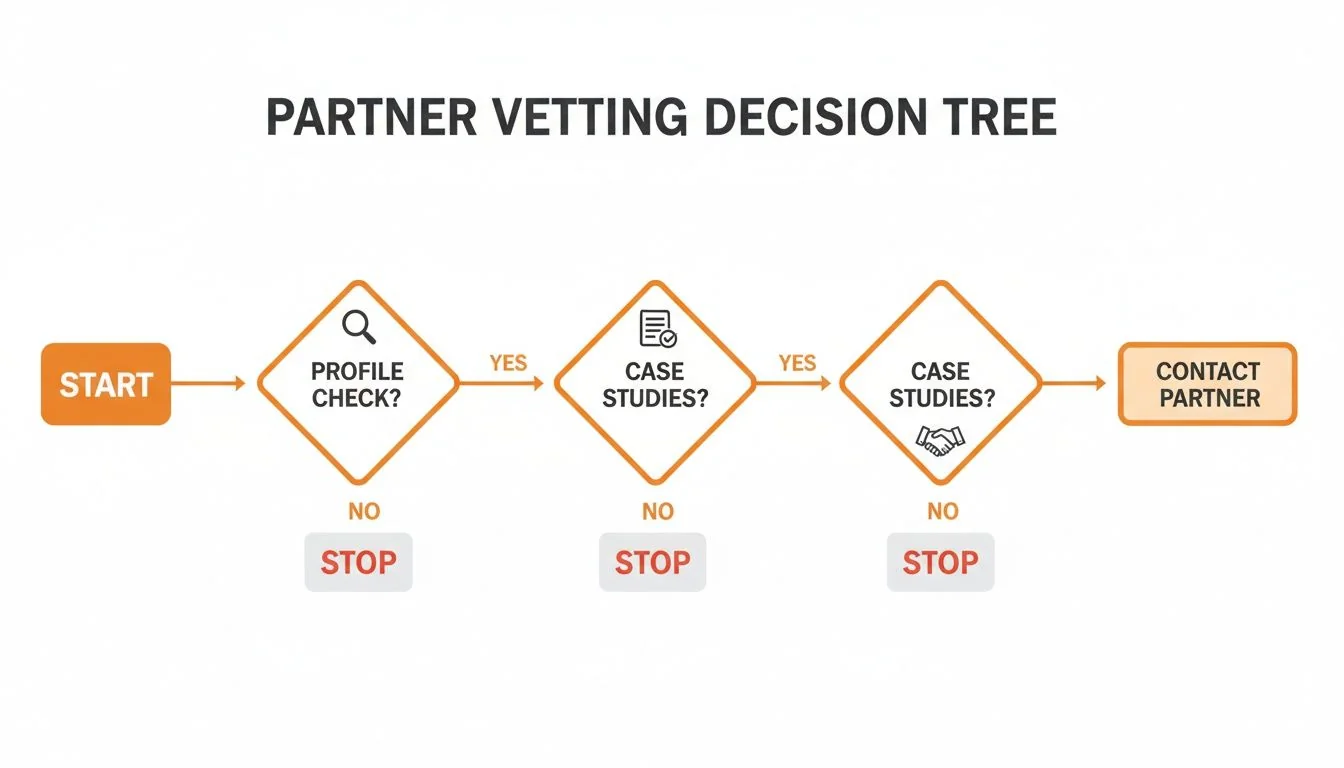
If a partner fails to clear basic hurdles like having a professional profile or relevant case studies, they should not make your final list.
Structuring an Effective RFP
Your Request for Proposal (RFP) is your most powerful tool at this stage. Avoid generic templates. A good RFP should compel potential partners to demonstrate they understand your specific business problems, not just recite their general Google Cloud expertise.
Be direct and ask for concrete details. Instead of a checkbox question like, “Do you use agile?” ask, “Describe your agile process for a project of our scale. What is your typical sprint length, how often do you hold stakeholder check-ins, and how do you handle scope creep?”
Key items for your RFP:
- Proposed Team Composition: Ask for the bios, roles, and certifications of the actual individuals who would work on your project.
- Detailed Project Timeline: Request a phased timeline with key milestones, deliverables for each stage, and dependencies.
- Post-Migration Support Plan: Get specifics on their support model, including SLAs, ticketing processes, and ongoing managed services costs.
Key Questions for Partner Interviews
Once you receive RFP responses, conduct interviews. This is your opportunity to assess cultural fit and probe their technical depth. The goal is to understand how they think and work.
Focus questions on a few critical areas:
- Problem-Solving Approach: Present a realistic, hypothetical challenge. For example: “We anticipate data integration issues between our legacy CRM and BigQuery. How would you de-risk that part of the migration?”
- Conflict Resolution: Assess how they handle disagreements. “Describe a project where you and the client had a major disagreement on the technical approach. How did you resolve it?”
- Knowledge Transfer: Ensure they won’t be a black box. “What is your plan to ensure our team can confidently manage the new environment independently after your engagement ends?”
These questions reveal more about their real-world experience and communication skills than asking them to list their certifications. You can see how firms compare by reviewing guides on the best cloud migration companies and their differentiators.
The Power of a Paid Proof-of-Concept
Before signing a large contract, invest in a small, paid proof-of-concept (PoC) or discovery workshop. This is the ultimate test drive, allowing you to see their team in action on a low-risk piece of your actual project.
A paid PoC is the most effective way to mitigate risk. It shifts the evaluation from theoretical discussions to tangible collaboration, providing a real-world preview of the partner’s technical skill, communication style, and cultural fit.
While it is an upfront cost, this step can prevent you from getting locked into a six- or seven-figure contract with the wrong partner. It is an investment in certainty. After a two-week PoC, you will know definitively if you have found the right long-term partner for your Google Cloud initiatives.
Got Questions About GCP Partners? We’ve Got Answers.
As you finalize your shortlist of Google Cloud partners, several practical questions often arise. This section addresses common queries about cost, credentials, and the directory itself.
What Kind of Budget Should I Expect to Set Aside?
The cost of a Google Cloud partner depends entirely on the project’s size and complexity.
For smaller, well-defined projects—like a single database migration or a specific analytics pipeline—boutique specialists often deliver excellent work for under $200,000.
For more involved initiatives, such as a broad application modernization, engagements with mid-sized consulting firms typically range from $200,000 to $750,000. For large-scale, multi-year digital transformations, projects with enterprise-level consultancies start in the multi-million dollar range.
Also, factor in ongoing managed services, which can add 10-15% of your monthly cloud bill to the total cost.
What’s the Real Difference Between a “Specialization” and an “Expertise”?
This distinction indicates a partner’s technical depth. Think of it as the difference between proven mastery and high capability.
A Specialization is the highest technical designation Google Cloud awards. To earn one, a partner must pass a rigorous third-party audit of their technical practices, demonstrate a deep bench of certified professionals, and provide multiple verifiable customer success stories in a specific area, like “Cloud Migration.” It is a heavily vetted, audited credential that proves mastery.
An Expertise is a valuable but less stringent designation. It means a partner has demonstrated success and met specific requirements for a certain product (like BigQuery) or industry (like Retail).
Bottom line: An Expertise shows experience. A Specialization represents a deeper, externally validated capability. If your project’s success depends on a specific technology, prioritize partners who hold that Specialization.
How Can I Find Partners Who Understand Compliance Like HIPAA or GDPR?
The directory does not have a simple checkbox for “HIPAA” or “GDPR,” so you must use industry filters as a proxy.
-
For HIPAA needs, filter for partners with a “Healthcare and Life Sciences” focus. These firms are experienced with protected health information (PHI) regulations.
-
For GDPR compliance, look for partners with a strong European presence and experience in “Public Sector” or “Financial Services,” as they will be familiar with data sovereignty and privacy laws.
Once you have a shortlist, make compliance a central topic in your RFP and interviews. Ask for concrete examples and references from clients in other regulated industries.
How Up-to-Date Is the Partner Directory, Anyway?
The Google Cloud Partner Directory is a dynamic platform, not a static list. It is updated continuously as partners earn new credentials and meet Google’s program requirements.
Partner statuses, certifications, and Specializations are refreshed based on Google’s review cycles, so the information is generally current. However, it is always a good practice to verify a partner’s most important credentials directly during your conversations to ensure you have the latest information.
Finding the right partner is the single most important factor in your cloud project’s success. At CloudConsultingFirms.com, we provide independent, data-driven comparisons to help you make that decision with total confidence. Check out our 2025 guide to filter top firms by platform, budget, and industry expertise. Start your partner search on CloudConsultingFirms.com.
Frequently Asked Questions
What is the gateway to vetted expertise?
The directory is the primary source for major industry analysis. For a company to be considered for a report like the ISG Provider Lens™ 2025 Google Cloud Partner Ecosystem, it must be listed in the Google Cloud Partner Directory.
What is a tool for strategic alignment?
The directory is a strategic matching tool built to align your business goals with a partner capable of delivering on them. It allows you to move past generic web searches and focus on experts with a proven history in your industry and with the specific technologies you need.
What is start with foundational filters?
First, lock in your non-negotiables. The two most common starting points are geography and partner tier.
What is refine your search with expertise and product filters?
After setting foundational filters, get more granular to match a partner’s skills to your project's technical demands. The directory provides two filters for this: Expertise and Product.
What is a practical example?
Imagine you are the VP of Engineering at a mid-sized e-commerce company in the U.S. You need to build a new analytics platform to track customer behavior.
Peter Korpak
Founder
Data-driven market researcher with 15+ years helping software agencies and IT organizations make evidence-based decisions. Former market research analyst at Aviva Investors and Credit Suisse. Analyzed 200+ verified cloud projects (migrations, implementations, optimizations) to build Cloud Intel.
Connect on LinkedInContinue Reading
Google Cloud
Top Google Cloud consulting firms and rankings
BigQuery vs Snowflake vs Redshift: Which Wins for Mid-Market in 2026
BigQuery vs Snowflake vs Redshift, modeled at 10TB/100TB/1PB with 3-year TCO and exit egress. Independent Cloud Intel analysis →
Anthos vs GKE: When Each Wins (and When You're Overpaying)
Anthos was dissolved as a GKE tier in Sept 2025. Here's what you actually pay for in 2026 and the 3 configs where teams overpay. Independent Cloud Intel →
Stay ahead of cloud consulting
Quarterly rankings, pricing benchmarks, and new research — delivered to your inbox.
No spam. Unsubscribe anytime.