Top IT Services Companies for Cloud & Infrastructure in 2026
The cloud services market is saturated with generic promises. This guide bypasses marketing fluff to provide a technical framework for selecting the right partner. In 2026, the stakes are higher; it’s about optimizing multi-cloud estates, embedding generative AI, and achieving verifiable TCO reduction, not just migrating servers. We’ll analyze leading it services companies through an engineering lens, focusing on certifications, proven outcomes, typical engagement costs, and critical red flags.
This listicle is built for technical leaders who demand actionable data, not a directory of names. You will find direct links and screenshots for each firm, allowing for immediate, independent verification. We examine how to differentiate between large-scale enterprise transformers and specialized cloud-native boutiques, ensuring you can match a firm’s core competencies to your specific project needs.
Whether your objective is a complex multi-region transformation, a FinOps overhaul, or securing regulated workloads, the analysis here provides the clarity needed for a sound decision. We move directly into a structured comparison of top firms, organized by:
- Platform Specialization: AWS, Azure, Google Cloud, and multi-cloud proficiency.
- Budget Tiers: From sub-$500K projects to multi-million dollar enterprise contracts.
- Industry Strengths: Expertise in sectors like finance, healthcare, and government.
- Engagement Timelines: Typical project durations from discovery to go-live.
This resource is designed to help you quickly identify a shortlist of qualified partners and avoid costly vendor mismatches. You’ll also find practical guidance on spotting red flags and structuring an effective RFP process to secure the best-fit cloud consultant for your technical and business goals.
1. CloudConsultingFirms.com
For technology leaders selecting a cloud partner, the process often involves navigating a fragmented market of biased recommendations and opaque pricing. CloudConsultingFirms.com provides a structured, evidence-based alternative. It operates as an independent aggregation platform for CIOs, engineering leaders, and procurement teams who must quickly identify and vet qualified AWS, Azure, or Google Cloud consulting partners. The site consolidates objective data points to bring clarity to an otherwise complex decision-making process, making it a critical first step for organizations evaluating it services companies.
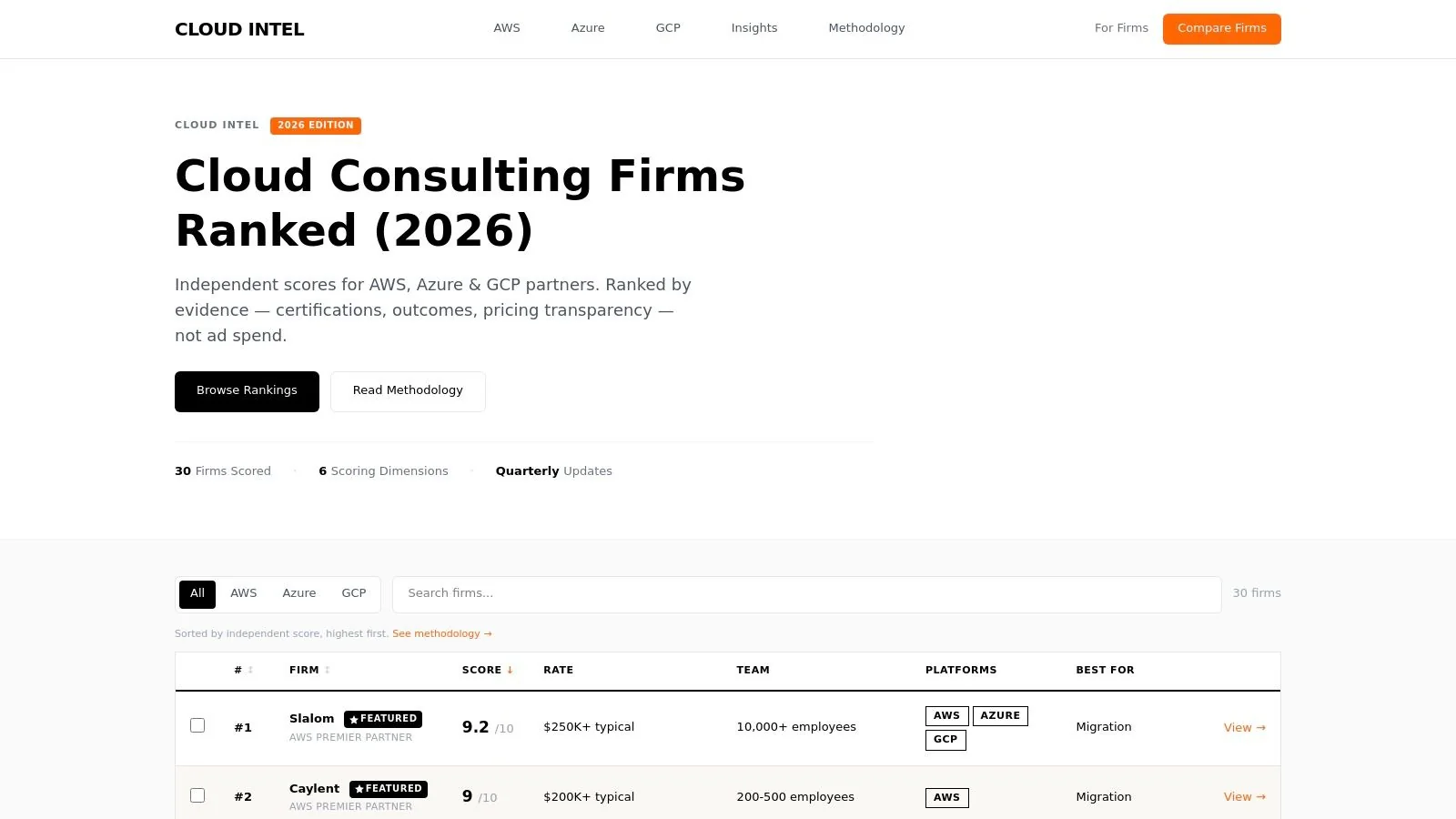
This platform’s primary strength is its rigorous, data-first methodology. Instead of relying on marketing claims, it scores 30 top-tier firms across six quantitative dimensions: certifications, documented project outcomes, pricing transparency, verified client reviews, depth of specialization, and responsiveness. With a dataset that includes over 2,400 verified reviews, this approach gives decision-makers an empirical foundation for building a shortlist of potential partners.
Key Capabilities and Use Cases
CloudConsultingFirms.com is built around practical tools that translate raw data into actionable intelligence. These features are designed to map directly to the procurement and due diligence workflow.
- Interactive Partner Quiz: This guided questionnaire narrows the field based on critical project parameters. You can input your primary cloud platform (AWS, Azure, GCP), budget range, required compliance standards (e.g., HIPAA, FedRAMP), and project timeline to generate a ranked list of suitable firms. This is effective for teams moving from ambiguous requirements to a concrete set of potential vendors.
- ROI and Cost Calculator: The platform includes a calculator that helps model the financial implications of a cloud engagement. Users can estimate potential savings from infrastructure optimization or the projected revenue lift from a successful application modernization, providing data for building an internal business case.
- Detailed Firm Profiles: Each of the 30 ranked firms has a comprehensive profile that goes beyond a simple directory listing. These profiles include typical project costs, hourly rates for different roles, team sizes, and specific industry experience. For instance, you can directly compare a boutique firm specializing in sub-$200K migrations with a global systems integrator managing multi-million-dollar transformations.
The platform is a powerful tool for risk mitigation. By explicitly flagging “red flags” and detailing the trade-offs between cost, speed, and deep expertise, it equips procurement teams to ask better questions during the RFP process. For a deeper dive into the evaluation process, you can find more guidance on their blog, which details how to choose from different IT consulting firms.
Expert Insight: The most valuable feature is the clear mapping of partner tiers (e.g., AWS Premier, Azure Expert MSP) to verified outcomes. This connection allows you to validate whether a firm’s certified status translates into real-world delivery excellence—a crucial step in de-risking a significant cloud investment.
Pros and Cons
| Strengths | Weaknesses |
|---|---|
| Data-Driven & Independent: Aggregates objective data like 2,400+ reviews and certifications with a transparent scoring methodology. | Not a Substitute for RFPs: The platform is a starting point; direct engagement is still required to confirm scope, SLAs, and cultural fit. |
| Actionable Decision Tools: The interactive quiz, filters, and ROI calculator accelerate shortlisting and clarify budget trade-offs. | Paid Placements Exist: Featured listings are paid (though clearly labeled), requiring users to cross-reference with independent scores. |
| Wide Market Coverage: Ranks 30 firms from specialized boutiques to Big Four, showing typical pricing and team structures. | |
| Current and Risk-Aware: Quarterly updates and red-flag screening help procurement teams identify potential delivery or vendor issues. |
Ultimately, CloudConsultingFirms.com serves as a high-signal, independent guide that structures the initial discovery phase of selecting a cloud partner. It enables technical and procurement leaders to move from a wide-open field of vendors to a well-researched shortlist, all backed by verifiable data.
Visit CloudConsultingFirms.com
2. Accenture — Cloud First
Accenture’s Cloud First practice operates at the intersection of enterprise-scale transformation and deep technical execution. Designed for complex, multi-cloud programs, it acts as a global systems integrator that bundles strategy, technology, and industry-specific blueprints into a single engagement. This approach is particularly effective for organizations managing regulatory burdens, global supply chains, or significant technical debt that complicates cloud adoption.
Unlike boutique firms that may focus on a single cloud or technology stack, Accenture’s core strength is its capacity to orchestrate large-scale change across AWS, Azure, and Google Cloud simultaneously. The Cloud First initiative represents a significant investment in talent and tooling, backed by over 100,000 cloud professionals and a suite of proprietary accelerators. This scale makes them one of the go-to it services companies for Fortune 500 enterprises and public sector agencies.
Core Offerings and Differentiators
Accenture’s approach is built on a foundation of standardized, yet customizable, industry playbooks. For a financial services firm, this means pre-built reference architectures for compliance with regulations like GDPR or CCPA. For a manufacturing company, it could be IoT platform frameworks that integrate directly with existing ERP systems.
A key tool in their arsenal is myNav, a platform designed to de-risk the initial planning phases. It assesses an organization’s existing application portfolio, dependencies, and business objectives to generate a data-driven cloud migration roadmap. It recommends the best cloud architecture and provider mix based on factors like cost, performance, and security requirements, moving the conversation from opinion to empirical analysis. This structured approach contrasts with smaller firms that often rely more on ad-hoc discovery.
Key Insight: Accenture’s primary value is not just technical implementation but also program management and risk mitigation for multi-year, multi-million dollar transformations. They are architected to absorb the complexity that would overwhelm smaller teams.
Platform and Team Structure
| Attribute | Details |
|---|---|
| Primary Platforms | AWS, Microsoft Azure, Google Cloud Platform |
| Team Certifications | Thousands of certified professionals across all major hyperscalers |
| Typical Engagement | 12-36 months; often multi-phased programs |
| Team Size | 20-200+ consultants per engagement |
Suitability and Red Flags
Accenture is best suited for large enterprises undertaking foundational change. Their model thrives on complexity. For instance, a global retailer looking to unify its e-commerce, supply chain, and in-store data platforms across three continents would be an ideal fit. Their established relationships with hyperscalers provide early access to new technologies. The firm’s structure also makes it a strong candidate for government and regulated industry work, including sovereign cloud programs.
However, this scale can be a drawback for smaller, more agile projects. The governance and communication overhead inherent in a large firm can slow down decision-making. A startup needing to rapidly iterate on a product-market fit would likely find the structure too rigid. Their premium pricing model is optimized for large, multi-tower contracts, making them less cost-effective for single-threaded projects or sub-$1M engagements. Understanding which type of firm aligns with your needs is critical; you can learn more about the different types of consulting firm models to see where they fit.
Website: https://www.accenture.com
3. Deloitte (US) — Strategy-Through-Run Cloud Services
Deloitte provides end-to-end cloud services, extending from high-level strategy and board-level alignment to day-to-day managed operations. Their practice is engineered for organizations where security, regulatory compliance, and risk management are primary drivers of technology decisions. With a strong focus on the U.S. public sector and regulated industries like finance and healthcare, Deloitte integrates deep cyber and compliance expertise directly into its cloud engagements.
This approach differentiates them from firms that treat security as a separate workstream. Deloitte’s strength lies in its ability to navigate complex governance and deliver secure, auditable cloud environments across AWS, Azure, and Google Cloud. Their significant investment in managed services and deep AI capabilities, especially with Google Cloud, signals a commitment to full-lifecycle support. This makes them one of the preferred it services companies for high-stakes, risk-averse programs.
Core Offerings and Differentiators
Deloitte’s methodology is built around securing the entire cloud journey. They offer purpose-built solutions like ConvergeSECURITY, a platform that integrates threat intelligence, security orchestration, and compliance monitoring into a unified service. This pre-engineered solution helps organizations establish a robust security posture much faster than building equivalent capabilities from scratch.
Their deep sector knowledge is another key differentiator. For a government agency, this translates to tangible outcomes, such as building generative AI solutions on AWS Bedrock that meet federal data handling requirements. For financial institutions, it means cloud architectures designed from the ground up to meet FFIEC or SEC regulations. Deloitte’s approach ensures that executive-level risk conversations are directly mapped to technical implementation and operational controls.
Key Insight: Deloitte’s value is its ability to de-risk complex cloud initiatives by embedding security and compliance into every phase, making them a default choice for regulated industries and government entities.
Platform and Team Structure
| Attribute | Details |
|---|---|
| Primary Platforms | AWS, Microsoft Azure, Google Cloud Platform |
| Team Certifications | Extensive certifications in security, governance, and all major cloud platforms |
| Typical Engagement | 12-36 months; often includes strategy, implementation, and managed services |
| Team Size | 25-150+ consultants per engagement |
Suitability and Red Flags
Deloitte is best suited for large enterprises and public sector organizations where the cost of a security breach or compliance failure is catastrophic. A hospital system moving patient data to the cloud or a national bank adopting a multi-cloud strategy would find Deloitte’s rigorous, security-first model a strong fit. Their executive relationships and ability to manage complex stakeholder environments are critical for programs with high visibility and significant business risk.
However, this enterprise-grade governance and premium pricing model are not ideal for all scenarios. The structured, milestone-driven approach can introduce overhead that slows down teams needing to move quickly. A startup or a mid-market company with a straightforward application migration would likely find the engagement model too cumbersome and expensive. Their enterprise contracting cycles can also extend project start times, which is a key consideration for teams working against tight deadlines.
Website: https://www.deloitte.com
4. Slalom — Collaborative Delivery and Modernization
Slalom operates as a modern consultancy focused on outcome-driven projects, embedding its teams directly with clients to co-create solutions. With a strong North American presence and deep roots in AWS, it excels at building cloud-native applications, data and AI platforms, and leading complex modernization efforts. Their model prioritizes transferring knowledge and skills to client teams, making them a strategic partner for organizations that want to build internal capabilities, not just outsource execution.
This collaborative approach distinguishes Slalom from it services companies that operate in a more siloed, black-box fashion. With over 3,300 AWS certifications and 7,500 consultants, they possess the technical depth to rival larger integrators but deliver it through a more agile and client-centric framework. This makes them particularly effective for organizations that need a partner to guide them through the technical and cultural shifts required for cloud adoption.

Core Offerings and Differentiators
Slalom’s strength lies in translating business strategy into functional technology. Their “Build as a Service” offering is a prime example, providing cross-functional teams of engineers, product managers, and designers to accelerate software delivery. This is not just staff augmentation; it is a structured methodology for building and launching new digital products or modernizing legacy systems using cloud-native principles. Their recognized leadership in public-sector AI, especially with Google Cloud, further demonstrates their ability to handle complex, data-intensive projects.
A significant differentiator is their emphasis on change management and organizational enablement. A Slalom engagement often includes dedicated resources focused on user adoption, process redesign, and upskilling internal staff. For a company migrating its analytics platform to AWS, Slalom would not only build the data lake but also train the internal BI team on new tools and establish a data governance framework. This ensures the technology delivers lasting value long after the consultants have departed.
Key Insight: Slalom’s value is in its co-delivery model. They are built for organizations that want to be active participants in their own transformation and develop sustainable, in-house cloud expertise.
Platform and Team Structure
| Attribute | Details |
|---|---|
| Primary Platforms | AWS, Google Cloud Platform, Microsoft Azure |
| Team Certifications | 3,300+ AWS certifications, strong competencies in Data & Analytics |
| Typical Engagement | 6-18 months; often project-based or focused on specific builds |
| Team Size | 5-50 consultants per engagement |
Suitability and Red Flags
Slalom is an excellent fit for mid-market and enterprise clients undertaking cloud-native application development, data platform modernization, or public-sector AI initiatives. A company looking to build a new serverless customer portal on AWS or a state agency implementing a machine learning model for fraud detection would find their model ideal. The focus on collaboration and knowledge transfer is a significant benefit for organizations committed to building long-term internal cloud fluency.
However, organizations seeking a low-cost, 24/7 global managed services provider for routine infrastructure maintenance may find Slalom less suitable. Their model is not optimized for commoditized “keep-the-lights-on” operational support, which larger, offshore-centric MSPs handle more cost-effectively. Similarly, their premium boutique rates are aligned with high-impact project work, making them a less economical choice for simple staff augmentation or smaller, isolated tasks.
Website: https://www.slalom.com
5. Kyndryl — Hybrid Infrastructure Mastery
Kyndryl, spun out from IBM’s infrastructure services division, focuses on managing the complexity of large-scale hybrid IT environments. The company operates as a pure-play infrastructure provider, addressing the real-world challenge where mission-critical systems on mainframes must coexist and integrate with modern multicloud architectures. This makes them a critical partner for established enterprises in sectors like banking, insurance, and logistics where legacy systems are non-negotiable assets.
Their core value proposition is not just cloud migration but operational coherence across disparate platforms, from on-premise data centers and IBM Z systems to AWS, Azure, and Google Cloud. As one of the largest it services companies, Kyndryl brings a structured, industrial-scale approach to managed services, designed to ensure resilience and availability for the systems that run global economies. This operational rigor is increasingly important as companies balance innovation with the stability of core business functions.
Core Offerings and Differentiators
Kyndryl’s services are centered on the end-to-end management of hybrid infrastructure, a task that many cloud-native firms are not equipped to handle. Their expertise in mainframe integration (IBM Z and IBM i) is a significant differentiator, allowing them to modernize applications and data flows without a costly or risky full-scale rewrite. This is a practical approach for organizations that cannot afford downtime on their most critical systems.
The Kyndryl Bridge platform is central to their delivery model. It acts as an open integration platform, providing a single pane of glass for observability, AIOps, and automation across an enterprise’s entire tech stack. Kyndryl Bridge gives IT leaders real-time operational insights and analytics, connecting data from legacy systems and cloud environments to predict issues and automate remediation. This contrasts with tools that only see the cloud-native portion of the estate.
Key Insight: Kyndryl’s primary strength is managing the ‘messy middle’ of enterprise IT. They excel where decades of technology investments must be integrated with modern cloud services, ensuring stability and performance for high-availability workloads.
Platform and Team Structure
| Attribute | Details |
|---|---|
| Primary Platforms | AWS, Microsoft Azure, Google Cloud, IBM Cloud, Private Cloud |
| Team Certifications | Deep expertise in legacy IBM systems alongside hyperscaler certifications |
| Typical Engagement | 24-60 months; long-term managed services contracts |
| Team Size | 50-500+ professionals for large-scale managed services |
Suitability and Red Flags
Kyndryl is an ideal partner for large, multinational corporations with complex, mission-critical hybrid IT estates. A global financial institution needing to connect its mainframe transaction processing systems to a new cloud-based analytics platform would be a perfect fit. Their demonstrated ability to modernize core infrastructure is a key strength. Their operational scale is built for organizations where five-nines availability is a business requirement.
However, the firm’s enterprise-oriented operating model can feel cumbersome for smaller, agile organizations. The methodical processes and governance required to manage critical infrastructure at scale may introduce overhead that slows down rapid-growth companies. A tech startup building a new SaaS product would find a more cloud-native, DevOps-focused partner a better match. Kyndryl’s model is priced and structured for multi-year, comprehensive outsourcing agreements, making it less suitable for project-based, short-term engagements.
Website: https://www.kyndryl.com
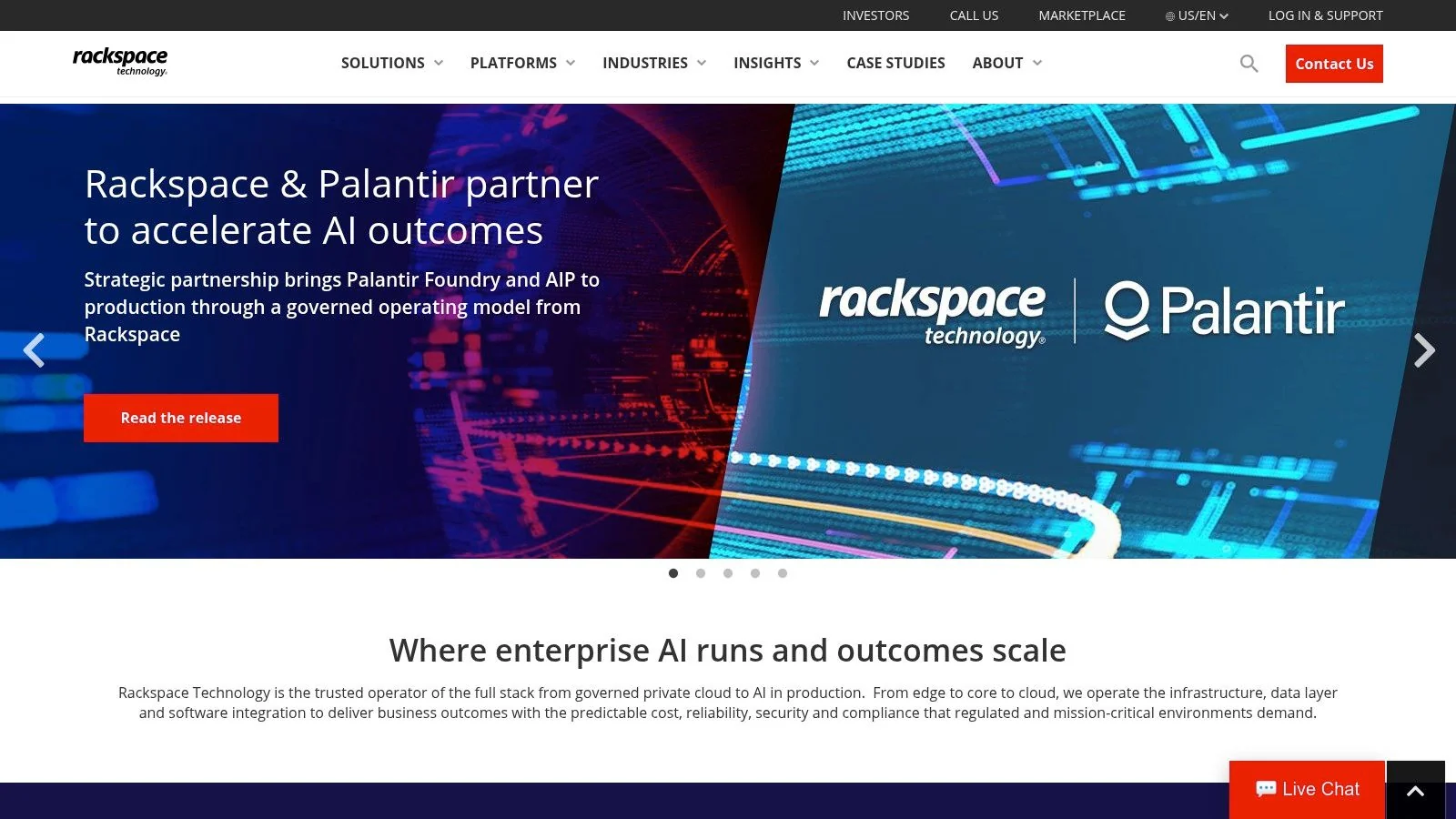
6. Rackspace Technology — Managed Multicloud Operations
Rackspace Technology occupies a distinct space in the IT services market, focusing heavily on day-2 operations and managed services. Their ‘operate-and-transform’ model is designed for organizations that need a partner to run their existing cloud infrastructure while simultaneously pursuing incremental modernization. This approach makes them a strong fit for IT teams that are resource-constrained and require a partner to handle the complexities of multicloud governance, security, and cost management.
Unlike systems integrators focused purely on large-scale migrations, Rackspace’s heritage is in managed hosting and operations. This background informs their core value proposition: taking on the operational burden of AWS, Azure, and Google Cloud, allowing internal teams to focus on application development rather than infrastructure maintenance. This makes them one of the key it services companies for organizations looking to outsource the ‘run’ state of their cloud environments.
Core Offerings and Differentiators
Rackspace’s approach is grounded in providing a unified operational layer across disparate cloud environments. Their services are built to manage the entire lifecycle, from infrastructure provisioning to security monitoring and cost optimization. This is particularly valuable for companies that have grown into a multicloud footprint without a centralized governance strategy.
A key differentiator is their emphasis on FinOps and outcome-based pricing. Instead of a purely consumption-based model, they construct engagements around achieving specific business outcomes, such as a percentage reduction in cloud spend or guaranteed uptime SLAs. Their use of AI-driven automation for tasks like patching, monitoring, and threat detection aims to reduce manual effort and improve reliability. Analyst firms like ISG have recognized their leadership in the multi-public cloud services space.
Key Insight: Rackspace’s primary value is its operational expertise. They are best suited for organizations that view cloud infrastructure as a utility to be managed efficiently, rather than a project to be built from scratch.
Platform and Team Structure
| Attribute | Details |
|---|---|
| Primary Platforms | AWS, Microsoft Azure, Google Cloud Platform |
| Team Certifications | Certified professionals across all major hyperscalers |
| Typical Engagement | 12-36 months; often managed services contracts |
| Team Size | 10-50+ engineers per engagement |
Suitability and Red Flags
Rackspace is an ideal partner for mid-market and enterprise companies that need to stabilize their cloud operations and gain control over spending. A classic use case is a company that has completed a “lift-and-shift” migration but now faces spiraling costs and a skills gap in managing the new environment. Their managed security and compliance services also make them a good fit for organizations in moderately regulated industries.
However, prospective clients should conduct thorough due diligence regarding their security posture and service level agreements (SLAs), referencing their operational track record over the last 24-36 months. Teams seeking a partner for cutting-edge, application-level innovation or complex bespoke development may find their model more operationally focused than transformative.
Website: https://www.rackspace.com
7. Presidio — AWS-Centric Managed Services
Presidio is a U.S.-headquartered systems integrator that excels in delivering managed cloud services with a strong focus on the AWS ecosystem. Their model is built for mid-market and enterprise organizations that need to offload day-to-day cloud operations, security monitoring, and cost governance to a trusted third party. By combining deep engineering talent with 24/7 support from SOC-2 certified data centers, they provide a structured framework for managing complex cloud environments.
As an AWS Premier Tier Services Partner, Presidio’s primary strength lies in its ability to execute within the AWS ecosystem. Their strategic collaboration agreements with AWS are focused on accelerating procurement and demonstrating clear cost savings through AWS Marketplace transformations. This makes them one of the key it services companies for businesses looking to maximize their AWS investment without building a large internal operations team.
Core Offerings and Differentiators
Presidio’s core value is its blend of managed services and procurement optimization. The 24/7 managed services offering provides continuous monitoring, incident response, and patching, all governed by strict security and compliance guardrails. This is not just a reactive support model; it’s a proactive operational framework designed to maintain stability and security.
A significant differentiator is their structured approach to AWS Marketplace. They guide clients through private offers and enterprise discount programs, simplifying the often-complex procurement process and generating measurable cost savings. This ability to tie technical management directly to financial governance outcomes provides a clear ROI that resonates with both IT and finance leaders. Unlike global SIs that focus on massive transformation projects, Presidio delivers tangible operational and financial wins on a more immediate timeline.
Key Insight: Presidio’s strength is its pragmatic, operations-first approach. They are ideal for organizations that have already committed to AWS and now need a reliable partner to run, secure, and optimize that environment at scale.
Platform and Team Structure
| Attribute | Details |
|---|---|
| Primary Platforms | Strongest on AWS; growing capabilities on Microsoft Azure & GCP |
| Team Certifications | Hundreds of AWS certifications and multiple Competencies |
| Typical Engagement | 12-24 months; often ongoing managed services contracts |
| Team Size | 5-50 engineers and support staff per engagement |
Suitability and Red Flags
Presidio is an excellent fit for U.S.-based mid-market companies and enterprise divisions seeking a high-touch, AWS-centric managed services provider. A healthcare provider needing to ensure HIPAA compliance for its cloud infrastructure or a retail company looking to optimize its AWS spend through Marketplace would find their model compelling. Their U.S. delivery footprint ensures quick access to engineering talent without the time-zone complications of offshore teams.
However, organizations requiring a truly balanced multi-cloud strategy may find their depth on Azure and GCP is still maturing compared to their AWS expertise. Companies with extensive global operations that require multilingual 24/7 support from in-region teams might also find their footprint narrower than that of a mega-integrator. The model is less suited for pure-play, short-term strategic consulting; their value is unlocked through long-term operational partnerships.
Website: https://www.presidio.com
Top 7 IT Services Providers Comparison
| Provider | Implementation complexity | Resource requirements | Expected outcomes | Ideal use cases | Key advantages |
|---|---|---|---|---|---|
| CloudConsultingFirms.com | None — research/shortlisting tool | Low — web access and review time | Shortlist partners, pricing bands, evidence-based procurement case | Vendor selection, RFP prep, benchmarking | Independent, data-driven rankings, verified reviews, ROI and filter tools |
| Accenture — Cloud First | High — enterprise, multi-region programs | Very high — large budget, executive sponsorship, broad vendor governance | End-to-end transformation, scalable managed services, advanced automation/AI | Global multi-tower migrations, regulated/complex enterprises, AI at scale | Massive delivery capacity, automation (myNav), strong hyperscaler partnerships |
| Deloitte (US) | High — strategy-through-run with strong governance | Very high — compliance, cyber resources, executive alignment | Secure, compliant managed services and risk-mitigated transformations | Regulated U.S. industries, government, high-risk programs | Deep compliance/cyber expertise, mature managed services, executive-level alignment |
| Slalom | Medium — collaborative, co-delivery model | Medium — specialized consultants, premium boutique rates, client involvement | Cloud-native modernization, data/AI outcomes, upskilled client teams | Modernization, data/AI initiatives, public-sector AI, teams needing co-delivery | Highly collaborative delivery, strong AWS/data expertise, change management |
| Kyndryl | High — hybrid, mission-critical integration | High — infrastructure teams, legacy/mainframe integration skills | Stable high-availability operations and hybrid modernization | Mission-critical workloads, mainframe integration, complex hybrid estates | Infrastructure modernization focus, Kyndryl Bridge for operations, hybrid expertise |
| Rackspace Technology | Medium — operate-and-transform model | Medium — managed ops, FinOps and security capabilities | Managed multicloud operations, FinOps improvements, outcome-based models | Run + incremental modernization, FinOps-driven programs, multicloud governance | Strong day‑2 operations, FinOps focus, analyst-recognized multicloud services |
| Presidio | Low–Medium — AWS-centric managed services | Medium — AWS-certified teams, 24/7 SOC, moderate budget | Cost optimization, governance improvements, secure managed operations | Mid-market and enterprise AWS projects, faster procurement cycles | AWS Premier partner, 24/7 SOC, proven AWS Marketplace transformation outcomes |
Making Your Decision: A Framework for Action
You have now reviewed a technical analysis of significant IT services companies, from global systems integrators to specialized managed service providers. This article was designed not as a definitive ranking, but as a data-driven map for a high-stakes procurement process. The right partnership can accelerate your objectives and build lasting internal capability; the wrong one introduces technical debt, budget overruns, and vendor dependency.
The core takeaway is that a partner’s brand name is insufficient evidence for a sound technical decision. Your evaluation must be rooted in your specific operational reality: your existing architecture, your team’s skill set, your budget constraints, and your precise regulatory requirements. A firm that excels at a multi-million-dollar enterprise transformation might be a poor fit for a mid-market business needing to optimize a sub-$500K cloud spend.
Synthesizing the Data for Your Shortlist
The first step is to distill this information into a practical, actionable shortlist. Move beyond surface-level comparisons and apply a multi-faceted filter to the partners we’ve discussed.
- Platform & Certification Alignment: Does the partner hold advanced specializations directly relevant to your core cloud provider (AWS, Azure, GCP) and the specific services you use (e.g., AWS Migration Competency, Azure Expert MSP)? General certifications are common; demand proof of elite-tier status in your critical areas.
- Budget & Engagement Model: Compare your project budget against the typical engagement size for each company. A firm like Slalom often thrives in the mid-market, while large-scale SIs may require seven-figure commitments to deploy their A-team. Clarify if they offer flexible models (e.g., staff augmentation, managed services) or primarily focus on fixed-scope projects.
- Regulatory & Industry DNA: If you operate in a regulated sector like finance (FINRA, PCI DSS) or healthcare (HIPAA), your first question should be about their dedicated compliance practice. Ask for evidence of previous, successful audits and sanitized examples of architectures they designed for clients with similar constraints.
The Due Diligence Framework: From RFP to Reference Call
Once you have a shortlist of two or three potential partners, the real work begins. Your goal is to penetrate the sales pitch and assess the delivery engine. A rigorous due diligence process is your best defense against a bad outcome.
-
Structure a Demanding RFP: Your Request for Proposal should be designed to solicit evidence, not promises. Mandate the inclusion of specific, non-negotiable items:
- Verifiable Metrics: Require sanitized case studies that show concrete business outcomes, such as a percentage reduction in TCO, improved deployment frequency (DORA metrics), or decreased security incident response times.
- The Actual Team: Demand résumés and certifications for the specific architects and engineers who would be assigned to your project, not just a list of the company’s overall talent pool.
- A Knowledge Transfer Plan: Ask for a detailed, week-by-week plan outlining how your internal team will be upskilled and enabled. The engagement should end with your team being more self-sufficient, not more dependent.
-
Conduct Deep Technical Reference Calls: Go beyond the list of curated references provided by the partner. Use your network to find past clients. When you do speak with references, ask the tough questions:
- “Describe a time the project went off-track. How did the partner’s team communicate the issue and what was their approach to remediation?”
- “How did the final delivered architecture differ from the initial SOW, and how was scope creep managed?”
- “What was the quality of the post-engagement support and documentation? Was the handover to your internal team smooth?”
Key Insight: The best IT services companies act as accelerators for your internal teams, not long-term replacements. Success is measured by the capabilities your team retains long after the consultants have left. Choosing a partner is fundamentally an investment in your own people.
This decision will shape your technical capabilities and financial outlook for years. It requires a disciplined, evidence-based approach that prioritizes demonstrated expertise and cultural fit over marketing polish. Use this framework to move from initial research to a confident, well-informed partnership that drives tangible business results.
Ready to build your data-driven shortlist? The interactive tools at CloudConsultingFirms.com allow you to filter and compare leading IT services companies based on your specific platform, budget, and compliance needs. Move beyond generic lists and find the right partner for your technical environment at CloudConsultingFirms.com.
Peter Korpak
Chief Analyst & Founder
Data-driven market researcher with 10+ years helping software agencies and IT organizations make evidence-based decisions. Former market research analyst at Aviva Investors and Credit Suisse. Analyzed 200+ verified cloud projects (migrations, implementations, optimizations) to build Cloud Intel.
Connect on LinkedInContinue Reading
Insights
Explore our complete insights hub
The Top 7 AWS Migration Partners for 2026: A Technical Analysis
Cut through the noise. Find the right aws migration partners with our 2026 technical roundup covering pricing, case studies, and red flags. Actionable data.
AWS vs Azure vs GCP: A Strategic Comparison
Explore our strategic comparison of AWS vs Azure vs GCP. This guide provides actionable insights for choosing the right cloud platform for your business needs.
Stay ahead of cloud consulting
Quarterly rankings, pricing benchmarks, and new research — delivered to your inbox.
No spam. Unsubscribe anytime.