How to Choose a Google Cloud Data Analytics Consulting Partner
Selecting the right Google Cloud data analytics consulting firm is a decision that dictates your project’s timeline, budget, and success. The right partner depends entirely on your project’s scale and strategic importance. Are you looking for a boutique specialist for a targeted project under $200k? A specialist firm for a complex data platform build up to $1M? Or a system integrator or Big Four firm for a massive, enterprise-wide transformation?
This guide provides a direct, evidence-based framework for engineering leaders to match a partner’s capabilities with your specific data strategy, ensuring you select a firm that delivers measurable results, not just billable hours.
How to Choose a Google Cloud Data Analytics Consulting Partner
Navigating the Google Cloud Consulting partner market means choosing between distinct tiers—from nimble boutique shops to global system integrators. This choice is critical, influencing everything from budget adherence to the business value extracted from your investment. A top-tier firm does not just execute technical tasks; it delivers the strategic guidance needed to maximize Google’s powerful data ecosystem.
Demand for these skills is accelerating. Google Cloud’s focus on AI-driven workloads is a primary driver of its growth, with our analysis projecting it will capture 13% of the global cloud infrastructure market by Q3 2026. This adoption fuels a consulting sub-segment expected to grow from $35.7 billion in 2024 to $118.5 billion by 2029. For deeper insights, read our related insight on Google Cloud Managed Services or see the latest market share analysis about the major hyperscalers.
For an engineering leader, selecting a partner is a high-stakes decision. The objective is to find a firm whose technical depth, engagement model, and cost structure align precisely with your project’s scope and strategic goals.
Initial Partner Tier Comparison
The first step is to understand the primary categories of consulting firms. Each tier is structured to serve a different client and project type, with significant trade-offs in cost, speed, and breadth of expertise. An initial assessment narrows the field before a formal evaluation begins.
The table below provides a high-level framework of the landscape, breaking down the four main partner types to show where they excel and what to expect.
GCP Data Analytics Consulting Partner Tiers at a Glance
This table summarizes the different consulting firm types, their ideal project scope, typical pricing, and core strengths to help you make an initial assessment.
| Partner Tier | Ideal Project Size | Typical Engagement Cost | Core Strength |
|---|---|---|---|
| Boutique Specialist | <$200,000 | $50k - $250k | Deep, niche expertise in one tool (e.g., Looker, BigQuery) |
| Specialist Firm | $200,000 - $1M | $200k - $900k | Balanced expertise and scale for complex data platform builds |
| System Integrator (SI) | $1M+ | $1M - $10M+ | Large-scale migration and enterprise-wide transformation |
| Big Four | $1M+ (Strategic) | $1M - $20M+ | Business strategy combined with technology implementation |
Use this as your starting point. It allows for quick sorting of potential partners based on project scale. If you have a well-defined, smaller-scope problem, a boutique or specialist firm is your best bet. For a massive, multi-year transformation affecting the entire business, you will be evaluating SIs or the Big Four.
Comparing GCP Consulting Firm Tiers for Data Analytics
Choosing the right partner for your Google Cloud data analytics project requires matching their expertise, scale, and operating model to your specific needs. You can also learn how to use the Google Cloud Partner Directory Effectively to streamline your search. The decision involves a classic trade-off between cost, speed, and deep-seated expertise.
Whether you engage a nimble boutique firm, a focused specialist, a massive system integrator (SI), or a Big Four consultancy will shape everything from the project’s cost to the post-engagement support you receive. The correct choice depends on what you aim to achieve, both technically and strategically.
This decision tree helps filter your options based on your project’s size, budget, and required specialized skills.
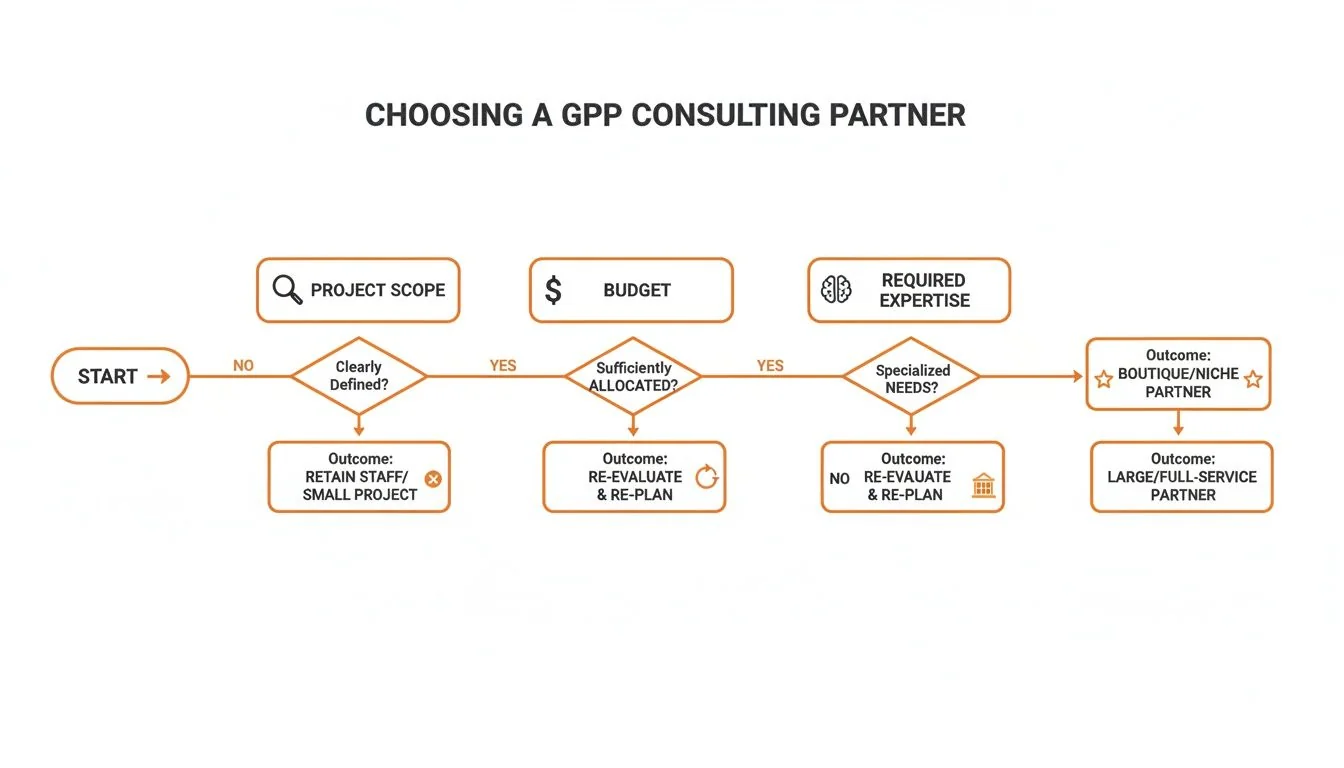
As shown, smaller, tightly scoped projects are a natural fit for boutique firms. In contrast, large-scale, enterprise-wide transformations demand the deep resources and global reach that only an SI or Big Four firm provides.
Service and Engagement Model Comparison Across GCP Consulting Tiers
To clarify these distinctions, the following table breaks down how each firm type operates across key attributes. This comparison highlights the practical differences you will encounter, from certifications and pricing to the types of projects they excel at.
| Attribute | Boutique Specialist | Specialist Firm | System Integrator (SI) | Big Four |
|---|---|---|---|---|
| Typical Project Size | < $200,000 | $200,000 - $1 million | $1M+ (often multi-million) | $500k+ (often multi-million) |
| Hourly Rate (Blended) | $150 - $225 | $200 - $300 | $250 - $350 | $300 - $400+ |
| Team Size | 2-5 experts | 5-20 engineers & architects | 50-200+ global resources | 10-50+ consultants & engineers |
| GCP Expertise | Deep niche skill (e.g., BigQuery optimization) | Broad platform expertise | Wide-ranging technical skills | Strategic & technical expertise |
| Best For… | Tactical problem-solving, PoCs | End-to-end platform builds, migrations | Large-scale enterprise transformation | Business strategy + tech execution |
| Primary Strength | Unmatched depth in one area | Balanced skill, scale, and cost | Execution power at massive scale | C-suite advisory, business alignment |
| Main Weakness | Limited scale and breadth | May lack top-tier strategy focus | Can be less agile, higher overhead | Highest cost, may be overkill |
This table shows a clear progression from hyper-focused, cost-effective experts to massive, strategy-led partners. Your project’s complexity and strategic importance will point you to the correct column.
Boutique vs. Specialist Firms
Boutique specialists are your tactical strike team. They are masters of a single craft, offering unparalleled depth in a specific GCP area, such as tuning BigQuery for maximum performance or designing effective Looker dashboards. Their rates are more accessible, typically landing in the $150-$225 per hour range. They excel on short, focused projects under $200,000 with clear deliverables. The trade-off is their small size, which limits their ability to scale for a complex, multi-faceted data platform build.
Specialist firms, in contrast, balance deep expertise with greater operational capacity. They maintain a strong bench of certified GCP Data Engineers and Cloud Architects, enabling them to take on larger projects, often in the $200,000 to $1 million range. Their broader skillset makes them an excellent choice for building a data platform from the ground up, migrating multiple data sources, or implementing foundational data governance.
Key Takeaway: Engage a boutique firm to solve a specific, isolated problem with a best-in-class tool expert. Select a specialist firm when you need a dedicated team to build or modernize a major component of your data infrastructure.
System Integrators vs. Big Four
For an enterprise-level transformation, your choice narrows to global System Integrators (SIs) and Big Four advisory firms. SIs are the undisputed masters of execution at scale. They possess the capability to deploy hundreds of engineers for multi-year, multi-million-dollar migration projects. Their core strength lies in complex technical project management and integrating GCP into an intricate web of existing enterprise systems.
The Big Four bring a different value proposition. Their approach merges technical implementation with high-level business strategy consulting. An engagement often starts in the C-suite, advising on how data and analytics can drive fundamental business outcomes, with the technology build-out as the subsequent step. This strategic layer comes at a premium, with blended rates often exceeding $400 per hour.
The explosion in AI has intensified this demand. For instance, the market for GPU-as-a-Service increased over 200% year-over-year in Q3 2026, which helped drive a 32% YoY revenue growth for Google’s partners. You can read the full research about cloud market share dynamics on Quantumrun.com to understand these trends better.
What to Expect from a GCP Data Analytics Engagement
When you engage a Google Cloud data analytics partner, you are not just buying hours. You are engaging them for a specific set of services designed to build, migrate, or improve your data capabilities on GCP. For any engineering leader, knowing what these core services entail is crucial for defining project scope and ensuring you hire a team with the right skills.
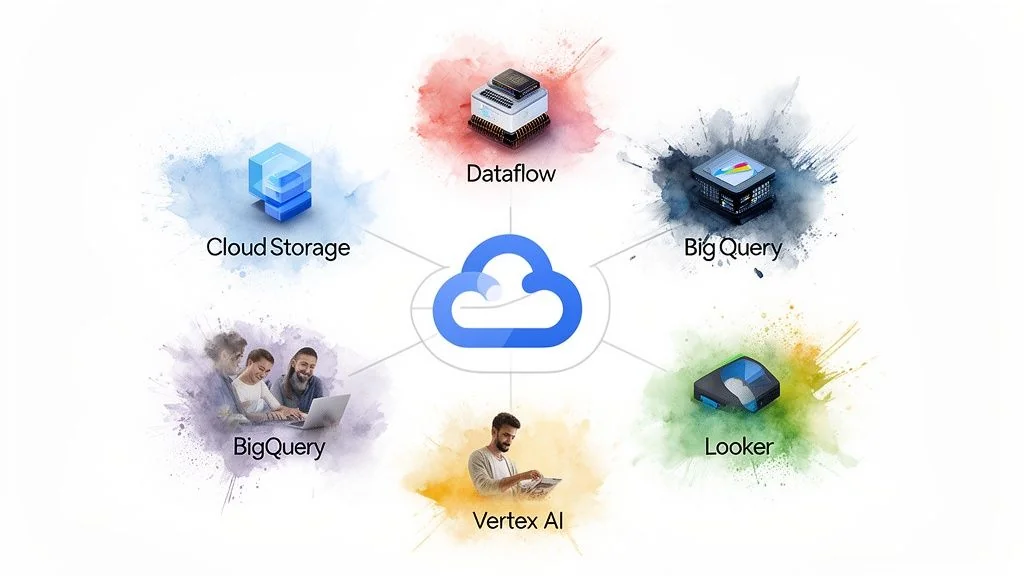
Most projects are structured around one or more of these four service areas. Each one corresponds to a different stage of data maturity, and understanding them is the first step toward writing a Statement of Work (SOW) that delivers results.
Building Your Data Platform and Infrastructure
This is the foundational layer. Here, a consulting partner architects and builds the fundamental infrastructure for your analytics. This extends beyond spinning up virtual machines; it involves designing a data ecosystem that is both scalable and cost-effective from day one.
Key activities include:
- Data Ingestion and ETL: Creating robust data pipelines with tools like Dataflow or Dataproc. The objective is to reliably pull data from all sources—APIs, databases, logs—into GCP.
- Data Lake and Warehousing: This involves setting up Google Cloud Storage (GCS) as your data lake for raw, unstructured data. From there, they structure BigQuery to serve as the powerful, centralized data warehouse for all analytics.
- Orchestration: Using Cloud Composer (Google’s managed Apache Airflow) to schedule and manage complex workflows, ensuring data is processed on time, every time, without manual intervention.
Migrating and Modernizing Your Data Stack
If you are moving off an outdated on-premise system, this is the service you need. Consultants will manage the entire process of moving data warehouses like Teradata or Netezza over to BigQuery. This is more than a simple “lift-and-shift.” A proper migration involves rethinking schemas, translating legacy queries, and optimizing everything to fully leverage BigQuery’s serverless architecture.
The biggest mistake in a migration is failing to modernize. Copying an inefficient on-premise architecture to the cloud negates most of the performance gains and cost savings. A great partner focuses on transformation, not just technical transfer.
Tapping into Advanced Analytics and Machine Learning
Once your data is organized in GCP, the engagement shifts from infrastructure to extracting business value. A partner’s deep knowledge of GCP’s advanced tools is a game-changer here.
Services in this area include:
- ML Model Development: Using Vertex AI to build, train, and deploy custom machine learning models for tasks like sales forecasting, customer feedback classification, or fraud detection.
- Business Intelligence (BI): Implementing Looker to build intuitive, interactive dashboards. The goal is to empower business teams with self-service analytics, allowing them to explore data and find answers without requiring a data scientist for every query.
Gauging a Partner’s Technical Chops and Certifications
When vetting a Google Cloud partner, certifications are quantifiable evidence of their commitment and expertise within the GCP ecosystem. A single badge is a start, but the depth and breadth of certifications across their engineering team reveal their capacity for complex data analytics projects. Sales team badges do not build data pipelines; you must see the credentials of the practitioners who will execute the work.
Google Cloud’s market position is solid, consistently holding 11-13% of the cloud infrastructure share, while the top players command 63-71%. This stability makes GCP partners an excellent choice, particularly for regulated industries. With projections showing that by 2026, half of the world’s 200 zettabytes of data will reside in the cloud, finding a capable partner is critical. For a closer look at these market trends, you can explore more insights on the global cloud market share on Tekrevol.com.
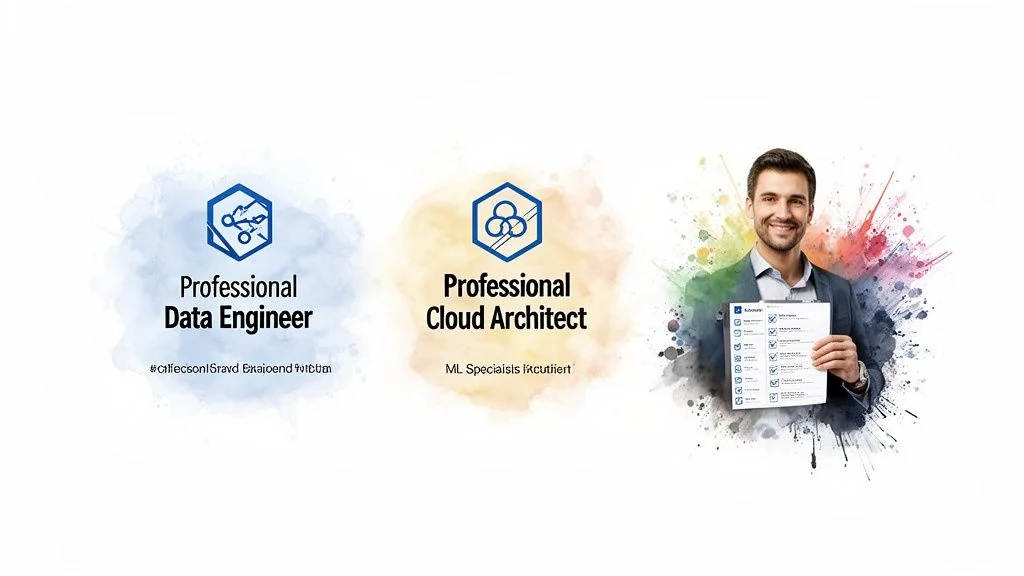
The Must-Have Certifications for Data Projects
For any serious data initiative on Google Cloud, two certifications are non-negotiable. Do not take the firm’s word for it; ask to see the certifications for the specific team members assigned to your project.
- Professional Data Engineer: This is the cornerstone. It proves an engineer can design and build data processing systems using core GCP services like Dataflow and BigQuery. It also covers the essentials of securing and monitoring those systems. Without this, they are not a data specialist.
- Professional Cloud Architect: This certification confirms a consultant can think at a higher level. They can design a cloud solution that is secure, scalable, and built according to Google’s best practices. A great data platform requires a solid architectural foundation.
Advanced Credentials That Signal True Expertise
Once you confirm the basics, look for specializations that align with your specific goals. These advanced certifications separate generalists from true experts in high-demand areas.
According to CloudConsultingFirms.com’s analysis of 2,400 cloud consulting firms, those with a high concentration of certified engineers delivered projects 15% faster and had 20% fewer post-launch issues. The data is clear—a deep bench of certified talent directly correlates with smoother, more successful projects.
For example, a top-tier partner will have individuals certified in Machine Learning and Business Intelligence. This demonstrates hands-on skill with powerful tools like Vertex AI and Looker. When you see a high density of these credentials across the delivery team, it’s a strong signal that the firm invests in its talent and has the technical depth your project demands.
A Practical Framework for Choosing Your GCP Partner
Selecting the right Google Cloud data analytics partner is a structured, evidence-based process, not a decision based on a sales pitch. This framework removes the guesswork from the decision.
The process begins with creating a detailed Request for Proposal (RFP). A strong RFP serves as the project blueprint, forcing internal alignment on objectives and providing potential partners with clear expectations. Your RFP must cover your current data architecture, the business problems to be solved, required technical outcomes, and target timeline.
First, Nail Down Your Requirements
Before writing the RFP, define what a successful outcome looks like for this project. Vagueness at this stage leads to scope creep and mismatched proposals.
Assemble your internal team and create a checklist that includes:
- Business Objectives: What specific business metric will this project impact? Define tangible goals, like “reduce customer churn by 5%” or “cut our data query costs by 30%.”
- Technical Scope: What are the non-negotiable deliverables? For example, migrating a Teradata warehouse to BigQuery, building three new dashboards in Looker, or deploying one model using Vertex AI.
- Team Composition: What specific skills are you paying for? Demand to see the credentials of the delivery team, not just the sales team.
- Timeline and Budget: What are your real-world constraints? Be direct about your timeline and budget expectations.
This level of specificity forces potential partners to respond with a concrete plan, not recycled marketing material.
Look Beyond the Price Tag When Evaluating Proposals
Choosing a partner based on the lowest bid is a common and costly mistake. The real value is in their technical strategy, the experience of their proposed team, and their track record with similar projects. Use a weighted scoring matrix to compare options objectively across the criteria that matter most to your organization.
A partner’s team certifications are a verifiable signal of their expertise. This image from Google Cloud’s official site provides an overview of the different certification paths.
For a data analytics project, you must confirm that the assigned team members hold key credentials like the Professional Data Engineer certification. Even better, look for specialized knowledge in machine learning or business intelligence. A high concentration of these advanced certifications indicates the firm invests in deep, genuine expertise. To explore a curated list of partners and their specializations, you can learn more about the GCP partner landscape in our directory.
Seeing It in Action: How Real Companies Chose Their GCP Partner
Theory is one thing; practical application is another. These anonymized examples from our data show how different companies selected the right Google Cloud data analytics partner for their specific needs.
Scenario 1: Taming a Runaway BigQuery Bill
A mid-market e-commerce company faced spiraling Google BigQuery costs as its analytics team expanded. Their tactical goal was to cut spending without sacrificing query performance, with a budget under $200k.
They chose a boutique specialist firm known for BigQuery performance tuning. The firm’s proposal was precise, targeting inefficient queries for rewrites, implementing better partitioning and clustering, and training the company’s team to avoid future pitfalls. The engagement lasted eight weeks and cost $110,000.
The ROI was immediate. In the first quarter post-project, the company cut its BigQuery bill by 45%, resulting in over $250,000 in annual savings.
Scenario 2: Building a Real-Time AI Defense
A fast-growing fintech company was battling sophisticated fraud. They needed a real-time detection platform on GCP that could stop attacks as they happened—a complex build involving live data streams and machine learning. Their budget was approximately $750,000.
This company selected a specialist firm with a strong portfolio of successful ML projects on GCP. The decision hinged on the firm’s proven ability to work with Vertex AI and build ultra-low-latency data pipelines using Dataflow.
Over a six-month engagement, the partner delivered a robust platform capable of analyzing transactions in milliseconds. The impact was significant: a 60% reduction in fraudulent transactions within six months of launch, saving millions in potential losses.
Scenario 3: A High-Stakes Enterprise Data Warehouse Migration
A major healthcare provider was undertaking a massive project: migrating its entire on-premise data warehouse to a new, HIPAA-compliant data lake on GCP. This was a multi-million dollar initiative where security, governance, and organizational change management were as critical as the technology.
They chose a global system integrator (SI). The deciding factors were scale and process. The SI could deploy a large, diverse team with deep experience in HIPAA compliance and the rigorous program management required for a multi-year migration. They offered the sheer horsepower and governance necessary to execute a complex, regulated move without disrupting business operations.
Frequently Asked Questions
As you narrow down your choice of a Google Cloud data analytics partner, several critical questions consistently arise. Here are direct, practical answers to help you finalize your selection and start the project correctly.
What Is a Realistic Budget for a Mid-Sized GCP Data Analytics Project?
For a mid-sized project, a budget between $150,000 and $500,000 is realistic. This range typically covers a 3-6 month engagement with a specialist firm for projects like migrating a departmental data mart to BigQuery or rolling out a new set of BI dashboards using Looker.
Factors that push a project toward the $500,000 mark include the number and complexity of data sources, the total data volume for migration, and the need for custom machine learning models built with tools like Vertex AI. A budget under $150,000 is better suited for a surgical engagement with a boutique firm, such as query performance tuning.
How Do I Ensure Knowledge Transfer to My In-House Team?
This is non-negotiable. Effective knowledge transfer must be written into the contract. Your Statement of Work (SOW) must explicitly define the mechanisms, such as paired programming sessions, detailed architectural diagrams, and mandatory joint code reviews.
A major red flag is any firm that hesitates to build collaboration into the project plan. If they resist having your team shadow their engineers, walk away. The project is only a true success if your team can confidently own, operate, and extend the platform long after the consultants have departed.
What Are the Biggest Risks in a GCP Data Analytics Consulting Project?
Three factors consistently jeopardize these projects: scope creep, poor data quality, and weak project governance.
You can mitigate these risks with proactive measures:
- Scope Creep: Lock down project boundaries with a tightly defined SOW that all stakeholders sign. Eliminate ambiguity.
- Poor Data Quality: Allocate a dedicated phase at the project’s start for data profiling, cleansing, and validation. Ignoring poor source data guarantees poor analytics and costly delays.
- Weak Governance: Establish a formal steering committee before kickoff. Define roles and responsibilities, secure an executive sponsor, and establish a clear decision-making process to prevent the project from stalling due to internal politics.
Ready to find a vetted Google Cloud data analytics partner that matches your budget and technical needs? CloudConsultingFirms.com provides independent, data-driven comparisons of top firms, helping you make a confident decision. Explore our 2025 guide at https://cloudconsultingfirms.com to filter partners by expertise, pricing, and project outcomes.
Frequently Asked Questions
What is initial partner tier comparison?
The first step is to understand the primary categories of consulting firms. Each tier is structured to serve a different client and project type, with significant trade-offs in cost, speed, and breadth of expertise. An initial assessment narrows the field before a formal evaluation begins.
What are GCP data analytics consulting partner tiers at a glance?
This table summarizes the different consulting firm types, their ideal project scope, typical pricing, and core strengths to help you make an initial assessment.
What are service and engagement model comparison across GCP consulting tiers?
To clarify these distinctions, the following table breaks down how each firm type operates across key attributes. This comparison highlights the practical differences you will encounter, from certifications and pricing to the types of projects they excel at.
What are boutique vs. specialist firms?
Boutique specialists are your tactical strike team. They are masters of a single craft, offering unparalleled depth in a specific GCP area, such as tuning BigQuery for maximum performance or designing effective Looker dashboards. Their rates are more accessible, typically landing in the $150-$225 per hour range. They excel on short, focused projects under $200,000 with clear deliverables.
What is system integrators vs. big four?
For an enterprise-level transformation, your choice narrows to global System Integrators (SIs) and Big Four advisory firms. SIs are the undisputed masters of execution at scale. They possess the capability to deploy hundreds of engineers for multi-year, multi-million-dollar migration projects.
Peter Korpak
Founder
Data-driven market researcher with 15+ years helping software agencies and IT organizations make evidence-based decisions. Former market research analyst at Aviva Investors and Credit Suisse. Analyzed 200+ verified cloud projects (migrations, implementations, optimizations) to build Cloud Intel.
Connect on LinkedInContinue Reading
Google Cloud
Top Google Cloud consulting firms and rankings
BigQuery vs Snowflake vs Redshift: Which Wins for Mid-Market in 2026
BigQuery vs Snowflake vs Redshift, modeled at 10TB/100TB/1PB with 3-year TCO and exit egress. Independent Cloud Intel analysis →
Anthos vs GKE: When Each Wins (and When You're Overpaying)
Anthos was dissolved as a GKE tier in Sept 2025. Here's what you actually pay for in 2026 and the 3 configs where teams overpay. Independent Cloud Intel →
Stay ahead of cloud consulting
Quarterly rankings, pricing benchmarks, and new research — delivered to your inbox.
No spam. Unsubscribe anytime.