What is Serverless Architecture? A Technical Deep Dive for 2026
Serverless architecture is a cloud execution model where the cloud provider dynamically manages the allocation and provisioning of servers. Your development teams deploy and run code as functions, without interacting with the underlying infrastructure—a capability that AWS Cloud Consulting Services can help you implement effectively.
This model abstracts away server management, including OS patching, capacity provisioning, and scaling. It’s a direct shift from managing infrastructure to consuming services, similar to moving from maintaining a local server room to using a public utility grid. You pay only for the compute time you consume, eliminating the cost of idle capacity.
The core principle is abstraction: You are no longer responsible for the server. The cloud provider manages the entire infrastructure stack, allowing your teams to focus exclusively on application code and business logic.
Deconstructing Serverless Architecture
“Serverless” is a misnomer; servers are still involved. The critical distinction is that your organization is not responsible for managing them. The physical hardware, virtual machine management, and web server software are entirely handled by the cloud provider.
Your development workflow shifts to deploying code in discrete, event-driven functions. These functions are stateless and execute in response to specific triggers, such as an HTTP request, a file upload, or a message in a queue.
This model is a significant departure from IaaS (VMs) and even CaaS (containers), where engineering teams retain responsibility for OS maintenance, runtime configuration, and scaling logic—unlike hybrid cloud architecture approaches that distribute responsibilities differently. Serverless offloads these operational burdens to the provider.
The architecture is built on two primary components:

-
Functions as a Service (FaaS): This is the compute layer. Platforms like AWS Lambda or Azure Functions execute your code in ephemeral containers that are provisioned on-demand in response to triggers.
-
Backend as a Service (BaaS): These are managed third-party services that provide common backend functionality. Examples include managed databases like Amazon DynamoDB or Fauna, and authentication services like Auth0 or AWS Cognito.
By composing applications from FaaS for custom logic and BaaS for commodity backend services, teams can build and deploy complex systems with minimal operational overhead.
Market and Operational Reality in 2026
The operational model has proven its value across startups, SMEs, and enterprises. By 2026, serverless is not a niche choice but a standard architectural option for specific workloads, and selecting the right implementation partner matters—consider reviewing AWS consulting partners to guide your adoption strategy. The global serverless market continues its strong growth trajectory from early projections like the one forecasting a USD 19.84 billion market by 2025 (market growth projections on PR Newswire). For event-driven and variable-traffic workloads, organizations report infrastructure cost reductions exceeding 70% due to the pay-per-execution billing model.
Architectural Models Compared: VM vs. Containers vs. Serverless
For technical leadership, the choice of architectural model involves clear trade-offs in operational responsibility, scaling mechanisms, and cost structure.
| Attribute | Traditional VMs (IaaS) | Containers (CaaS/PaaS) | Serverless (FaaS) |
|---|---|---|---|
| Operational Responsibility | High: Manage OS, runtime, scaling logic, security patching, and hardware. | Medium: Manage container orchestration, cluster scaling, and base images. | Low: Manage only the function code. Provider handles the rest. |
| Scaling | Manual or Complex Auto-Scaling: Requires significant configuration and pre-provisioning. | Automated but Requires Configuration: Cluster and pod auto-scaling rules must be defined. | Automatic & Event-Based: Scales per request, from zero to thousands, managed by the provider. |
| Cost Model | Pay for Provisioned Capacity: Billed for running VMs, whether utilized or not. | Pay for Reserved Resources: Billed for cluster nodes, even if underutilized. | Pay-Per-Execution: Billed only for compute time consumed, typically in milliseconds. |
This comparison highlights serverless as the highest level of abstraction, offloading the maximum operational burden to the cloud provider, which directly translates to reduced overhead and a usage-based cost model.
Key Takeaway: Serverless is an operational model that dictates an architectural pattern. It prioritizes outsourcing infrastructure management to accelerate feature delivery. This philosophy is a cornerstone of a mature what is cloud-native architecture strategy.
Serverless is not a universal solution. It excels in event-driven systems, applications with intermittent or unpredictable traffic, and stateless, short-lived tasks. For these use cases, the combination of pay-per-use billing and automatic scaling delivers unmatched operational and cost efficiency.
Understanding The Core Serverless Components
A robust serverless architecture is a composition of Functions as a Service (FaaS) for custom compute and Backend as a Service (BaaS) for managed infrastructure components. These are not mutually exclusive; effective serverless applications integrate them to minimize undifferentiated heavy lifting.
FaaS executes the unique business logic, while BaaS provides the foundational services (databases, authentication, storage) that would otherwise require significant engineering effort to build and maintain.
This composition allows engineering teams to focus their resources on developing features that deliver direct business value, resulting in systems that are more resilient, scalable, and cost-effective to operate.
Functions as a Service: The Compute Engine
Functions as a Service (FaaS) is the event-driven compute core of serverless architecture.
A FaaS function is a stateless unit of code designed to perform a single, specific task. It remains dormant, incurring no cost, until an “event” triggers its execution. This event can be an API request, a file upload to cloud storage, or a message published to a queue.
Upon triggering, the cloud provider dynamically provisions a secure execution environment, runs the function code, and then decommissions the environment.
By 2026, this pay-per-execution model is the de facto standard for event-driven computing. Billing is granular, often measured in milliseconds, making FaaS exceptionally cost-effective for workloads with variable demand.
The major cloud providers offer mature FaaS platforms that are deeply integrated into their ecosystems:
- AWS Lambda: The market pioneer and most widely adopted FaaS platform, offering extensive integrations with the AWS ecosystem.
- Azure Functions: Microsoft’s FaaS offering, valued for its flexible hosting models and native integration with services like Azure Active Directory and Cosmos DB.
- Google Cloud Functions: A core component of Google’s serverless offerings, recognized for its performance and tight integration with Google Cloud services and Firebase.
These platforms abstract away all underlying infrastructure management, requiring teams only to provide the code and configure the trigger.
Backend as a Service: The Managed Foundation
While FaaS handles custom compute, Backend as a Service (BaaS) provides pre-built, fully managed backend components accessible via APIs. Instead of building and operating database clusters, authentication systems, or file storage infrastructure, teams integrate with these provider-managed services.
This approach significantly accelerates development cycles. Engineering a secure, scalable authentication system can take months; integrating a BaaS identity provider can be done in hours.
BaaS services enable small teams to build applications with enterprise-grade features and reliability without the associated capital and operational expenditure.
Common BaaS categories include:
- Identity Management: Services like AWS Cognito, Azure AD B2C, or Auth0 manage user authentication, authorization, and user directory services.
- Managed Databases: NoSQL databases such as Fauna, Firebase Realtime Database, or Amazon DynamoDB provide scalable and resilient data persistence without server management.
- Cloud Storage: Object storage services like Amazon S3 or Google Cloud Storage offer durable, highly available, and scalable storage for unstructured data.
How FaaS and BaaS Work Together: A Practical Example
Consider a common use case: an automated image processing pipeline.
When a user uploads an image to a web application, an event-driven workflow executes without any provisioned servers.
- Trigger: The user’s image is uploaded to an Amazon S3 bucket (BaaS component). This object creation event serves as the trigger.
- Compute: The S3 event automatically invokes an AWS Lambda function (FaaS component).
- Action: The Lambda function’s code executes, resizing the source image into multiple formats (e.g., thumbnail, web-optimized).
- Storage: The function writes the newly generated images back to a different S3 bucket.
- Metadata: Finally, the function records metadata about the processed images (e.g., URLs, dimensions) into an Amazon DynamoDB table (another BaaS component).
Throughout this workflow, no servers were provisioned or managed by the development team. The system scales automatically based on upload volume and incurs zero cost when idle. This demonstrates the practical efficiency of composing FaaS and BaaS.
Proven Serverless Patterns and Use Cases
Understanding the theory of serverless architecture is one thing; applying it to solve real-world business problems is another. By 2026, a set of battle-tested architectural patterns have emerged, enabling startups, SMEs, and enterprises to build highly scalable and cost-efficient systems.
Serverless architecture excels in event-driven scenarios. An event—an API call, a file upload, a database change—triggers a function that performs a specific action. This “trigger-action” model is fundamental to building decoupled, resilient, and efficient systems.
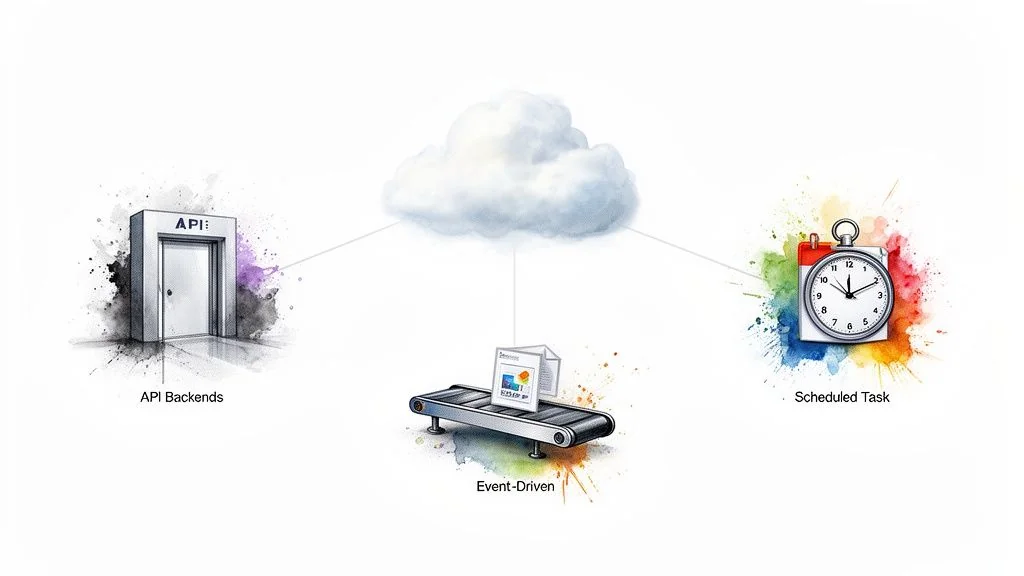
Here are three common and powerful serverless patterns being implemented today.
Scalable API Backends
This is a primary use case for serverless. The pattern replaces traditional, always-on monolithic backends with a lean, pay-per-request model that is ideal for web and mobile applications.
The implementation is direct and effective:
- An API Gateway acts as the front door, handling HTTP request routing, authentication, rate limiting, and traffic management.
- The gateway maps specific routes and methods (e.g.,
POST /users,GET /products/{id}) to individual Lambda functions. - Each function contains the business logic for its specific endpoint and interacts with BaaS components, like a DynamoDB table, for data persistence.
This pattern is highly effective for applications with variable traffic patterns, such as an e-commerce platform during a flash sale. The backend can scale from minimal load to handling tens of thousands of concurrent requests without manual intervention, and costs return to near-zero as traffic subsides.
Real-Time Event-Driven Data Processing
Serverless is exceptionally well-suited for processing data streams in real time. This pattern is widely used in ETL (Extract, Transform, Load) pipelines, IoT data ingestion, and log analysis, replacing fleets of servers that poll for new data with functions that react instantly.
Consider an IoT platform for industrial predictive maintenance:
- Thousands of sensors stream telemetry data to a message queue like Amazon Kinesis or Amazon SQS.
- Each message published to the queue automatically triggers a Lambda function.
- The function executes logic to validate, enrich, or transform the raw sensor data before forwarding the processed data to a data warehouse like Amazon Redshift or a data lake in Amazon S3.
This architecture processes data with minimal latency and maximal cost efficiency. As a case study, Smartsheet implemented a serverless architecture that resulted in an 80% reduction in latency for their data processing workflows. Decoupling components with events is a core tenet of modern system design, detailed in our guide to microservices architecture best practices.
Reliable Scheduled Tasks
Nearly every organization requires tasks that run on a fixed schedule, such as generating nightly reports, performing database maintenance, or executing data synchronization jobs. Traditionally, this required dedicated “cron servers,” which represent a single point of failure and incur costs while idle.
Serverless provides a more robust and cost-effective solution.
- A scheduling service like Amazon EventBridge Scheduler is configured to emit an event based on a cron expression (e.g., daily at 01:00 UTC).
- This event invokes a Lambda function that executes the scheduled task, such as querying a database, generating a report, and delivering it via email.
This pattern eliminates the need for a dedicated server for scheduled tasks. The job executes reliably and you only pay for the compute time used. Automotive giant Stellantis adopted this model for internal license management, demonstrating the applicability of serverless for critical operational tasks. These patterns confirm that serverless has evolved from a niche technology to a pragmatic approach for building modern applications.
Evaluating The Real-World Trade-Offs
Adopting any architecture involves a careful analysis of trade-offs. A pragmatic evaluation of serverless requires looking beyond the marketing hype to weigh its significant advantages against its inherent challenges. This is not a universal solution; it is a strategic choice with specific operational consequences.
The benefits are compelling, but the challenges are real and require proactive management. A decision to adopt serverless is a decision to exchange one set of problems (e.g., server management) for another (e.g., distributed system complexity).
The Upside: Tangible Business and Technical Benefits
The primary drivers for serverless adoption deliver measurable improvements in cost, operational efficiency, and development velocity.
-
Significant Cost Reduction: The pay-per-execution model eliminates costs for idle infrastructure. This is a fundamental shift from a CapEx-heavy model to a purely OpEx model, directly aligning cloud spend with application usage. For workloads with variable or unpredictable traffic, the savings are substantial.
-
Elastic Auto-Scaling: Serverless platforms manage scaling automatically and transparently. The system scales from zero to handle massive traffic spikes without any manual intervention, eliminating the need for complex auto-scaling configurations and capacity planning.
-
Accelerated Time-to-Market: By abstracting away infrastructure management, engineering teams can focus their resources entirely on writing business logic and shipping features. This drastically reduces the development lifecycle and increases the organization’s ability to innovate and respond to market demands.
The core value proposition is efficiency—in capital, resources, and time. Teams are freed from low-value infrastructure maintenance to focus on high-value product development.
The Downside: Critical Challenges to Address
The operational simplicity of serverless introduces new complexities that, if unmanaged, can lead to technical debt, cost overruns, and architectural brittleness. Technical leadership must plan for these challenges from day one.
The primary issues are not flaws in the model but new paradigms requiring new tools, skills, and architectural considerations.
Vendor Lock-In
This is a primary concern for enterprises. Building a serverless application involves deep integration with a cloud provider’s ecosystem (e.g., AWS Lambda integrated with API Gateway, S3, and DynamoDB). This tight coupling makes migration to another cloud provider a complex and costly undertaking.
Observability Complexities
Debugging a distributed serverless system is fundamentally different from troubleshooting a monolith. A single transaction may traverse multiple functions and managed services. Without appropriate tooling, tracing requests and identifying the root cause of failures in this distributed environment is extremely difficult. Traditional monitoring tools are often inadequate.
The Initial Learning Curve
While serverless simplifies operations long-term, it requires developers to adopt new architectural patterns, deployment frameworks (IaC), and debugging techniques. Teams accustomed to traditional server-based development will require training and time to become proficient in the event-driven, stateless paradigm.
The following matrix outlines these risks and provides proven mitigation strategies. The objective is not to avoid these challenges, but to address them with a clear, deliberate plan.
Serverless Adoption Decision Matrix: Risks and Mitigation Strategies
This matrix is a tool for leadership to proactively identify and manage the primary challenges of serverless adoption.
| Challenge Area | Potential Risk | Mitigation Strategy |
|---|---|---|
| Vendor Lock-In | High cost and engineering effort required to migrate to a different cloud provider. | Utilize Infrastructure-as-Code (IaC) tools like Terraform or the Serverless Framework to create provider-agnostic architecture definitions where possible. Encapsulate provider-specific SDK calls behind an abstraction layer (e.g., a repository pattern) in the application code. |
| Observability | Difficulty tracing requests across distributed functions, leading to increased Mean Time to Resolution (MTTR). | Adopt an “observability-first” culture. Implement distributed tracing from day one using tools designed for serverless environments, such as AWS X-Ray, Datadog, or New Relic. |
| Learning Curve | Reduced initial developer productivity and potential for suboptimal architectural designs. | Invest in targeted training. Begin with a non-critical pilot project to build practical expertise. Establish and enforce clear architectural standards and best practices for serverless development within the organization. |
A successful serverless strategy involves a conscious decision to trade a known set of problems for a new, but manageable, set of challenges.
Executing a Strategic Serverless Migration
Migrating to serverless is a phased, strategic process, not a “big bang” rewrite. A well-defined roadmap is critical for any organization—startup, SME, or enterprise—to mitigate risk, demonstrate value, and realize the promised benefits of agility and cost efficiency.
The journey begins not with a full-scale monolith decomposition, but with the selection of a strategic pilot project. This first step is crucial for building team competency and securing stakeholder buy-in through early, measurable success.
Identifying the Ideal Pilot Project
The first serverless project must be a low-risk, high-impact candidate. The goal is to gain practical experience in a controlled environment where learning from mistakes does not jeopardize core business operations.
Criteria for a strong pilot candidate include:
- Non-Critical Workloads: Choose a process that is not in the critical path of revenue generation. Internal administrative tools, report generation pipelines, or background data synchronization tasks are excellent starting points.
- Event-Driven Nature: Select a workload that is inherently event-driven. A classic example is an image resizing service that triggers upon file upload. Data processing jobs that execute in response to new database records are also ideal.
- Asynchronous Tasks: Background jobs that are loosely coupled with the main application are prime candidates. Examples include sending transactional emails, processing analytics events, or generating nightly data summaries.
Starting with a well-defined, small-scale project allows the team to build hands-on expertise with FaaS, BaaS, and the associated deployment workflows, establishing a solid foundation for more complex migrations.
Pragmatic Monolith Refactoring
With a successful pilot completed, the focus can shift to methodically decomposing existing monolithic applications. The objective is not a high-risk, all-at-once rewrite but a gradual refactoring process.
The strangler fig pattern is a proven methodology for this. New serverless services are built to incrementally replace specific pieces of the monolith’s functionality. For example, a single API endpoint might be rerouted to a new Lambda function instead of the legacy application. Over time, more functionality is “strangled” from the monolith and replaced with new services until the original application can be safely decommissioned.
This iterative approach requires patience and precision. Focus on decoupling one distinct business capability at a time. Each new serverless component must be thoroughly tested and observable before moving to the next, ensuring system stability throughout the migration.
This methodical strategy builds resilience and allows the organization to realize the benefits of serverless—such as independent deployment and scaling—incrementally.
Building Serverless-Optimized CI/CD
Serverless architecture demands a shift in CI/CD philosophy. Deploying hundreds of small, independent functions is operationally different from deploying a single monolithic application. The CI/CD pipeline must be designed for this granularity.
A mature serverless CI/CD pipeline incorporates:
- Infrastructure as Code (IaC): All cloud resources (functions, API gateways, databases, event rules) must be defined as code. Tools like AWS SAM, Terraform, or the Serverless Framework are non-negotiable for ensuring consistent, repeatable, and automated deployments.
- Automated Testing: Each function requires its own automated test suite, including unit and integration tests, which are executed on every commit.
- Granular Deployments: The pipeline must support the independent deployment of a single function or a small group of related services without affecting the rest of the system.
Security and compliance must be integrated (“shifted left”) into the pipeline. This includes automated scanning of function code and dependencies for vulnerabilities and validating IaC templates against organizational security policies before deployment.
Choosing the Right Cloud Consulting Partner
Engaging an experienced partner is often the most effective way to accelerate a serverless migration and avoid common pitfalls. Selecting the right cloud consultancy is a strategic decision that directly impacts the success of the initiative.
Evaluate potential partners on their demonstrated, hands-on expertise. The evaluation criteria should be rigorous:
- Certified Serverless Expertise: Verify advanced certifications, such as the AWS Certified Serverless Specialty. This provides objective validation of their technical depth.
- Proven Migration Experience: Request detailed case studies of complex monolith refactoring projects or large-scale, event-driven systems they have successfully delivered.
- Commitment to Knowledge Transfer: A strategic partner enables your team, they do not create dependency. Their engagement model must include mechanisms like pair programming, targeted training workshops, and comprehensive documentation to upskill your internal team.
- Post-Migration and FinOps Support: The engagement should not end at “go-live.” A valuable partner provides ongoing support for performance optimization and offers FinOps expertise to help manage and optimize serverless costs.
Market data can inform partner selection. A global serverless architecture market analysis shows significant growth and adoption across regions. This can help identify partners with specific regional strengths, from those specializing in cost optimization in the fast-growing Asia-Pacific market to those with deep expertise in the complex compliance landscapes of North America, which was projected to hold a 33.5% market share.
Your Top Serverless Questions, Answered
As technical leaders and procurement teams move beyond the high-level concepts of serverless, critical questions about cost, performance, security, and strategy emerge. This section addresses the most common and important questions from organizations seriously evaluating a serverless adoption.
How Does This Actually Affect Our Total Cost of Ownership (TCO)?
Serverless fundamentally alters the TCO model by shifting infrastructure costs from fixed Capital Expenditures (CapEx) to variable Operating Expenditures (OpEx). It eliminates direct costs associated with server hardware, data center space, and maintenance contracts. Crucially, it eliminates payment for idle compute capacity.
The cloud bill becomes a direct reflection of application usage, calculated based on the number of function invocations, execution duration (to the millisecond), and consumption of managed services. This model is extremely cost-efficient for applications with variable or unpredictable traffic.
The most significant impact on TCO is often the reallocation of engineering resources. By eliminating the undifferentiated heavy lifting of infrastructure management, engineers can focus on developing revenue-generating features, turning an IT cost center into a value driver.
However, for workloads with constant, high-volume, 24/7 traffic, a provisioned compute model may be more cost-effective. A thorough TCO analysis requires modeling specific traffic patterns to identify true savings and potential cost traps.
What’s a “Cold Start” and Is It a Critical Problem?
A cold start is the latency incurred on the first invocation of a serverless function after a period of inactivity. The cloud provider must provision a new execution environment, download the function code, and initialize the runtime before processing the request. This can add latency ranging from milliseconds to several seconds.
For latency-sensitive applications like real-time APIs, this can be a significant issue. However, by 2026, cloud providers offer mature solutions to mitigate this.
Strategies to manage cold starts include:
- Provisioned Concurrency: This feature, available on platforms like AWS Lambda, allows you to pre-allocate a specified number of “warm” function instances that are always ready to execute. This eliminates cold starts for predictable traffic but incurs a cost for keeping instances provisioned.
- Code and Dependency Optimization: Smaller function packages with fewer dependencies initialize faster. Using compiled languages like Go or Rust can also reduce initialization time compared to interpreted languages like Python.
- Warming Strategies: For less predictable workloads, a scheduled task can be configured to invoke a function periodically (e.g., every five minutes) to keep an execution environment warm. This is a common pattern but adds a nominal cost.
An experienced cloud partner can perform a workload analysis to determine the optimal strategy that balances performance requirements with cost constraints.
Can Serverless Be Used in Regulated Industries Like Finance or Healthcare?
Yes, serverless is widely used in regulated industries, but it requires a clear understanding of the shared responsibility model for security. The cloud provider is responsible for securing the underlying infrastructure (hardware, hypervisor, physical network).
Your organization is responsible for securing everything you build on that infrastructure: your application code, data, and the configuration of cloud services. The security focus shifts “up the stack” to the application layer.
Essential security practices for serverless applications include:
- Principle of Least Privilege: Each function must have a tightly scoped IAM role that grants only the permissions necessary for its specific task.
- Secure Triggers: API Gateway endpoints and other event sources must be secured with appropriate authentication and authorization mechanisms.
- Supply Chain Security: The CI/CD pipeline must include automated security scanning for vulnerabilities in your code and its third-party dependencies.
- Secrets Management: API keys, database credentials, and other secrets must never be hardcoded. Use a dedicated service like AWS Secrets Manager or Azure Key Vault for secure storage and runtime injection.
For compliance frameworks like HIPAA or PCI DSS, working with a consultant experienced in serverless security is critical to implement the necessary logging, auditing, and controls.
How Do We Avoid Getting Locked into a Single Cloud Vendor?
Vendor lock-in is a valid strategic concern. Serverless applications often leverage a suite of provider-specific services (e.g., AWS Lambda, S3, DynamoDB) that are designed for deep integration. Migrating this tightly coupled architecture to another provider is a significant engineering effort.
The goal is not to avoid using these powerful managed services—that would negate many of the benefits of serverless. The goal is to manage the dependency strategically.
Practical strategies include:
- Infrastructure-as-Code Abstraction: Frameworks like the Serverless Framework or Terraform allow you to define your infrastructure in a more cloud-agnostic configuration language. While not a “write once, run anywhere” solution, they significantly reduce the effort required to redeploy the architecture on a different cloud.
- Architectural Abstraction: Employ clean architecture principles (like hexagonal or “ports and adapters” architecture) to isolate your core business logic from the code that interacts with provider-specific SDKs. This creates a boundary so that if you need to replace DynamoDB with Azure Cosmos DB, you only need to rewrite the “adapter” code, not your entire application logic.
This is a strategic trade-off. Deep integration accelerates initial development, while architectural abstraction provides long-term flexibility. The key is to make this decision deliberately for the most critical components of your application.
Navigating the complexities of serverless adoption, from cost modeling to security planning, requires deep expertise. At CloudConsultingFirms.com, we provide data-driven comparisons of top cloud consulting partners, helping you find the right expertise to ensure your serverless strategy delivers on its promise. Discover your ideal partner by exploring our 2026 guide.
Frequently Asked Questions
What is market and operational reality in 2026?
The operational model has proven its value across startups, SMEs, and enterprises. By 2026, serverless is not a niche choice but a standard architectural option for specific workloads. The global serverless market continues its strong growth trajectory from early projections like the one forecasting a USD 19.84 billion market by 2025 (market growth projections on PR Newswire).
What are architectural models compared?
For technical leadership, the choice of architectural model involves clear trade-offs in operational responsibility, scaling mechanisms, and cost structure.
What are functions as a service?
Functions as a Service (FaaS) is the event-driven compute core of serverless architecture.
What is backend as a service?
While FaaS handles custom compute, Backend as a Service (BaaS) provides pre-built, fully managed backend components accessible via APIs. Instead of building and operating database clusters, authentication systems, or file storage infrastructure, teams integrate with these provider-managed services.
How FaaS and BaaS work together?
Consider a common use case: an automated image processing pipeline.
Peter Korpak
Founder
Data-driven market researcher with 15+ years helping software agencies and IT organizations make evidence-based decisions. Former market research analyst at Aviva Investors and Credit Suisse. Built the 50 cloud consulting firm profiles published on cloudconsultingfirms.com from publicly available evidence.
Connect on LinkedInContinue Reading
View all insights →AWS
Browse public AWS consulting firm profiles and buyer guidance
10 AWS Migration Best Practices for 2026: A Practical Execution Guide
Use these AWS migration best practices to choose 7 Rs, build a governed landing zone, validate DMS cutovers, control cost, and run post-migration operations.
10 Cloud Cost Optimization Strategies for AWS, Azure, and GCP (2026)
Use 10 cloud cost optimization strategies for AWS, Azure, and GCP in 2026—covering visibility, rightsizing, commitments, egress, Kubernetes, and FinOps.
Stay ahead of cloud consulting
Quarterly directory updates, pricing benchmarks, and new research — delivered to your inbox.
No spam. Unsubscribe anytime.