A Technical Guide to Azure Managed Services Pricing in 2026
When evaluating proposals for Azure managed services, pricing structures converge on two primary mechanisms: a percentage of your total Azure consumption—typically between 5% and 15%—or a fixed monthly fee per resource. The final cost is a function of the model: fixed-fee for predictability, consumption-based for elasticity, or a hybrid approach that balances both. This guide deconstructs these models to provide actionable, technical insights for startups, SMEs, and enterprises.
Understanding Core Azure Managed Services Pricing Models
Azure managed services pricing, while varied, is built on three foundational models. Understanding the mechanics of each is the first step in assessing whether a provider’s proposal aligns with your technical and financial requirements. Misalignment here leads to budget overruns and operational friction.
The decision is analogous to selecting an infrastructure provisioning strategy: you can reserve capacity for predictable workloads, pay on-demand for variable needs, or blend the two. The choice directly impacts financial efficiency and operational agility.
The Fixed-Fee Model: Predictable and Stable
The fixed-fee model offers a deterministic, recurring monthly cost for a predefined scope of services. This model is optimal for organizations with mature, stable Azure environments where the resource count and architecture exhibit minimal month-over-month variance.
This approach simplifies budgeting, providing absolute cost certainty for finance and operations teams. The primary trade-off is inflexibility. A significant reduction in Azure consumption does not lower the management fee. Conversely, an expansion of scope or the introduction of new services necessitates contract renegotiation.
Key Takeaway: The fixed-fee model is engineered for cost predictability. It is best suited for established organizations requiring comprehensive support for a well-defined cloud footprint without financial volatility.
The Consumption-Based Model: Flexible and Scalable
The consumption-based or “pay-as-you-go” model directly ties your managed services bill to your Azure usage. The cost is calculated either as a percentage of your monthly Azure spend or on a per-resource basis (e.g., a set price per VM, per managed database, or per terabyte of storage).
This model provides maximum elasticity, making it ideal for startups, high-growth companies, or any business with highly variable or seasonal workloads. As your Azure footprint scales, your managed services bill adjusts accordingly, ensuring you only pay for the management overhead you actively consume. The inherent risk is budget unpredictability. A usage spike, whether planned or accidental, will directly increase your MSP invoice, complicating long-term financial forecasting. For a deeper dive into how providers manage these dynamic environments, see our related insight on Azure Cloud Managed Services.
The Hybrid Model: Balanced and Adaptable
The hybrid model combines the stability of a fixed fee with the elasticity of consumption-based pricing, offering a balanced approach.
A typical hybrid structure involves a base fixed fee covering core, non-negotiable services: 24/7 infrastructure monitoring, security patching, backup verification, and helpdesk access. Variable costs are then layered on top for consumption-driven or project-based work, such as advanced security incident response, on-demand architectural consulting, or managing ephemeral development environments.
This model provides budget stability for core operations while retaining the agility to scale support in response to business dynamics. It has become the de facto standard for companies requiring a pragmatic balance of financial predictability and operational flexibility.
Decoding How MSPs Structure Their Engagement Tiers
After grasping the core pricing models, the next step is to understand how providers package their services. Azure MSPs bundle their expertise into distinct engagement tiers, each designed for a specific level of organizational maturity and technical complexity.
Miscalculating the required tier leads to two negative outcomes: over-provisioning services you don’t need, or under-provisioning support, leaving critical systems exposed. Understanding these tiers provides a framework for evaluating whether a quote is commensurate with the value delivered.
These tiers are almost always underpinned by one of the three foundational pricing models.
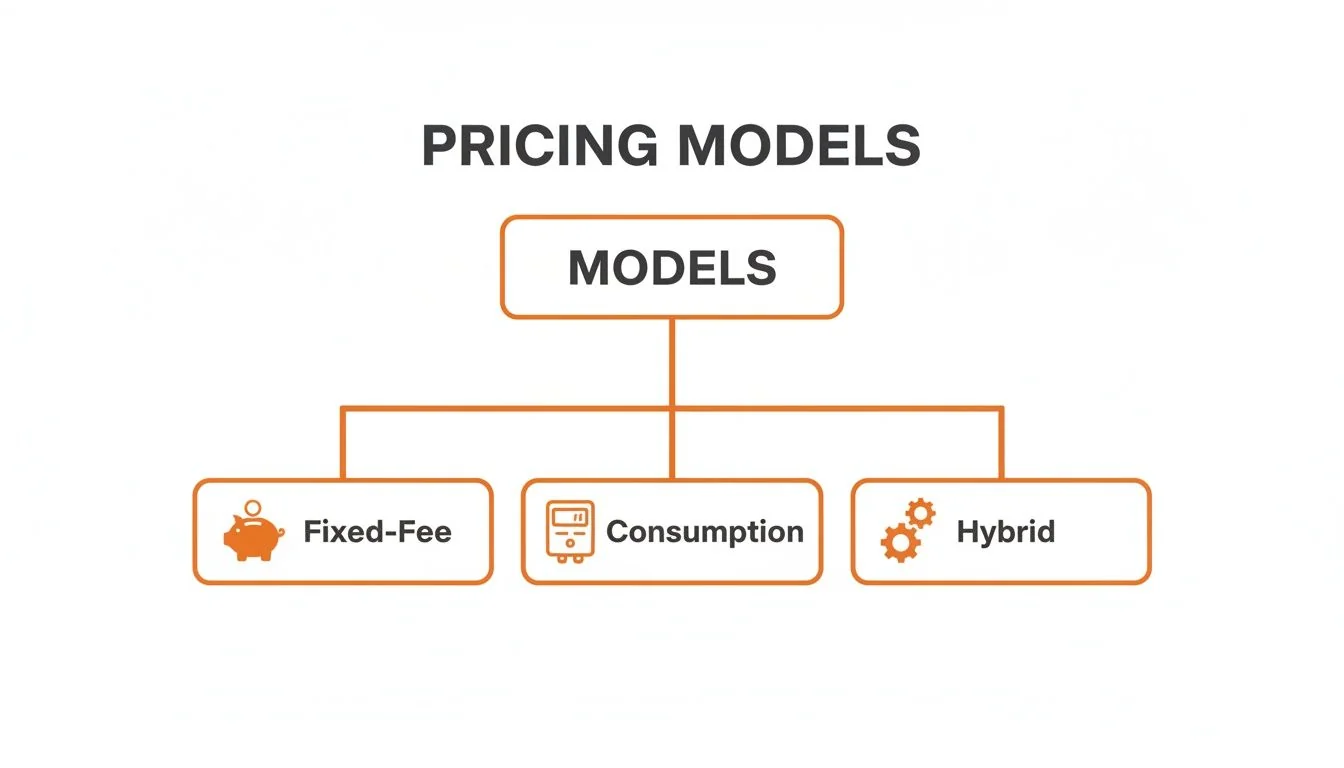
Providers typically map a Fixed-Fee, Consumption-based, or Hybrid model to these service levels, aligning the cost structure with the client’s operational needs and technical maturity.
The following table deconstructs the common service tiers, scope, and target profiles you will encounter when analyzing MSP proposals.
Typical Azure MSP Engagement Tiers and Included Services
| Engagement Tier (Annual Contract Value) | Typical Services Included | Ideal For (Company Profile & Needs) | Pricing Model Commonality |
|---|---|---|---|
| Startup & SMB (<$50,000) | • Essential health monitoring & alerting • Automated OS patching • Backup management & verification • Business-hours helpdesk support | Startups and SMBs without a dedicated cloud ops team that need to offload foundational maintenance tasks for stability and security. | Predominantly Fixed-Fee for budget predictability. |
| Mid-Market ($50,000 - $250,000) | • Everything in Startup tier • 24/7/365 monitoring & incident response • Proactive cost optimization reviews • Advanced security monitoring (e.g., Microsoft Sentinel) | Growth-stage companies with business-critical applications requiring high availability and a focus on operational efficiency and security. | Often a Hybrid model—a fixed fee for core services plus consumption-based billing for incident response or project work. |
| Enterprise (>$250,000) | • Everything in Mid-Market tier • Dedicated Technical Account Manager (TAM) • Compliance management (HIPAA, PCI) • Strategic architecture & design guidance • Advanced FinOps | Large organizations needing a strategic partner for complex, regulated environments, focusing on governance, architecture, and business alignment. | Typically Hybrid or Blended-Rate models that reflect a deep, ongoing partnership with both operational and strategic components. |
The value proposition evolves from foundational infrastructure management to a strategic partnership as you ascend the tiers.
Startup and Small Business Tiers
For startups and SMBs, the primary objective is foundational stability. Engagements in the sub-$50,000 per year range focus on ensuring the core Azure environment is secure, patched, and resilient.
At this level, you are outsourcing essential but time-consuming operational tasks. The service scope typically includes:
- Essential Monitoring: Health checks and alerts for key resources (VMs, App Services, SQL Databases).
- Automated Patch Management: Systematic application of security updates to operating systems and core software.
- Backup and Recovery: Management of Azure Backup policies and regular restoration tests.
- Standard Business-Hours Support: Access to a helpdesk for technical support during standard business hours.
This tier is ideal for companies without a dedicated cloud operations engineer. Pricing is typically a fixed fee, providing cost predictability for lean budgets.
Mid-Market and Growth-Stage Tiers
As an organization scales, so does its Azure complexity. Mid-market agreements, ranging from $50,000 to $250,000 annually, shift from reactive maintenance to proactive optimization and resilience.
The operational focus shifts from “Is the service running?” to “Is the service running efficiently, securely, and cost-effectively 24/7?” The MSP functions as an extension of your technical team, focused on continuous improvement.
This tier includes all basic services, plus advanced capabilities:
- 24/7/365 Support: Around-the-clock monitoring and incident response for revenue-generating applications.
- Proactive Cost Optimization: Regular analysis to right-size resources, eliminate waste, and optimize reservation coverage.
- Advanced Security Monitoring: Threat detection and response using tools like Microsoft Sentinel for deeper visibility.
- Performance Tuning: Identification and resolution of infrastructure bottlenecks to improve application latency and throughput.
Enterprise and Strategic Partnership Tiers
For large enterprises, an Azure managed service is a strategic partnership. Contracts frequently exceed $250,000 per year, with the MSP operating as a high-level extension of the internal IT organization, focused on architecture, governance, and compliance.
These engagements are oriented around business outcomes, not tickets. They encompass all previous services, plus specialized expertise:
- Dedicated Resources: A named Technical Account Manager (TAM) or a pod of engineers with deep institutional knowledge of your environment.
- Compliance Management: Expertise in architecting and operating environments subject to regulations like HIPAA, PCI-DSS, or data sovereignty laws.
- Architecture and Design: Strategic guidance on cloud-native design patterns, DevOps automation, and platform engineering.
- FinOps Governance: Implementation of sophisticated financial operations to provide granular cost visibility and accountability to business units.
The Key Drivers That Influence Your Final Quote
Discrepancies between MSP quotes for what appears to be the same scope of work are not arbitrary. The final price is a function of specific variables that dictate the provider’s cost to deliver and the level of risk they must assume.
The analysis must go beyond surface-level metrics like VM counts or storage terabytes. The true cost drivers are embedded in operational complexity, architectural design, and contractual risk. Understanding these factors is critical for a valid apples-to-apples comparison.
Service Level Agreements and Operational Guarantees
The single most significant factor impacting Azure managed services pricing is the Service Level Agreement (SLA). An SLA is a binding contract defining uptime guarantees, response times, and resolution targets, with specified financial penalties for non-compliance.
Consider the engineering and operational overhead required to support different availability targets:
- 99.9% Uptime: This standard allows for approximately 43 minutes of downtime per month. A competent MSP can achieve this with robust monitoring, well-defined alerting, and a standard on-call rotation.
- 99.99% Uptime: This target reduces permissible downtime to just over 4 minutes per month. Achieving this requires a fundamentally different architecture and operational posture: automated failover, proactive self-healing systems, and a larger, more experienced 24/7 engineering team.
The transition from “three nines” to “four nines” is not linear. It represents a substantial investment in automation, process maturity, and personnel, which is directly reflected in the premium pricing.
Architectural and Environmental Complexity
The architecture of your applications and infrastructure is a primary cost driver. A monolithic application on a few VMs is orders of magnitude simpler—and cheaper—to manage than a distributed microservices architecture spanning dozens of interdependent Azure services.
A provider’s quote is fundamentally a risk assessment of the engineering hours your environment will consume. The more complex the system—with intricate dependencies, legacy components, or high-velocity CI/CD pipelines—the higher the perceived operational risk and, consequently, the price.
This complexity extends to the infrastructure footprint. An environment spanning multiple Azure regions introduces challenges related to latency, data sovereignty, and network topology. When managing cloud infrastructure across regions, providers must account for regional pricing variations—a VM costing $0.096 per hour in US East might be $0.105 per hour in West Europe. This 9.4% premium is a factor a global MSP must incorporate into its management overhead.
Compliance and Regulatory Mandates
For regulated industries, managing an environment subject to standards like HIPAA, PCI-DSS, or GDPR is a non-negotiable and costly requirement. This necessitates a specialized skill set.
An MSP managing a regulated workload must provide:
- Auditable Controls: The implementation and verifiable maintenance of specific security controls, immutable logging, and strict access policies mandated by the regulations.
- Specialized Tooling: Deployment and management of tools for continuous vulnerability scanning, intrusion detection, and data loss prevention (DLP).
- Expert Personnel: Engineers with deep, demonstrable expertise in the technical implementation of regulatory controls who can successfully navigate an audit.
This specialization adds a significant layer of operational cost and risk, which is factored into the managed services fee. A quote for a regulated workload that seems anomalously low may indicate a provider that underestimates the requirements, exposing your organization to significant compliance risk.
Provider Maturity and Support Model
Finally, the MSP’s operational maturity and business model directly influence pricing. A mature provider with heavy investment in automation and a sophisticated FinOps practice can operate more efficiently, potentially passing those savings to clients.
Conversely, their support model is a critical cost component. An MSP with a 24/7, onshore team of certified senior engineers will have a higher cost structure than a provider utilizing offshore resources or a tiered support model that escalates issues through junior technicians. You are not just purchasing a service; you are investing in the quality, experience, and responsiveness of the engineering team responsible for your critical infrastructure.
Calculating the True TCO of a Managed Service
Evaluating MSP proposals solely on their monthly fee is a common but critical error. The lowest quote rarely represents the best value. A thorough analysis requires calculating the Total Cost of Ownership (TCO), which accounts for the direct monthly fee plus the indirect and avoided costs of self-management.
A commodity-priced service often leads to poor outcomes. A true MSP partner does more than maintain infrastructure; they actively reduce your cloud spend and mitigate operational risk. The fee should be viewed as an investment with a demonstrable return.

Normalizing Quotes with a Feature Matrix
The first step in a TCO analysis is to normalize disparate proposals. MSPs structure quotes, SLAs, and service inclusions differently, making direct comparison difficult. A feature matrix is a simple but effective tool for creating an apples-to-apples view.
List your non-negotiable requirements in the first column and each vendor across the top. Methodically populate the matrix by dissecting each proposal.
Include specific, quantifiable metrics:
- SLA Uptime Guarantee: Is it 99.9% or 99.99%? What are the specific financial penalties (service credits) for an SLA breach?
- Incident Response Times: What is the guaranteed response time for a P1 (critical) incident? 15 minutes? 60 minutes? Is this an acknowledgement or time-to-engage-engineer?
- Scope of Service: Are cost optimization reports, security audits, and architectural reviews included in the base fee or are they billable add-ons?
- Support Model: Is support 24/7/365 with direct access to senior engineers, or is it business hours with a tiered, offshore model?
This exercise provides immediate clarity, exposing where a low-cost provider may be compromising on service quality and helping to quantify the value of a more comprehensive, premium offering.
Quantifying the ‘Soft Costs’ of Going It Alone
The most significant component of a TCO calculation is quantifying the costs avoided by partnering with an MSP. These are the “soft costs” that don’t appear on an invoice but consume internal resources and impede business velocity.
The primary value of an MSP is not just managing cloud resources; it’s reclaiming your engineering team’s focus. Offloading operational toil frees your most valuable engineers to work on product innovation and revenue-generating initiatives.
To quantify this, perform an honest internal assessment:
- Internal Engineering Hours: Calculate the weekly hours your team spends on routine maintenance, patching, incident response, and cost management. Multiply this by their fully-loaded hourly rate to determine the true cost of self-management.
- Financial Impact of Downtime: Calculate the cost of one hour of downtime for your mission-critical applications in terms of lost revenue, SLA penalties, and reputational damage. A premium MSP with a 99.99% uptime SLA functions as an insurance policy against this loss.
- Opportunity Cost: Quantify the value of features or products your team could have shipped if they were not consumed by operational tasks. This represents the hidden cost of delayed innovation.
Maximizing Native Azure Savings
A competent MSP functions as your FinOps partner, ensuring you maximize savings from Azure’s native pricing constructs. The migration to Azure itself offers significant TCO benefits; studies show organizations can reduce infrastructure costs by an average of 49% over seven years compared to on-premises. A skilled MSP is essential to realize and exceed these projections. You can learn more about Azure’s TCO advantages on turbo360.com.
Your provider should be proactively managing Azure Reserved Instances and Savings Plans, passing the discounts directly to you. They must also implement continuous resource rightsizing and automated shutdown policies for non-production environments. A proper TCO analysis reveals that you are not just buying a service; you are investing in a partnership designed to optimize spending and accelerate business outcomes.
Actionable Negotiation Tactics to Optimize Your Spend

After completing the TCO analysis, the negotiation phase begins. This is the opportunity to transform a standard vendor proposal into a strategic partnership engineered for cost efficiency.
The objective extends beyond haggling the monthly fee. It’s about embedding cost optimization mechanisms directly into the contract. A mature MSP will welcome this, as it aligns their success with yours. By focusing on specific, measurable outcomes, you can craft an agreement that structurally lowers your Azure managed services pricing over time.
Mandate Pass-Through Savings from Azure Commitments
This is non-negotiable. The MSP must function as your agent in maximizing discounts from Azure’s commitment-based programs, primarily Reserved Instances (RIs) and Azure Savings Plans.
For predictable production workloads, RIs can reduce compute costs by up to 72% with a three-year commitment. Savings Plans offer greater flexibility, providing discounts across different instance families and regions. A competent MSP must actively manage a portfolio of these commitments on your behalf.
Your contract must explicitly state that 100% of these savings are passed through to you. Scrutinize the proposal to ensure the MSP is not marking up these discounts or using them to obscure their management fee. This ensures the provider is financially motivated to lower your Azure bill.
Weave Cost Control Levers into the Contract
Proactive cost management must be a contractual obligation. Insist on including specific operational disciplines in the Scope of Work (SOW) or Master Service Agreement (MSA).
Demand clear terms for these key items:
- Continuous Resource Rightsizing: The MSP must agree to conduct regular (quarterly minimum, monthly preferred) reviews to identify and remediate over-provisioned resources. The contract should define the process for recommendations and implementation.
- Automated Shutdown Policies: Mandate the implementation of “lights-out” automation for all non-production environments (development, staging, QA). This tactic can reduce costs for these workloads by over 50%.
- Robust Tagging and Governance: The provider must enforce a comprehensive resource tagging strategy. This is fundamental for financial accountability, enabling chargeback/showback models that attribute cloud costs to specific business units, projects, or cost centers.
Embedding these practices into the legal agreement transforms them from best-effort suggestions into required deliverables.
Key Takeaway: The contract should define a fiduciary partnership. The MSP’s role includes acting as a steward of your cloud spend, and the agreement must codify this responsibility with clear, enforceable optimization clauses.
Implement Performance-Based Incentives
This tactic separates a transactional vendor from a strategic partner. Propose a model where a portion of the MSP’s compensation is tied directly to their success in reducing your costs.
Consider these structures:
- Shared Savings Model: The MSP earns a percentage (e.g., 20-30%) of the documented cost savings they deliver through optimization initiatives each quarter.
- Performance Bonuses: Set specific cost reduction targets (e.g., reduce compute spend by 15% within 12 months). If the MSP achieves the target, they receive a pre-negotiated bonus.
- Efficiency Metrics in SLA: Tie a portion of the monthly fee to achieving specific FinOps KPIs, such as maintaining RI coverage above a certain threshold or reducing untagged resources below 5% of total spend.
This model fundamentally alters the partnership dynamic. The provider is now directly compensated for innovation and efficiency. These are just a few advanced techniques; consider exploring other cloud cost optimization strategies as well. When your MSP wins only when you save, you create a powerful alignment that drives continuous improvement.
Common Questions About Azure MSP Pricing
After analyzing pricing models and calculating TCO, practical questions arise regarding budget, staffing, and risk. Below are answers to the most common inquiries from technical leaders.
Why Should We Pay an MSP Instead of Hiring More Engineers?
This is the classic “build versus buy” dilemma. While hiring direct employees offers control, the economic and technical calculus has shifted.
Hiring one or two senior Azure engineers provides dedicated resources but incurs significant overhead (recruitment costs, six-figure salaries, benefits, continuous training). Critically, a small team cannot provide the breadth of specialized expertise required by modern cloud environments—from security and networking to data platforms and FinOps.
An MSP provides immediate access to a deep bench of specialists. For the cost of a single senior hire, you often gain 24/7/365 coverage, access to enterprise-grade tooling (monitoring, security, cost management), and the aggregated experience from managing hundreds of different Azure environments.
The ROI is measured in business outcomes:
- Reduced Downtime: An experienced team with mature automation can preemptively resolve issues, preventing customer-facing outages.
- Improved Security Posture: You gain dedicated security experts focused on threat intelligence and compliance, rather than generalists.
- Optimized Cloud Spend: A dedicated team is tasked with identifying and eliminating waste, ensuring maximum utilization of Azure’s cost-saving features.
- Increased Innovation Velocity: Freeing your internal team from operational toil allows them to focus on building features that drive revenue.
How Can We Control Costs with a Consumption-Based Pricing Model?
The elasticity of a consumption-based model requires a robust governance framework to prevent cost overruns. Cost control must be a shared responsibility defined by policy and enforced by automation.
To govern a pay-as-you-go model, you and your MSP must collaborate on these strategies:
- Implement Budgets and Alerts: Use Azure Cost Management to set hard budgets for subscriptions or resource groups. Configure alerts that trigger when thresholds are approached, with a pre-defined action plan.
- Enforce Mandatory Tagging: Implement an Azure Policy that requires all resources to be tagged with a cost center, project, or owner upon creation. Untagged resources are flagged for remediation. This creates direct accountability.
- Automate Non-Production Shutdown: Enforce automated start/stop schedules for all dev, test, and staging environments. These workloads do not need to run 24/7.
- Schedule Regular Rightsizing Reviews: Your contract must obligate the MSP to conduct regular (monthly or quarterly) reviews to identify and eliminate over-provisioned resources.
A well-structured consumption-based contract is not a blank check. It is a partnership where the MSP is incentivized and contractually obligated to help you manage consumption efficiently.
What Is the Real Difference Between a Basic and a Premium SLA?
The core difference between a basic and a premium Service Level Agreement (SLA) is the degree of business risk you are offloading to the provider. You are purchasing operational insurance.
A basic SLA is suitable for non-critical workloads, such as development environments or internal applications. It might guarantee 99.5% uptime (allowing over 3.5 hours of downtime per month) and a four-hour response time for non-critical issues. It provides a safety net.
A premium SLA is designed for mission-critical, revenue-generating systems where downtime has a direct and significant financial impact.
A premium SLA is a fundamentally different contract. It often guarantees 99.99% uptime (less than 4.5 minutes of downtime per month), a 15-minute response guarantee for critical incidents, proactive monitoring with automated remediation, a dedicated technical account manager, and strategic architectural reviews.
The significant price increase reflects the MSP’s massive investment in advanced automation, redundant systems, and elite senior engineering talent required to meet these stringent guarantees. The decision is a business risk calculation: match the SLA tier to the financial and reputational value of the workload it protects.
Finding the right Azure managed services partner is a critical decision. At CloudConsultingFirms.com, compare firms by partner designations, pricing signals, documented project outcomes, and engagement fit to build a shortlist for your budget, technical needs, and compliance requirements.
Frequently Asked Questions
What is the fixed-fee model?
The fixed-fee model offers a deterministic, recurring monthly cost for a predefined scope of services. This model is optimal for organizations with mature, stable Azure environments where the resource count and architecture exhibit minimal month-over-month variance.
What is the consumption-based model?
The consumption-based or "pay-as-you-go" model directly ties your managed services bill to your Azure usage. The cost is calculated either as a percentage of your monthly Azure spend or on a per-resource basis (e.g., a set price per VM, per managed database, or per terabyte of storage).
What is the hybrid model?
The hybrid model combines the stability of a fixed fee with the elasticity of consumption-based pricing, offering a balanced approach.
What are typical azure MSP engagement tiers and included services?
The value proposition evolves from foundational infrastructure management to a strategic partnership as you ascend the tiers.
What are startup and small business tiers?
For startups and SMBs, the primary objective is foundational stability. Engagements in the sub-$50,000 per year range focus on ensuring the core Azure environment is secure, patched, and resilient.
Peter Korpak
Founder
Data-driven market researcher with 15+ years helping software agencies and IT organizations make evidence-based decisions. Former market research analyst at Aviva Investors and Credit Suisse. Built the 50 cloud consulting firm profiles published on cloudconsultingfirms.com from publicly available evidence.
Connect on LinkedInContinue Reading
View all insights →Azure
Browse public Azure consulting firm profiles and buyer guidance
7 Vetted Marketplaces to Find Top DevOps Consulting Companies
Cut through the noise. Find the right devops consulting companies with our data-driven guide to the top 7 platforms for hiring vetted experts in 2026.
Azure Cloud Consulting: Pricing, Tiers & Partners [2026]
Azure cloud consulting pricing, partner tiers, and selection criteria. Compare managed, migration, and modernization services. See top firms →
Stay ahead of cloud consulting
Quarterly directory updates, pricing benchmarks, and new research — delivered to your inbox.
No spam. Unsubscribe anytime.