Engineering High-Performance Delivery with Azure DevOps Consulting Services
Azure DevOps consulting services provide the specialized engineering expertise to build, optimize, and manage the entire software development lifecycle on Microsoft Azure. This isn’t about tool setup; it’s about architecting a cohesive ecosystem for automated, secure, and rapid software delivery.
What You’re Really Buying: A High-Performance Delivery Engine
Technical leaders often view Azure DevOps as a collection of discrete tools—Azure Pipelines for CI/CD, Azure Boards for planning, and Azure Repos for code. This perspective misses the strategic value.
Engaging an Azure DevOps consultant is analogous to hiring a specialized engineering firm to design and construct an automated, high-performance factory. The objective isn’t merely to install machinery (the tools), but to engineer the entire production line (your software delivery process) for maximum efficiency, quality, and security. This requires a synthesis of systems engineering, deep security integration, and a culture of continuous improvement.
The Pillars of an Elite Consulting Practice
A top-tier consulting engagement focuses on creating a resilient, interconnected system built on core pillars that collectively shorten the path from code commit to customer value.
- CI/CD Automation: The core of the operation. Consultants architect and implement automated pipelines that build, test, and deploy code with precision, eliminating manual errors and accelerating release cycles.
- Infrastructure as Code (IaC): Using tools like Terraform or Bicep, experts codify the entire cloud infrastructure. This ensures environment provisioning is repeatable, auditable, and consistent, permanently eradicating “configuration drift.”
- Integrated Security (DevSecOps): Security is integrated directly into the development process, not appended at the end. Automated code scanning, policy enforcement, and vulnerability management are embedded within the CI/CD pipeline.
- Observability and SRE: Consultants implement deep monitoring, logging, and tracing to provide critical insights into application performance and system health, enabling a proactive Site Reliability Engineering (SRE) posture.
The value lies in orchestrating these pillars into a single, cohesive DevOps ecosystem.
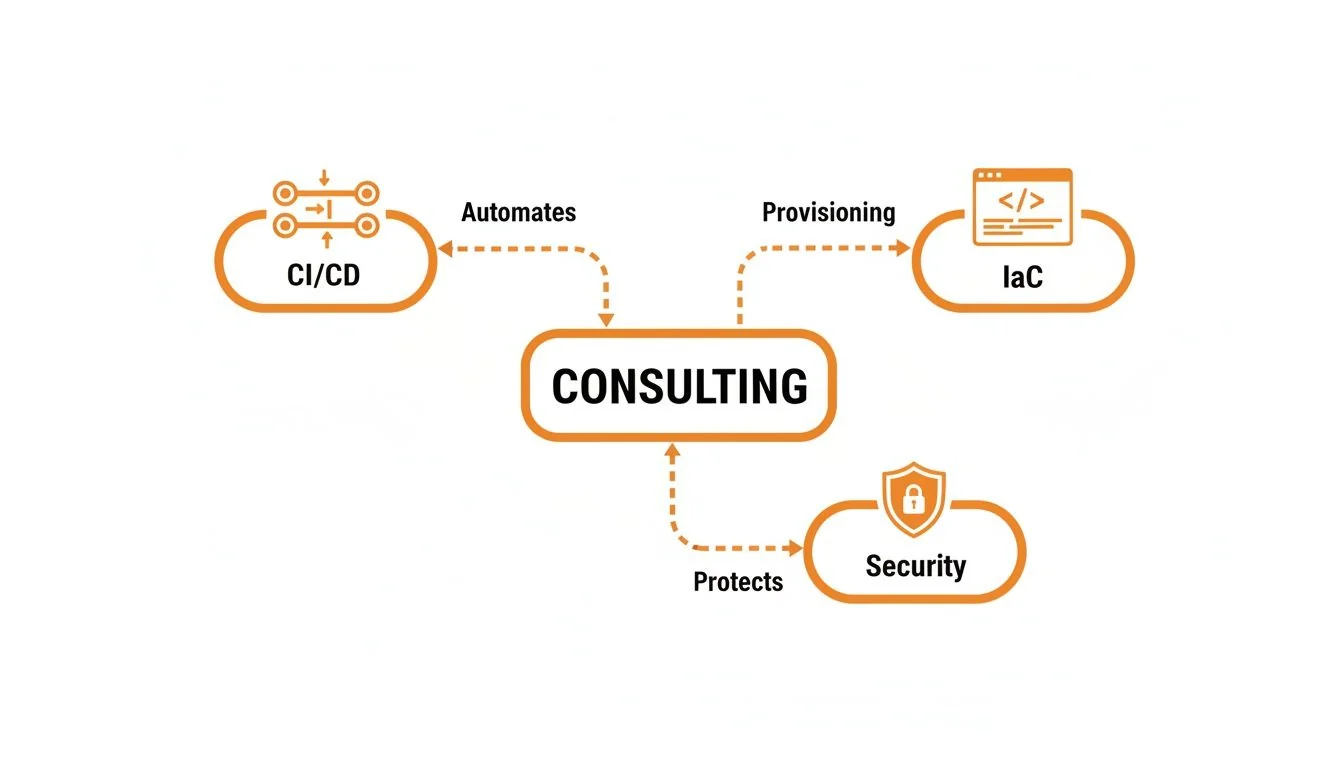
A successful engagement integrates these domains into a unified, functional strategy.
To provide a technical context, here is a breakdown of common service offerings and their direct outcomes.
Core Azure DevOps Consulting Service Offerings
| Service Pillar | Core Activities and Tools | Primary Business Outcome |
|---|---|---|
| CI/CD Pipeline Architecture | Azure Pipelines (YAML), GitHub Actions, automated testing frameworks, release gates, progressive delivery patterns | Increased deployment frequency and reduced change failure rate. |
| Infrastructure as Code (IaC) | Terraform, Bicep, ARM Templates, secure state management, modular design | Consistent, repeatable, and auditable environments; drastically reduced configuration drift and faster environment provisioning. |
| DevSecOps & Compliance | SAST/DAST/SCA integration, secrets management (Azure Key Vault), policy-as-code (Azure Policy) | Reduced security risk and compliance overhead by embedding automated checks directly into the development workflow. |
| SRE & Observability | Azure Monitor, Application Insights, Log Analytics, Prometheus, Grafana | Proactive issue detection and reduced Mean Time to Recovery (MTTR) through improved system visibility. |
These pillars form the foundation of a modern practice, transforming disconnected activities into a predictable system for software delivery.
Market Growth and Demand
The demand for this specialized expertise is significant. The global Microsoft Azure Consulting Service market, which relies heavily on these DevOps practices, was valued at USD 10.53 billion in 2024 and is projected to reach USD 34.92 billion by 2033.
This growth highlights the criticality of expert guidance as organizations migrate complex, mission-critical workloads to the cloud. You can read more about the Azure consulting market trends for a complete analysis, or browse our Azure partner hub for a curated view of the leading firms in this space.
A mature Azure DevOps practice transforms software development from a series of disjointed, manual steps into a predictable, automated, and secure value stream. It is the foundational engine for modern digital business.
Whether for a startup requiring a compliant foundation, an SME scaling efficiently, or an enterprise modernizing legacy systems, the objective is consistent: create a system that enables engineers to deliver better software, faster. Consulting services provide the architectural blueprint, expert implementation, and operational discipline to achieve this.
The Actionable Deliverables of a Top-Tier Consultant
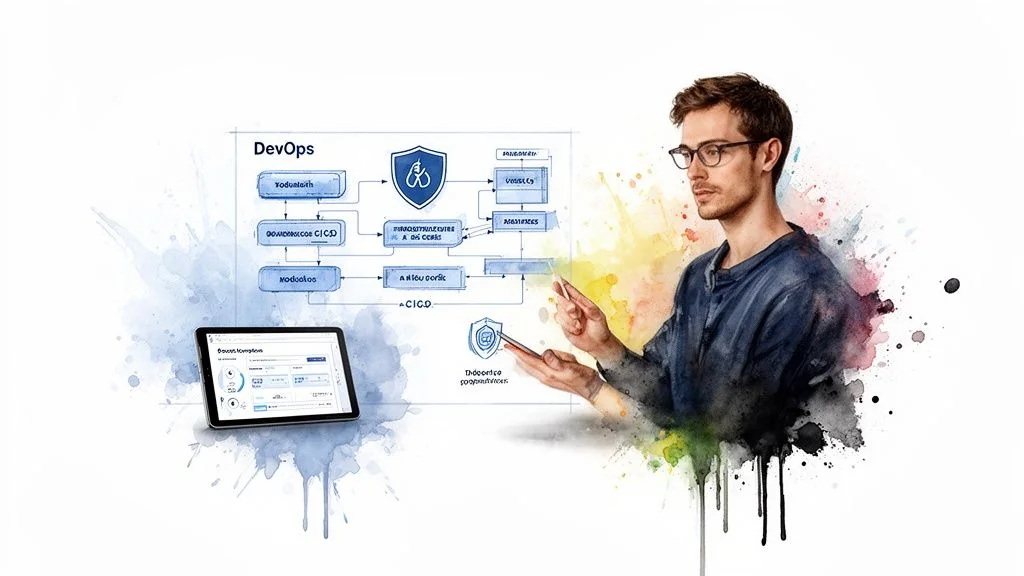
The value of Azure DevOps consulting services is not in advice but in the quality, reusability, and security of the engineered systems they leave behind. You are investing in production-grade assets that become the backbone of your software delivery. These deliverables provide a clear checklist for what “done” means.
Production-Ready CI/CD Pipelines
A primary deliverable is a set of automated CI/CD pipelines. A top-tier consultant provides more than a simple script; they deliver a library of templated, reusable YAML pipelines. This approach allows teams to reference a central, version-controlled template that enforces organizational best practices for build, test, and deployment, ensuring consistency across all applications.
These pipelines must include critical features from day one:
- Integrated Testing Gates: Automated unit, integration, and end-to-end tests run as mandatory stages within the pipeline, providing the first line of defense against defects.
- Security Scanning: Static Application Security Testing (SAST) and dependency scanning tools are embedded as required stages, identifying vulnerabilities early in the development cycle.
- Controlled Deployments: Pipelines are configured for modern deployment strategies like blue-green or canary releases to minimize the risk and impact radius of potential failures.
The result is not just automation but a secure, standardized, self-service platform that empowers development teams.
Modular Infrastructure as Code
A second critical deliverable is a well-structured Infrastructure as Code (IaC) repository. This is not a single, monolithic script. An expert will deliver modular, reusable code using a tool like Terraform or Bicep.
This provides a catalog of pre-approved, secure building blocks—a module for a virtual network, another for a Kubernetes cluster, a third for a database. Teams can assemble these tested components to provision new environments with speed and consistency. By 2026, this modularity is a non-negotiable requirement for scaling operations on Azure.
A proper IaC deliverable includes:
- Secure State Management: A robust backend, such as Azure Storage with state locking, is configured to securely manage the infrastructure’s state file, preventing conflicts and unauthorized changes.
- Automated Provisioning: IaC modules are integrated directly into Azure Pipelines, providing a fully automated, auditable method for creating and updating environments.
- Variable-Driven Configuration: Environments are defined by simple variable files (e.g.,
dev.tfvars,prod.tfvars), allowing management of differences between staging and production without code duplication.
This deliverable systematically eliminates manual infrastructure configuration, a primary source of production incidents.
The ultimate goal of an IaC deliverable is to make creating a compliant, production-grade environment as simple and repeatable as executing a single pipeline. This is the cornerstone of scalable and reliable cloud operations.
Integrated Security and Compliance Frameworks
A modern Azure DevOps engagement must result in a robust security and compliance framework delivered as code. This shifts security from a manual review process to an automated, preventative control integrated into the developer workflow.
This is often delivered as a policy-as-code framework using Azure Policy. Instead of manual checklists, the consultant writes policies that automatically enforce security standards, such as blocking the creation of public storage accounts or requiring specific network security group rules.
The security package should also include:
- Auditable Dashboards: Centralized Azure dashboards providing a real-time, at-a-glance view of compliance posture, simplifying adherence to standards like SOC 2 or HIPAA.
- Automated Secrets Management: Secure, proven patterns for managing API keys, connection strings, and certificates using Azure Key Vault, integrated directly into CI/CD pipelines.
These deliverables provide tangible proof of a secure software supply chain, giving security teams the visibility and control they need without impeding developer velocity.
How to Structure and Price An Engagement
Structuring a consulting engagement correctly is as critical as selecting the right partner. Misalignment can lead to budget overruns, missed deadlines, and frustration. The optimal model depends on your objectives, in-house expertise, and long-term goals.
The Project-Based Model
This is the most traditional approach, built around a detailed Statement of Work (SOW) that defines a fixed scope, specific deliverables, a timeline, and a firm price.
This model is ideal for well-defined, specific problems.
Ideal Use Cases:
- Initial CI/CD Pipeline Implementation: Building foundational YAML pipelines for a new application.
- Targeted IaC Rollout: Developing a modular Terraform or Bicep repository for a new cloud environment.
- Security Audit and Remediation: A one-time DevSecOps assessment and implementation of required security controls.
The primary advantage is cost predictability. The main disadvantage is rigidity; scope changes typically require a formal change order and additional cost.
The Retainer-Based Model
A retainer provides ongoing access to expertise. You secure a block of a consultant’s time each month for continuous improvement, strategic advice, and senior-level support.
This model suits companies with existing DevOps processes that require senior-level guidance to optimize, mentor internal teams, and make strategic technology decisions.
A retainer transforms the consultant from a temporary project resource into a long-term strategic advisor who develops deep institutional knowledge of your systems, culture, and business objectives.
Common Activities:
- Ongoing Pipeline Optimization: Reducing build times, improving deployment reliability, and introducing new automation.
- SRE and Operational Support: Analyzing performance metrics, troubleshooting complex production issues, and enhancing system resiliency.
- Strategic Roadmapping: Guiding adoption of new Azure features and maturing the overall DevOps practice.
The main benefit is consistent access to top-tier talent without the cost of a full-time hire. Effective utilization of the allocated hours is key to maximizing value. For more details on pricing, see this guide to understanding cloud consulting hourly rates.
The Staff Augmentation Model
In this model, one or more consultants are embedded directly into your team. They report to your managers and contribute to daily work, typically billed on a time-and-materials basis (hourly or daily rate).
This model is effective for filling immediate skills gaps or augmenting team capacity to meet tight deadlines. For example, a Terraform expert can be brought in to lead an IaC project and upskill the existing team of developers.
The primary advantage is flexibility and direct knowledge transfer. The consultant becomes an extension of your team, adapting to shifting priorities and mentoring your staff. The main consideration is cost management, as the final bill is variable and depends on hours logged.
How To Evaluate An Azure DevOps Partner (And Spot The Red Flags)
Selecting an Azure DevOps consulting partner is a high-stakes decision. The right partner acts as a force multiplier for your engineering organization; the wrong one results in wasted time, budget overruns, and significant technical debt.
The key is to cut through sales pitches and verify hands-on expertise. The firm directory can help build an initial longlist from published profiles; direct diligence must confirm the named team’s comparable delivery experience.

Asking Questions That Reveal True Expertise
To assess a potential partner, ask pointed, scenario-based questions that test their architectural thinking and practical skills.
Questions About Infrastructure as Code (IaC)
- “Describe your strategy for managing Terraform state for an enterprise with multiple teams and environments. How do you implement state locking, secure backends, and prevent configuration drift?”
- “Using Bicep, how would you structure our repositories to maximize code reuse and modularity across different business units?”
Questions About CI/CD and Release Management
- “How would you implement a progressive delivery strategy, like canary releases, using native Azure Pipelines? Can you provide a high-level YAML structure for the release stages?”
- “Walk us through your strategy for securing a software supply chain using Azure-native tools. What specific services and configurations do you consider non-negotiable?”
Questions About Security and Governance
- “Demonstrate how you would use Azure Policy to enforce our security baselines as code across all subscriptions in our management group.”
- “Describe a time you integrated SAST, DAST, and dependency scanning into a pipeline without significantly degrading developer cycle time. What were the trade-offs?”
A confident, detailed, and opinionated response is a positive signal. Vague answers, hesitation, or reliance on buzzwords are major red flags.
Red Flags vs. Green Flags: A Quick Guide
As you evaluate partners, certain patterns will emerge. Some are warning signs, while others indicate a high-quality firm. While 49% of organizations see a dramatically faster time-to-market with DevOps, around 30% of these initiatives fail without expert guidance.
The best partners are teachers, not gatekeepers. Their primary goal should be to make your team self-sufficient by transferring knowledge, documenting processes, and building systems that are easy to understand and maintain.
This table helps differentiate between a partner who will empower you and one who will create dependency.
Partner Evaluation Red Flags vs Green Flags
| Evaluation Area | Red Flag (Warning Sign) | Green Flag (Positive Indicator) |
|---|---|---|
| Tooling Philosophy | Pushes a single proprietary tool or a “black box” solution. | Takes a pragmatic, tool-agnostic approach, selecting the best tool for your specific requirements. |
| Success Metrics | Focuses on vague outputs like “number of pipelines built.” | Defines clear, outcome-based goals like “reduce lead time for changes by 50%.” |
| Knowledge Transfer | Keeps expertise siloed, making themselves indispensable. | Has a clear plan for pairing, documentation, and training to upskill your team. |
| Problem Solving | Gives generic “best practice” answers without asking why. | Asks deep discovery questions to understand your unique business and technical constraints. |
Recognizing these signs early can prevent a failed partnership.
The Litmus Test: Do They Prioritize Knowledge Transfer?
The most critical component of a consulting engagement is the exit strategy. A successful partnership builds your team’s internal capabilities, not a long-term dependency. From day one, the consultant should be actively working to make themselves redundant.
This should be a core part of the engagement plan, including:
- Paired Engineering: The consultant works side-by-side with your engineers, not in a silo.
- Rock-Solid Documentation: They produce well-written READMEs, architectural diagrams, and operational runbooks.
- Internal Demos & Training: They hold regular sessions to explain what was built, why it was built that way, and how to operate it.
A consultant obsessed with making your team smarter and more independent is a true partner. This focus on empowerment is the hallmark of effective Azure DevOps consulting services. To learn more about identifying top-tier firms, see our detailed guide on the best DevOps consulting companies.
Real-World Impact Scenarios and Case Studies
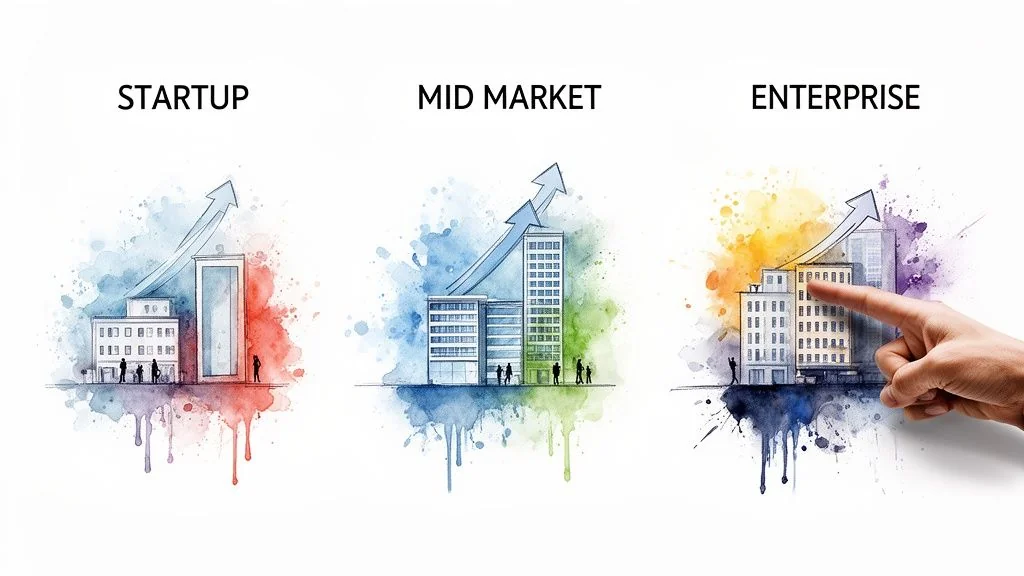
The value of Azure DevOps consulting is most evident when applied to specific, high-stakes business problems. These are strategic initiatives that directly result in faster product delivery, leaner operations, and a robust security posture.
Scenario 1: The Fintech Startup
A fintech startup needed to build its cloud-native platform on Azure with extreme velocity while proving to auditors that its infrastructure was secure and compliant with financial regulations from day one.
- Consultant’s Solution: The consultant architected a secure CI/CD pipeline from scratch using Azure Pipelines and a modular Terraform repository. Azure Policy was used to enforce security rules automatically, such as blocking public IPs on sensitive services and ensuring data encryption at rest and in transit.
- Measurable ROI: The startup passed its initial security audits on the first attempt. By leveraging reusable pipeline templates, they launched their core product 50% faster than projected, securing a critical first-mover advantage.
Scenario 2: The Mid-Market Retailer
A mid-market retail company was constrained by legacy applications running on manually provisioned virtual machines. Deployments were a high-risk, quarterly event that frequently caused production outages.
- Consultant’s Solution: The partner led a phased migration of the retailer’s core applications to Azure Kubernetes Service (AKS). They introduced a GitOps workflow using FluxCD, where every infrastructure and application change was managed through a pull request in Azure Repos.
- Measurable ROI: The transition to AKS and containers immediately reduced underlying infrastructure costs by 40%. Deployment frequency increased from quarterly to multiple times per day, enabling the business to rapidly iterate on its e-commerce platform.
The consultant’s work transformed the company’s IT from a cost center focused on maintenance to a value-driver capable of delivering new features on demand, directly boosting revenue.
Scenario 3: The Enterprise Financial Firm
A large financial services firm faced significant risk due to an inconsistent, manual approach to application security across hundreds of development teams. There was no centralized visibility into vulnerabilities or a mechanism to enforce security standards.
With 85% of Fortune 500 companies running workloads on Azure and the platform holding a 25% global cloud market share, mastering its security tools is non-negotiable for regulated industries. You can explore insights on Azure’s enterprise market dominance.
- Consultant’s Solution: The consultants designed and implemented a comprehensive DevSecOps program. They embedded automated security testing tools (SAST, DAST, SCA) directly into standardized Azure Pipelines templates, ensuring every code change was automatically scanned for vulnerabilities.
- Measurable ROI: Within the first year, the firm achieved a 90% reduction in critical vulnerabilities reaching production. This significantly improved their security posture and reduced the manual workload on the central security team, allowing them to focus on more strategic threat modeling.
Common Questions About Azure DevOps Consulting
As you consider a technical partnership, the focus shifts from strategy to execution. Here are answers to common questions about engaging Azure DevOps consulting services.
What Is a Typical Timeline for an Initial Implementation?
While every project is different, we can provide general timelines based on common scopes:
- Small (Targeted Project): 4-8 weeks. This typically involves a focused, high-impact goal, such as building a production-ready CI/CD pipeline for a single key application or establishing the initial Infrastructure as Code (IaC) for a new environment.
- Medium (Team or Department Rollout): 3-6 months. This involves a more substantial effort, such as migrating an entire department to modern Azure Pipelines or implementing a comprehensive DevSecOps framework into their workflow.
- Large (Enterprise Transformation): 6-18+ months. This is a strategic program aimed at changing how a large organization builds software, involving the modernization of hundreds of applications and fostering significant cultural change.
The most effective approach is often to start with a smaller, high-impact project to demonstrate value and build momentum for larger initiatives. If you’re unsure where to begin, take our matching quiz to get a shortlist of consultants suited to your scope and timeline.
How Do We Ensure Knowledge Transfer?
A top-tier consultant’s primary goal should be to make your team self-sufficient. Success is defined by your team’s ability to confidently own, operate, and improve the systems after the engagement ends.
Effective knowledge transfer occurs through active collaboration, not passive hand-offs. Your team must be involved from day one.
Insist on the following practices:
- Paired Engineering: Your engineers work side-by-side with the consultant, writing code and solving problems collaboratively.
- Comprehensive Documentation: Clear architectural diagrams, operational runbooks, and well-commented code are non-negotiable deliverables.
- Regular Demos and Training: The consultant holds frequent sessions to explain the what and, more importantly, the why behind architectural and implementation decisions.
Can These Services Help with Hybrid and Multi-Cloud?
Yes. The principles and many of the tools are designed for heterogeneous environments. By 2026, hybrid and multi-cloud architectures are the standard for most enterprises.
An experienced consultant designs systems to manage workloads regardless of their location. They can leverage Azure Arc to extend Azure’s management plane and DevOps tooling to on-premises data centers or other public clouds like AWS and GCP. Tools like Terraform are also key, as they are platform-agnostic by design. For a detailed breakdown of how the three major platforms compare, see our strategic AWS vs Azure vs GCP comparison.
What Metrics Best Measure a DevOps Transformation?
Avoid vanity metrics like deployment count. True success is measured by business outcomes and tangible improvements to the engineering process.
The industry standard is the set of four key DORA (DevOps Research and Assessment) metrics. Focus on these to measure real progress:
- Deployment Frequency: How often you successfully release to production.
- Lead Time for Changes: The time from code commit to production deployment.
- Mean Time to Recovery (MTTR): How quickly you can restore service after a production incident.
- Change Failure Rate: The percentage of deployments that cause a production failure.
Improving these four metrics is the clearest indicator that your investment in azure devops consulting services is delivering a tangible return.
Finding the right expert is crucial for a successful Azure DevOps initiative. At CloudConsultingFirms.com, compare Azure firms by partner designations, pricing signals, documented project outcomes, and engagement fit. Explore Azure consulting firms.
Frequently Asked Questions
What are the pillars of an elite consulting practice?
A top-tier consulting engagement focuses on creating a resilient, interconnected system built on core pillars that collectively shorten the path from code commit to customer value.
What is core azure DevOps consulting service offerings?
These pillars form the foundation of a modern practice, transforming disconnected activities into a predictable system for software delivery.
What is market growth and demand?
The demand for this specialized expertise is significant. The global Microsoft Azure Consulting Service market, which relies heavily on these DevOps practices, was valued at USD 10.53 billion in 2024 and is projected to reach USD 34.92 billion by 2033.
What is production-ready CI/CD pipelines?
A primary deliverable is a set of automated CI/CD pipelines. A top-tier consultant provides more than a simple script; they deliver a library of templated, reusable YAML pipelines. This approach allows teams to reference a central, version-controlled template that enforces organizational best practices for build, test, and deployment, ensuring consistency across all applications.
What is modular infrastructure as code?
A second critical deliverable is a well-structured Infrastructure as Code (IaC) repository. This is not a single, monolithic script. An expert will deliver modular, reusable code using a tool like Terraform or Bicep.
Peter Korpak
Founder
Data-driven market researcher with 15+ years helping software agencies and IT organizations make evidence-based decisions. Former market research analyst at Aviva Investors and Credit Suisse. Built the 50 cloud consulting firm profiles published on cloudconsultingfirms.com from publicly available evidence.
Connect on LinkedInContinue Reading
View all insights →Azure
Browse public Azure consulting firm profiles and buyer guidance
7 Vetted Marketplaces to Find Top DevOps Consulting Companies
Cut through the noise. Find the right devops consulting companies with our data-driven guide to the top 7 platforms for hiring vetted experts in 2026.
A Technical Guide to Azure Managed Services Pricing in 2026
Unlock the secrets of Azure managed services pricing. This guide covers cost models, ROI calculation, and negotiation tactics for technical leaders.
Stay ahead of cloud consulting
Quarterly directory updates, pricing benchmarks, and new research — delivered to your inbox.
No spam. Unsubscribe anytime.