10 Actionable Cloud Security Best Practices for 2026
By 2026, the baseline for cloud security has shifted dramatically. Standard checklists are no longer sufficient to defend against sophisticated, AI-accelerated threats or to satisfy increasingly stringent compliance mandates like GDPR, CCPA, and evolving industry-specific regulations. Generic advice fails to address the nuanced realities of multi-cloud environments, serverless architectures, and the pervasive integration of third-party APIs. Simply “lifting and shifting” on-premises security paradigms to the cloud is a recipe for critical vulnerabilities, data breaches, and costly operational failures. This is precisely why a modern, actionable framework of cloud security best practices is essential not just for risk mitigation, but for business enablement.
This guide moves beyond theoretical concepts and provides a technical, prioritized roadmap for hardening your cloud infrastructure. We will dissect 10 critical security domains, offering a blueprint for engineers, architects, and technology leaders. Each section provides a clear “why” behind the practice, followed by concrete implementation steps for AWS, Azure, and Google Cloud Platform. You’ll find specific controls, code snippets, and configuration examples to translate strategy into secure deployments. We cover everything from implementing a zero-trust identity model with fine-grained IAM policies and robust network segmentation to integrating security directly into your CI/CD pipeline using Infrastructure as Code (IaC). This is a field guide designed for immediate application, helping you build a resilient, auditable, and demonstrably secure cloud posture. Whether you are optimizing an existing environment or evaluating a managed security services partner, these insights will equip you to make informed, high-impact decisions.
1. Implement Identity and Access Management (IAM) with Least Privilege Principle
Effective cloud security begins not at the network edge, but with identity. Implementing a robust Identity and Access Management (IAM) strategy, anchored by the principle of least privilege, is the most critical step in establishing a secure cloud foundation. This approach dictates that any user, service, or application should only have the absolute minimum permissions required to perform its designated function, and nothing more. This practice dramatically reduces your attack surface and contains the potential damage (the “blast radius”) if a single account is compromised.
Centralized IAM serves as the control plane for who can access what resources under which conditions. By rigorously defining and enforcing these boundaries, you prevent both accidental misconfigurations and malicious lateral movement across your environment.
Why This Is a Core Practice
Adopting a least privilege IAM model is a foundational element of modern, zero-trust security architectures. It shifts the security paradigm from a perimeter-based defense to an identity-centric one, which is essential in the borderless world of the cloud. Implementing this is a non-negotiable step in any comprehensive cloud security best practices framework.
Key Insight: Treat every identity, whether human or machine, as a potential threat vector. Granting broad, permissive access is the digital equivalent of leaving all your doors and windows unlocked. A strong IAM foundation is your first and most effective line of defense.
Actionable Implementation Steps
- Enforce Multi-Factor Authentication (MFA): This is the single most impactful IAM control. Enable MFA for all privileged accounts immediately and create a plan to roll it out to all users within 90 days.
- Utilize Role-Based Access Control (RBAC): Define roles based on job functions (e.g., “DatabaseAdmin,” “BillingManager”) with pre-defined permission sets instead of assigning permissions directly to individual users. This simplifies management and auditing.
- Conduct Regular Access Reviews: Schedule quarterly reviews with business leaders to validate that existing permissions are still necessary. Automate the de-provisioning of access for employees who change roles or leave the company.
- Secure Service Accounts and Keys: Eliminate long-lived static credentials for applications and infrastructure. Instead, use cloud-native solutions like AWS IAM Roles for EC2/ECS, Azure Managed Identities, or Google Cloud Workload Identity Federation to grant temporary, automatically rotated credentials to services.
- Automate Alerts for Privilege Escalation: Configure alerts to notify your security team immediately when high-risk permissions (e.g.,
iam:PassRolein AWS,Global Administratorin Azure) are granted or used.
2. Enable Encryption at Rest and in Transit with Key Management
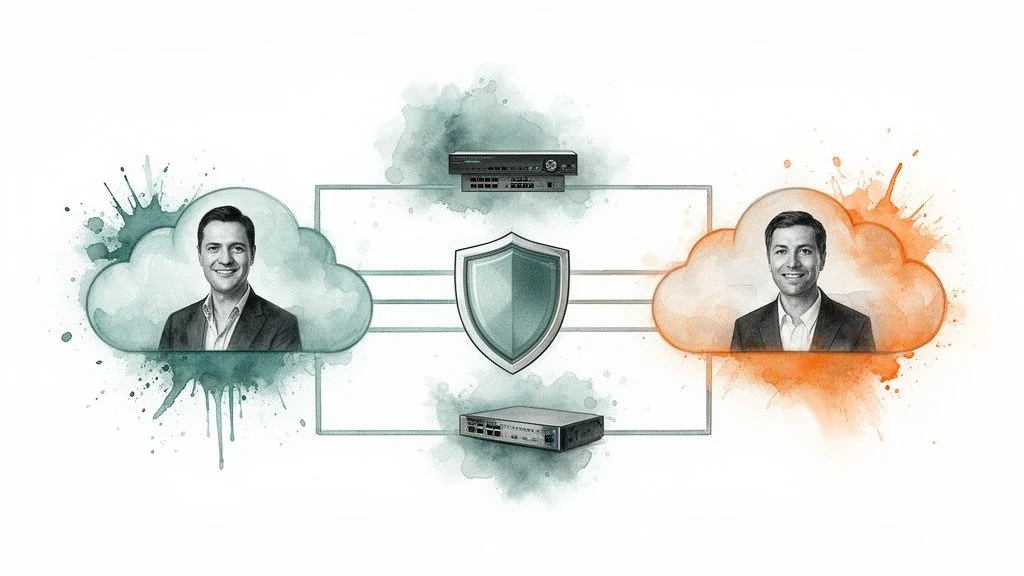
While IAM controls who can access data, encryption ensures that even if access controls fail, the data itself remains protected and unreadable. A comprehensive encryption strategy involves protecting data in two primary states: “in transit” as it moves across networks and “at rest” while it is stored on disk. This is a non-negotiable layer of defense, mandated by nearly every major compliance framework like HIPAA, PCI-DSS, and GDPR.
Effective encryption relies on robust key management. Modern cloud platforms provide sophisticated Key Management Services (KMS) that centralize the creation, rotation, and usage logging of cryptographic keys. This abstracts away the complexity of managing hardware security modules (HSMs) and provides auditable proof that your data is secure, a core pillar of any mature cloud security best practices implementation.
Why This Is a Core Practice
Unencrypted data is a critical vulnerability. A single misconfigured storage bucket or an intercepted API call could expose highly sensitive information. Implementing end-to-end encryption with centralized key management provides a powerful safeguard that persists even if other security layers are bypassed. It turns raw, sensitive data into useless ciphertext without the corresponding key, which is managed and protected by a separate, highly secure service.
Key Insight: Assume your perimeter will eventually be breached. Encryption is your last line of defense, rendering stolen data worthless to an attacker. Treat key management with the same rigor as root account credentials; control over the keys is control over the data itself.
Actionable Implementation Steps
- Enforce TLS 1.2+ for All Endpoints: Mandate a minimum of TLS 1.2 (with a plan for TLS 1.3) for all data in transit, including internal service-to-service communication, APIs, and load balancers. Disable support for all outdated SSL/TLS versions.
- Utilize Cloud-Native KMS: Leverage services like AWS KMS, Azure Key Vault, or Google Cloud KMS to manage the entire lifecycle of your encryption keys. Avoid building and managing your own key infrastructure.
- Automate Key Rotation: Configure policies to automatically rotate keys at least annually. For highly sensitive data, implement a 90-day rotation schedule. This limits the “blast radius” of a compromised key.
- Implement Envelope Encryption: For large data objects, use envelope encryption. This involves encrypting the data with a unique Data Encryption Key (DEK) and then encrypting the DEK with a master key stored in your KMS. This is more performant and cost-effective.
- Segment Keys by Data Classification: Create and use separate Customer-Managed Keys (CMKs) for different data sensitivity levels or applications. This allows you to apply more granular access policies and isolate tenants or workloads.
3. Implement Cloud-Native Network Security (VPC, NACLs, Security Groups)
Effective cloud security requires translating traditional network segmentation concepts into the cloud’s software-defined environment. By mastering cloud-native tools like Virtual Private Clouds (VPCs), Network Access Control Lists (NACLs), and Security Groups, you can construct a micro-segmented architecture that isolates resources, controls traffic flow, and strictly enforces the principle of least privilege at the network layer. This approach creates logical “moats” around critical workloads, preventing lateral movement and containing the blast radius if a single resource is compromised.
This layered defense model, using both stateless NACLs at the subnet level and stateful Security Groups at the instance level, provides granular control. For example, Airbnb uses precise security groups to isolate payment processing systems, drastically reducing its PCI-DSS compliance scope. This is a fundamental component of any robust cloud security best practices framework.
Why This Is a Core Practice
Adopting a cloud-native, zero-trust network model is essential for protecting modern, distributed applications. Unlike on-premises data centers with a clear perimeter, cloud environments are inherently porous. Implementing disciplined network segmentation ensures that a breach in a less-critical, internet-facing tier cannot automatically pivot to compromise sensitive backend databases or internal administrative systems. This practice is foundational to the AWS Well-Architected Framework and the CIS Benchmarks.
Key Insight: In the cloud, your network is code. Treat your VPC, subnet, and security group configurations with the same rigor as your application code. A “deny-all” default posture is your most powerful network security control; every allowed rule should be a deliberate, justified, and time-bound exception.
Actionable Implementation Steps
- Start with a Default-Deny Policy: Configure all Security Groups and NACLs with a deny-all default rule. Explicitly whitelist only the specific source IPs, ports, and protocols necessary for each application tier to function.
- Segment by Environment and Criticality: Create separate VPCs or subnets for development, staging, and production environments. Within production, further segment workloads by their function and data sensitivity (e.g., web tier, application tier, database tier).
- Enable and Analyze Flow Logs: Activate VPC Flow Logs (AWS), NSG Flow Logs (Azure), or VPC Flow Logs (GCP) for all critical subnets. Ingest this data into a security analytics platform to monitor for anomalous traffic patterns, unauthorized port scans, or data exfiltration attempts.
- Automate Rule Auditing: Use services like AWS Config, Azure Policy, or Google Cloud Asset Inventory to create automated rules that continuously audit your security groups. Flag and alert on overly permissive rules (e.g.,
0.0.0.0/0), unused rules, or unauthorized changes. - Use Descriptive Naming Conventions: Implement a strict naming convention for security groups that clearly defines their purpose (e.g.,
prod-web-sg-inbound-443,dev-db-sg-inbound-app-tier). This simplifies auditing, troubleshooting, and automation efforts.
4. Establish Centralized Logging and Security Monitoring (SIEM/SOC)
You cannot secure what you cannot see. Establishing a centralized logging and security monitoring program is essential for detecting, investigating, and responding to threats in a dynamic cloud environment. This involves aggregating logs from all cloud services, infrastructure, and applications into a unified platform, such as a Security Information and Event Management (SIEM) system, where they can be correlated, analyzed, and acted upon in real-time.

This centralized visibility allows a Security Operations Center (SOC) team to move from reactive incident response to proactive threat hunting. By analyzing correlated data streams, teams can identify anomalous patterns, uncover sophisticated attack campaigns, and significantly reduce the mean time to detect (MTTD) and mean time to respond (MTTR) to security incidents.
Why This Is a Core Practice
In the cloud, infrastructure is ephemeral and actions are API-driven, making comprehensive logging your primary source of truth for all activity. Without a centralized view, security signals are fragmented across dozens of services, making it impossible to connect the dots during an attack. A well-implemented SIEM is a non-negotiable component of any mature cloud security best practices framework, forming the backbone of your “Detect” and “Respond” capabilities as defined by the NIST Cybersecurity Framework.
Key Insight: In the cloud, logs are the digital equivalent of security camera footage for every action taken. A decentralized or incomplete logging strategy is like having cameras that don’t record or only cover a fraction of your building, leaving critical blind spots for attackers to exploit.
Actionable Implementation Steps
- Ingest High-Value Log Sources: Start by enabling and centralizing critical logs. This includes AWS CloudTrail, Azure Activity Logs, and Google Cloud Audit Logs for API activity; VPC/VNet flow logs for network traffic; and cloud-native threat detection service logs like AWS GuardDuty or Microsoft Defender for Cloud.
- Define Log Retention Policies: Implement tiered retention policies based on compliance and operational needs. For example, retain operational logs for at least 90 days for active analysis, and archive critical audit and security logs for 1 to 7 years in low-cost storage to meet PCI-DSS or SOC 2 requirements.
- Develop High-Confidence Alerts: Begin by configuring alerts for unambiguous, high-impact events like root/Global Admin account activity, deletion of logging configurations, or multiple failed login attempts from a privileged account. This builds a reliable baseline before tuning for more nuanced threats.
- Implement Playbooks for Common Alerts: For every alert you create, document a corresponding incident response playbook. Automate the initial steps where possible, such as enriching an alert with user context or isolating an affected instance, to standardize and accelerate your team’s response.
- Leverage AI/ML for Anomaly Detection: Use the AI-powered capabilities within modern SIEMs like Microsoft Sentinel or Google Chronicle to automatically detect anomalous user behavior, unusual data exfiltration patterns, or other deviations from established baselines that rule-based systems might miss.
5. Conduct Regular Vulnerability Scanning and Penetration Testing
A secure cloud architecture is not a “set it and forget it” achievement; it requires continuous vigilance. Establishing a robust vulnerability management program that integrates automated scanning and manual penetration testing is essential for discovering and remediating weaknesses before they can be exploited. This practice moves security from a reactive, incident-driven model to a proactive, predictive one, continuously hardening your environment against emerging threats.
This comprehensive approach involves scanning everything from infrastructure and container images to application code and third-party dependencies. By combining high-frequency automated scans with in-depth, human-led penetration tests, organizations can uncover both common configuration errors and complex, business-logic flaws that automated tools often miss. The infamous 2017 Equifax breach, caused by an unpatched Apache Struts vulnerability, serves as a permanent reminder of the catastrophic cost of a weak vulnerability management program.
Why This Is a Core Practice
In the dynamic and ephemeral cloud environment, new resources are spun up and down constantly, creating a fluid attack surface. A continuous vulnerability management program, a key tenet of frameworks like the NIST Cybersecurity Framework, is the only way to maintain visibility and control. It provides the empirical data needed to prioritize patching, justify security investments, and systematically reduce risk across all cloud assets. This is a foundational pillar of any mature set of cloud security best practices.
Key Insight: Treat your infrastructure as code, but also treat your vulnerabilities as data. A systematic program transforms vulnerability scanning from a simple compliance checkbox into a data-driven risk reduction engine that provides clear, measurable security improvements over time.
Actionable Implementation Steps
- Integrate Scanning into CI/CD: Shift security left by embedding automated scanning tools directly into your CI/CD pipelines. For example, use AWS Inspector scans on build artifacts or Azure Defender for Cloud to assess container registries. Configure pipelines to fail builds if new, critical-severity vulnerabilities are detected.
- Establish Risk-Based Remediation SLAs: Not all vulnerabilities are equal. Define and enforce strict Service Level Agreements (SLAs) for remediation based on severity: Critical within 24-72 hours, High within 7-14 days, and Medium within 30 days. Track Mean Time to Remediate (MTTR) as a key performance indicator.
- Layer Automated and Manual Testing: Use automated tools like Qualys, Tenable, or Rapid7 for broad, continuous coverage. Supplement this with annual penetration tests from specialized IT security consulting firms to identify complex flaws, and conduct quarterly internal red-team exercises to test your detection and response capabilities.
- Manage Third-Party Dependencies: Maintain a complete Software Bill of Materials (SBOM) for all applications. Use tools like Snyk or GitHub Dependabot to continuously scan open-source dependencies and receive immediate alerts when new vulnerabilities are disclosed.
- Utilize Golden AMIs and Baselines: Create and maintain hardened, pre-scanned “golden” Amazon Machine Images (AMIs) or their GCP/Azure equivalents. Use configuration management tools to enforce these secure baselines and prevent configuration drift on deployed instances.
6. Implement Multi-Factor Authentication (MFA) and Strong Identity Verification
If identity is the new perimeter, then Multi-Factor Authentication (MFA) is its most essential guard. MFA adds a critical second layer of defense to the login process, requiring users to provide two or more verification factors to gain access to a resource. This simple step moves security beyond a single, often compromised, point of failure-the password-and dramatically mitigates the risk of credential theft.
By requiring a secondary proof of identity, such as a code from a mobile app, a push notification, or a physical hardware key, MFA ensures that even if a user’s password is stolen, unauthorized access is blocked. This is a foundational control for protecting sensitive data and administrative access in any cloud environment.
Why This Is a Core Practice
Implementing MFA is one of the most effective, highest-impact security measures an organization can take. Microsoft’s research famously found that MFA blocks over 99.9% of account compromise attacks. In an era of rampant phishing and credential stuffing, relying on passwords alone is a negligent security posture. Enforcing MFA across your cloud estate is a non-negotiable component of a modern, resilient security strategy.
Key Insight: A compromised password is no longer a hypothetical risk; it’s an operational certainty. MFA is the primary control that contains the damage from this inevitability, transforming a potential major breach into a logged, unsuccessful login attempt.
Actionable Implementation Steps
- Prioritize Privileged Accounts: Immediately enforce MFA for all cloud administrative accounts and any roles with elevated permissions. Aim for 100% coverage on these high-value targets within 30 days.
- Roll Out Phishing-Resistant MFA: For high-risk accounts like executives and system administrators, mandate the use of FIDO2-compliant hardware security keys (e.g., YubiKey) to neutralize phishing threats. Use Time-based One-Time Passwords (TOTP) or verified push notifications as a baseline for all other users.
- Implement Conditional Access Policies: Leverage your identity provider’s capabilities to create risk-based authentication rules. For example, require MFA only when a user logs in from an unfamiliar location, a non-compliant device, or an anonymous IP address. This balances security with user experience.
- Establish Account Recovery Protocols: Provide users with secure backup methods, like pre-generated recovery codes stored offline, to prevent lockouts. Ensure your IT support team has a verified process for helping users who lose their primary MFA device.
- Audit and Enforce Adoption: Use your cloud provider or IdP dashboard to track MFA enrollment rates. Set a company-wide goal to achieve 100% adoption within 90 days and create automated alerts to follow up with non-compliant users.
7. Establish Cloud Data Loss Prevention (DLP) and Data Classification Policies
In the cloud, data doesn’t just reside in databases; it flows through SaaS applications, object storage, and serverless functions. Establishing robust Data Loss Prevention (DLP) and classification policies is essential for discovering, identifying, and protecting your sensitive information wherever it lives or moves. This practice involves using automated tools to scan for and classify critical data-like PII, PHI, or intellectual property-and then enforcing policies to prevent its unauthorized exfiltration or exposure.
A successful DLP strategy is not about blocking everything; it’s about gaining visibility and control. It allows you to understand your data landscape and apply granular security controls, such as redaction, encryption, or access restriction, based on the data’s sensitivity and context. This is a crucial component of modern cloud security best practices, directly supporting data governance and compliance mandates.
Why This Is a Core Practice
Without automated classification and DLP, organizations are effectively blind to the risks associated with their most valuable asset: data. An employee accidentally sharing a document with sensitive customer information to a public link, or a misconfigured S3 bucket exposing proprietary source code, can lead to catastrophic regulatory fines and reputational damage. Cloud DLP provides the automated “eyes” and “hands” needed to enforce data handling policies at scale across a distributed environment.
Key Insight: Data is the primary target of most cyberattacks. Your security posture is incomplete if you protect the infrastructure but neglect to understand and protect the sensitive information it contains. DLP shifts the focus from securing containers to securing the contents.
Actionable Implementation Steps
- Start with Discovery and Classification: Begin by using cloud-native tools like Amazon Macie, Azure Purview, or the Google Cloud DLP API to scan your storage services. Identify and tag data based on pre-defined or custom classifiers (e.g., “Confidential-PHI,” “Internal-IP”).
- Implement Graduated Enforcement: Don’t start by blocking all potential violations. Begin in an audit-only or “log-and-alert” mode to establish a baseline and fine-tune your policies. This minimizes disruption and reduces false positives before moving to more restrictive actions like blocking transfers.
- Use Data Fingerprinting for IP: For unstructured intellectual property like source code, M&A documents, or product designs, use fingerprinting. This creates a unique hash of a sensitive document, allowing DLP tools to detect even partial copies being moved to unauthorized locations.
- Integrate DLP with Your CASB and Email Gateway: Extend your DLP policies beyond cloud storage. Integrate them with your Cloud Access Security Broker (CASB) and email security solutions to monitor and control data movement to and from unapproved SaaS applications and external recipients.
- Automate Incident Response: Configure your DLP system to trigger automated workflows upon detecting a high-severity policy violation. This could involve creating a ticket in your ITSM, notifying the data owner via Slack, and automatically quarantining the file or revoking public sharing links.
8. Perform Regular Security Assessments and Compliance Audits
A secure cloud environment isn’t a “set it and forget it” state; it requires continuous validation. Regularly performing security assessments and formal compliance audits is crucial for verifying that your controls are designed and operating effectively. This process moves beyond assumptions, providing tangible evidence that your security posture aligns with both internal policies and external regulatory mandates like SOC 2, ISO 27001, or PCI-DSS.
These structured evaluations systematically identify gaps, misconfigurations, and vulnerabilities against established frameworks such as the CIS Benchmarks. The resulting reports and corrective action plans create a documented, repeatable cycle of improvement, which is fundamental to maturing your cloud security program and demonstrating due diligence to stakeholders and customers.
Why This Is a Core Practice
In the dynamic cloud landscape, configurations drift, new services are deployed, and threat actors evolve their tactics. Audits and assessments serve as the essential feedback loop, confirming that your security controls are not only implemented but remain effective over time. For companies in regulated industries or those serving enterprise clients, formal certifications are often non-negotiable table stakes, proving your commitment to robust cloud security best practices. When vetting potential partners, comparing firms side by side on their compliance credentials can streamline the selection process.
Key Insight: Security controls are hypotheses until they are tested. Regular, independent assessments turn assumptions into assertions, providing the objective proof needed to build trust with customers, partners, and regulators. Without this validation, you are operating on faith, not fact.
Actionable Implementation Steps
- Automate Continuous Compliance Checks: Deploy cloud-native tools like AWS Config Rules, Azure Policy, and Google Cloud Asset Inventory to continuously monitor your environment against security benchmarks. This provides real-time visibility and shortens the evidence-gathering cycle for formal audits.
- Conduct Pre-Audit Internal Assessments: Schedule an internal review 60-90 days before your external audit. This “dress rehearsal” helps identify and remediate obvious gaps, streamlining the formal audit process and reducing the likelihood of major findings.
- Engage Auditors Early and Strategically: Bring your certified auditors into the planning process well before the audit period begins. This ensures you understand evidence requirements, scoping, and timelines, preventing last-minute scrambles for documentation.
- Document Everything: Maintain a centralized repository of evidence for each control. This includes policy documents, configuration screenshots, change management tickets, and access review logs. This preparation significantly accelerates the audit fieldwork. For guidance on navigating these complex requirements, exploring regulatory compliance consulting services can provide a structured path forward.
- Create a Formal Corrective Action Plan: For every finding, document a remediation plan with a clear owner, specific actions, and a target completion date. Track these plans rigorously to ensure all identified security gaps are closed in a timely manner.
9. Implement Infrastructure as Code (IaC) with Security Controls and Version Control
Manually configuring cloud environments is an obsolete practice prone to human error, drift, and security gaps. Adopting Infrastructure as Code (IaC) treats your cloud architecture configuration as software, defining and managing it through declarative code files stored in a version control system like Git. This approach codifies your security policies, network rules, and resource configurations, enabling automated, repeatable, and auditable deployments.
By integrating security directly into your development lifecycle, you shift security left, catching misconfigurations before they ever reach a production environment. IaC provides a single source of truth for your infrastructure, eliminating configuration drift and providing a clear, immutable history of every change.
Why This Is a Core Practice
IaC is a fundamental enabler of DevSecOps and a core component of modern cloud security best practices. It transforms security from a manual, after-the-fact checklist into an automated, preventative guardrail built into the deployment pipeline. This programmatic approach is essential for managing complex, dynamic cloud environments at scale while maintaining a consistent and verifiable security posture.
Key Insight: Your infrastructure’s desired state is code. Any deviation from that code, known as “drift,” is a potential security incident. IaC provides the framework to not only define the secure state but also to automatically detect and remediate any unauthorized changes.
Actionable Implementation Steps
- Store IaC in Version Control with Branch Protection: Centralize all your Terraform, CloudFormation, or Bicep templates in a Git repository. Enforce branch protection rules that require peer reviews for all changes to the
mainbranch, ensuring a second set of eyes on any infrastructure modification. - Integrate Static Analysis Security Testing (SAST): Embed automated scanning tools like Checkov, tfsec, or KICS directly into your CI/CD pipeline. Configure the pipeline to fail the build if the scan detects high-severity misconfigurations, such as public S3 buckets or overly permissive firewall rules.
- Enforce Policy-as-Code Guardrails: Use frameworks like Open Policy Agent (OPA) or Sentinel to enforce organizational policies programmatically. For example, you can write a policy that automatically rejects any deployment attempting to create a database instance without encryption enabled.
- Separate Secrets from Code: Never hardcode secrets, API keys, or passwords in your IaC templates. Use a dedicated secrets manager like AWS Secrets Manager, Azure Key Vault, or HashiCorp Vault, and dynamically reference these secrets at deployment time.
- Implement Continuous Drift Detection: Regularly run tools that compare the state defined in your IaC templates against the actual state of your cloud environment. Configure automated alerts to notify the security team of any detected drift, which could indicate a manual misconfiguration or a potential breach.
10. Manage Secrets and Configuration Securely
Hard-coded credentials, API keys, and certificates are among the most common and damaging security vulnerabilities in cloud applications. Secure secrets management involves externalizing all sensitive configuration data from your application code and infrastructure definitions. Instead of embedding secrets in source code, configuration files, or user data scripts, applications should fetch them dynamically and securely from a centralized, hardened service at runtime.
This practice is a cornerstone of modern DevSecOps and is critical for automating infrastructure and application deployments safely. By decoupling secrets from the application lifecycle, you can enforce strict access controls, enable automated rotation, and maintain a detailed audit trail of all secret access, which is a key component of robust cloud security best practices.
Why This Is a Core Practice
Storing secrets in code repositories, even private ones, is a recipe for disaster. A single leaked credential can grant an attacker a foothold into your entire cloud environment. Centralized secret management systems are purpose-built to store, encrypt, manage, and audit access to this sensitive data, providing a secure and scalable solution that traditional configuration files cannot match.
Key Insight: Treat secrets as dynamic, ephemeral data, not static configuration. Your application’s identity, managed through IAM, should be its key to the vault, not a hard-coded password stored alongside it. This approach minimizes the window of opportunity for attackers if a credential is ever exposed.
Actionable Implementation Steps
- Centralize Secrets in a Dedicated Vault: Immediately adopt a cloud-native secret manager like AWS Secrets Manager, Azure Key Vault, or Google Cloud Secret Manager. For multi-cloud or on-premises needs, consider solutions like HashiCorp Vault.
- Use Workload Identity for Runtime Access: Configure your compute services (e.g., EC2 instances, Kubernetes pods, Lambda functions) to use IAM roles or managed identities to authenticate with the secrets manager. This eliminates the need to manage and distribute access keys for your applications.
- Implement Automated Secret Rotation: For secrets like database passwords, enable the built-in automatic rotation features offered by cloud providers. This drastically reduces the useful lifespan of a compromised credential, limiting its potential for misuse.
- Scan Continuously for Exposed Secrets: Integrate secret scanning tools (e.g., Git-secrets, TruffleHog) into your CI/CD pipelines and source code repositories to proactively detect and block any commits containing hard-coded credentials.
- Audit and Alert on Secret Access: Configure detailed logging for your secret manager and create automated alerts for high-risk events, such as a secret being accessed by an unexpected identity, frequent failed retrieval attempts, or the deletion of a critical secret.
10-Point Cloud Security Best Practices Comparison
| Security Control | Implementation complexity | Resource requirements | Expected outcomes | Ideal use cases | Key advantages |
|---|---|---|---|---|---|
| Implement Identity and Access Management (IAM) with Least Privilege Principle | High — role design, policy modeling, RBAC/ABAC mapping | Identity platform (AD/Entra/AWS IAM), engineers, governance, ongoing audits | Reduced unauthorized access, limited blast radius, stronger audits | Large orgs, regulated environments, multi-cloud teams | Fine-grained access control; scalable; compliance facilitation |
| Enable Encryption at Rest and in Transit with Key Management | Medium — integrate KMS/HSM and enforce TLS across services | Cloud KMS/HSM, key rotation automation, encryption config, occasional HSM cost | Data confidentiality preserved, regulatory alignment, reduced breach impact | Storage of PII/PHI/payment data, cross-region backups, third-party sharing | Strong data protection; regulatory compliance; key lifecycle control |
| Implement Cloud-Native Network Security (VPC, NACLs, Security Groups) | Medium–High — network segmentation and rule governance | Network architects, logging (VPC Flow Logs), tooling for automation and audits | Reduced lateral movement, segmented attack surface, improved traffic visibility | Multi-tier apps, multi-tenant platforms, PCI/HIPAA scoped systems | Logical isolation; granular traffic control; improved forensic visibility |
| Establish Centralized Logging and Security Monitoring (SIEM/SOC) | High — many integrations, tuning, playbook development | SIEM/SOAR solution, storage for retention, security analysts, alerting infrastructure | Faster detection and response, forensic evidence, compliance reporting | Organizations with high log volume or mature security operations | Correlation and alerting; automated response; threat hunting capability |
| Conduct Regular Vulnerability Scanning and Penetration Testing | Medium — tool integration, scan cadence, pentest coordination | Scanners, external pentesters, remediation workflows, dev resources | Identifies exploitable weaknesses, reduces MTTR, informs patching priorities | CI/CD pipelines, high-risk apps, pre-release testing | Proactive vulnerability discovery; prioritized remediation; compliance evidence |
| Implement Multi-Factor Authentication (MFA) and Strong Identity Verification | Low–Medium — enable MFA and conditional access policies | Identity provider features, user enrollment, training, optional hardware keys | Large reduction in account takeover risk; adaptive access control | All organizations (priority: privileged and admin accounts) | Prevents credential attacks; supports zero-trust; improves account security |
| Establish Cloud Data Loss Prevention (DLP) and Data Classification Policies | Medium–High — classification rules, policy tuning, integrations | DLP tools, data inventory, policy engines, user training and change mgmt | Prevents data exfiltration, visibility into sensitive data locations | Organizations handling PII/PHI/payment data or IP-sensitive workflows | Reduces data leakage; automated enforcement; regulatory support |
| Perform Regular Security Assessments and Compliance Audits | Medium — audit planning, evidence collection, remediation tracking | External auditors, compliance tools, cross-team coordination, audit costs | Validated controls, formal certifications, prioritized remediation roadmap | Regulated industries, vendor assurance, preparing for certification | Formal compliance proof; gap identification; customer trust building |
| Implement Infrastructure as Code (IaC) with Security Controls and Version Control | Medium–High — authoring templates, policy-as-code, CI/CD integration | IaC tools (Terraform/CFN), CI pipelines, policy engines, DevOps engineers | Consistent secure deployments, fewer manual errors, auditable change history | Rapid-deploy environments, multi-region infra, reproducible stacks | Automation and reproducibility; pre-deploy policy enforcement; audit trails |
| Manage Secrets and Configuration Securely | Low–Medium — migrate secrets, integrate runtime retrieval, rotation | Secret manager service, app changes, rotation automation, IAM controls | Reduced credential exposure, auditable access, safer deployments | Microservices, CI/CD pipelines, containerized workloads | Eliminates hard-coded secrets; automated rotation; fine-grained access control |
From Checklist to Culture: Embedding Security into Your Cloud DNA
Navigating the complexities of cloud security can feel like a perpetual arms race, but the foundational principles for a resilient defense remain constant. We have traversed a comprehensive set of cloud security best practices, moving from the non-negotiable bedrock of Identity and Access Management (IAM) and robust encryption to the operational disciplines of Infrastructure as Code (IaC) and proactive security monitoring. Each practice, from network segmentation with VPCs to centralized logging and regular vulnerability scanning, represents a critical layer in a defense-in-depth strategy.
However, the most profound takeaway is that these practices are not isolated line items on a project plan. They are interconnected components of a living, breathing security ecosystem. An effective IAM policy is amplified by MFA; a secure IaC pipeline is validated by penetration testing; centralized logging provides the necessary visibility to enforce DLP policies. Viewing these controls as a checklist to be completed once is a critical mistake. The true goal is to transcend the checklist mindset and embed these principles into the very DNA of your organization’s cloud operations. This is the shift from a reactive security posture to a proactive security culture.
Beyond Implementation: The Continuous Security Lifecycle
The cloud is defined by its dynamic nature-new services are released, architectures evolve, and attack vectors change. Consequently, your security strategy cannot be static. The cloud security best practices detailed in this article are not a “set it and forget it” solution. They form the basis of a continuous lifecycle of improvement that should be ingrained in your development and operations workflows.
This continuous cycle involves several key phases:
- Assess and Remediate: Regularly scheduled vulnerability scans, penetration tests, and compliance audits provide the data needed to understand your current risk posture. The findings from these assessments must feed directly into your development backlog for prioritized remediation.
- Automate and Enforce: Leverage IaC, policy-as-code tools (like Open Policy Agent), and automated security checks within CI/CD pipelines. Automation is your most powerful ally in ensuring that security controls are applied consistently and at scale, removing the potential for human error.
- Monitor and Respond: Your centralized logging and SIEM/SOC capabilities are your eyes and ears. This is not just about collecting logs; it’s about defining meaningful alerts, establishing incident response playbooks, and continuously refining your detection logic based on emerging threats and insights from past incidents.
- Educate and Empower: A security culture thrives when every engineer, developer, and operator understands their role in protecting the environment. Continuous training, clear documentation of security standards, and fostering a blameless post-mortem culture for security incidents are essential for building collective ownership.
The Strategic Value of a Mature Cloud Security Program
Achieving this level of security maturity is not merely an exercise in risk mitigation; it is a significant business enabler. A robust security posture builds trust with customers, particularly in regulated industries like finance and healthcare. It accelerates development velocity by providing secure-by-default guardrails, allowing teams to innovate safely and confidently. If you need expert guidance implementing these controls, our platform-specific partner directories for AWS, Azure, and Google Cloud can connect you with firms that specialize in cloud security. Furthermore, it prevents the catastrophic financial and reputational damage associated with a major data breach, which in 2026 can easily derail a company’s growth trajectory.
Mastering these cloud security best practices transforms security from a cost center into a competitive advantage. It demonstrates a commitment to operational excellence and customer trust that resonates across the market. Whether you are a startup building your first cloud application or an enterprise optimizing a sprawling multi-cloud environment, the journey toward a secure and resilient cloud footprint is one of the most critical investments you will make. If you need help identifying where to start, get matched with a vetted cloud security partner in under two minutes.
Finding the right expert to guide your security journey can dramatically accelerate your time to value and prevent costly missteps. For a data-driven approach to vetting partners, visit CloudConsultingFirms.com. The platform provides verified client reviews, detailed project outcomes, and capability comparisons to help you select a managed security service provider that truly understands your industry and technical requirements.
Peter Korpak
Chief Analyst & Founder
Data-driven market researcher with 10+ years helping software agencies and IT organizations make evidence-based decisions. Former market research analyst at Aviva Investors and Credit Suisse. Analyzed 200+ verified cloud projects (migrations, implementations, optimizations) to build Cloud Intel.
Connect on LinkedInContinue Reading
Security
Resources for vetting information security consulting firms
Solving Modern Cloud Compliance Challenges
A technical guide to overcoming modern cloud compliance challenges. Learn to mitigate risks for GDPR, HIPAA, and PCI DSS in complex cloud environments.
The Top 12 HIPAA Compliant Cloud Providers
Discover the top HIPAA compliant cloud providers. Our 2025 guide covers AWS, Azure, GCP, and managed services with actionable BAA and selection advice.
Stay ahead of cloud consulting
Quarterly rankings, pricing benchmarks, and new research — delivered to your inbox.
No spam. Unsubscribe anytime.