A CIO's Guide to Google Cloud Managed Services
The decision is not if you will use managed services for your Google Cloud Platform (GCP) environment, but how. The operational model you select—whether to build an internal team, outsource to a Managed Services Provider (MSP), or blend the two—directly dictates your budget, control, and access to specialized talent. For organizations considering Google Cloud specifically, Google Cloud Consulting services can help guide this critical decision. Choosing incorrectly leads to budget overruns, operational drag, and slower feature delivery.
Choosing Your Google Cloud Operational Model
The global cloud managed services market is projected to reach USD 178.45 billion by 2029, growing at a 14.1% CAGR. This growth is a direct result of engineering leaders outsourcing complexity to accelerate outcomes. Research on cloud managed services market trends confirms that organizations are actively seeking external expertise to manage increasingly sophisticated cloud environments.
You have three primary operational models for managing a GCP environment. When evaluating partners, you can reference the Google Cloud Partner Directory to find qualified consulting and managed services providers. Your selection must be a deliberate, strategic choice based on your team’s current capabilities and business objectives.
Defining the Three Core Models
Understanding the trade-offs between these models is the first step toward building an effective cloud operations strategy.
-
Google-Native Services: Your internal engineering team manages the GCP environment directly using Google’s native services like Cloud Run, Google Kubernetes Engine, and Cloud SQL. This model provides maximum control but requires a significant investment in specialized, high-cost internal talent.
-
Third-Party Managed Services Provider (MSP): You outsource the day-to-day operations of your GCP environment to a specialized partner. The MSP handles monitoring, security, incident response, and cost optimization, freeing your internal engineers to focus on product development.
-
Hybrid Model: This model blends internal management with outsourced services. Your team retains control over strategic, high-value components (like core application architecture), while the MSP manages routine, undifferentiated tasks like 24/7 monitoring, patching, and backups. This balances control with operational efficiency.
This decision tree outlines the primary factor in selecting a model: your internal team’s cloud maturity.
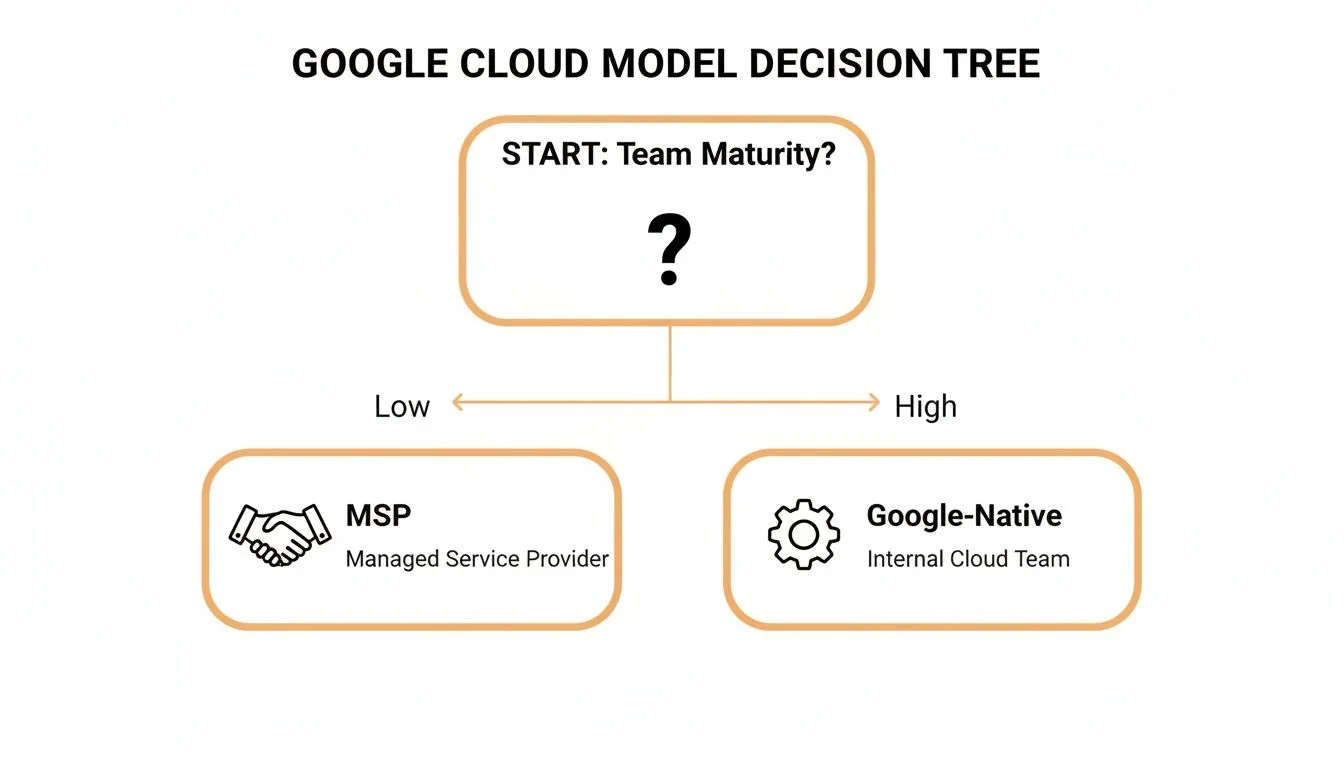
The conclusion is direct: if your team lacks deep GCP expertise, an MSP provides the fastest path to a stable, optimized state. A highly mature team can justify the cost and effort of a native approach. The right choice requires an honest assessment of your team’s skills, budget, and strategic priorities.
Comparing Google Cloud Management Models
This table provides a direct comparison of the three primary models for managing a Google Cloud environment, focusing on the criteria that matter most to engineering leaders: cost, control, expertise, and accountability.
| Attribute | Google-Native Managed Services | Third-Party MSP | Hybrid Model |
|---|---|---|---|
| Cost Structure | Primarily headcount and salaries for internal staff, plus Google Cloud’s native tool fees. | Predictable monthly fees based on consumption or a fixed retainer. Includes cost optimization services. | A mix of internal salaries and MSP fees, providing flexibility to scale support up or down as needed. |
| Operational Control | Maximum control. Your team makes all architectural, security, and operational decisions. | Less direct control. You set the strategy, but the MSP handles day-to-day execution. | Balanced control. Internal teams manage core architecture and product-specific infra, while the MSP handles routine maintenance. |
| Access to Expertise | Limited to your internal team’s knowledge. Requires significant investment in training and hiring. | Immediate access to certified experts with broad, cross-industry experience. | Augments your team’s expertise with specialized partner skills, filling critical knowledge gaps. |
| SLA Accountability | Your internal team is solely responsible for uptime and performance. | The MSP is contractually bound by an SLA, providing clear accountability and financial recourse for downtime. | Shared responsibility. The SLA covers the MSP’s scope, while your team is accountable for its managed components. |
There is no single “best” model. The Google-Native approach suits mature, well-funded teams. A full MSP partnership is ideal for organizations that need to move fast without a large internal team. The hybrid model offers a pragmatic middle ground for organizations looking to scale efficiently.
How Google Cloud’s Market Position Impacts Your Strategy
Your managed services plan is directly tied to the market dynamics of the major cloud providers. Understanding Google Cloud’s market position is critical for developing a durable, long-term strategy.
Google Cloud’s aggressive growth is a clear signal of its sustained investment in enterprise-grade services, making it a strategic platform where innovation in managed services is accelerating.
For engineering leaders, this means GCP is no longer just a viable alternative to AWS or Azure; it is a strategic platform for data, AI, and modern application development.
Riding the Wave of GCP’s Growing Market Share
Google’s increasing market share creates tangible advantages for your organization. A larger market share fuels a more competitive ecosystem of third-party MSPs, which drives up service quality and pushes down prices. This growth also increases your negotiation leverage, both with Google and its partners.
Google Cloud’s recent financials demonstrate this enterprise momentum. According to the global cloud revenue growth analysis at CRN.com, the platform’s revenue grew by 22% year-over-year, outpacing both AWS and Azure. This growth has helped it solidify its position, with the “Big Three” cloud providers now controlling a combined 67% of the global market. This data confirms GCP’s success in capturing enterprise workloads.
Strategic Implications for Your Roadmap
Google’s trajectory makes it a powerful choice, particularly for data-intensive or AI-driven workloads. When you choose google cloud managed services, you are aligning your business with a platform’s long-term strategic vision.
Understanding GCP’s market position relative to its competitors allows you to build a more resilient, forward-looking strategy. This insight enables you to anticipate platform evolution, justify technology choices to stakeholders, and select partners who are deeply invested in the GCP ecosystem.
For a detailed analysis of how the platforms compare, see our AWS vs. Azure vs. GCP comparison. This context ensures your strategy solves today’s problems while positioning you for future opportunities.
7-Step Guide for Choosing Your Google Cloud Partner
Selecting the right third-party Managed Services Provider (MSP) is the most critical decision in an outsourced or hybrid Google Cloud strategy. A strong partner accelerates your roadmap; a poor one negates the platform’s benefits and creates persistent operational drag. This guide provides a step-by-step process for evaluating a partner’s true operational capabilities, not just their sales pitch.
1. Dig Deeper Than the Partner Badge
A “Google Cloud Partner” logo is the minimum entry requirement, not a mark of distinction. Demand proof of GCP Partner Specializations in areas relevant to your business, such as Infrastructure Modernization, Data Analytics, or Security. According to CloudConsultingFirms.com’s analysis of over 500 cloud consulting firms, partners holding at least two relevant specializations deliver project outcomes 15-20% faster than those with only generic credentials.
2. Scrutinize Their Technical Chops
Technical validation is non-negotiable. A provider’s real-world problem-solving ability separates elite partners from the rest.
- Pressure-Test Their Support: Request a sanitized root cause analysis (RCA) from a recent high-severity incident. A detailed, blameless RCA demonstrates a mature, accountable process. Vague or defensive responses are a major red flag.
- Probe for Platform-Specific Knowledge: General cloud knowledge is insufficient. Ask targeted questions in your RFP, such as, “Detail your team’s experience with Anthos for multi-cloud governance,” or “Describe your methodology for optimizing BigQuery costs for a streaming data workload.”
- Verify the Team You’re Getting: The impressive résumés in the sales deck must match the team assigned to your account. Insist on meeting the senior engineers and architects who will manage your environment.
3. Check for Global and Compliance Know-How
With Google Cloud holding a 13% share of a global market projected to exceed $600 billion, per global cloud market share data from Cargoson.com, its expanding global footprint is undeniable. Your partner must have proven experience managing complex, geographically distributed environments and adhering to compliance frameworks like HIPAA, PCI DSS, or GDPR if they are relevant to your business.
4. Analyze Their Pricing Model
A partner’s pricing model reveals their business philosophy. A fixed-fee structure provides predictable OPEX, ideal for stable environments. A consumption-based model (typically a percentage of your GCP bill) offers flexibility but creates a potential conflict of interest, as the partner benefits from your increased spend.
5. Ask These 5 Questions in Your RFP/RFI
Move beyond generic questions. Use these to expose a partner’s true capabilities:
- “Show us a sanitized Root Cause Analysis (RCA) from a recent P1 or P0 incident. What was the outcome, and what process changes were made?”
- “What is your engineer-to-client ratio, and what are the GCP certifications of the specific engineers who would be assigned to our account?”
- “Describe your cost optimization methodology. Provide a case study where you reduced a client’s GCP spend by over 20% without impacting performance.”
- “How do you handle security incidents? Walk us through your communication protocol and escalation path for a suspected data breach.”
- “Detail your experience migrating a workload similar to our primary application. What were the biggest challenges, and how did you overcome them?“
6. Use a Scoring Checklist
To ensure an objective evaluation, use a weighted checklist. This framework allows you to compare partners systematically and justify your decision to stakeholders.
GCP Managed Services Partner Evaluation Checklist
This scorable checklist helps you systematically evaluate potential Google Cloud MSPs. By assigning weights to what matters most to your organization, you can create a data-driven comparison based on technical skill, operational maturity, and commercial terms.
| Evaluation Criteria | Weighting (1-5) | Partner A Score | Partner B Score | Notes and Red Flags |
|---|---|---|---|---|
| GCP Specializations (Relevant to You) | ||||
| P1 Incident Response Process (RCA) | ||||
| Cost Optimization Track Record | ||||
| Security & Compliance Expertise (e.g., PCI, HIPAA) | ||||
| Team Certifications & Experience | ||||
| Client References & Case Studies | ||||
| Pricing Model Alignment | ||||
| Migration Methodology & Experience |
Once you have scored each partner, the data will reveal which provider is the superior technical and cultural fit.
7. Find Your Shortlist
Your objective is to find a partner whose operational discipline matches your own. To build a list of qualified candidates, our comprehensive Google Cloud Partner Directory provides filterable data on certifications, specializations, and client reviews.
Using this framework alongside detailed partner data equips you to select a provider that functions as a true extension of your engineering team.
Calculating ROI and Identifying Critical Red Flags
Engaging a Google Cloud managed services partner is an investment, not just an expense. A proper return on investment (ROI) calculation must account for both direct cost savings and indirect financial gains.

The productivity gains from freeing senior engineers from routine infrastructure management are substantial. According to an analysis of over 500 engagements on CloudConsultingFirms.com, teams that offload infrastructure monitoring increase time spent on new feature development by 25-30%. This is a direct competitive advantage.
Building Your Business Case
A credible ROI calculation must include four key components:
- Operational Savings: Calculate the fully-loaded cost of an internal 24/7/365 operations team, including salaries, benefits, training, and specialized tooling.
- Developer Productivity: Quantify the value of shifting your highest-paid engineers from maintenance tasks to revenue-generating feature development.
- FinOps and Cost Reduction: A competent MSP delivers cost optimization. According to our dataset, expert partners consistently reduce client cloud spend by 10-18% in the first six months through disciplined FinOps.
- Uptime and Availability: Calculate the revenue impact of downtime. A strong MSP SLA is an insurance policy against lost revenue.
Spotting Critical Partnership Red Flags
A poor partnership decision will destroy your ROI. As you evaluate potential partners, watch for these common warning signs.
A partner’s refusal to provide a sanitized root cause analysis (RCA) from a recent P1 incident is a deal-breaker. It signals a lack of transparency and a culture that avoids accountability—two traits that will create massive friction during a real crisis.
Here are other critical red flags:
- Vague SLAs: An SLA without clear financial penalties for missed targets is a marketing document, not an operational commitment.
- No GCP-Specific Case Studies: A portfolio of success stories limited to AWS or Azure indicates a lack of deep, platform-specific expertise.
- Over-reliance on Junior Talent: If senior architects dominate the sales process but junior engineers are assigned to the account, you are not getting the expertise you are paying for.
- Inflexible Contracts: A partner unwilling to negotiate contract terms or lock-in periods is prioritizing their interests over a collaborative relationship.
Putting Your GCP Managed Services Strategy Into Action
You have completed the analysis. It is now time to execute. The objective is to make a confident, data-backed decision within the next 30 days that aligns your GCP operations with your strategic business goals.

These next steps provide a direct path from evaluation to decision.
Your 30-Day Action Plan
Follow this process to move from evaluation to execution efficiently.
-
Benchmark Your Needs (Days 1-5): Use the decision matrix to perform an honest assessment of your organization’s technical maturity and operational requirements. Select the most appropriate model: Google-native, third-party MSP, or hybrid.
-
Conduct an Informal Assessment (Days 6-10): Apply the Partner Selection Framework to conduct a preliminary evaluation of two to three potential MSPs. Use the scorable checklist to create a high-level comparison and shortlist the most promising candidates.
-
Build a Preliminary Business Case (Days 11-15): Using your shortlisted candidates, build a draft business case with the ROI model. Quantify the tangible benefits: reduced operational overhead, increased developer productivity, and projected savings from FinOps. Prepare this for review with your CFO and procurement team.
This business case is your internal justification tool. It must translate technical benefits into financial outcomes. Show how a Google Cloud managed services partner will deliver a measurable return, not just be another line on an expense report.
-
Schedule Discovery Calls (Days 16-25): Engage your shortlisted partners. Use the targeted RFP questions from this guide to pressure-test their claims and assess their operational depth and cultural fit.
-
Make a Data-Informed Decision (Days 26-30): Synthesize all evaluation data: checklist scores, business case projections, and discovery call insights. Make your final selection based on which partner best aligns with your technical requirements, financial model, and long-term strategic goals.
Frequently Asked Questions
What Is the Typical Cost for a Google Cloud MSP?
Google Cloud MSP pricing typically falls into three models. The most common is a fee based on a percentage of your total GCP spend, generally between 7% and 15%. This model is straightforward but creates a potential conflict of interest, as the provider’s revenue increases with your cloud spend.
A fixed-fee retainer provides a predictable operational expense for a defined scope of services. This is well-suited for organizations with stable cloud environments requiring consistent operational support.
Finally, value-based pricing ties MSP fees to specific business outcomes, such as guaranteed cost savings or performance benchmarks. According to data from CloudConsultingFirms.com, mid-market companies often find the best value in a hybrid model: a fixed fee for core services combined with a smaller percentage-based fee for variable workloads.
Can an MSP Manage a Multi-Cloud Environment with GCP?
Yes, multi-cloud management is a core competency for any top-tier MSP. It is common for organizations to leverage GCP for its data and AI capabilities while hosting other applications on AWS or Azure. A qualified partner will have certified experts across all major cloud platforms.
When vetting partners, demand specific case studies on multi-cloud management. Probe their experience with tools like Anthos, which provides a unified control plane for security, monitoring, and FinOps across a heterogeneous cloud environment. The ability to deliver a cohesive strategy, not just manage services in silos, is the key differentiator.
How Do MSP SLAs Compare to Google’s Native SLAs?
These two types of Service Level Agreements (SLAs) are not interchangeable; they cover fundamentally different domains. Google’s native SLAs guarantee the availability of its individual services, such as the uptime for a specific Compute Engine zone. They promise the underlying infrastructure will be operational.
A third-party MSP’s SLA covers the operational management of the entire application environment built on top of Google’s services. It is a guarantee of action and resolution.
This operational SLA includes metrics such as:
- Response Time: The time to acknowledge an alert (e.g., within 15 minutes for a critical P1 incident).
- Time to Resolution: The target for fixing the issue.
- Process Compliance: Guarantees that essential tasks like patching and security scans are completed on schedule.
A strong MSP SLA provides assurance that the entire business application will perform as expected, offering a layer of protection that Google’s native SLAs do not. Scrutinize the “remedy” clause in any SLA. Without meaningful financial penalties for non-compliance, the agreement is unenforceable.
Ready to find a Google Cloud partner that can deliver real results? At CloudConsultingFirms.com, our data-driven guide and interactive tools help you benchmark top MSPs based on verified certifications, client reviews, and pricing models. Find the right partner for your project.
Frequently Asked Questions
How do you define the three core models?
Understanding the trade-offs between these models is the first step toward building an effective cloud operations strategy.
How do you compare google cloud management models?
This table provides a direct comparison of the three primary models for managing a Google Cloud environment, focusing on the criteria that matter most to engineering leaders: cost, control, expertise, and accountability.
How do you ride the wave of GCP’s growing market share?
Google’s increasing market share creates tangible advantages for your organization. A larger market share fuels a more competitive ecosystem of third-party MSPs, which drives up service quality and pushes down prices. This growth also increases your negotiation leverage, both with Google and its partners.
What is strategic implications for your roadmap?
Google's trajectory makes it a powerful choice, particularly for data-intensive or AI-driven workloads. When you choose google cloud managed services, you are aligning your business with a platform's long-term strategic vision.
What is dig deeper than the partner badge?
A "Google Cloud Partner" logo is the minimum entry requirement, not a mark of distinction. Demand proof of GCP Partner Specializations in areas relevant to your business, such as Infrastructure Modernization, Data Analytics, or Security.
Peter Korpak
Founder
Data-driven market researcher with 15+ years helping software agencies and IT organizations make evidence-based decisions. Former market research analyst at Aviva Investors and Credit Suisse. Analyzed 200+ verified cloud projects (migrations, implementations, optimizations) to build Cloud Intel.
Connect on LinkedInContinue Reading
Google Cloud
Top Google Cloud consulting firms and rankings
BigQuery vs Snowflake vs Redshift: Which Wins for Mid-Market in 2026
BigQuery vs Snowflake vs Redshift, modeled at 10TB/100TB/1PB with 3-year TCO and exit egress. Independent Cloud Intel analysis →
Anthos vs GKE: When Each Wins (and When You're Overpaying)
Anthos was dissolved as a GKE tier in Sept 2025. Here's what you actually pay for in 2026 and the 3 configs where teams overpay. Independent Cloud Intel →
Stay ahead of cloud consulting
Quarterly rankings, pricing benchmarks, and new research — delivered to your inbox.
No spam. Unsubscribe anytime.