Top Managed Service Providers for Cloud (2026): Independent Comparison
Selecting a managed service provider in 2026 is an exercise in filtering signal from noise. The market is saturated with firms promising AI-driven operations and revolutionary cost savings, yet many deliver little more than a commoditized ticketing system. For CIOs, CTOs, and engineering leaders, the challenge isn’t finding a provider; it’s validating a strategic partner with platform-specific expertise that aligns with your technical and business objectives. A poor choice leads to budget overruns, security vulnerabilities, and missed SLAs. The right partner becomes an extension of your team, proactively managing infrastructure, optimizing cloud spend, and ensuring operational resilience.
This guide provides a tactical framework for vetting and selecting the top managed service providers. We bypass marketing claims and focus on the platforms and directories where technical validation, client reviews, and official certifications are the primary currency. We’ll analyze the most effective resources for identifying qualified MSPs, from B2B review aggregators to the official partner finders for AWS, Microsoft Azure, and Google Cloud.
Inside, you will find a structured analysis of each platform, complete with direct links to help you navigate their specific search and filtering capabilities. We’ll detail how to use these tools to find MSPs with the precise competencies you need, whether it’s architecting a zero-trust security model in a multi-cloud environment or optimizing a sub-$500K cloud budget with a robust FinOps practice. This is your playbook for making a data-driven decision and securing a partner equipped for the technical realities of your 2026 roadmap.
What is a managed service provider (MSP) and why do you need one?
A managed service provider (MSP) is an outsourced third-party company that proactively assumes the responsibility of operating and maintaining a defined set of IT and cloud operations. You need an MSP to ensure continuous system availability, optimize infrastructure costs, and mitigate security risks off-hours.
In modern cloud environments, waiting for systems to fail before fixing them is too costly. An MSP shifts your IT strategy from reactive troubleshooting to proactive optimization, freeing your internal engineering teams to focus entirely on building core product features and driving revenue.
What are the core services offered by top managed service providers?
Top managed service providers offer 24/7 infrastructure monitoring, automated patch management, advanced cybersecurity threat detection, and continuous cloud cost optimization (FinOps). They act as a dedicated operations center to keep your complex environments running smoothly.
A premium MSP goes beyond simply “keeping the lights on.” They analyze utilization metrics to right-size your cloud instances, implement serverless architecture and infrastructure-as-code (IaC) to standardize deployments, and run regular disaster recovery drills to ensure your business remains resilient against unexpected outages.
How much do managed IT services typically cost?
Managed IT services typically cost between $100 and $250 per user per month, or a flat percentage (often 10-20%) of your total monthly cloud infrastructure spend. Specialized security or compliance monitoring add-ons will significantly increase these baseline fees.
To provide a clearer picture, here is a general breakdown of MSP pricing models and their ideal use cases:
| Pricing Model | Typical Cost | Best Fit For |
|---|---|---|
| Per-User / Per-Device | $100 - $250 per user/month | Standard corporate IT support, endpoint management, Helpdesk |
| Tiered Flat-Fee | $2,000 - $10,000+ per month | Mid-market companies needing predictable, all-inclusive IT budgets |
| Percentage of Cloud Spend | 10% - 20% of monthly AWS Cloud bill | Cloud-native startups and enterprises needing dedicated cloud operations |
| A La Carte / Hourly | $150 - $250 per hour | Specific project work, emergency incident response, specialized audits |
Key Insight: When evaluating an MSP’s cost, the cheapest option is rarely the most cost-effective. A high-quality MSP that charges a premium but proactively reduces your monthly AWS bill by 30% through FinOps optimization will easily pay for itself.
Where are the best places to find top managed service providers?
The best places to find top managed service providers are verified B2B directories like Clutch, enterprise review platforms like Gartner Peer Insights, and the official MSP validation programs run by AWS, Azure, and Google Cloud. These platforms prioritize verified customer success.
1. Clutch - Managed IT Services (MSP) directory
Clutch has established itself as a B2B research and review platform, particularly for companies seeking to identify and shortlist top managed service providers. Its primary strength lies in a vast, U.S.-centric directory of over 8,000 MSPs, coupled with a robust system of verified client reviews. This combination transforms the initial, often chaotic, discovery phase into a structured, data-driven process.
For technical leaders, the platform’s value is in its granular filtering capabilities. You aren’t just searching for “MSPs”; you’re drilling down by specific, critical criteria that directly impact technical outcomes and compliance.
Key Platform Features & Use Cases
- Granular Filtering: Users can slice the directory by location (e.g., “MSPs in Denver”), industry focus (e.g., healthcare, finance), hourly rate, team size, and specific technology stacks (e.g., AWS, Azure, Google Cloud). This is crucial for businesses in regulated industries like healthcare (HIPAA) or finance (PCI-DSS) that require partners with verified compliance expertise.
- Verified Client Reviews: Clutch analysts conduct live phone interviews with a provider’s clients to gather reviews. This verification process adds a layer of authenticity often missing from text-based testimonials, providing deeper insights into an MSP’s project management, communication, and technical execution.
- Standardized Profiles: Each MSP profile presents information in a consistent format, including a service focus breakdown (e.g., 60% IT Managed Services, 20% Cloud Consulting, 20% Cybersecurity), minimum project size, and client portfolio. This standardization simplifies side-by-side comparisons during the RFP shortlisting stage.
Actionable Tip: Use the “Industry Focus” filter in conjunction with client reviews. An MSP might list “Financial Services” as a focus, but reading reviews from actual financial clients will reveal their true experience level with specific compliance standards, security frameworks, and fintech platforms.
Platform Pros and Cons
| Strengths | Limitations |
|---|---|
| Extensive Local Discovery: Strong city and state-specific landing pages make it easy to find local or regional MSPs. | Opaque Pricing: Most listings use a “contact for quote” model, requiring direct outreach to get any pricing data. |
| Standardized Data for RFPs: The consistent profile structure helps procurement teams build shortlists faster. | Sponsored Placements: Be aware that paid listings (“Sponsors”) may appear above editorial or organic results. |
| Verified Review Process: Adds a layer of trust and detail to client feedback. | U.S. Centric: While there is international presence, the directory is most comprehensive for North American providers. |
How to Use Clutch Effectively
Approach Clutch with a clear set of technical and compliance requirements. Start with a broad search based on your core service need (e.g., “Cloud Consulting”) and location. Apply successive filters for budget, industry, and team size to narrow the field. From there, dive into the profiles of the top 5-10 candidates, paying close attention to the service focus percentages and detailed case studies before initiating contact.
Website: https://clutch.co/it-services/msp
2. G2 — Managed IT Services Providers
G2 operates as a software and services marketplace, where its Managed IT Services category serves as a dynamic, review-driven hub for identifying top managed service providers. Its core differentiator is the “G2 Grid,” a real-time, algorithmically-generated chart that plots providers based on user satisfaction scores and market presence. This provides a clear visual snapshot of vendor reputation, turning the complex task of vetting MSPs into a more intuitive, peer-informed exercise.
For IT decision-makers, G2’s value lies in its synthesis of user-generated feedback. Instead of just raw reviews, the platform aggregates common themes into digestible pros and cons, allowing for a rapid assessment of a provider’s perceived strengths and weaknesses directly from their existing customer base.
Key Platform Features & Use Cases
- Live G2 Grid & Scores: The platform uses verified user reviews to calculate real-time satisfaction and market presence scores, plotting vendors on a four-quadrant grid (Leaders, High Performers, Contenders, Niche). This is useful for quickly identifying providers with high customer satisfaction, regardless of their market share.
- Customer Segment Filtering: Users can filter providers based on the primary customer segment they serve: Small Business, Mid-Market, or Enterprise. This feature is critical for ensuring a potential MSP has proven experience with the scale, complexity, and support expectations relevant to your organization’s size.
- Synthesized User Feedback: G2’s algorithm reviews user feedback to generate a summary of what users “Liked” and “Disliked” about each MSP. This saves time during initial research, highlighting recurring patterns in areas like support responsiveness, technical expertise, and onboarding processes.
- Built-in Vendor Outreach: Profiles feature prominent “Get a Quote” or “Request a Demo” calls-to-action, streamlining the process of moving from shortlisting to direct engagement.
Actionable Tip: Pay close attention to the review distribution across customer segments. An MSP may be a “Leader” overall but have significantly lower satisfaction scores from Enterprise clients. Use the filters to see how they perform specifically within your company size bracket for a more accurate picture of fit.
Platform Pros and Cons
| Strengths | Limitations |
|---|---|
| Current, Review-Driven Rankings: The G2 Grid provides an up-to-date, transparent view of vendor reputation. | Light on Technical Depth: Listings often lack granular detail on specific certifications or technology stacks. |
| Clear Customer Segment Breakdown: Makes it easy to find MSPs experienced with your business scale. | Quote-Based Pricing Model: Pricing information is rarely standardized, requiring direct outreach for cost analysis. |
| Integrated Vendor Contact: Simplifies the process of requesting quotes and initiating RFPs. | Varying Profile Completeness: The quality and depth of information can differ significantly from one provider to the next. |
How to Use G2 Effectively
Begin by navigating to the Managed IT Services category and applying the “Company Size” filter to match your organization. Use the G2 Grid to identify providers in the “Leaders” and “High Performers” quadrants. For each of these, analyze the synthesized pros and cons and read several recent, detailed reviews. Look for feedback from companies in similar industries or with similar technical challenges. Use the platform’s outreach tools to contact your top 3-5 candidates to gather the specific technical and pricing details not listed on their profiles.
Website: https://www.g2.com/categories/managed-it-services
3. UpCity — Managed Service Providers
UpCity, part of the Gartner Digital Markets ecosystem, operates as a comprehensive B2B service provider marketplace. For organizations looking to identify top managed service providers, its value proposition is built on trust signals and regional discovery, particularly within the United States. The platform aggregates provider data, reputation signals, and user reviews to create a credibility-focused directory for vendor shortlisting.
For technical buyers, UpCity streamlines the initial due diligence process. It consolidates key data points like service offerings, industry focus, and verified reviews into a standardized profile, making it a practical tool for quickly assessing and contacting potential MSP partners for specific regional or service-based needs.
Key Platform Features & Use Cases
- Regional and Local Filtering: UpCity excels at U.S.-based geographic searches. Users can easily filter MSP listings by state and major metropolitan areas, which is ideal for businesses that require on-site support, co-managed IT services, or partners who understand local business regulations and networks.
- Consolidated Credibility Signals: Each profile prominently displays “UpCity Recommendability” scores, awards, and reviews from across the Gartner Digital Markets network (including Capterra and Software Advice). This provides a quick, at-a-glance measure of a provider’s reputation and client satisfaction history.
- Standardized Service Profiles: Provider listings clearly outline core service areas, such as managed IT, cybersecurity, cloud consulting, and help desk support. This structured format helps procurement teams rapidly identify MSPs whose service mix aligns directly with their project requirements.
Actionable Tip: Pay close attention to the “Project History” or portfolio section. An MSP may list dozens of services, but seeing verified projects that match your specific use case (e.g., a Microsoft 365 migration for a 500-employee company) is a much stronger indicator of relevant expertise.
Platform Pros and Cons
| Strengths | Limitations |
|---|---|
| Solid U.S. Coverage: Strong filtering capabilities make it straightforward to discover and vet regional and local MSPs. | Varying Budget Transparency: The majority of listings require direct contact for pricing, making initial budget screening difficult. |
| Consolidated Review Signals: Aggregates reputation data from multiple sources, providing a holistic view of credibility. | Sponsored Profile Priority: Paid or sponsored listings can appear higher in search results than more qualified organic matches. |
| Clear Service Breakdowns: Profiles effectively categorize an MSP’s offerings for quick relevance checks. | Less Granular Technical Filters: Lacks the deep technical stack filtering (e.g., specific IaC tools) found on more specialized platforms. |
How to Use UpCity Effectively
Begin your search on UpCity by defining your geographic scope first (e.g., “MSPs in Texas”). From there, apply service filters like “Managed IT Services” or “Cybersecurity” to create a baseline list. Scrutinize the top results, focusing on the Recommendability score and reading a mix of positive and critical reviews to understand each provider’s operational strengths and weaknesses before adding them to your RFP consideration set.
Website: https://upcity.com/it-services/msp
4. Gartner Peer Insights — Managed Services categories
Gartner Peer Insights offers an enterprise-grade alternative for evaluating top managed service providers, focusing on peer-driven, role-verified reviews. Unlike open directories, its strength is the credibility of its feedback, which comes from verified enterprise users. This makes it an essential due diligence tool for CIOs, CTOs, and IT leaders validating vendor shortlists for complex, large-scale service agreements.
The platform is structured around specific market categories, such as “Managed Network Services” or “Public Cloud IT Transformation Services.” This segmentation ensures that reviews and ratings are highly relevant to the specific service being procured, providing a level of detail crucial for making strategic, high-stakes decisions.
Key Platform Features & Use Cases
- Role-Verified Enterprise Reviews: Gartner verifies the reviewer’s identity, role, and organization size. This process ensures that feedback on an MSP’s performance comes from actual enterprise clients, providing an authentic look into service delivery, support, and contract negotiation.
- Market-Specific Filtering: Users can navigate to distinct managed services markets and filter vendors based on company size, industry, and deployment region. This is vital for global enterprises needing an MSP with a proven track record in specific geographic markets like EMEA or APAC.
- “Customers’ Choice” Designation: In many categories, Gartner recognizes vendors who meet a high threshold for market presence and positive customer ratings. This distinction serves as a powerful signal for shortlisting providers who have a demonstrated history of customer satisfaction in a specific service area.
- Structured Review Data: Each review captures structured data points beyond a simple star rating, including an evaluation of the contracting process, service capabilities, and overall implementation experience. This granular data helps procurement teams assess a provider’s full lifecycle performance.
Actionable Tip: Pay close attention to the “Reviewer’s Company Size” and “Reviewer’s Industry” demographics provided with each review. An MSP that excels with Fortune 500 manufacturing clients may have a completely different service model than one that specializes in mid-market financial services firms.
Platform Pros and Cons
| Strengths | Limitations |
|---|---|
| High-Credibility Reviews: The role-verification process provides a trustworthy source for executive due diligence. | Gated Content: Accessing detailed reports or the full depth of review data often requires user registration or a paid Gartner subscription. |
| Focus on Complex Services: Excellent coverage for specialized areas like hybrid cloud, network, and security services. | Segmented Taxonomy: Finding the right MSP may require searching across several distinct market categories, which can be time-consuming. |
| Peer-Driven Market Signals: The “Customers’ Choice” badge offers a quick, data-backed indicator of market leaders. | Fewer SMB-Focused Providers: The platform’s enterprise focus means smaller or niche MSPs are less likely to be represented. |
How to Use Gartner Peer Insights Effectively
Begin by identifying the most relevant Gartner market category for your needs (e.g., “Data Center Outsourcing and Hybrid Infrastructure Managed Services”). Use this page as your starting point to view the vendor quadrant and overall ratings. Filter the results by your company size and industry to contextualize the reviews. Focus on the detailed commentary, especially notes on deployment challenges and support responsiveness, to build a qualitative understanding that complements quantitative ratings before you engage a vendor.
Website: https://www.gartner.com/reviews/market/managed-network-services
5. AWS Partner Solutions Finder — Validated AWS MSP Partners
For organizations operating within the AWS ecosystem, the AWS Partner Solutions Finder is a pre-vetted shortlist of top managed service providers. Its core value comes from the rigorous AWS Managed Service Provider (MSP) Program. Partners listed here have passed a comprehensive third-party audit of their technical capabilities and business practices, ensuring they meet AWS’s high standards for 24/7 operations, security, and cloud management.
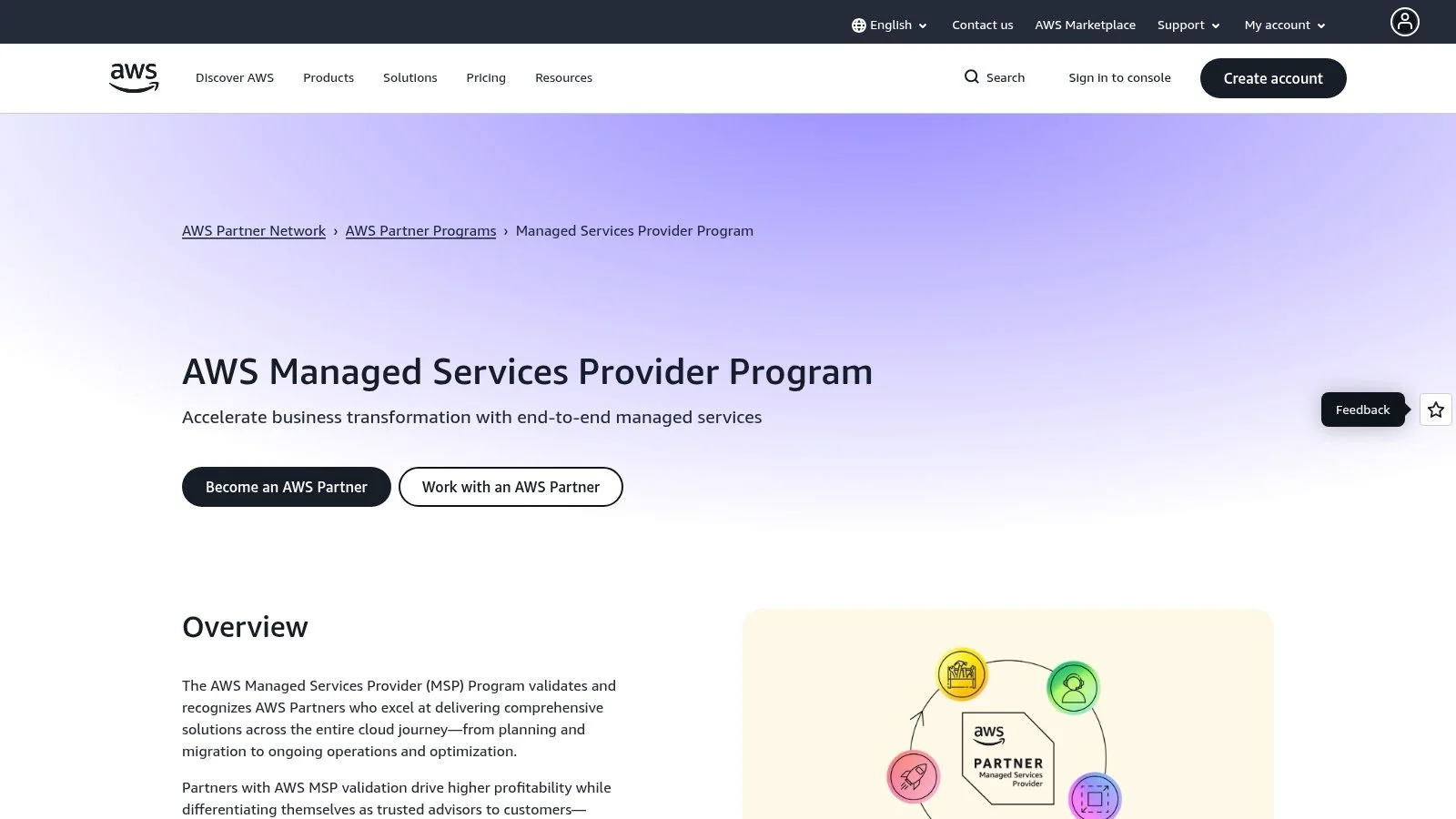
This validation provides a crucial layer of trust for technical leaders. Instead of starting with an unverified pool of providers, you begin with a curated group that has already proven its ability to manage complex AWS environments, from migration and modernization to cost optimization and compliance. For a deeper look at how these validated partners stack up, see our AWS managed services hub.
Key Platform Features & Use Cases
- AWS-Validated MSP Badge: This is the platform’s primary trust signal. The badge signifies that a provider has successfully completed a stringent, independent audit against AWS criteria. This is invaluable for enterprises in regulated sectors like finance or healthcare that cannot afford risks associated with unproven partners.
- Competency-Based Filtering: The Finder allows you to filter partners by specific, audited competencies such as “Migration” or “Security”. This helps you quickly identify MSPs with validated expertise in your immediate project area, such as a large-scale data center evacuation or achieving FedRAMP compliance.
- AWS Marketplace & Co-sell Integration: Many partners are integrated directly with AWS Marketplace, allowing for streamlined procurement and billing through your existing AWS account. The co-sell channel also means you may engage with a partner who works directly alongside your AWS account team, ensuring aligned strategic goals.
- Direct Access to AWS Specialists: The platform is a direct path to vetted cloud specialists. Profiles often detail the number of certified engineers and specific case studies, providing clear evidence of their hands-on experience with services like Amazon EKS, Lambda, or Redshift.
Actionable Tip: Look beyond the main MSP badge to specific AWS Competencies. A partner with the “DevOps Competency,” for example, is a much stronger candidate for a CI/CD pipeline automation project than one with only the base-level MSP validation. Match the competency to your specific technical initiative.
Platform Pros and Cons
| Strengths | Limitations |
|---|---|
| High Trust Signal: The mandatory third-party audit provides a strong guarantee of a partner’s technical and operational capabilities. | AWS-Centric: The finder is exclusively for AWS. A partner’s multi-cloud or on-premises capabilities are not validated and will vary significantly. |
| Improved Shortlist Quality: By filtering out unvetted providers, it significantly accelerates the creation of a high-quality RFP list. | No Transparent Pricing: All cost and pricing information requires direct engagement with the partner, making initial budget estimates difficult. |
| Alignment with AWS Roadmap: Certified partners are deeply integrated with AWS, often gaining early access to new services and features. | Varying Service Models: The definition of what is included in a “managed service” can differ greatly from one audited partner to the next. |
How to Use AWS Partner Solutions Finder Effectively
Define your primary challenge (e.g., “reduce cloud spend” or “migrate legacy applications”). Use the “Find a Partner” tool and filter by the most relevant competency, such as “Cloud Operations” for cost optimization or “Migration” for a lift-and-shift project. Once you have a shortlist, analyze their case studies and customer references specific to your industry. These details are often more telling than a partner’s marketing materials.
Website: https://aws.amazon.com/partners/programs/msp/
6. Microsoft Azure — Find Azure Expert MSPs and advanced specializations
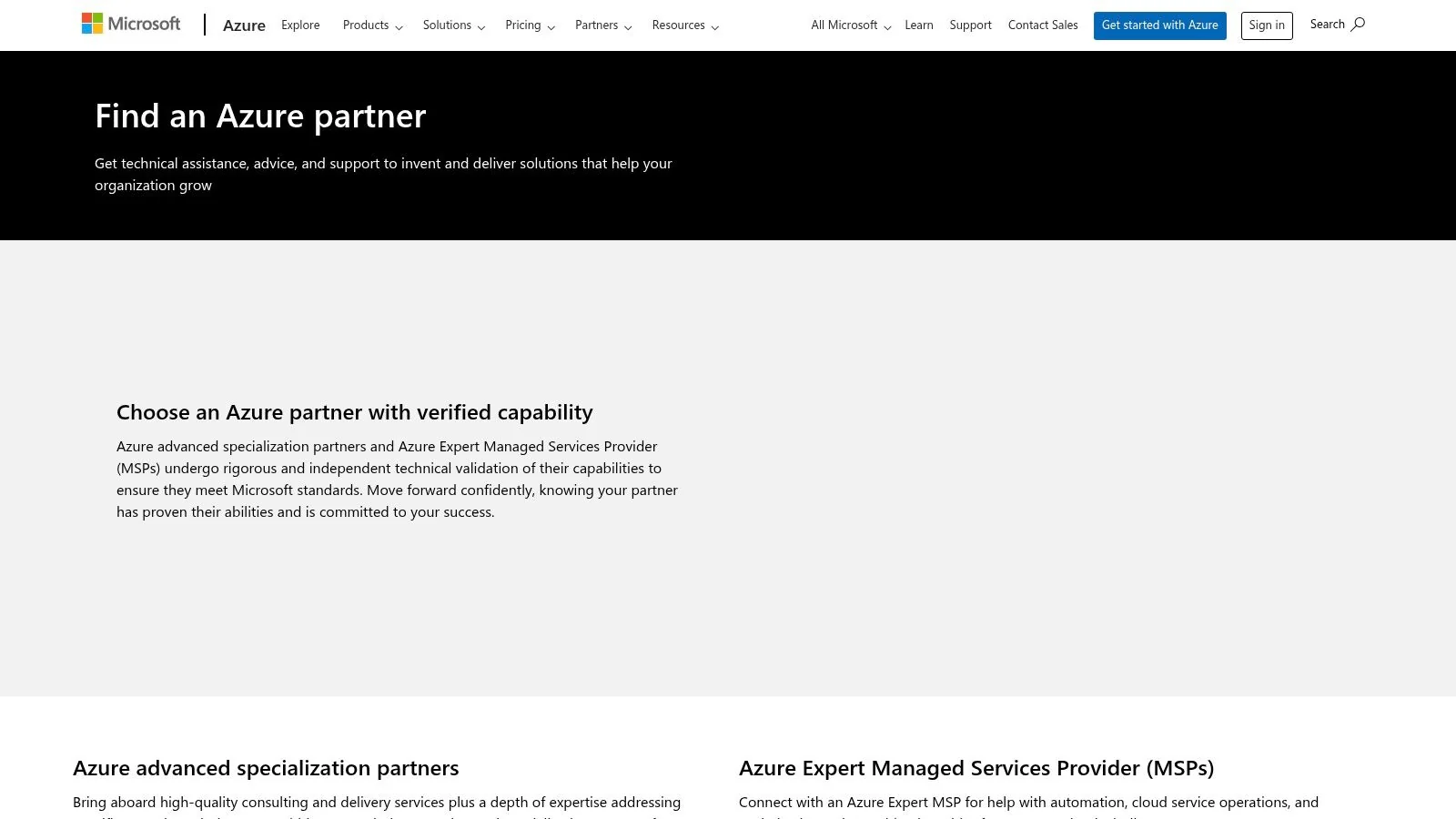
For organizations standardized on the Microsoft ecosystem, the official Azure Partner Directory is the authoritative source for identifying top managed service providers. It moves beyond generic claims by highlighting partners who have achieved the elite “Azure Expert MSP” designation. This isn’t just a badge; it represents a partner’s successful completion of a rigorous, third-party audit of their technical skills, operational processes, and customer support capabilities.
This platform is engineered for leaders who need to de-risk their Azure investments. By focusing on partners with verified specializations, it ensures you’re engaging with firms that have proven, repeatable success in complex areas like cloud migration, application modernization, and security management within the Azure framework.
Key Platform Features & Use Cases
- Azure Expert MSP Designation: This is the platform’s core value. Partners with this status have passed an intensive audit that validates their 24/7/365 operational capabilities, advanced cloud management tooling, and deep technical expertise. It’s a critical signal for enterprises needing high-availability managed services.
- Advanced Specialization Filters: You can filter for partners with specific, validated skills in high-stakes areas like “SAP on Azure,” “Windows Server and SQL Server Migration,” or “Threat Protection.” This is essential for projects requiring niche expertise and compliance adherence.
- Microsoft Cloud Partner Program Tiers: The directory provides visibility into a partner’s overall status within the Microsoft ecosystem, including “Solutions Partner” designations. This helps gauge the breadth of their Microsoft Cloud capabilities beyond just Azure, covering areas like Modern Work and Security.
- RFP Weighting Signal: The Expert MSP status and advanced specializations serve as powerful, objective criteria for vendor evaluation. Procurement teams can use these verified credentials to assign higher scores to qualified partners during the RFP and shortlisting process.
Actionable Tip: Don’t just look for the “Azure Expert MSP” badge. Cross-reference it with advanced specializations. A partner holding both the Expert MSP designation and the “Security” specialization is a strong candidate for managing workloads with stringent compliance and threat detection requirements.
Platform Pros and Cons
| Strengths | Limitations |
|---|---|
| Highest Signal of Azure Capability: The Expert MSP audit is a rigorous, objective measure of a provider’s skills. | Strictly Azure-Centric: A partner’s multi-cloud (AWS, GCP) capabilities are not detailed and will vary. |
| Efficient for Regulated Industries: Quickly find partners adept at deploying Microsoft’s security and compliance stack. | Opaque Pricing: All listings are “contact for quote.” Engagements require direct scoping and negotiation. |
| Reduces Vetting Time: Microsoft has already performed the initial deep technical and operational due diligence. | Focus on Technical, Not Business: The directory excels at highlighting technical skills, not vertical market expertise. |
How to Use the Azure Partner Directory Effectively
Begin by filtering for the “Azure Expert MSP” designation to create a baseline of highly qualified providers. Next, apply advanced specialization filters that match your primary project goal, such as “Cloud Native App Development” or “Analytics on Azure.” Review the resulting partner profiles to understand their scale and geographic presence. For a more complete picture, explore our in-depth guide to selecting Azure cloud managed services to prepare your technical and business questions before initiating contact with your shortlisted providers.
Website: https://azure.microsoft.com/en-us/partners
7. Google Cloud — Find a Partner (Partner Directory)
For organizations embedded in the Google Cloud Platform (GCP) ecosystem, Google’s own Partner Directory is an indispensable resource. It’s designed to connect businesses with top managed service providers that have proven, verified expertise specifically within Google’s suite of products. Unlike general-purpose directories, this platform’s primary value is its direct link to Google’s official partner validation and specialization programs.
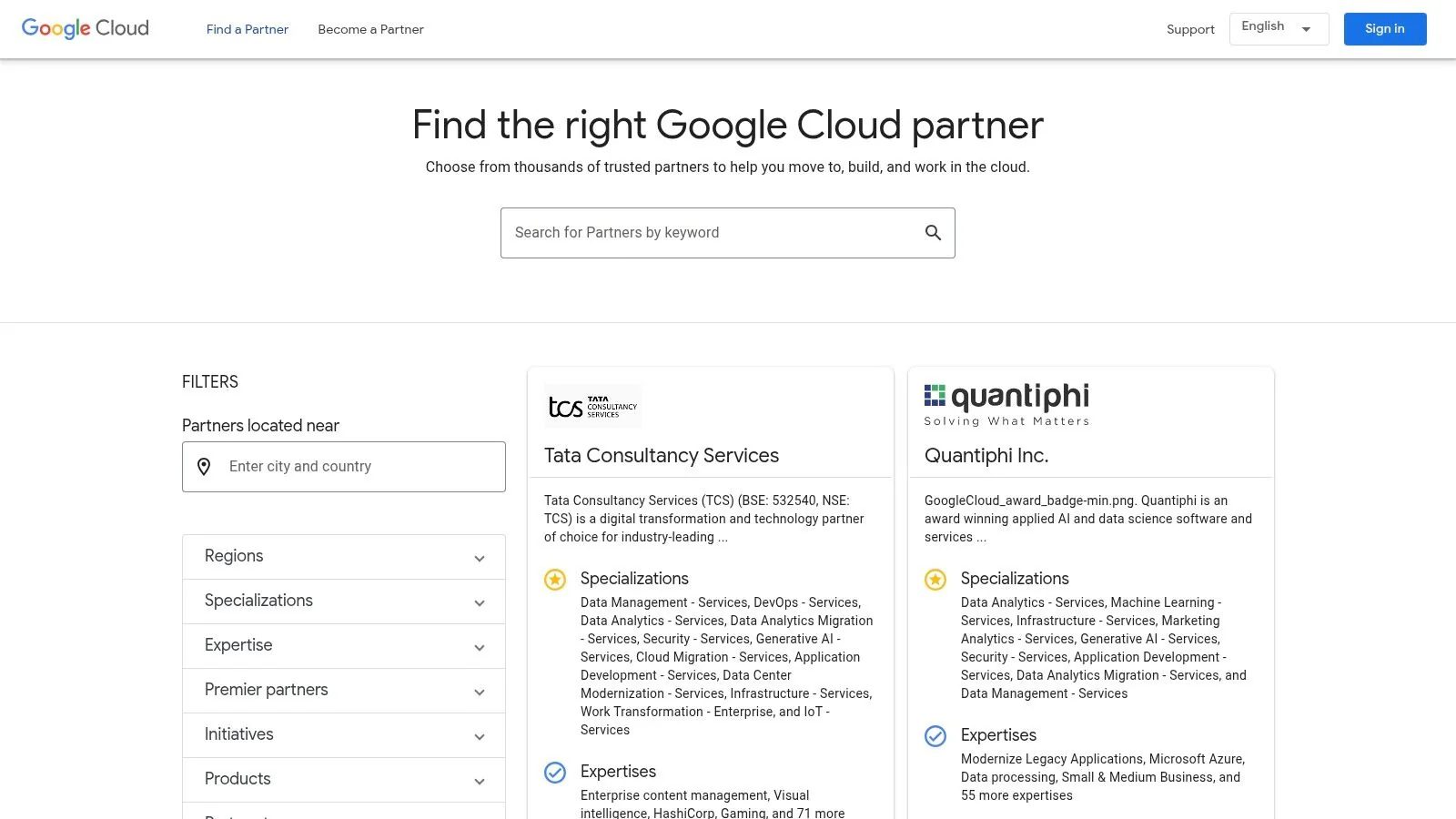
This directory moves beyond simple listings by integrating Google’s own credentialing system. For technical leaders, this means you can immediately identify MSPs with specific, hard-to-earn specializations like “Cloud Migration,” “Infrastructure,” or “Security.” This validation significantly de-risks the selection process, especially for mission-critical workloads on GCP.
Key Platform Features & Use Cases
- Specialization & Badge Filtering: The directory’s core strength is its filtering based on official Google-awarded credentials. Users can search for “Premier” partners (the highest tier) or those with specializations in areas like “Data Analytics” or “Machine Learning.” This is crucial for enterprises needing partners with documented success in complex or regulated environments.
- Product-Specific Search: You can filter for partners that manage specific Google products, from Google Cloud core infrastructure to Google Workspace. This allows a CTO to find a provider that not only manages their cloud servers but also has deep expertise in optimizing their organization’s collaboration and productivity tools.
- Geographic and Industry Focus: The directory allows for precise filtering by region and industry vertical. This helps businesses find local partners with an understanding of regional compliance needs or those with a track record in specific sectors like retail, media, or financial services, ensuring a better fit for their unique operational context.
Actionable Tip: Prioritize partners holding the “Managed Services Provider” specialization. This badge is not just a label; it signifies the MSP has passed a rigorous third-party audit of their technical capabilities, support processes, and customer success, providing a strong signal of operational maturity.
Platform Pros and Cons
| Strengths | Limitations |
|---|---|
| Official Partner Validation: Partner credentials and specializations are verified directly by Google. | Hidden Pricing Data: All listings operate on a “contact for quote” basis, making initial budget estimation difficult. |
| GCP-Specific Expertise: Ideal for finding MSPs with deep, focused knowledge of the Google Cloud ecosystem. | Navigational Nuances: The user interface can sometimes feel geared toward partners, making the buyer’s journey less direct. |
| Direct Access to Top-Tier Partners: Easily identifies Premier partners capable of handling complex enterprise needs. | Limited to Google Ecosystem: Exclusively features Google Cloud partners, requiring other directories for multi-cloud searches. |
How to Use Google Cloud Partner Directory Effectively
Begin your search by defining your primary technical need (e.g., “Kubernetes Engine management” or “BigQuery optimization”). Use the search function with that product name, then layer on filters for your region and industry. From the initial results, filter further by “Specialization,” prioritizing MSPs with relevant credentials. Review the top 3-5 partner profiles, noting their case studies and specific services before initiating contact to discuss project scope and pricing.
Website: https://cloud.google.com/find-a-partner
Top 7 MSP Directories Comparison
| Directory / Platform | Implementation complexity | Resource requirements | Expected outcomes | Ideal use cases | Key advantages |
|---|---|---|---|---|---|
| Clutch — Managed IT Services (MSP) directory | Low — browse, filter and request proposals | Low–Moderate — time to review profiles and case studies | Shortlist of U.S.-centric MSPs with verified client reviews | Shortlisting local MSPs and compliance-heavy verticals in U.S. metros | Strong U.S. coverage, granular filters and vetted reviews |
| G2 — Managed IT Services Providers | Low — view live rankings and user syntheses | Low–Moderate — read user reviews and satisfaction scores | Reputation-driven comparisons and quick vendor outreach | Cross-comparing vendor reputations globally and segmentation by customer size | Up-to-date user reviews, G2 Scores and built-in quote CTAs |
| UpCity — Managed Service Providers | Low — paginated marketplace with filters | Low–Moderate — review profiles, awards and contact options | Regional MSP shortlist with consolidated credibility signals | Finding regional U.S. MSPs and quick vendor contact | Combined review signals and Gartner Digital Markets exposure |
| Gartner Peer Insights — Managed Services categories | Moderate — filter role-verified reviews across markets | Moderate–High — executive due diligence; some gated content | Role-verified, enterprise-grade validation and ratings | CIO/CTO due diligence for complex, hybrid or cloud-managed services | High-quality, role-verified reviews and market-specific insights |
| AWS Partner Solutions Finder — Validated AWS MSP Partners | Low–Moderate — filter by competencies and industry | Moderate — rely on partner audits; require scoping for pricing | Shortlist of AWS-validated MSPs for cloud operations and migrations | AWS-centric migrations, 24/7 operations and audited practices | AWS validation/audit badge and Marketplace/co-sell integration |
| Microsoft Azure — Find Azure Expert MSPs | Low–Moderate — search by Expert MSP and specializations | Moderate — partners validated; engagements need scoping | Vetted Azure-focused partners for migration, security and ops | Organizations standardizing on Microsoft Cloud, regulated industries | Azure Expert MSP designation and advanced specialization signals |
| Google Cloud — Find a Partner (Partner Directory) | Low–Moderate — filter by product, region and badges | Moderate — contact partners for proposals; navigation may vary | GCP-validated managed service partners and specializations | Managed services for Google Cloud and Google Workspace workloads | Partner badges/specializations and product-specific filtering |
How do you successfully evaluate and select a managed service provider?
Successfully evaluate and select a managed service provider by demanding proof of technical depth over breadth, verifying their operational alignment through their incident response SOPs, and examining anonymized performance data from similar clients. This evidence-based vetting ensures a reliable long-term partnership.
You’ve navigated the foundational directories, from broad-based platforms like Clutch and G2 to the hyperscaler-specific portals of AWS, Azure, and Google Cloud. This initial discovery is crucial, but it’s just the starting grid. The difference between a competent vendor and a transformative strategic partner lies in the granular details that high-level directories cannot fully capture.
No single platform provides a complete picture. Gartner offers peer-driven qualitative insights, while the AWS Partner Solutions Finder provides deep technical validation. UpCity surfaces localized expertise but may lack enterprise-scale data. Your task is to synthesize these disparate data points into a coherent, actionable vetting process — or you can get matched to a shortlist based on your specific requirements in under two minutes. This means moving beyond brand names and marketing slicks to rigorously assess the factors that directly impact your operational success.
From Vetting to Validating: An Actionable Framework
Transitioning from a long list to a shortlist requires a shift from discovery to forensic analysis. Your focus must now pivot to validating claims and aligning capabilities with your specific technical and business context. The goal is to de-risk your investment and ensure the chosen MSP can deliver on their promises not just on day one, but in year three and beyond.
Prioritize these critical validation points as you move forward:
- Technical Depth Over Breadth: A provider listing “multi-cloud expertise” is common. A provider with engineers holding current, advanced certifications like the AWS Certified Security - Specialty or Azure Solutions Architect Expert is verifiable. Demand to see anonymized resumes or certification counts for the team that would be assigned to your account.
- Proof of Performance, Not Just Promises: Case studies are useful, but validated project outcomes are better. Ask for performance data aligned with your KPIs. If cost optimization is your goal, request anonymized data showing a client’s cloud spend reduction (e.g., “achieved 28% TCO reduction for a SaaS client in the fintech space by implementing a FinOps framework and reserved instance strategy”).
- Cultural and Operational Alignment: How does the MSP handle escalations at 3 AM? What is their process for communicating during a critical incident? These operational details are more telling than any sales pitch. Request a copy of their standard operating procedures (SOPs) for incident management or their communication matrix. This reveals their maturity and a preview of your working relationship.
Key Insight: The best managed service providers don’t just manage your infrastructure; they become an extension of your engineering team. This integration is impossible to gauge from a directory listing alone. It requires deep, evidence-based conversations centered on process, expertise, and proven outcomes.
Ultimately, selecting from the top managed service providers is less about finding a “best” provider and more about identifying the right partner for your unique ecosystem. A mid-market e-commerce company has vastly different compliance and scalability needs than an enterprise healthcare organization. Your selection criteria must be weighted accordingly, transforming this final evaluation phase from a vendor bake-off into a strategic alignment exercise. This rigorous, data-driven approach ensures you forge a partnership that accelerates innovation, strengthens security, and delivers a measurable return on your cloud investment.
Don’t let your search end with generic lists. CloudConsultingFirms.com helps you move from a broad candidate pool to a defensible shortlist. Compare 50 firm profiles by platform focus, partner designations, pricing signals, documented project outcomes, and explicit best-fit and wrong-fit assessments. Explore the directory.
Frequently Asked Questions
What are clutch - managed IT services (MSP) directory?
Clutch has established itself as a B2B research and review platform, particularly for companies seeking to identify and shortlist top managed service providers. Its primary strength lies in a vast, U.S.-centric directory of over 8,000 MSPs, coupled with a robust system of verified client reviews.
What are key platform features & use cases?
Granular Filtering: Users can slice the directory by location (e.g., "MSPs in Denver"), industry focus (e.g., healthcare, finance), hourly rate, team size, and specific technology stacks (e.g., AWS, Azure, Google Cloud). This is crucial for businesses in regulated industries like healthcare (HIPAA) or finance (PCI-DSS) that require partners with verified compliance expertise.
How do you use clutch effectively?
Approach Clutch with a clear set of technical and compliance requirements. Start with a broad search based on your core service need (e.g., "Cloud Consulting") and location. Apply successive filters for budget, industry, and team size to narrow the field.
What are G2 — managed IT services providers?
G2 operates as a software and services marketplace, where its Managed IT Services category serves as a dynamic, review-driven hub for identifying top managed service providers. Its core differentiator is the "G2 Grid," a real-time, algorithmically-generated chart that plots providers based on user satisfaction scores and market presence.
How do you use G2 effectively?
Begin by navigating to the Managed IT Services category and applying the "Company Size" filter to match your organization. Use the G2 Grid to identify providers in the "Leaders" and "High Performers" quadrants. For each of these, analyze the synthesized pros and cons and read several recent, detailed reviews.
Peter Korpak
Founder
Data-driven market researcher with 15+ years helping software agencies and IT organizations make evidence-based decisions. Former market research analyst at Aviva Investors and Credit Suisse. Built the 50 cloud consulting firm profiles published on cloudconsultingfirms.com from publicly available evidence.
Connect on LinkedInContinue Reading
View all insights →AWS
Top AWS consulting firms and rankings
Traits of High Performing Teams for Cloud Consulting
Don't gamble on your cloud partner. Learn the 7 critical traits of high performing teams and get a checklist to evaluate consultants for AWS, Azure, or GCP.
IT Consulting Firms: How to Vet, Compare & Hire [2026]
IT consulting firms compared on certifications, service scope, and pricing. Data-driven vetting criteria, cost benchmarks, and hire checklist.
Stay ahead of cloud consulting
Quarterly rankings, pricing benchmarks, and new research — delivered to your inbox.
No spam. Unsubscribe anytime.