What Is Hybrid Cloud Architecture: An Actionable Guide
A hybrid cloud architecture integrates an organization’s on-premises private cloud with services from one or more public cloud providers, such as those offered through AWS Cloud Consulting Services. The objective is to create a single, unified, and flexible infrastructure where applications and data can move between these environments based on business needs. This model provides a strategic balance of control and scalability, especially when following AWS migration best practices for implementation.
A Practical Definition of Hybrid Cloud
Consider a retail business. It operates a central, secure warehouse for high-value inventory and critical operations—this is the private cloud. Simultaneously, it uses temporary storefronts in various locations to manage seasonal demand—these are the public clouds.
A true hybrid model isn’t just about having both; it’s about a connected system where inventory and data flow seamlessly between them. When demand spikes at a storefront, more stock is pulled from the warehouse. When demand is low, operations scale back. That is the core principle of a hybrid cloud.
This strategy is the standard for modern IT. Approximately 73% of organizations have adopted a hybrid cloud model, and selecting the right consulting partner can accelerate successful implementation. This reflects a shift away from single-environment strategies (all-private or all-public) toward distributed systems that balance security with on-demand scalability. For more context, see these enterprise cloud trends on faddom.com.
How Hybrid Cloud Compares to Other Models
To understand hybrid cloud, it’s useful to compare it against other deployment models. The right choice depends on specific business requirements, security posture, and existing infrastructure.
The key differentiator is orchestration. A hybrid cloud is a deliberately integrated system where private and public resources function as one. In contrast, a multi-cloud strategy often involves using services from different cloud vendors without deep integration.
This diagram illustrates how a hybrid strategy acts as the connective tissue, linking public, private, and even multi-cloud environments into a cohesive whole.
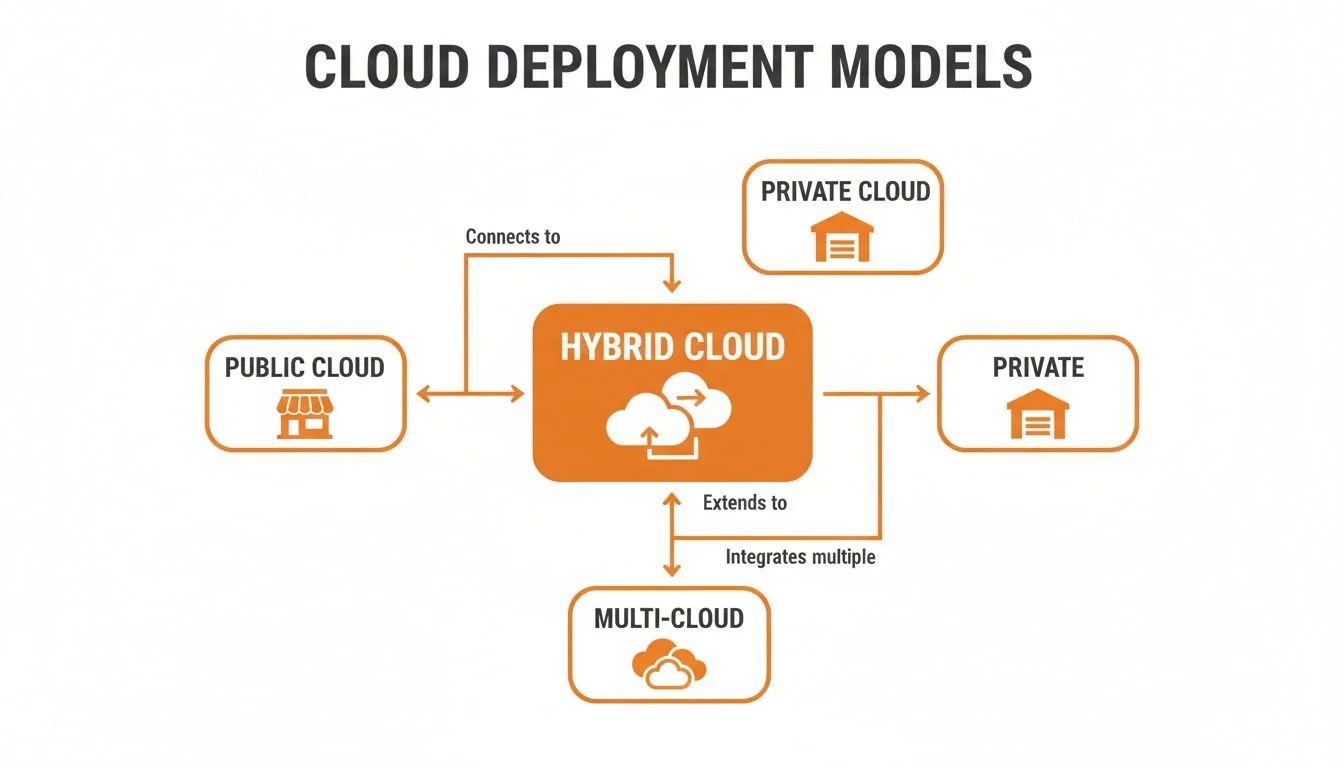
The hybrid model serves as a central hub, allowing organizations to place workloads in the optimal environment based on performance, cost, security, or compliance criteria.
Cloud Models At a Glance: Hybrid vs Multi-Cloud vs Private vs Public
This table provides a direct comparison of the four main cloud models and their primary use cases.
| Model | Core Concept | Best For | Primary Trade-Off |
|---|---|---|---|
| Public Cloud | Resources owned and operated by a third-party provider (AWS, Azure, GCP) and shared among customers. | Applications with variable traffic, disaster recovery, and development/test environments. | Less control over hardware and data sovereignty; potential for resource contention. |
| Private Cloud | Infrastructure dedicated to a single organization, either on-premises or hosted by a third party. | Regulated industries, sensitive data, and mission-critical workloads requiring maximum control. | Higher capital expenditure and operational overhead; limited elasticity. |
| Hybrid Cloud | Integrates a private cloud with one or more public clouds, enabling workload portability. | Balancing security and scalability; modernizing legacy apps; handling unpredictable traffic spikes. | Increased complexity in management, networking, and security across environments. |
| Multi-Cloud | Using services from more than one public cloud provider (e.g., AWS for compute, GCP for data analytics). | Avoiding vendor lock-in, optimizing costs, and accessing best-of-breed services. | Significant operational complexity and potential for skill gaps across platforms. |
Choosing the right model is an ongoing strategic process that evolves with business needs. Hybrid cloud provides a flexible foundation for that evolution, bridging the control of a private data center with the agility of the public cloud.
The Core Components of a Hybrid Cloud
A robust hybrid cloud architecture is more than a simple connection between a private data center and a public cloud. It’s an engineered system built on four essential pillars that enable a single, manageable environment.
Executing these components correctly is the blueprint for a resilient and efficient hybrid infrastructure.
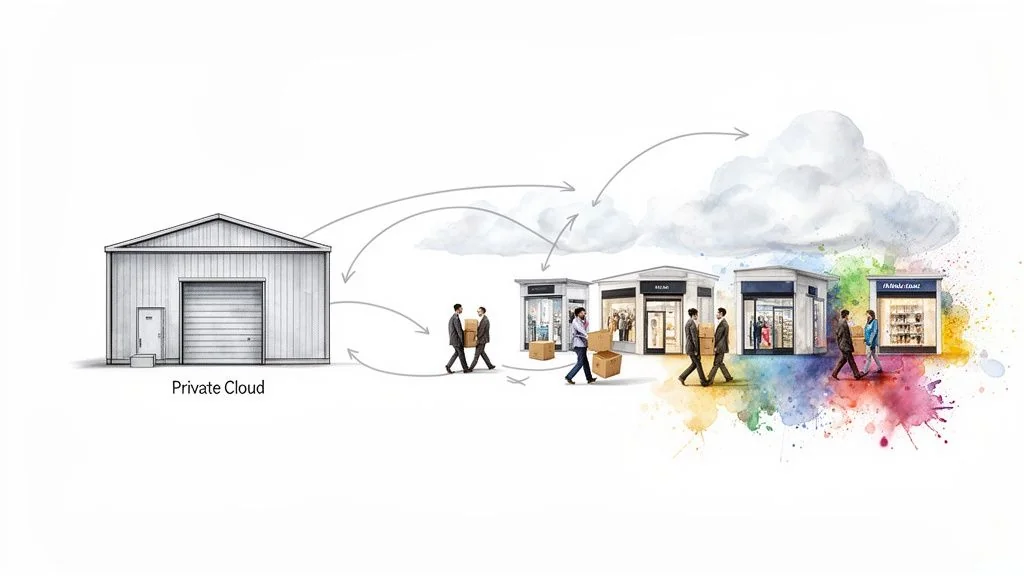
Building this is analogous to creating a national logistics network. It requires private transport routes, a universal identity system, a central control tower, and standardized containers. In hybrid cloud, these translate to secure networking, unified identity, orchestration, and data integration.
Secure and High-Performance Networking
The foundation of any hybrid cloud is the network connecting private and public environments. This requires more than a standard internet connection; it must be a private, secure link engineered for low latency and high reliability. Without it, data and applications cannot move freely, and the model fails.
The objective is to make the public cloud a secure, logical extension of the on-premises data center. This is achieved through two primary technologies:
- Virtual Private Networks (VPNs) create encrypted tunnels over the public internet, providing a secure and cost-effective method for linking environments.
- Dedicated Connections like AWS Direct Connect, Azure ExpressRoute, or Google Cloud Interconnect establish a private, physical link to the cloud provider. They offer superior performance and consistency, making them the standard for mission-critical workloads.
This secure link is the bedrock, ensuring data in transit is protected and applications perform as expected.
Unified Identity Management
With environments connected, controlling access across the entire infrastructure is critical. This is the function of unified identity management. It acts as a universal access control system for the entire hybrid environment, ensuring a single set of policies applies everywhere.
Instead of managing separate user accounts and permissions for on-premises systems and each public cloud, a unified system centralizes administration. This enhances security by eliminating policy gaps and simplifies operations. Teams manage a single identity per user, providing seamless and secure access to resources regardless of their location.
A unified identity plane is non-negotiable for security and compliance. It ensures that when an employee’s access is revoked, it is revoked everywhere simultaneously, closing a common and critical security vulnerability in distributed systems.
Centralized Orchestration and Management
With a secure network and unified access control, the next challenge is managing the flow of applications and data. Orchestration and management platforms serve as the control plane for the hybrid cloud. These tools provide a single interface to deploy, monitor, and automate workloads across all environments.
Containerization, particularly Kubernetes, is the key enabling technology. Kubernetes packages applications into portable containers that run consistently on any infrastructure.
Platforms built on this principle extend management across different environments:
- Azure Arc enables management of non-Azure resources (including on-premises servers and other clouds) from the Azure control plane.
- AWS Outposts extends AWS hardware and services into a customer’s data center for a consistent hybrid experience.
- Google Anthos provides a platform to run containerized applications on-premises and in the cloud using Kubernetes.
These tools are crucial for preventing operational silos and managing distributed infrastructure as a single, cohesive unit.
Consistent Data Integration and Management
Finally, data must move efficiently and securely wherever it is needed. Data integration strategies ensure information remains consistent, accessible, and protected as it traverses private and public clouds. This involves creating standardized transport and storage protocols for data.
This requires a clear strategy for data replication, synchronization, and backup that functions across different storage systems and locations. By establishing common data formats, APIs, and security protocols, applications in the public cloud can reliably access data stored on-premises, and vice versa. This consistency is vital for functions ranging from disaster recovery to complex analytics.
Where Should Your Workloads Live? A Guide to Smart Placement
The most critical decision in a hybrid cloud strategy is determining where each application and its data reside. This process, known as workload placement, is a strategic choice that directly impacts cost, performance, and security.
Think of it as organizing a professional kitchen. The high-security, temperature-controlled storage—your private cloud—holds sensitive and valuable ingredients. The large, flexible prep areas—your public cloud—are used for high-volume, time-sensitive tasks. The goal is to place each element where it functions most efficiently without compromising safety or quality.
Mapping Applications to the Right Cloud Environment
Effective workload placement starts with a candid assessment of each application. Not all workloads are equal. Some require the strict control of an on-premises data center, while others are designed for the elasticity of the public cloud. A successful hybrid architecture leverages these differences.
For instance, a financial services firm will almost certainly maintain its core transaction processing systems and sensitive customer data on-premises. These legacy systems are often tightly integrated with private infrastructure and subject to stringent regulatory requirements. The private cloud is their logical home.
Simultaneously, the same firm can host its customer-facing mobile banking application in the public cloud. This allows it to scale instantly to handle high-traffic events, like paydays, and then scale down. This avoids the capital expenditure of purchasing and maintaining servers that would remain idle 95% of the time.
Key Scenarios for Strategic Workload Placement
Matching a workload’s characteristics to an environment’s strengths is how you unlock the value of a hybrid model. Here are common and effective placement scenarios.
- Data Sovereignty and Compliance: Workloads handling sensitive data, such as personal health information (PHI) or payment card details (PCI DSS), belong in a private cloud or on-premises data center. This provides complete control over the physical location of data, which is a non-negotiable requirement for regulations like GDPR or HIPAA.
- Scalability for Variable Demand: Applications with unpredictable traffic, like e-commerce sites during holiday sales or media streaming services, are ideal candidates for the public cloud. You can automatically scale resources to meet demand and pay only for what you use, avoiding the cost of overprovisioning private infrastructure.
- Cost-Effective Disaster Recovery: Instead of building and maintaining a duplicate, expensive data center for disaster recovery (DR), use the public cloud. Replicating critical systems to the cloud provides a more affordable and resilient business continuity solution that can be activated on demand.
The core advantage of a hybrid model is its flexibility. The public cloud can be treated as a logical extension of your data center, providing access to nearly infinite resources for specific tasks without long-term capital commitment.
Using the Public Cloud for Heavy Lifting
Beyond hosting applications, the public cloud is ideal for resource-intensive jobs that are impractical or cost-prohibitive to run on-premises. This tactic, often called cloud bursting, is a hallmark of a mature hybrid strategy.
A primary example is training an AI model. This process requires immense computational power for a limited time. Instead of purchasing dozens of high-end GPUs that would be underutilized, you can “burst” this workload to a public cloud provider. Once the model is trained, the finished product is brought back in-house to run on private infrastructure.
The same logic applies to other temporary, high-demand workloads like big data analytics, video rendering, or quarterly financial reporting. For a detailed comparison of provider capabilities, our guide to compare cloud service providers breaks down their strengths for these specialized tasks.
Building a Unified Security and Compliance Strategy
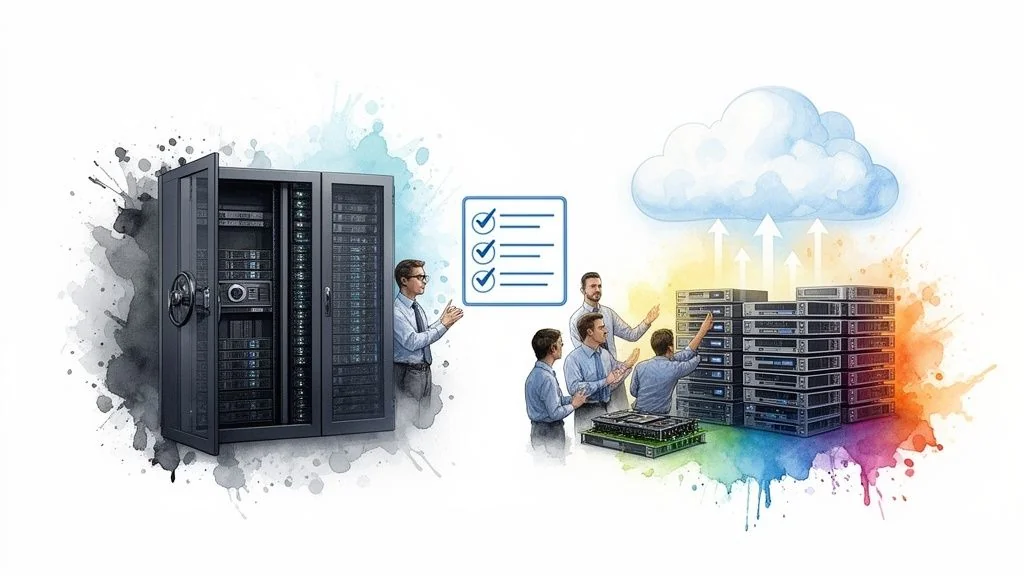
When workloads are distributed between on-premises data centers and a public cloud, managing security becomes complex. For regulated industries, this complexity introduces significant business risk. A successful hybrid cloud strategy requires a single, robust security posture that covers all environments, ensuring consistent policy enforcement.
This is not about managing two separate security plans. It’s about creating one unified framework to monitor threats, enforce policies, and protect data as if it were all in a single location. Failure to do so creates security gaps and vulnerabilities.
Centralizing Threat Monitoring and Response
A distributed environment challenges security teams. Attackers do not differentiate between an on-premises server and a cloud instance; therefore, your monitoring must not either. The solution is a centralized security information and event management (SIEM) system that aggregates logs and alerts from every component of your hybrid infrastructure.
This “single pane of glass” provides a unified command center for security operations, enabling teams to:
- Correlate events across different environments to detect sophisticated, multi-stage attacks.
- Apply consistent alerting rules everywhere, ensuring a threat in the cloud receives the same response as one on-premises.
- Accelerate incident response by having all relevant data consolidated in one place.
Unified visibility is the first and most critical step toward managing risk in a hybrid environment.
Enforcing Consistent Policies Everywhere
Access control, data handling, and network configuration policies must be identical, regardless of where an application runs. A common failure in hybrid cloud adoption is “policy drift,” where security rules for the cloud are less stringent than those for the data center. This creates a clear vulnerability.
To prevent this, organizations should use policy-as-code tools. These tools allow you to define security and compliance rules as code and then automatically apply them across both private infrastructure and public cloud accounts. This ensures that every new resource—server, storage account, or network—is configured to your security standards from the moment of its creation.
The shared responsibility model is more complex in a hybrid environment. You are responsible for on-premises security, while the cloud provider secures their infrastructure. However, you are always ultimately responsible for securing the data and applications you place in the cloud and the connections between environments.
Protecting Data In Transit and At Rest
With data flowing continuously between private and public clouds, strong encryption is mandatory. Data must be protected at every stage.
- End-to-end encryption protects data as it moves through dedicated network connections or VPNs, rendering it unreadable to unauthorized parties.
- Encryption at rest secures data stored in cloud databases, object storage, and on-premises servers using strong cryptographic keys under your management.
Before moving any sensitive data, a thorough risk assessment is essential. Our guide on performing a cloud migration risk assessment provides a framework for this process. For businesses subject to regulations like HIPAA, GDPR, or PCI DSS, engaging with experts who specialize in these frameworks is the only way to ensure compliance and avoid significant penalties.
Analyzing the Real Costs and Operational Tradeoffs
Adopting a hybrid cloud is a financial decision as much as a technical one. The initial appeal is the shift from large, upfront hardware purchases (CapEx) to a more predictable pay-as-you-go subscription model (OpEx). This model allows companies to avoid buying expensive servers to handle peak loads that occur infrequently.
Instead of building a data center to handle annual traffic spikes, you can leverage the public cloud’s elastic capacity on demand. This financial flexibility is a primary driver for hybrid adoption, as it aligns spending directly with resource consumption. However, a complete total cost of ownership (TCO) analysis reveals a more complex financial picture.
Uncovering the Hidden Costs
The pay-as-you-go model can obscure other significant expenses. A realistic budget must account for these “hidden” costs, which often appear on monthly invoices if not carefully managed.
The most common hidden cost is data egress fees. These are charges incurred when moving data out of a public cloud. For applications that frequently transfer large datasets between on-premises systems and the cloud, these fees can accumulate rapidly and become a major, unplanned expense.
A successful hybrid financial model requires full cost transparency. The total cost includes not only compute and storage but also networking, data transfer, and the specialized talent needed to manage the integrated environment.
Factoring in Operational Complexity and Talent
Managing a distributed environment is inherently more complex than managing a single data center. This operational overhead translates into costs, typically in the form of specialized engineering talent and advanced management software.
Your team needs expertise not only in your on-premises infrastructure but also in the specific public cloud platforms you use, such as AWS, Azure, or Google Cloud. The demand for multi-platform talent can increase salary and training budgets. You will also likely need to invest in a unified management platform to maintain visibility and prevent operational silos. For a deeper dive, explore these cloud cost optimization strategies.
The Bigger Picture on Cloud Spending
The global adoption of hybrid cloud is reshaping IT budgets. In a recent quarter, enterprise spending on cloud infrastructure reached between $95.3 to $99 billion, a year-over-year increase of 22-25%. A significant portion of this growth is driven by hybrid cloud deployments, indicating a substantial allocation of modern IT budgets to these mixed environments.
This trend signals the need for disciplined governance. While hybrid cloud offers powerful tools for cost control, it also requires a rigorous TCO analysis that accounts for all direct and indirect costs to ensure it delivers on its financial promise.
How to Choose the Right Hybrid Cloud Partner
Embarking on a hybrid cloud initiative without an experienced partner is a high-risk endeavor. The right partner is a critical factor in a project’s success. This requires more than technical proficiency; it demands a partner who functions as an extension of your team, understands your business objectives, and can mitigate implementation risks.
The hybrid cloud market is growing rapidly, with a recent valuation between $134.22 and $172.77 billion and projections for significant future expansion. You can find more details in these hybrid cloud statistics from pump.co. This growth has led to a crowded vendor landscape, making a structured evaluation process essential to identify a partner capable of delivering a positive return on investment.
Vetting Technical Expertise and Platform Fluency
First, a partner must have proven, hands-on experience across multiple cloud environments. A true “hybrid” expert must demonstrate deep knowledge beyond a single public cloud. Look for firms with certified professionals across the major platforms: AWS, Azure, and Google Cloud.
Certifications are only a baseline. Real-world experience with the core technologies that enable hybrid cloud is what matters. Ask specific, project-based questions:
- Modern Orchestration Tools: Can they demonstrate experience using tools like Kubernetes, Azure Arc, or AWS Outposts to create a unified management plane?
- Complex Networking: Can they provide examples of projects where they implemented secure, low-latency connections like AWS Direct Connect or Azure ExpressRoute?
- Data Integration: How have they addressed the challenges of data synchronization and management between on-premises databases and cloud storage?
A partner who provides concrete project examples is far more credible than one who relies on theoretical knowledge.
Evaluating Industry and Compliance Specialization
Technical skill alone is insufficient. A partner must understand the specific security and compliance requirements of your industry. A firm with experience navigating HIPAA for a healthcare client or PCI DSS for a financial services company brings battle-tested knowledge that is invaluable.
A strong partner does not simply execute your requests. They challenge your assumptions and apply industry best practices to help you avoid costly compliance errors before they occur.
When evaluating potential partners, review their portfolio for detailed case studies of complex migration projects similar to yours. These should clearly define the initial problem, the implemented solution, and the measurable business outcomes.
The Partner as a Strategic Ally
Ultimately, the best partner is a strategic advisor, not just a vendor. The selection process should feel like hiring a key team member. Evaluate their approach to knowledge transfer and their long-term support model.
To ensure a good fit, consider these factors:
- Cultural Alignment: Does their communication style and project management methodology align with your team’s workflow?
- Post-Migration Support: What services do they offer after the initial project is complete, such as managed services or ongoing optimization?
- Transparent Pricing: Is their pricing model clear and understandable? Can they demonstrate a track record of delivering projects on budget without unexpected fees?
Choosing the right partner is a long-term investment. By rigorously vetting their technical depth, industry knowledge, and strategic alignment, you can select a firm that will not only build your hybrid cloud but also help you maximize its value for years to come.
Frequently Asked Questions About Hybrid Cloud
Beyond the definitions, practical questions arise when moving from theory to implementation. This section addresses common inquiries from leaders planning a hybrid cloud strategy.
What’s the Main Difference Between Hybrid Cloud and Multi-Cloud?
While the terms are often used interchangeably, they describe distinct IT infrastructure strategies.
Multi-cloud refers to using services from more than one public cloud provider. For example, a company might run its primary applications on AWS while using Google Cloud for its specialized machine learning services. In this model, the cloud environments typically operate independently with minimal interaction.
A hybrid cloud is a specific architecture that tightly integrates a private, on-premises data center with at least one public cloud. This integration creates a single, orchestrated environment where workloads and data can be moved seamlessly between them. The key differentiator is this deliberate, deep integration.
What Are the Biggest Mistakes to Avoid When Implementing Hybrid Cloud?
A successful hybrid strategy depends more on avoiding common pitfalls than on the technology itself. Here are three critical mistakes to avoid:
-
Underestimating Network Complexity: The connection between your private data center and the public cloud is the backbone of the entire architecture. A slow, unreliable, or insecure link will cause systemic failure. Relying on a standard internet connection instead of investing in a dedicated, high-performance link is a common and costly error.
-
Lacking a Unified Management Strategy: Without a single control plane to manage both environments, you are operating two separate systems, not a true hybrid cloud. This leads to operational silos, increased administrative overhead, and makes effective automation impossible.
-
Ignoring Hidden Costs: The advertised price for cloud services is only part of the total cost. Budgets are frequently exceeded by unmanaged expenses like data egress fees—charges for transferring your own data out of a public cloud. A comprehensive total cost of ownership (TCO) analysis must account for these variables.
The objective is to create one cohesive system, not to loosely connect two disparate ones. Success requires planning for deep integration from day one, spanning technology, operations, and finance.
How Does Containerization Support a Hybrid Cloud Strategy?
Containerization has become the enabling technology for an effective hybrid cloud. Tools like Docker and orchestration platforms like Kubernetes are fundamental to realizing the model’s potential.
Containers package an application and all its dependencies into a single, portable unit. This self-contained package can run consistently on any infrastructure—on-premises servers, AWS, Azure—without modification.
This technology delivers on the “build once, deploy anywhere” promise. With Kubernetes managing containerized applications, you can move them seamlessly between private and public clouds. This liberates workloads from being tied to a single environment, providing the flexibility to place them where it makes the most sense based on performance, cost, or compliance requirements.
Finding the right expertise is critical to navigating the complexities of hybrid cloud architecture. CloudConsultingFirms.com offers an independent, data-driven guide to help you select the perfect cloud consulting partner for AWS, Azure, or Google Cloud. Compare top firms based on 2,400+ reviews, verified certifications, and project outcomes to de-risk your investment and accelerate your success. Find your certified hybrid cloud partner on CloudConsultingFirms.com.
Frequently Asked Questions
How hybrid cloud compares to other models?
To understand hybrid cloud, it's useful to compare it against other deployment models. The right choice depends on specific business requirements, security posture, and existing infrastructure.
What are cloud models at a glance?
This table provides a direct comparison of the four main cloud models and their primary use cases.
What is secure and high-performance networking?
The foundation of any hybrid cloud is the network connecting private and public environments. This requires more than a standard internet connection; it must be a private, secure link engineered for low latency and high reliability. Without it, data and applications cannot move freely, and the model fails.
What is unified identity management?
With environments connected, controlling access across the entire infrastructure is critical. This is the function of unified identity management. It acts as a universal access control system for the entire hybrid environment, ensuring a single set of policies applies everywhere.
What is centralized orchestration and management?
With a secure network and unified access control, the next challenge is managing the flow of applications and data. Orchestration and management platforms serve as the control plane for the hybrid cloud. These tools provide a single interface to deploy, monitor, and automate workloads across all environments.
Peter Korpak
Founder
Data-driven market researcher with 15+ years helping software agencies and IT organizations make evidence-based decisions. Former market research analyst at Aviva Investors and Credit Suisse. Analyzed 200+ verified cloud projects (migrations, implementations, optimizations) to build Cloud Intel.
Connect on LinkedInContinue Reading
AWS
Top AWS consulting firms and rankings
10 AWS Migration Best Practices for a Flawless 2025 Cloud Journey
Discover the essential AWS migration best practices for CTOs. This guide provides an actionable, no-fluff playbook on strategy, security, and cost.
Top AWS Consulting Partners: A Framework for Choosing the Right Expert
Discover top aws consulting partners with data-backed rankings to choose the right fit for your budget and tech needs.
Stay ahead of cloud consulting
Quarterly rankings, pricing benchmarks, and new research — delivered to your inbox.
No spam. Unsubscribe anytime.