10 Actionable Cloud Migration Best Practices
A successful cloud transition unlocks agility and innovation, but a misstep leads to budget overruns, security vulnerabilities, and operational disruption. The difference lies in a disciplined, strategic approach. This guide delivers a definitive list of evergreen, actionable cloud migration best practices.
This is not generic advice. The following sections are grounded in real-world projects and designed for immediate implementation. Whether you are moving your first workload or optimizing a multi-year transformation, these principles provide a clear roadmap. We will move beyond basic “lift and shift” to cover the critical pillars of a successful cloud strategy.
This is a practical playbook. Each best practice is structured to provide clarity and direction, helping you avoid common pitfalls and ensure your cloud journey delivers maximum business value.
1. Conduct a Comprehensive Cloud Readiness Assessment
A cloud readiness assessment is the foundational first step. It is a systematic evaluation of your current IT landscape, organizational processes, and business objectives to determine your capacity for a smooth transition. This is not just a technical inventory; it is a strategic analysis that prevents costly surprises and scope creep.
This process establishes a baseline, identifying which applications are ready for migration, which require rework, and which should remain on-premises. By mapping application dependencies, evaluating infrastructure, and assessing your team’s cloud skills, you create an evidence-based foundation for your strategy. This initial diligence is a cornerstone of effective cloud migration best practices.
Why it’s a critical first step
Skipping a thorough assessment leads to unforeseen technical debt, security vulnerabilities, and budget overruns. A formal assessment provides a data-driven roadmap that aligns technical execution with business outcomes. For example, an assessment might reveal that a critical legacy application has an unknown dependency on an outdated database, a discovery that changes its migration approach from a simple “lift-and-shift” to a more complex refactoring effort.
How to implement a cloud readiness assessment
To execute an effective assessment, focus on these key actions:
- Automated Discovery: Deploy tools like AWS Application Discovery Service, Azure Migrate, or third-party platforms to automatically map servers, infrastructure, performance metrics, and application dependencies.
- Stakeholder Engagement: Involve business unit leaders, application owners, and finance teams to understand usage patterns, business criticality, and the true cost of ownership for each application.
- Skills Gap Analysis: Evaluate your team’s proficiency with your target cloud provider (AWS, Azure, GCP). Identify specific training needs or areas where a certified partner’s expertise is required.
A detailed assessment provides the clarity needed to make informed decisions about migration sequencing, budget allocation, and resource planning.
2. Develop a Clear Migration Strategy and Roadmap
Following the assessment, translate that data into a clear migration strategy and a detailed, phased roadmap. This is a strategic document that outlines the what, when, and how of your cloud transition. It defines the sequence of application migrations, establishes a realistic timeline, allocates resources, and sets clear success criteria for each stage.
A well-constructed roadmap prioritizes workloads based on business value, technical complexity, and inter-application dependencies. This approach transforms a monolithic, high-risk migration into a series of manageable, low-risk waves. Developing this plan is a fundamental component of cloud migration best practices, ensuring the project maintains momentum and delivers value incrementally.

Why it’s a critical next step
Without a strategic roadmap, migrations often become chaotic. Teams may tackle the easiest applications first, neglecting those that deliver the most business value, or they might attempt to move a complex application without addressing its dependencies, leading to failure. A formal roadmap provides the directional clarity needed to align technical teams and business stakeholders.
For example, a retail company might use its roadmap to migrate its e-commerce platform before the peak holiday season to leverage cloud scalability, while deferring less critical backend systems until after the season. This strategic sequencing directly supports business objectives.
How to implement a migration strategy and roadmap
To build an effective roadmap, translate your assessment findings into a structured plan:
- Prioritize with a Scoring System: Develop a score for each application based on metrics like potential cost savings, revenue impact, and risk reduction. This data-driven approach removes ambiguity from prioritization.
- Group Applications into Waves: Organize the migration into logical phases. Early waves should include less complex, lower-risk applications to build team confidence and refine processes. A healthcare organization would prioritize migrating HIPAA-compliant workloads first before moving non-regulated systems.
- Allocate Buffer Capacity: Allocate a 20-30% buffer in your timeline and budget for unexpected technical challenges, remediation tasks, and optimization opportunities. This builds resilience into your plan.
- Establish a Cloud Center of Excellence (CCoE): Create a central team to capture lessons learned from each wave. This group is responsible for refining best practices and ensuring that insights from one migration phase improve the next.
3. Plan for Right-Sizing and Cost Optimization
Right-sizing is the practice of matching your cloud resources to your actual workload performance and capacity needs. It involves analyzing your pre-migration utilization data to select the most appropriate cloud instance types, storage tiers, and pricing models. This is a data-driven process to prevent overprovisioning (wasting money) or underprovisioning (risking performance).
This planning phase translates your on-premises resource usage into an efficient cloud-native footprint. By moving away from the on-premises model of buying for peak capacity, you embrace the cloud’s elasticity. This proactive approach ensures your migration delivers a strong return on investment, making it a non-negotiable step in cloud migration best practices.
Why it’s a critical planning step
Ignoring right-sizing is a common mistake that leads to “bill shock” post-migration. Many organizations map on-premises server specifications to the nearest cloud equivalent, carrying over inefficient provisioning into a pay-as-you-go environment. A manufacturing firm, for instance, could move archive data to cold storage tiers, realizing a 70% cost reduction that would be missed without this upfront analysis. This diligence ensures you capitalize on the cloud’s economic advantages from day one.
How to implement right-sizing and cost optimization
To integrate cost planning into your migration, focus on these actions:
- Analyze Pre-Migration Performance: Use tools like AWS Compute Optimizer or Azure Advisor to monitor on-premises workloads for 4-6 weeks before migrating. This provides a baseline of actual CPU, memory, and network utilization, rather than relying on inflated server specs.
- Implement a Robust Tagging Strategy: Create and enforce a comprehensive resource tagging policy. Tagging resources by project, department, or cost center is fundamental for allocating costs and identifying optimization opportunities.
- Evaluate Pricing Models: Beyond on-demand pricing, analyze the potential savings from Reserved Instances (RIs), Savings Plans, or Spot Instances for different workloads. An e-commerce platform can leverage spot instances for non-critical batch processing to reduce costs.
By building this financial discipline into your migration plan, you establish a culture of cost accountability.
4. Design a Robust Security and Compliance Architecture
Treating security as an afterthought is a significant risk. A robust security and compliance architecture involves proactively designing and integrating controls, identity management, and compliance frameworks into the cloud environment before any workloads are moved. This “security-first” mindset shifts security from a reactive gatekeeper to a foundational enabler.
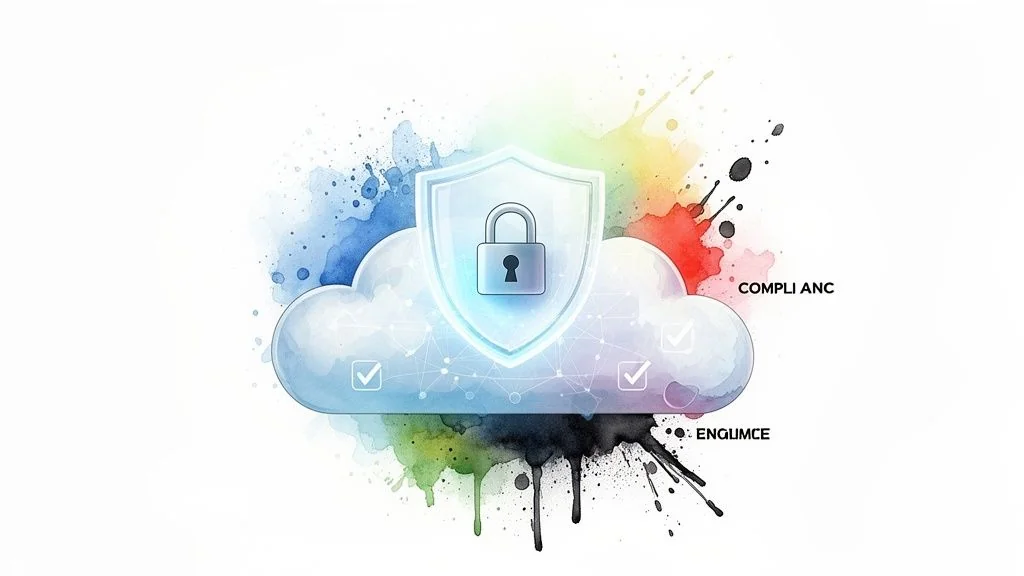
This approach ensures your new cloud environment is secure by design. By embedding controls like network segmentation, data encryption, and least-privilege access from the beginning, you build a resilient foundation that meets regulatory requirements. This practice is a non-negotiable component of modern cloud migration best practices, especially for regulated industries.
Why it’s a critical early-stage practice
Addressing security post-migration is exponentially more complex and expensive. It often requires re-architecting applications, retrofitting controls onto live environments, and risking data exposure or compliance violations. A proactive approach allows security to be automated and scaled alongside your cloud footprint.
For example, a healthcare provider building a HIPAA-compliant architecture on AWS must integrate specific logging, encryption, and access controls from the start. Trying to bolt these on after migrating patient data would be a high-risk, non-compliant, and difficult endeavor. Designing the architecture with compliance at its core is the only viable path.
How to implement a security-first architecture
To build a secure and compliant cloud foundation, integrate these actions into your planning phase:
- Involve Security and Compliance Teams Early: Your experts must be involved during the initial readiness assessment, not just before cutover. Their input is critical for defining requirements and designing appropriate guardrails.
- Leverage Cloud-Native Compliance Frameworks: Utilize tools like the AWS Well-Architected Framework (Security Pillar), Azure Policy, and Google Cloud’s Security Command Center. These platforms provide pre-built policies and blueprints that align with standards like PCI-DSS and HIPAA.
- Automate Governance with Policy-as-Code: Use Infrastructure-as-Code (IaC) tools like Terraform combined with policy-as-code engines like Open Policy Agent (OPA). This allows you to automatically enforce security rules, such as preventing public S3 buckets or unrestricted firewall rules, during resource deployment.
- Enforce Least-Privilege Access from Day One: Design your Identity and Access Management (IAM) roles and policies based on the principle of least privilege. Grant permissions only for the specific actions required for a job function.
5. Select the Right Partner and Manage the Vendor
Selecting the right cloud consulting partner is a pivotal decision. This process involves forging a strategic alliance with a team whose expertise and culture align with your business objectives. Effective vendor management ensures this partnership remains on track, delivering value from initial planning through post-migration optimization.
This is not just about outsourcing tasks; it’s about augmenting your team with specialized knowledge. The right partner acts as a force multiplier, helping you navigate complex technical challenges, avoid common pitfalls, and accelerate your time-to-value. Choosing wisely is one of the most critical cloud migration best practices for de-risking your investment, and a cloud partner comparison can help you objectively evaluate your options.
Why it’s a critical strategic decision
Attempting a complex migration without the right expertise can lead to security breaches, budget overruns, and failed projects. An experienced partner brings a history of successful migrations, proven methodologies, and deep platform-specific knowledge. For instance, a company migrating a legacy ERP system would engage a partner with proven success in that niche, not a generalist, to handle the intricate dependencies.
How to implement partner selection and management
To execute this effectively, approach vendor selection with rigor and manage the relationship proactively:
- Validate Expertise, Not Just Certifications: Go beyond a partner’s official status. Request anonymized case studies relevant to your industry and ask for the resumes of the team members who will be assigned to your project. A partner’s credentials are only as good as the talent doing the work.
- Conduct a Paid Proof-of-Concept (PoC): Before signing a multi-year contract, engage one or two shortlisted partners in a small, paid PoC for a non-critical workload. If you need help narrowing the field, get matched with vetted firms based on your project requirements. This “test drive” provides invaluable insight into their technical skills, communication style, and cultural fit.
- Establish a Strong Governance Framework: Your contract should clearly define roles, responsibilities, communication protocols, and key performance indicators (KPIs). Schedule regular cadence calls and quarterly business reviews to ensure continuous alignment.
A well-chosen partner accelerates your journey, but a poor choice can derail it completely.
6. Define a Data Migration and Integration Strategy
A robust data migration and integration strategy is the engine of a successful cloud transition. This involves the meticulous planning and execution of transferring data from on-premises systems to the cloud, all while guaranteeing data integrity, consistency, and minimal downtime. It is a strategic process that addresses data volume, transformation needs, and rigorous validation.
This plan forms the backbone of your application cutover, as applications are useless without their data. By mapping data sources, defining transformation logic, and establishing secure transfer mechanisms, you create a predictable and repeatable process. This level of planning is a non-negotiable component of cloud migration best practices, preventing data corruption, extended outages, and post-migration performance issues.
Why it’s a critical component
Underestimating data migration complexity is a common mistake. Without a detailed strategy, teams often face data loss, schema mismatches, and severe performance degradation. A formal strategy ensures business continuity. For example, a financial institution migrating terabytes of transactional data must plan for zero-loss transfer and real-time synchronization during the cutover window to avoid disrupting customer payments.
How to implement a data migration and integration strategy
To build an effective data strategy, concentrate on these core activities:
- Utilize Cloud-Native Services: Leverage tools built for this purpose. Services like AWS Database Migration Service (DMS) or Azure Database Migration Service are designed to handle heterogeneous migrations (e.g., Oracle to PostgreSQL) and automate much of the replication and validation process. If AWS is your target platform, explore certified AWS migration partners for hands-on implementation support.
- Implement Phased Validation: Do not wait until the end to validate data. Check for integrity at multiple stages: at the source, after any ETL (Extract, Transform, Load) processes, and once it lands in the target cloud database. This staged approach catches errors early.
- Plan for Parallel Runs: For critical systems, implement bi-directional data replication that allows the legacy and new cloud systems to run in parallel. This creates a safety net, enabling you to test the new environment with live data while providing an immediate rollback path if issues arise.
A carefully executed data migration ensures that when your applications go live in the cloud, they are powered by complete, consistent, and correct data.
7. Plan for Application Modernization and Re-architecting
While a “lift-and-shift” gets you to the cloud quickly, true transformation comes from application modernization. This practice involves re-architecting applications to leverage cloud-native services like containers, microservices, and serverless computing. It is a strategic decision that trades a higher upfront investment for long-term gains in agility, scalability, and operational efficiency.
This approach moves beyond just changing where an application runs; it changes how it runs. Instead of a monolithic application, you might break it down into independent microservices running on a platform like Kubernetes. This architectural shift unlocks the full potential of the cloud, enabling faster release cycles and improved fault tolerance. Making smart modernization choices is a crucial element of advanced cloud migration best practices.
Why it’s a critical modernization step
Simply rehosting a legacy application in the cloud often means carrying over old inefficiencies and technical debt. You pay for cloud infrastructure without reaping the primary benefits of cloud-native architecture. Modernization, on the other hand, directly impacts your ability to innovate. For example, refactoring a monolithic e-commerce platform into microservices can reduce deployment times for new features from weeks to hours.
How to implement application modernization
To execute a modernization strategy effectively, focus on a phased and pragmatic approach:
- Prioritize Based on Business Value: Not every application needs a complete rewrite. Analyze your portfolio and identify applications where modernization will deliver the most significant business impact, such as improved customer experience or faster time-to-market.
- Adopt the Strangler Fig Pattern: Avoid a risky “big bang” rewrite. Instead, gradually replace pieces of the legacy monolith with new cloud-native microservices. Over time, these new services “strangle” the old application until it can be fully decommissioned.
- Leverage Containerization as a Bridge: Containerizing an application using Docker and deploying it on a managed service like Azure Container Instances or AWS Fargate is an excellent intermediate step. It provides portability and operational consistency without the immediate complexity of a full microservices architecture.
A well-planned modernization strategy ensures your cloud migration delivers a new, more powerful capability for your business.
8. Implement a Comprehensive Change Management and Training Program
A cloud migration is a fundamental shift in how your organization operates. A comprehensive change management and training program is the framework for guiding your people through this transition. It focuses on developing organizational readiness, securing stakeholder buy-in, and building the necessary competencies to ensure long-term success.
This process proactively addresses the human side of the migration, mitigating resistance and transforming skepticism into advocacy. By creating structured learning paths and communicating transparently, you ensure your teams can manage and innovate within the new cloud environment. This focus on people is a critical component of cloud migration best practices, preventing a technologically sound migration from failing due to poor adoption.
Why it’s a critical human-centric step
Ignoring organizational change management is a common reason why cloud migrations fail to deliver their promised value. A state-of-the-art cloud platform is ineffective if your teams lack the skills to use it securely and cost-effectively. A formal program bridges this gap. For example, a financial services firm can invest millions in a secure cloud platform, but without training its developers on new security APIs, the investment is undermined by security gaps and budget overruns.
How to implement change management and training
To build an effective program, concentrate on these activities:
- Establish a Cloud Center of Excellence (CoE): Create a central governance body early. This team, comprised of technical and business leaders, acts as a knowledge hub, defines best practices, and guides the organization’s cloud journey.
- Develop Role-Based Training Paths: Tailor learning to specific roles: developers need deep dives into cloud-native services, operations teams require expertise in monitoring tools like Amazon CloudWatch or Azure Monitor, and finance teams need training on cost management dashboards.
- Empower Internal Champions: Identify influential individuals within different departments to act as cloud advocates. A peer-to-peer mentoring program can be highly effective in accelerating knowledge sharing.
- Utilize Hands-On Learning: Theory is not enough. Leverage sandbox environments and hands-on labs from providers like AWS, Microsoft Learn, and Google Cloud Training. This practical experience is crucial for building confidence.
9. Plan for Post-Migration Optimization, Monitoring and Observability
Cloud migration is not a one-time project; it is the beginning of a new operational model. Post-migration optimization is the continuous, data-driven process of refining your cloud environment for better performance, lower costs, and enhanced security. This practice is inseparable from robust monitoring and observability, which provide the essential visibility needed to make informed decisions.
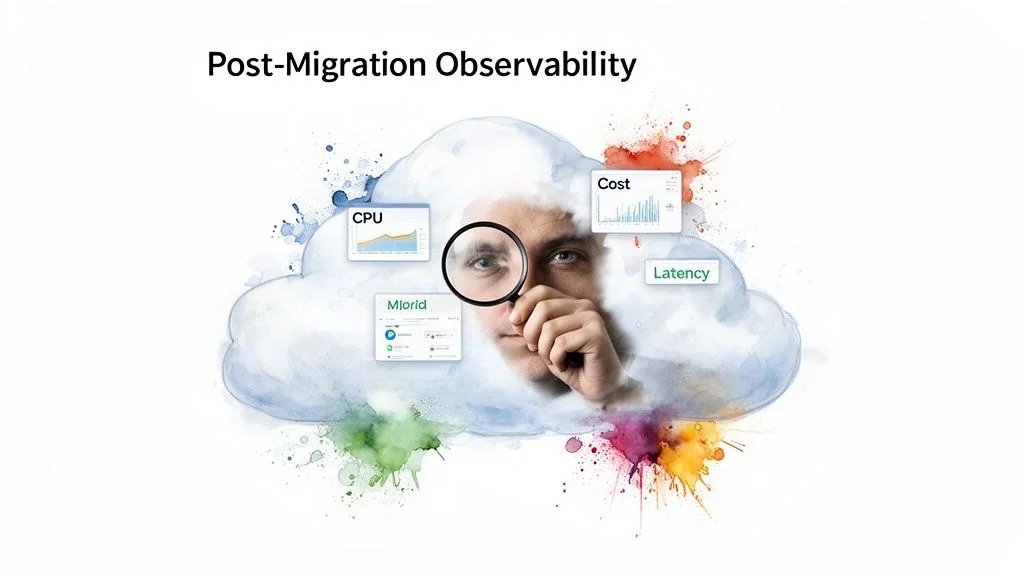
This ongoing cycle of measurement and refinement ensures you fully realize the benefits of the cloud. By treating migration as the starting line, organizations can prevent cost overruns and performance degradation. This discipline is a core tenet of modern cloud migration best practices, transforming cloud adoption into a continuous business advantage.
Why it’s a critical ongoing process
Neglecting post-migration activities is a common path to budget shock and “cloud sprawl,” where unused resources accumulate. A systematic approach to optimization and monitoring transforms cloud operations from a reactive, break-fix model to a proactive, predictive one. An enterprise can reduce annual cloud spend significantly through quarterly optimization reviews, while a SaaS company using AWS CloudWatch and X-Ray can slash incident resolution times by identifying performance bottlenecks before they impact customers.
How to implement post-migration excellence
To build a culture of continuous improvement, focus on these structured activities:
- Establish a FinOps Culture: Create a team to champion cost-conscious engineering. Implement the FinOps framework to foster collaboration between finance, engineering, and business units, making cost a shared responsibility. Conduct monthly cost reviews to institutionalize optimization.
- Leverage Native and Third-Party Tooling: Automate the identification of optimization opportunities using native tools like AWS Compute Optimizer, Azure Advisor, or GCP Recommender. For deeper insights, platforms like Datadog or New Relic provide comprehensive observability.
- Implement Proactive Monitoring and Alerting: Design your monitoring and logging architecture during the migration planning phase. Establish clear alerting thresholds based on historical performance baselines to avoid alert fatigue. Start by monitoring critical application and infrastructure metrics.
10. Develop a Disaster Recovery and Business Continuity Plan
Integrating a robust disaster recovery (DR) and business continuity (BC) strategy is an essential component of the migration planning process. This involves designing resilient architectures and defining clear procedures to ensure your applications and data remain available during infrastructure failures or regional outages. A cloud-native approach to DR/BC leverages the cloud’s geographic distribution to build fault-tolerant systems.
This process is about risk management, establishing predefined Recovery Time Objectives (RTOs) and Recovery Point Objectives (RPOs) for each workload based on its business criticality. By mapping these requirements to specific cloud services and architectures, you ensure your cloud environment is prepared to withstand disruptions. This foresight is a hallmark of mature cloud migration best practices.
Why it’s a critical component
Failing to design for resilience exposes the business to significant risk, including revenue loss and data integrity issues. Cloud platforms provide the tools, but a resilient architecture doesn’t happen by default. For example, a healthcare organization using Azure Site Recovery can configure automated failover to a secondary region, ensuring patient data systems meet HIPAA availability requirements with a four-hour RTO, a goal that would be prohibitively expensive to achieve on-premises.
How to implement a DR/BC plan
To build an effective cloud-native DR strategy, focus on these key actions:
- Define Tiered RTO/RPO: Classify your applications into tiers based on business impact. Not every workload needs a sub-minute RTO. A critical e-commerce platform may require a hot-standby multi-region architecture, while a development environment might be protected by daily backups with a 24-hour RTO.
- Leverage Native Cloud Services: Utilize platform-specific tools like AWS Backup, Azure Site Recovery, or Google Cloud Backup and DR. These services simplify the management of backups, replication, and automated failover processes.
- Test and Automate Relentlessly: A DR plan that has not been tested is a theory. Conduct regular, automated DR drills and failover tests to validate your procedures and ensure your team is prepared. Document these processes in detailed runbooks.
10-Point Cloud Migration Best Practices Comparison
| Practice | Implementation complexity | Resource requirements | Expected outcomes | Ideal use cases | Key advantages |
|---|---|---|---|---|---|
| Comprehensive Cloud Readiness Assessment | Medium–High; detailed discovery and analysis | Cross-functional team, automated discovery tools, access to legacy docs | Inventory, dependency maps, readiness report, timeline & budget estimates | Pre-migration planning for large or complex estates | Reduces surprises; aligns stakeholders; prioritizes migrations |
| Clear Migration Strategy and Roadmap Development | High; phased sequencing and dependency planning | Program managers, solution architects, stakeholder engagement | Wave-based roadmap, KPIs, risk & rollback plans, resource schedule | Multi-wave enterprise migrations and complex dependency environments | Controlled disruption; enables quick wins; repeatable approach |
| Right-Sizing and Cost Optimization Planning | Medium; requires monitoring and analysis | Telemetry data, cost tools, FinOps/engineers, tagging | Optimized instances/storage, savings plans, cost forecasts | High cloud spend environments; post-migration tuning | Immediate ROI; improved utilization; better budgeting |
| Robust Security and Compliance Architecture Design | High; integrates security and regulatory controls upfront | Security architects, compliance experts, IAM/KMS tooling | IAM, network segmentation, encryption, audit-ready compliance posture | Regulated industries, sensitive data workloads, high-risk apps | Prevents breaches; simplifies audits; enables secure deployments |
| Partner Selection and Vendor Management | Medium; due diligence and contract governance | Procurement/legal, reference checks, pilot projects, SLAs | Chosen partner(s), defined roles, performance metrics, knowledge transfer | Organizations lacking internal skills or needing acceleration | Access to expertise; accelerates delivery; reduces execution risk |
| Data Migration and Integration Strategy | Very High; data volume, quality and velocity challenges | DBAs, ETL/replication tools, bandwidth, validation & testing teams | Cleaned/mapped data, validated cutover, governance and lineage | Large data estates, transactional systems, consolidation projects | Ensures data integrity; prevents loss; supports compliance |
| Application Modernization and Re-architecting | Very High; refactor, redesign and platform changes | Development teams, platform engineering, CI/CD, upskilling | Cloud-native architectures, microservices/containers, long-term ops savings | Strategic transformations seeking scalability and agility | Improved scalability/performance; faster delivery; lower ops long-term |
| Comprehensive Change Management and Training Program | Medium; organizational behavior and skills shift | Trainers, CoE, sandbox labs, stakeholder time | Higher adoption, reduced support incidents, internal cloud capability | Large organizations, legacy cultures, vendor-to-internal transitions | Increases adoption; reduces vendor dependence; accelerates ROI |
| Post-Migration Optimization, Monitoring and Observability | Medium–High; ongoing operational discipline | Monitoring/observability tools, FinOps team, cloud engineers | Continuous cost & performance improvements, faster incident response | Sustained cloud operations, high-scale platforms, FinOps initiatives | Compounds savings; prevents technical debt; improves reliability |
| Disaster Recovery and Business Continuity Planning | High; cross-region failover and regular testing | Backup/replication services, DR testing teams, extra infra | Defined RTO/RPO, tested failover procedures, documented runbooks | Mission-critical applications, SLA-driven services, regulated orgs | Protects against catastrophic loss; minimizes downtime; meets compliance |
From Planning to Optimization: Your Next Steps
A cloud migration is a fundamental business transformation, not just a technical project. The best practices outlined here provide a strategic framework for sustained success. They represent a shift from viewing migration as a singular project to embracing it as the first step in a continuous cycle of innovation and optimization.
The journey begins with a rigorous Cloud Readiness Assessment and a detailed Migration Roadmap. These initial steps prevent costly miscalculations and align technical execution with business objectives. Similarly, integrating Right-Sizing and Cost Optimization from day one transforms cloud adoption from a potential budget liability into a driver of financial efficiency.
Synthesizing the Core Pillars of a Successful Migration
The most crucial takeaway is the interconnectedness of these practices. A migration cannot succeed with a brilliant technical plan if the human element is ignored. This is where a Comprehensive Change Management and Training Program becomes indispensable. Likewise, an application modernization strategy is vulnerable without a Robust Security and Compliance Architecture designed into its core.
Here are the most critical action points:
- Treat Security as Foundational: Embed security and compliance into every phase, from initial design to post-migration operations. A reactive security posture is a failed one.
- Prioritize Data Integrity: Your Data Migration and Integration Strategy must be flawless. Data gravity, integrity, and accessibility are paramount. Plan for this with the same rigor you apply to application refactoring.
- The Journey Starts at “Go-Live”: The cutover is not the finish line. Implementing robust Post-Migration Optimization, Monitoring, and Observability is what separates a functioning cloud environment from a high-performing one. Continuous improvement is the new operational standard.
Mastering these cloud migration best practices elevates the entire endeavor. It moves your organization from simply using the cloud to actively leveraging it as a competitive differentiator. You build a foundation that is resilient, scalable, secure, and agile enough to adapt to future market demands. This strategic approach ensures your investment delivers tangible returns, from operational efficiency to accelerated product development.
The single most impactful decision you’ll make is choosing the right partner to guide you. Our 2025 data-driven analysis at CloudConsultingFirms.com independently vets and ranks top-tier partners, ensuring you find the perfect fit for your specific technical needs, industry, and budget. Visit CloudConsultingFirms.com to de-risk your selection process and accelerate your path to a successful migration.
Frequently Asked Questions
How do you implement a cloud readiness assessment?
To execute an effective assessment, focus on these key actions:
How do you implement a migration strategy and roadmap?
To build an effective roadmap, translate your assessment findings into a structured plan:
How do you implement right-sizing and cost optimization?
To integrate cost planning into your migration, focus on these actions:
How do you implement a security-first architecture?
To build a secure and compliant cloud foundation, integrate these actions into your planning phase:
How do you implement partner selection and management?
To execute this effectively, approach vendor selection with rigor and manage the relationship proactively:
Peter Korpak
Founder
Data-driven market researcher with 15+ years helping software agencies and IT organizations make evidence-based decisions. Former market research analyst at Aviva Investors and Credit Suisse. Analyzed 200+ verified cloud projects (migrations, implementations, optimizations) to build Cloud Intel.
Connect on LinkedInContinue Reading
Cloud Migration
Cloud migration consulting firms evaluated on documented outcomes and pricing transparency
AWS vs Azure vs GCP: A Strategic Comparison
Explore our strategic comparison of AWS vs Azure vs GCP. This guide provides actionable insights for choosing the right cloud platform for your business needs.
The 12 Best Multi Cloud Management Platforms for 2026 and Beyond
Discover the best multi cloud management platforms for 2026. Get an actionable, no-fluff comparison of features, pricing, and use cases.
Stay ahead of cloud consulting
Quarterly rankings, pricing benchmarks, and new research — delivered to your inbox.
No spam. Unsubscribe anytime.