Cloud Migration Consulting Services: A Guide to a Seamless Cloud Move
Cloud migration consulting services are specialized firms that manage the entire process of moving a company’s digital operations—applications, data, and infrastructure—to a cloud platform. They provide the deep, technical expertise required to execute a complex cloud transition successfully, ensuring the move supports and advances core business objectives.
Why is a blueprint essential for your cloud migration journey?
A blueprint is essential for a cloud migration journey because it prevents cost overruns, security vulnerabilities, and operational disruptions. Moving to the cloud requires fundamentally re-architecting your technical foundation, making a detailed strategic plan and expert oversight critical for success.
As experienced partners, cloud migration consultants have managed hundreds of migrations across various industries and cloud platforms. They understand the common pitfalls, performance tuning requirements, and security configurations necessary to build a resilient and cost-effective cloud environment.
The Core Functions of a Migration Consultant
A consultant’s role extends far beyond technical execution. They manage the project to deliver measurable business value.
Here are their primary functions:
- Strategic Roadmap Development: Consultants begin by analyzing business objectives to create a detailed migration plan. This roadmap prioritizes workloads, sets achievable timelines, and links every technical task back to a specific business goal, such as improving operational efficiency or enabling market expansion.
- Comprehensive Risk Assessment: Consultants identify potential security gaps, compliance issues, and operational dependencies that an in-house team might overlook. This proactive risk management prevents costly errors and ensures the new cloud environment is secure and compliant from launch.
- Project and Change Management: Migrations involve coordinating multiple stakeholders, including internal teams, third-party vendors, and the cloud provider. Consultants act as the central project managers, overseeing all moving parts and facilitating the human side of the transition through targeted training and support.
A critical error is to view cloud migration as a purely IT project. A successful migration is a business transformation. Consultants ensure technology decisions serve strategic goals, preventing the common mistake of moving old problems into a new, more expensive environment.
Avoiding Common Migration Pitfalls
Without expert guidance, companies often encounter predictable challenges. One of the most significant is uncontrolled spending, often caused by the “migration double bubble”—the period where you pay for both legacy on-premises systems and the new cloud environment simultaneously. Consultants create accurate budgets and define a clear decommissioning plan to minimize this overlap.
Another challenge is application performance degradation. Consultants conduct thorough pre-migration assessments to ensure applications are optimized for the cloud, preventing performance issues that can disrupt business operations.
For a detailed guide on this crucial first step, use our cloud migration assessment checklist. Engaging a cloud migration consulting service is an investment in executing the project correctly the first time, minimizing risk and maximizing the return on your cloud investment.
How do you choose the right cloud migration strategy?
You choose the right cloud migration strategy by assessing your business goals, timeline, and budget. Whether rehosting for speed, replatforming for quick wins, or refactoring for long-term scalability, your strategy dictates the ultimate value and operational improvement derived from the cloud.
The three fundamental strategies can be understood through a simple analogy: moving to a new house.
Comparing Cloud Migration Strategies
This table provides a direct comparison of the three primary migration approaches. Use it to evaluate the trade-offs of each and align a strategy with your business requirements.
| Strategy | Analogy | Best For | Pros | Cons |
|---|---|---|---|---|
| Rehosting (Lift-and-Shift) | Moving everything from your old house to the new one, as-is. | Time-sensitive projects, such as a data center lease expiration. | Fastest migration path; lowest initial cost and complexity. | Fails to leverage cloud-native features; moves existing inefficiencies. |
| Replatforming (Lift-and-Tinker) | Moving in, but upgrading old appliances to new, efficient models. | Achieving quick performance wins by optimizing specific application components. | Balances speed with optimization; improves performance with moderate effort. | Risk of scope creep; requires more extensive testing. |
| Refactoring (Rearchitecting) | Designing custom-built furniture to perfectly fit every room. | Core, mission-critical applications requiring high performance and scalability. | Maximizes cloud benefits (scalability, resilience); lowest long-term operational costs. | Highest upfront cost, time, and resource investment. |
The optimal choice depends on your strategic priorities: speed to market or a foundation for future growth.
Rehosting: The Quick Move
Rehosting, or “lift-and-shift,” involves moving applications and servers to a cloud environment with minimal or no changes. It is the fastest and most straightforward path to the cloud, making it the default choice for organizations facing tight deadlines, such as an expiring data center lease.
It is a suitable approach for:
- Rapid Migrations: When speed is the primary driver.
- Legacy Applications: For systems that are difficult or impossible to modify.
- Disaster Recovery: To establish a cloud-based backup and recovery site without re-architecting systems.
The main drawback is that rehosting brings existing inefficiencies and technical debt into the cloud. Applications cannot leverage cloud-native capabilities like auto-scaling or serverless functions, which can lead to higher-than-expected operational costs.
Replatforming: The Smart Upgrade
Replatforming, or “lift-and-tinker,” is a balanced approach. It involves making targeted optimizations to applications during the migration process to gain immediate benefits from the cloud. A common example is migrating a self-managed database to a managed cloud service like Amazon RDS or Azure SQL.
This strategy provides a good compromise between speed and optimization, allowing businesses to realize tangible cloud benefits without the complexity of a full refactoring effort.
Refactoring: The Custom Build
Refactoring, also known as re-architecting, is the most intensive strategy. It involves fundamentally rebuilding applications to be cloud-native, using modern architectural patterns like microservices and serverless functions.
This strategy delivers the highest long-term value. Refactoring unlocks the full potential of the cloud, including maximum scalability, superior performance, and the lowest possible long-term operational costs.
The trade-off is a significant upfront investment in time, resources, and budget. Refactoring is typically reserved for mission-critical applications that provide a competitive advantage and require agility and scalability for future growth.
Navigating these strategic choices is why the cloud migration services market continues to expand. Valued at USD 16.90 billion, it is projected to reach USD 70.34 billion by 2030. Large enterprises, representing 62% of the market, depend on consultants for complex refactoring projects, while smaller businesses are driving an 18% CAGR by leveraging tools for simpler migrations. This growth is driven by proven results, with companies reporting operational efficiency gains of up to 30% and infrastructure cost savings approaching 50%.
To properly structure your plan, consult our detailed guide on how to build a cloud migration strategy.
The following decision tree provides a framework for determining when to engage a consultant.
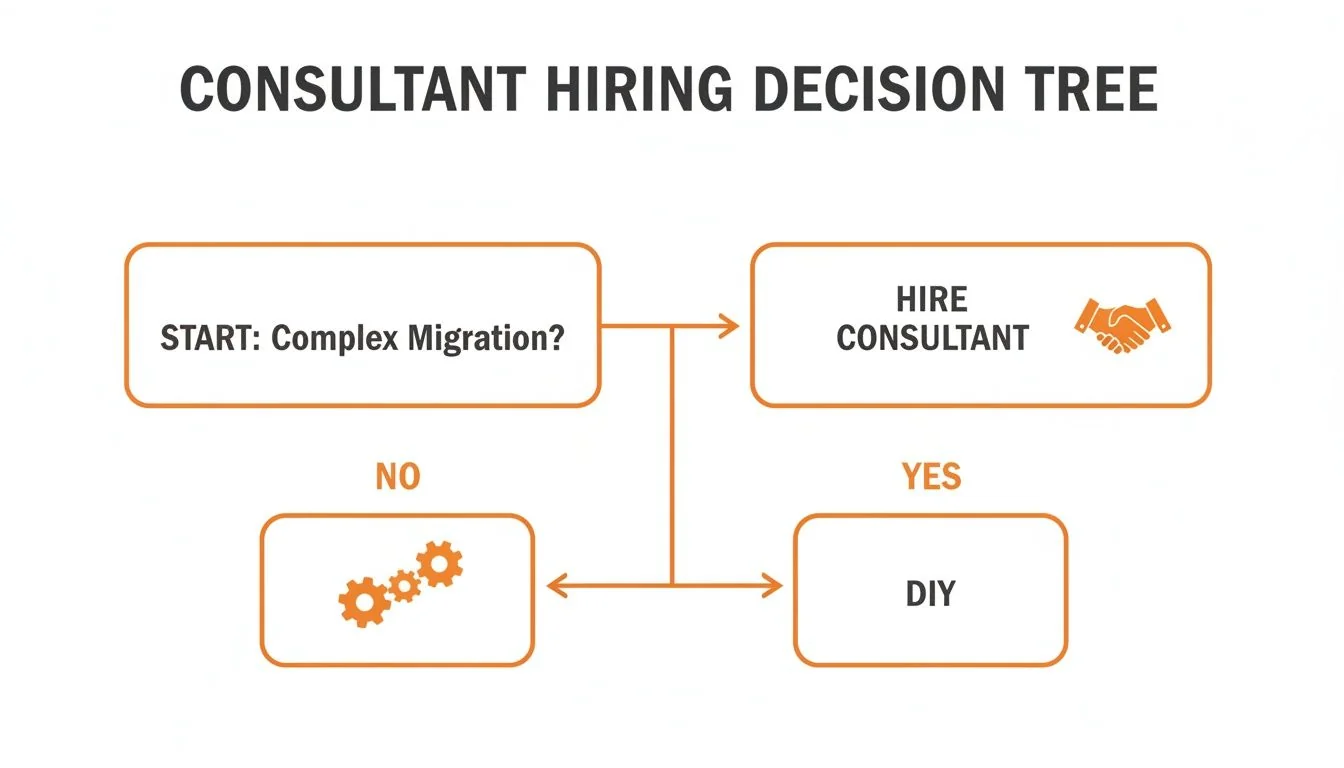
As the complexity of a project increases—particularly with replatforming or refactoring—the value of partnering with a consultant grows exponentially. They help you avoid costly missteps and ensure you achieve the maximum return on your cloud investment.
How do you select the right cloud migration partner?
Select the right cloud migration partner by thoroughly evaluating their technical expertise, industry-specific experience, and proven methodologies rather than just comparing hourly rates. The ideal partner mitigates project risk, maximizes ROI, and prevents costly security and implementation failures.
The cloud migration consulting market, valued at USD 5.2 billion and growing at a 10% CAGR, includes a mix of large global system integrators and specialized boutique firms. This diversity requires a structured approach to vetting potential partners. For deeper market analysis, visit ResearchAndMarkets.com.
Evaluate Technical Expertise and Certifications
Your prospective partner must demonstrate deep technical proficiency on your chosen cloud platform, whether it’s AWS, Azure, or Google Cloud. You can explore certified migration specialists through our AWS migration partner directory and Azure migration partner directory. Do not rely on marketing claims; require verifiable proof of their capabilities.
Look for these indicators of expertise:
- Official Partner Status: Designations such as AWS Premier Tier Services Partner, Microsoft Azure Expert MSP, or Google Cloud Premier Partner are earned through rigorous validation by the cloud providers themselves and signify a high level of competence.
- Advanced Specializations: These certifications validate expertise in specific domains like Data and Analytics, Security, or Application Modernization. If migrating a large-scale database, a partner with a data specialization is essential.
- Team Certifications: Inquire about the number of certified professionals on staff. A significant number of certified Solutions Architects, DevOps Engineers, and Security Specialists demonstrates a company-wide commitment to technical excellence.
Security and compliance certifications are non-negotiable for regulated industries. Credentials like SOC 2 Type II, ISO 27001, or HIPAA compliance validate that the partner has robust internal controls to protect your data throughout the migration.
Scrutinize Industry-Specific Experience
A consultant with extensive experience migrating retail e-commerce platforms may not be the right fit for a healthcare organization subject to strict patient data regulations. Each industry has unique compliance requirements, legacy systems, and operational challenges.
When vetting firms, request case studies and client references from your specific sector. A partner with relevant industry experience should be able to answer questions like:
- How have you addressed industry-specific compliance requirements (e.g., HIPAA, PCI DSS, GDPR) in previous migrations?
- Describe a project you completed that was similar in scale and complexity to ours.
- What unique challenges have you encountered in our industry, and how did you resolve them?
This line of questioning moves the conversation from generic sales pitches to tangible, relevant experience, quickly identifying whether a firm truly understands your business context.
A Checklist for Vetting Consulting Partners
Use this checklist to ensure a comprehensive and consistent evaluation of potential partners.
Checklist for Vetting Consulting Partners
| Category | Key Questions to Ask | What to Look For |
|---|---|---|
| Methodology | What is your end-to-end migration methodology? How do you handle project management and communication? | A documented, phased approach (e.g., Assess, Mobilize, Migrate, Optimize). Clear communication plans and stakeholder reporting. |
| Team Structure | Who will be on our dedicated project team? What are their roles, experience levels, and certifications? | A dedicated project manager and lead architect. Direct access to technical experts, not just account managers. |
| Risk Mitigation | How do you identify and mitigate risks related to security, downtime, and data loss during the project? | Proactive risk assessments, rollback plans for every migration stage, and a clear incident response protocol. |
| Post-Migration Support | What does your support look like after the migration is complete? Do you offer managed services or optimization? | Clear service level agreements (SLAs), cost optimization services, and knowledge transfer to upskill your internal team. |
Systematically working through these points will provide a clear, data-driven basis for selecting a partner that can deliver on its promises. To quickly narrow your options, get matched with a shortlist of vetted firms based on your project requirements.
How do you create a realistic cloud migration budget and timeline?
Create a realistic cloud migration budget and timeline by identifying all cost components, including consulting fees, cloud provider services, migration tooling, and internal team time. A comprehensive financial plan prevents budget overruns and ensures an optimized cloud implementation.

Breaking Down the Full Cost Structure
A common budgeting error is focusing solely on the monthly invoice from the cloud provider. The total migration cost includes several distinct components that must be accounted for.
A comprehensive budget should include:
- Consulting Fees: Compensation for strategic planning, project management, and technical execution. Rates vary based on the firm’s expertise and project complexity.
- Cloud Provider Services: Ongoing operational costs for compute, storage, networking, and managed services from providers like AWS, Azure, or Google Cloud.
- Migration Tooling: Licensing fees for specialized software used to automate the migration of data and applications.
- Internal Team Time: The “soft cost” of your team’s involvement in testing, validation, and training. This is a significant resource commitment that must be factored into the overall budget.
Illustrative Timelines and Budgets
Project scope is the primary driver of both cost and schedule. While every migration is unique, these general ranges provide a practical baseline for planning.
For a more precise estimate based on your specific workloads, our cloud migration cost calculator offers a detailed tool for financial modeling.
Here are typical project parameters:
-
Small Project (e.g., Single Application Migration):
- Timeline: 2-4 months
- Budget: $50,000 - $150,000
- Details: Typically a “lift-and-shift” of a non-critical application where the primary objective is speed and minimal disruption.
-
Medium Project (e.g., Departmental Migration):
- Timeline: 6-12 months
- Budget: $200,000 - $750,000
- Details: May involve replatforming several interconnected applications, requiring more detailed planning, integration, and testing.
-
Large Project (e.g., Enterprise Transformation):
- Timeline: 12-24+ months
- Budget: $1 Million+
- Details: A comprehensive migration and modernization program, often involving significant application refactoring and business process re-engineering.
One of the most significant financial challenges is the “migration double bubble,” the period where you pay for both legacy on-premises infrastructure and the new cloud environment simultaneously. An experienced consultant minimizes this overlap by developing an efficient decommissioning strategy.
Uncovering Hidden Migration Costs
Even well-planned budgets can be derailed by unexpected expenses. These “hidden costs” often arise during or after the migration. A seasoned consultant knows to anticipate and plan for these potential budget impacts.
Ensure your budget accounts for these common overlooked costs:
- Data Egress Fees: Cloud providers charge for data transferred out of their network. If the architecture is not designed to minimize data egress, these fees can lead to unexpectedly high monthly bills.
- Post-Migration Optimization: The project does not end at cutover. A period of post-migration optimization is necessary to right-size resources and control long-term cloud spend.
- Training and Upskilling: Your team will need training to effectively manage the new cloud environment. This investment in personnel is crucial for long-term success but is often omitted from the initial project budget.
How do you navigate security and compliance during a cloud migration?
Navigate security and compliance during a cloud migration by implementing a shared responsibility model, mastering relevant regulatory frameworks like HIPAA or GDPR, and establishing strict identity and access management controls. This proactive approach prevents data breaches and regulatory penalties.
Cloud security is governed by the shared responsibility model. The cloud provider (e.g., AWS or Azure) is responsible for the security of the cloud, which includes the physical data centers, hardware, and core networking. Your organization is responsible for security in the cloud, which includes your data, applications, and access management policies. A consultant’s primary role is to clearly define these responsibilities and implement controls to secure your portion of the environment.

Mastering Compliance Frameworks
For businesses in regulated industries, compliance is a non-negotiable requirement. A skilled consultant translates complex regulatory standards into specific cloud architecture and security controls.
Key frameworks they manage include:
- GDPR (General Data Protection Regulation): Mandatory for any organization handling the data of EU citizens, requiring strict data privacy and consent protocols.
- HIPAA (Health Insurance Portability and Accountability Act): For healthcare organizations, ensuring protected health information (PHI) is secured with required technical and administrative safeguards.
- PCI DSS (Payment Card Industry Data Security Standard): Required for any company processing credit card payments to protect cardholder data.
Consultants design the cloud environment to be compliant from the outset, ensuring it is audit-ready upon launch. This proactive approach prevents costly retrofitting and potential fines. The global market for these cloud implementation and migration services is projected to reach USD 54.47 billion, with migration and deployment accounting for the largest share at 23.23%. This growth underscores the reliance on expert guidance for complex needs like compliance. More market data is available from Coherent Market Insights.
The most common security risk during a cloud migration is not a sophisticated external attack but a simple internal misconfiguration, such as a publicly exposed storage bucket or overly permissive access policies.
Mitigating Common Migration Risks
An experienced consultant implements a “defense-in-depth” strategy to protect assets before, during, and after the migration. This involves several critical safeguards:
- Robust Identity and Access Management (IAM): Consultants establish strict IAM policies based on the principle of least privilege. This ensures users and applications are granted access only to the resources necessary for their function, significantly reducing the attack surface.
- End-to-End Encryption: Data is encrypted both “at rest” (in cloud storage) and “in transit” (during transfer from on-premises systems to the cloud), rendering it unreadable even if intercepted.
- Continuous Security Monitoring: Consultants configure automated tools to continuously scan for vulnerabilities, misconfigurations, and suspicious activity, enabling a real-time threat response.
By integrating these practices into the migration process, consultants build a resilient and compliant foundation that enables secure business growth.
What are common questions about cloud migration consulting?
Common questions about cloud migration consulting usually revolve around the return on investment, the role of internal teams, and project timelines. Addressing these common questions provides the clarity needed to select the right partner and position the project for success.
What Is the Typical ROI of Hiring a Cloud Migration Consultant?
The ROI of hiring a cloud consultant is realized through three primary benefits that extend beyond a simple cost-benefit analysis of their fees.
First, they accelerate time-to-value. An experienced consultant navigates technical challenges and avoids common pitfalls that can delay an in-house project for months. Reaching the cloud faster means realizing benefits like improved performance and lower operational costs sooner.
Second, they mitigate costly errors. A poorly executed migration can result in security vulnerabilities, compliance violations, or an inefficient cloud architecture that leads to excessive spending. The consultant’s fee is a form of insurance against these much larger financial risks. Expert-led projects often result in IT infrastructure cost savings of up to 50%.
Third, consultants are experts in cost optimization. They design the cloud environment for efficiency from the start and identify savings in areas like software licensing and resource right-sizing. These savings can often offset the consulting fees within the first one to two years.
Can Our In-House IT Team Handle the Migration?
Your in-house IT team possesses invaluable institutional knowledge of your systems and business processes. However, cloud migration requires a specialized skill set that most internal teams do not use on a daily basis. The best approach is to view consultants as a strategic extension of your team, not a replacement.
Cloud migration consultants don’t replace your team; they empower them. They bring specialized expertise from hundreds of migrations, allowing your staff to focus on critical business functions while learning best practices for the new environment.
Consultants provide up-to-date knowledge of cloud provider services, automation tools, and security best practices. This partnership model ensures the migration is executed correctly while upskilling your internal team to manage the cloud environment effectively long-term.
What Is the Biggest Mistake Companies Make?
The most common and costly mistake is treating cloud migration as a purely technical, “lift-and-shift” exercise without a clear business strategy. This approach views the cloud as merely a remote data center and fails to unlock its transformative potential.
When technology decisions are made without alignment to business goals, the typical outcomes are:
- High Cloud Bills: Migrating inefficient on-premises architecture directly to the cloud results in costly, unoptimized operations.
- Missed Opportunities: The failure to use cloud-native services like serverless computing or managed databases prevents business innovation.
- Poor User Experience: If the migration does not improve performance or usability for employees and customers, it is often perceived as a failure.
A top-tier cloud migration consulting service prevents this by always starting with business objectives (“why?”) and aligning every technical decision to those goals. This strategic foundation is what separates a simple relocation of problems from a true business transformation.
How Long Does a Typical Consulting Engagement Last?
The duration of a consulting engagement is determined by the project’s scope and complexity. However, a professional firm will always structure the work in predictable phases with defined milestones.
As a general guideline:
- Small-Scale Projects: A migration of a few applications or a single business function may take 2-4 months.
- Moderate Migrations: A project involving an entire business unit or a portfolio of related systems typically lasts 6-12 months.
- Enterprise Transformations: A large-scale, company-wide migration with significant application refactoring is a multi-year engagement.
Effective consultants structure the engagement to deliver value incrementally. This phased approach provides tangible progress and regular checkpoints, allowing for adjustments and ensuring benefits are realized throughout the project lifecycle, not just at the end.
Finding the right partner is the most critical step in your cloud journey. At CloudConsultingFirms.com, we provide a data-driven guide to help you compare and select the best AWS, Azure, or Google Cloud consulting firms for your specific needs. Start your search with confidence at https://cloudconsultingfirms.com.
Peter Korpak
Chief Analyst & Founder
Data-driven market researcher with 10+ years helping software agencies and IT organizations make evidence-based decisions. Former market research analyst at Aviva Investors and Credit Suisse. Analyzed 200+ verified cloud projects (migrations, implementations, optimizations) to build Cloud Intel.
Connect on LinkedInContinue Reading
Cloud Migration
Comprehensive guide and rankings for cloud migration
The No-Fluff Cloud Migration Assessment Checklist for 2025
Don't migrate blind. Use our battle-tested 10-point cloud migration assessment checklist to eliminate 90% of costly surprises and ensure success.
10 Actionable Cloud Migration Best Practices
Discover 10 actionable cloud migration best practices for 2025. Our guide covers strategy, security, and cost optimization to ensure a successful move.
Stay ahead of cloud consulting
Quarterly rankings, pricing benchmarks, and new research — delivered to your inbox.
No spam. Unsubscribe anytime.