Solving Modern Cloud Compliance Challenges
Cloud compliance is a technical balancing act. On one side, relentless pressure for rapid innovation; on the other, a dense matrix of regulatory requirements. For any technical leader in 2026, the core challenge is engineering a resilient system across multi-cloud architectures, sovereign data laws, and ephemeral infrastructure. This transforms compliance from an annual audit into a continuous, automated engineering discipline.
Understanding the Evolving Cloud Compliance Landscape
Moving to the cloud is no longer a simple lift-and-shift for efficiency; it’s a deep exercise in managing distributed complexity. The question isn’t if you use the cloud, but how you maintain provable control when your infrastructure spans multiple providers, each with distinct security models and APIs. This is where high-level policy meets hard technical reality.
The friction is inherent. Innovation demands agility—shipping features, scaling elastically, and experimenting with new services. Compliance demands control, immutability, and a verifiable audit trail. A developer testing a new feature might spin up a container in an unapproved region, violating data residency laws like GDPR. A misconfigured S3 bucket, left public, can escalate into a major data breach and a HIPAA violation.
The Multi-Cloud Complication
This friction intensifies in a multi-cloud architecture. Today, achieving consistent multi-cloud compliance is a top-tier engineering challenge. Data shows that a staggering 69% of organizations face significant challenges implementing consistent security controls across different cloud providers. Another 56% struggle just to secure data scattered across these disparate environments.
With 54% of all cloud data now classified as sensitive, the stakes are absolute. You can review the full research on modern cloud security statistics to quantify the scale of this problem.
The diagram below illustrates how major regulations intersect with core principles of cloud compliance.

While GDPR, HIPAA, and PCI-DSS target different data types—personal, health, and payment information—they all mandate a unified set of technical controls. You cannot solve for one in isolation.
The following table provides a high-level mapping of common cloud compliance challenges to their direct impact on these key regulatory standards. This is a quick reference for technical leaders to pinpoint systemic risks.
Mapping Core Cloud Compliance Challenges to Major Regulations
| Challenge Area | GDPR Implication | HIPAA Implication | PCI-DSS Implication |
|---|---|---|---|
| Shared Responsibility | Misunderstanding the control boundary for data protection leads to security gaps, violating GDPR’s accountability principle. | Failing to secure patient data you control (your responsibility) results in severe penalties for non-compliance with the Security Rule. | Assuming the CSP handles all security can leave cardholder data exposed, violating multiple PCI-DSS requirements. |
| Data Residency & Sovereignty | Processing EU citizen data outside of approved regions without valid legal mechanisms is a direct and costly violation. | While not explicitly a residency rule, storing Protected Health Information (PHI) offshore introduces legal and security complexities. | Storing cardholder data in certain jurisdictions may violate local laws or increase the risk of unauthorized access. |
| Identity & Access Management | Failure to enforce least privilege leads to unauthorized access to personal data, a clear GDPR breach. | Inadequate access controls that allow unauthorized personnel to view PHI are a major violation of the HIPAA Security Rule. | Weak or poorly managed access controls are a primary attack vector and a direct violation of Requirement 7. |
| Configuration Drift | An unmonitored change to a firewall or database setting can silently expose personal data, breaking GDPR’s “security by design” mandate. | Automated deployments that drift from a secure baseline can inadvertently expose electronic PHI (ePHI), violating technical safeguards. | A secure system that degrades due to small, unaudited changes fails to meet Requirement 11.5 for change detection. |
This mapping demonstrates that the underlying technical challenges are universal. A weak IAM policy or unmonitored configuration drift doesn’t just violate one regulation; it creates systemic risk across all applicable frameworks.
From Manual Audits to Automated Guardrails
In 2026, reliance on manual checklists and annual audits is a guaranteed failure mode. The velocity of cloud development, driven by Infrastructure-as-Code (IaC) and CI/CD pipelines, means an environment can drift out of compliance in minutes. A single code commit can alter firewall rules or IAM policies across hundreds of resources instantly.
Modern cloud compliance must be treated as an engineering problem, not a paperwork exercise. The objective is to build a self-healing, continuously compliant environment where automated guardrails prevent violations before they can be deployed.
This guide provides a mental model for this new reality, connecting technical hurdles—like enforcing data residency or preventing configuration drift—to their direct impact on major compliance frameworks. The following sections will break down the specific technical patterns and controls required to build a cloud architecture that is resilient, secure, and provably compliant.
Taking a Hard Look at Critical Cloud Compliance Challenges
To engineer a compliant cloud environment, you must move past high-level policy and into the technical root causes of failure. The most significant compliance gaps are not about misinterpreting regulations; they are engineering problems demanding precise technical solutions. Without understanding the why, you cannot build a compliance program that withstands technical scrutiny.
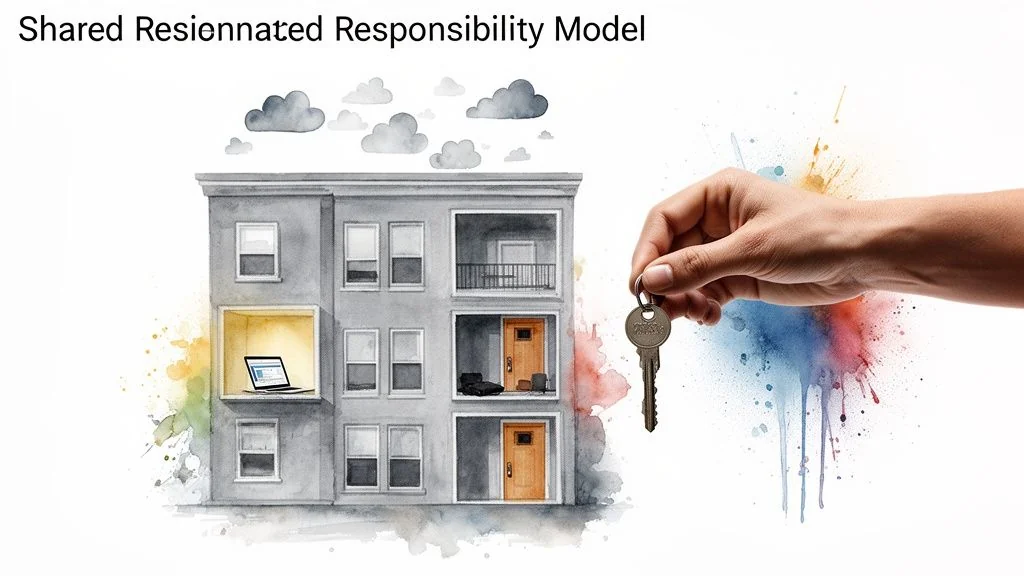
A significant number of compliance failures stem from a misunderstanding of one core concept: the Shared Responsibility Model. This defines the demarcation line between what your cloud provider (AWS, Azure, GCP) is responsible for and what you are. Misinterpreting this boundary creates critical security gaps.
Consider it like leasing a secure commercial space. The landlord is responsible for the building’s perimeter security, fire suppression, and structural integrity—that’s “security of the cloud.” You are responsible for the locks on your doors, who has keycard access, and the security of the assets inside—that’s “security in the cloud.” This is precisely where organizations fail.
The Shared Responsibility Model is not a guideline; it is a hard boundary of control. Assuming your cloud provider manages application-level security, data encryption, or user access policies is a direct path to a compliance breach. It is your code, your data, and your configuration—therefore, it is your responsibility.
The Technical Realities of Data Residency
Data residency is not a legal abstraction; it is a technical requirement that must be enforced at the infrastructure level. Regulations like GDPR impose severe penalties for processing an EU citizen’s data outside of approved locations. The engineering challenge is preventing a developer or an automated script from inadvertently provisioning a server or database in a non-compliant region.
Manual reviews are an ineffective control. A single line of code in a deployment script can launch a resource in the wrong country, triggering a violation in seconds. This makes automated, preventative guardrails non-negotiable.
- For AWS users: AWS Control Tower enables the use of Service Control Policies (SCPs) to set hard boundaries. An SCP can be applied to an entire organization to deny the creation of any services in regions outside the EU, for example, making a mistake impossible.
- For Azure users: Azure Policy serves the same function. Policies can restrict the geographic locations where resources can be deployed, forcing all deployments to comply with data residency rules by default.
These tools transform a policy document into an enforced, technical reality.
Identity and Access Management Missteps
Identity and Access Management (IAM) is another critical failure point. Overly permissive roles are a common finding in security audits and a primary entry point for attackers. The core challenge is enforcing the Principle of Least Privilege at scale—granting every user and service the absolute minimum permissions required to perform its function.
This requires a granular, surgical approach. Instead of using broad, default policies like AdministratorAccess, effective IAM involves writing custom policies that specify exact actions on specific resources.
For example, an application that only needs to read objects from a specific S3 bucket should not have broad S3 access. A least-privilege policy would be:
{
  "Version": "2012-10-17",
  "Statement": [
    {
      "Effect": "Allow",
      "Action": "s3:GetObject",
      "Resource": "arn:aws:s3:::your-compliant-bucket/*"
    }
  ]
}
This policy is explicit: it only allows the GetObject action on objects within a single, specified bucket. This precision drastically reduces the attack surface if the application’s credentials are ever compromised.
The Silent Risk of Configuration Drift
Configuration drift is the process by which systems slowly deviate from their secure, compliant baseline. It occurs through an accumulation of manual “hotfixes,” temporary firewall rules that are never revoked, and unaudited updates that silently disable a security setting.
This is why point-in-time audits are insufficient. An environment can be compliant on audit day and drift into a vulnerable state the following week. The only effective defense is continuous, real-time monitoring and strict adherence to Infrastructure-as-Code (IaC) as the single source of truth for the environment’s state.
The danger of misconfiguration is magnified by a widespread failure to protect data itself. One study found that while 54% of cloud data was classified as sensitive, only 8% of organizations are encrypting 80% or more of it. This creates a massive risk, where a simple drift could expose huge volumes of raw, sensitive data. You can read the full 2025 study on cloud security insights for a much deeper dive into these numbers.
Finally, you must account for third-party risk. Your compliance posture is only as strong as the weakest link in your supply chain—every SaaS platform, API, and third-party service integrated into your stack. A vulnerability in a vendor can become a direct threat to your environment, making rigorous vendor due diligence and continuous supply chain monitoring essential.
From Theory to Practice: Implementing Actionable Controls
Knowing the challenges is one thing; dismantling them with sound architecture and robust automation is another. This is where compliance is built into the fabric of cloud operations. It’s about translating dense regulatory text into real-world, automated technical enforcement.
The objective is not just to achieve a compliant state but to lock it in and make it difficult to break. This is done with proactive, automated controls, not reactive incident response. Let’s examine practical patterns for the challenges we’ve covered.
Battling Configuration Drift with Policy-as-Code
Configuration drift is one of the most insidious threats to compliance. A manual, “temporary” change is made, forgotten, and a security gap is created. The only effective defense is to codify the infrastructure’s desired state and enforce it programmatically.
This is the function of Policy-as-Code (PaC). PaC involves defining compliance rules in a declarative language and integrating them directly into deployment pipelines.
This shifts compliance “left,” catching non-compliant configurations before they are ever deployed to production. A tool like Open Policy Agent (OPA) is ideal for this. OPA allows you to write policies in its declarative language, Rego, which can then validate any JSON-based configuration file, such as a Terraform plan or a Kubernetes manifest.
Think of OPA as a pipeline’s automated compliance gate. Before infrastructure is deployed, the pipeline generates a plan and submits it to OPA for validation. OPA checks the plan against its rule set. If the plan attempts to create a public S3 bucket or a security group with SSH open to
0.0.0.0/0, OPA rejects it, and the pipeline fails. The non-compliant configuration is never deployed.
Here’s the workflow:
- Define Policies: The security team codes compliance rules in Rego (e.g., “All database instances must have encryption enabled”).
- Integrate into CI/CD: The CI/CD pipeline (e.g., Jenkins, GitHub Actions) runs
terraform planto generate a proposed set of changes. - Validate the Plan: Before applying, the pipeline sends the plan’s JSON output to the OPA engine for validation.
- Enforce the Verdict: OPA returns a pass/fail response. A failure stops the deployment and provides feedback to the developer on the specific rule that was violated.
This pattern transforms compliance from a post-mortem audit into an automated quality gate, effectively eliminating configuration drift at the source. For teams building this capability, exploring a complete cloud governance framework is the next logical step.
Enforcing Data Residency with Organizational Guardrails
Relying on developers to remember which regions are approved for resource deployment is not a scalable or reliable compliance strategy. The only robust solution is to implement guardrails that make it impossible to deploy resources in unapproved locations.
In AWS, the primary tool for this is Service Control Policies (SCPs), applied at the AWS Organization root. SCPs define the maximum permissions for all accounts in the organization; they are an absolute boundary that even administrators cannot override.
To enforce GDPR data residency, you can write an SCP that denies access to all AWS regions outside the EU.
Here is an example SCP:
{
  "Version": "2012-10-17",
  "Statement": [
    {
      "Sid": "DenyAllOutsideEU",
      "Effect": "Deny",
      "NotAction": [
        "iam:*",
        "organizations:*",
        "route53:*",
        "support:*"
      ],
      "Resource": "*",
      "Condition": {
        "StringNotEquals": {
          "aws:RequestedRegion": [
            "eu-central-1",
            "eu-west-1",
            "eu-west-2",
            "eu-north-1"
          ]
        }
      }
    }
  ]
}
This policy blocks all actions (with exceptions for a few global services) unless they are requested in one of the approved EU regions. If a developer attempts to launch an EC2 instance in us-east-1, the API call will be denied. The potential breach is prevented before it can occur.
Enhancing Auditability with Forensic Log Analysis
Passing an audit requires not just being compliant, but proving you were compliant and being able to trace every action taken. Cloud logs provide the raw data for this proof, but they are often too voluminous to analyze effectively without the right tools.
A powerful and cost-effective architecture for this combines AWS CloudTrail with Amazon Athena.
- AWS CloudTrail records every API call made in your AWS account—who, what, where, and when.
- Amazon Athena is a serverless query engine that allows you to run standard SQL queries on data stored directly in Amazon S3.
The implementation is straightforward:
- Centralize Logs: Configure a CloudTrail “organization trail” to collect all log files from every account in your organization and deliver them to a single, centralized S3 bucket.
- Catalog Log Data: Use an AWS Glue Crawler to scan the logs in S3 and automatically build a queryable data catalog in the AWS Glue Data Catalog. This step structures the raw log data for Athena.
- Execute Queries: Your security team can now use the Athena console to run SQL queries against the logs to investigate incidents or gather audit evidence.
For example, to identify who deleted a specific S3 bucket, you can run the following query:
SELECT
    eventTime,
    userIdentity.principalId,
    sourceIPAddress,
    requestParameters.bucketName
FROM
    "your_cloudtrail_table"
WHERE
    eventName = 'DeleteBucket'
AND
    eventTime > '2026-01-01T00:00:00Z'
This query can analyze terabytes of log data in seconds to provide a precise answer, transforming passive log archives into an active tool for audits and incident response.
Building Your Cloud Compliance Readiness Checklist

Understanding architectural patterns is necessary but not sufficient. You must translate them into a concrete compliance strategy. A readiness checklist serves as a self-assessment tool, enabling technical leaders and compliance officers to identify weaknesses before an external auditor does.
This is not a box-ticking exercise. It’s a mechanism to measure your actual posture and drive targeted engineering effort. The objective is to move from “I think we are compliant” to “I can prove we are compliant.”
Governance And Policy
This is the foundation of your compliance program, setting the rules of operation for your cloud environment. Without strong governance, technical controls will eventually fail.
- Shared Responsibility: Is our understanding of the shared responsibility model for each cloud service we use formally documented and reviewed?
- Data Classification: Do we have a data classification policy that is programmatically enforced to tag sensitive data (PII, PHI) across all cloud storage and databases?
- Data Residency: Are we using automated guardrails, like AWS Service Control Policies or Azure Policy, to programmatically block resource creation in unapproved geographic regions?
- Acceptable Use: Is our acceptable use policy for cloud services documented, socialized with all technical teams, and reviewed regularly?
A checklist’s value is in the actions it generates. A “no” or “not sure” answer to any of these questions identifies a risk that requires an immediate, concrete remediation plan.
Identity And Access Management
IAM is a primary target for attackers and a frequent source of audit failures. For frameworks like HIPAA, PCI-DSS, and SOC 2, granular control over access is a non-negotiable requirement.
- Least Privilege Principle: Are all IAM roles—for both humans and services—scoped to the absolute minimum permissions required for their function?
- Access Reviews: Do we conduct and document regular (at least quarterly) access reviews for all privileged accounts to remove stale permissions?
- MFA Enforcement: Is multi-factor authentication (MFA) programmatically enforced for all user access, particularly for administrative roles?
- Service Accounts: Are credentials for applications and services (e.g., API keys, secrets) managed in a dedicated secrets management system with automated rotation?
Data Protection And Infrastructure Security
This layer covers the core technical controls that protect data and infrastructure from unauthorized access and exfiltration.
- Encryption by Default: Is all sensitive data encrypted at rest (in object storage, databases, and volumes) and in transit using strong, current cryptographic standards?
- Configuration as Code: Is 100% of our production infrastructure defined, deployed, and managed using an Infrastructure-as-Code (IaC) tool like Terraform or CloudFormation?
- Vulnerability Scanning: Are automated vulnerability scans for both code dependencies and container images integrated into our CI/CD pipelines as a required step?
- Network Segmentation: Have we implemented strict network segmentation using security groups and VPCs to isolate sensitive systems from public-facing services?
- Monitoring and Response: Is there a central logging solution that aggregates audit trails from all cloud services, with automated alerts for suspicious or non-compliant activities?
This checklist provides a starting point. Answering these questions honestly will produce a clear, data-driven picture of your organization’s readiness to meet modern cloud compliance demands.
How to Vet a Cloud Partner for Compliance Expertise
In 2026, selecting a cloud partner based solely on technical prowess is a strategic error. A firm that can engineer a sophisticated multi-cloud architecture but lacks deep, verifiable compliance competency will become a liability. You require a partner with compliance expertise integrated into their engineering culture, not just offered as a service.
Solving complex cloud compliance challenges demands more than just certifications in AWS or Azure. It requires a specific engineering mindset and a proven track record of navigating regulatory frameworks. Your objective during the vetting process is to cut through marketing claims and find hard evidence of this expertise.
A partner’s value is not in their slide decks; it is in their ability to answer difficult questions with technical precision. The generic “Do you have compliance experience?” is insufficient. You must press them to demonstrate their methodology and prove its successful application under real-world audit pressure.
Moving Beyond Certifications to Proven Capabilities
A list of certifications is table stakes. While credentials like the AWS Certified Security - Specialty or Azure Security Engineer Associate indicate individual knowledge, they do not prove that the firm has the institutional capability to navigate a SOC 2 audit or architect a HIPAA-compliant data pipeline.
Focus your questions on their process, methodology, and results. Vague answers are a significant red flag. If a potential partner cannot articulate their approach with technical precision, they lack the requisite hands-on experience.
Here are specific, non-fluff questions to differentiate real experts from pretenders:
- On Automation and IaC: “Walk me through your methodology for implementing and validating compliance controls using Infrastructure-as-Code. Provide a specific example of a custom policy you have written with a tool like Open Policy Agent to prevent a common security misconfiguration.”
- On Audits and Evidence: “Provide a sanitized case study where you assisted a client in passing a SOC 2 Type 2 or a formal HIPAA audit. What was your team’s specific role in evidence collection and remediation of controls?”
- On Identity and Access: “How do you approach designing a least-privilege IAM strategy for an enterprise with hundreds of roles? What tools and processes do you use to automate access reviews and credential rotation?”
An experienced compliance partner will not just answer these questions—they will welcome them. They will have architectural diagrams, code samples, and case studies ready because this is their core competency. Hesitation or abstract responses indicate inexperience.
Verifying Hands-On Experience in Regulated Sectors
Compliance is not a generic skill. The technical nuances of implementing PCI-DSS controls for a payment processor are distinct from the requirements for FedRAMP in the public sector. You need a partner with direct experience in your specific industry.
Dig into their client history and the credentials of the proposed team.
1. Scrutinize Case Studies Request case studies directly relevant to your industry and compliance needs. Look for technical details: the specific compliance framework, the engineering challenges overcome, and the business outcome. A strong case study will illustrate the “before” and “after” architecture and specify the partner’s exact contributions.
2. Interview the Proposed Team Insist on speaking with the architects and engineers who would be assigned to your project. Probe their personal experience with the compliance standards that matter to you. A senior engineer should be able to discuss the implementation details of HIPAA’s Security Rule or GDPR’s data processing requirements with authority.
3. Check Client References for Compliance Projects When contacting references, go beyond general satisfaction questions. Get specific about their compliance work:
- “Did this partner help you prepare for and pass a specific audit?”
- “How did they manage the evidence and documentation gathering process?”
- “Did they successfully implement automated controls to help you maintain continuous compliance?”
Finally, it’s critical to understand how a partner manages third-party dependencies and supply chain risk, as this is where compliance gaps often hide. For a deeper look into this vital area, you can learn more about third-party verifications and supply chain security in our detailed guide. This level of due diligence isn’t optional—it’s essential for protecting your organization.
Frequently Asked Questions About Cloud Compliance
Even with a strong grasp of architectural principles, practical implementation of cloud compliance raises specific questions. Here are answers to some of the most common inquiries from technical leaders.
How Does Serverless Computing Change Our Compliance Approach?
Serverless computing abstracts away the underlying infrastructure, but it does not eliminate compliance obligations. Instead, it shifts the focus of responsibility. You are no longer responsible for OS patching or server configuration, but your responsibility for the code, its dependencies, its permissions, and the data it processes becomes more acute.
Your compliance strategy must pivot to address:
- IAM for Functions: This becomes paramount. Each function must have its own narrowly scoped IAM role adhering to the principle of least privilege. A function that only needs to read from a database must never have write permissions.
- Code-Level Security: Your function’s dependencies are your new infrastructure. Vulnerability scanning of code and third-party libraries must be integrated into the CI/CD pipeline as a mandatory check before deployment.
- Data Flow Logging: Functions are ephemeral. To maintain an audit trail, you must have detailed logging from services like AWS Lambda or Azure Functions that captures every invocation, data access event, and processing outcome.
With serverless, you trade infrastructure compliance tasks for a heightened focus on application-level security, dependency management, and meticulous logging.
What Is The Role Of AI In Automating Cloud Compliance Monitoring?
By 2026, AI is a core component of an effective compliance toolkit. Its primary value is moving beyond static rule-based checks to identify subtle, anomalous patterns that a human team would likely miss.
AI’s power in compliance lies in its ability to establish a behavioral baseline and detect deviations. It can analyze terabytes of log data to distinguish between routine administrative actions and the initial indicators of a non-compliant or malicious activity, flagging it for review long before it escalates into an incident.
AI-powered platforms automate several key tasks:
- Anomaly Detection: They learn the “normal” operational patterns of your environment. An administrator accessing a production database from an unusual geographic location at 3 AM would be flagged as an anomaly.
- Threat Intelligence Correlation: These systems correlate your internal logs with global threat intelligence feeds in real-time. Activity in your cloud environment matching a known attack pattern can be identified and blocked proactively.
- Remediation Guidance: Advanced tools do not just identify problems; they suggest solutions. They can flag a misconfigured security group and generate the specific Infrastructure-as-Code snippet required to remediate it, reducing mean time to repair.
What Are The First Three Steps For A Compliant Startup Cloud?
For a startup, establishing a compliant foundation from day one prevents the accumulation of technical debt that becomes difficult and expensive to remediate later. Speed is critical, but foundational security cannot be compromised.
The first three essential steps are:
- Establish a Secure Landing Zone: Before deploying any applications, use a framework like AWS Control Tower or Azure Landing Zones to establish a secure baseline. This automates the enforcement of essentials like centralized logging, data residency guardrails, and baseline network security.
- Implement Infrastructure-as-Code (IaC) Exclusively: Mandate a “no-click” policy: 100% of cloud resources must be provisioned via an IaC tool like Terraform. This provides a version-controlled, auditable record of your entire environment and is the most effective defense against configuration drift.
- Centralize Identity Management: Use a central identity provider (IdP) from the outset. Enforce multi-factor authentication (MFA) for all users and establish a strict policy against using shared accounts or root credentials for daily operations.
Executing these three steps creates a robust foundation, simplifying the process of addressing new cloud compliance challenges as the organization scales.
Finding the right partner is crucial for navigating these challenges. At CloudConsultingFirms.com, we provide data-driven profiles and verified reviews to help you vet and select a cloud consulting firm with proven compliance expertise. Explore our independent guide at https://cloudconsultingfirms.com.
Peter Korpak
Chief Analyst & Founder
Data-driven market researcher with 10+ years helping software agencies and IT organizations make evidence-based decisions. Former market research analyst at Aviva Investors and Credit Suisse. Analyzed 200+ verified cloud projects (migrations, implementations, optimizations) to build Cloud Intel.
Connect on LinkedInContinue Reading
Security
Resources for vetting information security consulting firms
10 Actionable Cloud Security Best Practices for 2026
Cut through the noise. Discover 10 technical, actionable cloud security best practices for 2026 covering IAM, encryption, and zero-trust networking.
The Top 12 HIPAA Compliant Cloud Providers
Discover the top HIPAA compliant cloud providers. Our 2025 guide covers AWS, Azure, GCP, and managed services with actionable BAA and selection advice.
Stay ahead of cloud consulting
Quarterly rankings, pricing benchmarks, and new research — delivered to your inbox.
No spam. Unsubscribe anytime.