A Guide to Consulting for Small Business Growth

For a small business, hiring a consultant is a strategic move to solve tough problems and gain a competitive advantage. It provides access to specialized expertise—in marketing, operations, or technology—without the overhead of a full-time executive. Think of it as investing in an objective perspective that delivers an actionable roadmap for growth.
Why Small Businesses Invest in Consulting
Hiring a consultant is often the fastest way to solve a high-stakes problem. The misconception that consulting is only for large corporations is outdated; it’s an effective way for a growing business to tap into top-tier talent precisely when needed.
A consultant brings a fresh set of eyes, free from internal politics or the “we’ve always done it this way” mentality. Their entire focus is on delivering a specific, agreed-upon result.
The Exploding Demand for Niche Experts
The global consulting industry is projected to reach US$1.32 trillion by 2029. This growth is driven not just by large firms, but by boutique agencies and solo experts who provide nimble, targeted advice to smaller companies.
This guide provides a playbook for finding the right expert and ensuring the investment pays off. We’ll walk through how to:
- Pinpoint exactly what your business needs.
- Set a budget that makes sense and calculate your potential ROI.
- Find, screen, and choose the ideal consulting partner.
- Understand specialized areas, like the full spectrum of IT consulting services available to tackle technology challenges.
Charting Your Course to the Right Partner
Even the Small Business Administration (SBA) highlights the value of consultants for identifying new opportunities and solving persistent problems. They are a trusted resource for a reason.

As the SBA points out, consultants provide critical, objective advice. By following a structured process, you can turn a consulting engagement into a powerful engine for measurable growth.
Pinpointing Your Exact Needs Before You Hire
Hiring a consultant without a clear problem is the single biggest mistake small businesses make. Starting with a vague feeling of “we need help” leads to misaligned expectations, a blown budget, and solutions that don’t fix the real issue.
Before you start looking, translate business pain into a precise, actionable problem statement. This requires digging into your own data to build a solid case for what needs to be fixed.

From Vague Pains to Specific Problems
Shift your thinking from the symptom to the root cause. A consultant can’t do much with “sales are down,” but they can build a winning strategy to fix a well-defined problem.
Consider these examples:
- Vague Pain: “Our retail shop can’t compete with online giants.”
- Specific Problem: “We need an e-commerce platform that syncs with our physical inventory, plus a local SEO strategy to increase foot traffic for high-margin products.”
- Vague Pain: “If we take on one more client, things will start breaking.”
- Specific Problem: “We need to map our operational process to find bottlenecks and develop a plan to make our client onboarding and project delivery workflows scalable.”
This level of detail helps you find a consultant with the right skills and gives them a clear target to hit from day one.
Use Your Own Data to Build the Brief
The best clues are already inside your business. Use hard numbers to diagnose the problem and define the scope of work. A brief backed by data is infinitely more powerful than one based on conversation.
According to a survey from Capital One, top challenges for small business owners are planning for the future and managing cash flow. Your internal data is key to cracking both.
Key Takeaway: Before you hire, become a detective inside your own company. Your financials, customer feedback, and analytics hold the clues needed to define a successful consulting project.
Start by pulling information from these three sources:
- Financial Data: Analyze your P&L statements, cash flow reports, and sales data. Is a product line underperforming? Are customer acquisition costs rising without a corresponding increase in lifetime value?
- Customer Feedback: Dive into reviews, support tickets, and survey results. Consistent complaints about slow shipping, a confusing website, or poor service reveal major friction points.
- Operational & Web Analytics: Look at website traffic, conversion rates, and internal team metrics. A high bounce rate on a key landing page could be killing leads. Wasted hours on manual data entry indicate process inefficiencies.
Crafting an Actionable Problem Statement
Once you’ve gathered your data, pull it together into a clear, concise problem statement. This will be your North Star for the engagement.
A good problem statement includes three elements:
- The Current Situation: A short, data-backed description of the issue.
- The Desired Outcome: What does “success” look like in measurable terms?
- Known Constraints: Any budget limits, deadlines, or technical restrictions.
For example: “Our current project management system requires 15 hours of manual data entry per week (Current Situation), causing delays. We need to implement an automated workflow that cuts manual tasks by at least 80% (Desired Outcome) within three months, and it must integrate with our existing accounting software (Known Constraint).”
This clarity is non-negotiable. It ensures any consulting for small business you hire is targeted, effective, and delivers a measurable return.
Setting a Realistic Budget and Forecasting ROI
Two critical questions are: “How much will this cost?” and “Will it be worth it?” Answering these turns a potential expense into a strategic investment. Without a solid financial framework, you’re flying blind.

Demystifying Consulting Fee Structures
Most consultants use one of three billing models. Understanding them is the first step to creating a budget and comparing proposals.
- Hourly Rate: You pay for time worked. This is suitable for smaller, well-defined tasks or when the initial scope is uncertain.
- Project-Based Fee: A single flat fee for the entire project. This provides cost certainty and is ideal for projects with a clear scope and deliverables.
- Retainer: A fixed monthly fee for a guaranteed amount of time. This works best for ongoing advisory roles or long-term support.
Rates vary based on a consultant’s experience, location, and specialization. To understand the market, check resources that break down typical hourly IT consulting rates to see how different skills are valued.
Building Your Business Case with ROI Forecasting
Forecasting your ROI builds a data-backed case that justifies the cost. The formula is: (Financial Gain - Project Cost) / Project Cost. A positive result means the project paid for itself.
To calculate this, pinpoint tangible gains you can measure, such as increased revenue, reduced operational costs, or improved team efficiency.
A strong ROI forecast does more than get budget approval. It sets clear, measurable goals for the consultant and gives you a benchmark to evaluate their performance.
Consider a small manufacturing company facing production bottlenecks and material waste. They consider a $15,000 engagement with an operations consultant.
Here’s how they map out the potential return:
- Reduced Material Waste: The consultant’s analysis suggests they can cut material waste, saving $2,500 per month.
- Increased Output: Reconfiguring the production line could boost output, generating an extra $3,000 per month in revenue.
The total projected monthly gain is $5,500. Annually, that’s a $66,000 financial gain from a one-time $15,000 investment.
The ROI calculation is: ($66,000 - $15,000) / $15,000 = 3.4, which translates to a 340% return.
With numbers like these, the hiring decision becomes much easier.
The Power of Independent Expertise
Engaging in consulting for small business opens the door to a large talent pool. A significant portion of the U.S. management consulting industry consists of independent professionals. These “nonemployers” are often ideal for small businesses, offering deep expertise without the high overhead of large firms.
The results can be significant. For example, one regional retailer boosted sales by 25% after consultants overhauled their pricing and inventory management. You can find more industry statistics on ibisworld.com.
By setting a clear budget and forecasting your return, you shift from hoping for a good outcome to planning for one.
Finding and Vetting the Right Consulting Partner
You’ve defined your needs and set a budget. Now you must find a consultant who understands your business. This is a deliberate talent hunt, not a simple search.
Sourcing High-Quality Candidates
Avoid generic searches like “consulting for small business.” Tap into networks where experts have been vetted.
- Industry Associations: Your trade organization often maintains directories of consultants specializing in your market. They already know the challenges and competitive landscape.
- Targeted LinkedIn Searches: Use LinkedIn’s advanced filters to find consultants with specific skills and recommendations from businesses like yours.
- Peer Referrals: Ask contacts in your network who they’ve used. A direct referral comes with a real story about their work style, communication, and results.
The Art of the Discovery Call
The discovery call is your first gut check. This is your chance to interview them. A great consultant will ask intelligent questions and show genuine interest in solving your specific problem. They should spend more time listening than talking, digging into the “why” behind your request.
A consultant’s primary job in a discovery call is to diagnose, not to prescribe. If they jump straight to a canned solution without deeply understanding your unique situation, it’s a significant red flag.
Your Evaluation Checklist
Use a structured approach to compare options. Scrutinize their past work for relevance. Do their case studies feature companies of a similar size and industry? A strategy for a Fortune 500 company will likely fail for a 20-person team.
Use this checklist to score and compare potential partners.
Consultant Evaluation Checklist
| Evaluation Criteria | What to Look For | Red Flags to Watch For |
|---|---|---|
| Relevant Experience | Case studies and client testimonials from businesses your size and in your industry. | Vague examples or an overreliance on big-name corporate logos that don’t match your context. |
| Communication Style | Clear, direct communication that matches your company culture. Do they explain complex ideas simply? | Overuse of jargon, evasive answers, or a communication style that feels condescending or mismatched. |
| Proposed Approach | A customized approach that shows they’ve listened to your specific needs and constraints. | A one-size-fits-all “proprietary system” or a proposal that feels like a copy-and-paste template. |
| Transparency | Openness about their process, potential challenges, and how they measure success. | Unrealistic guarantees of specific results (e.g., “We guarantee a 200% ROI”), or vague, unclear proposals. |
A thorough vendor assessment is a non-negotiable step. For a more detailed framework, this vendor due diligence checklist can help ensure nothing is missed.
Spotting Critical Red Flags
Trust your gut. Be wary of anyone using high-pressure sales tactics or who seems more focused on closing the deal than on understanding your problem.
Another major red flag is a lack of curiosity. If a consultant isn’t asking tough, insightful questions about your operations, team, and finances, they may not have the depth to deliver a meaningful solution. The right partner will challenge your assumptions from the first conversation. This vetting process ensures you find a partner truly invested in your success.
Managing the Selection and Onboarding Process
You have a shortlist of qualified consultants. Now you must make the final choice, finding a partner who meshes with your team and understands your business’s DNA.
Running an Efficient Selection Process
To compare top candidates fairly, use a simple Request for Proposal (RFP). This is a straightforward document asking for the specifics needed to make an informed decision.
Your RFP should ask each consultant for:
- Proposed Methodology: How, exactly, do they plan to solve your problem? Look for a custom-fit plan.
- Project Timelines: Ask for key phases, milestones, and an estimated completion date.
- Detailed Pricing: Get a full breakdown of fees, potential expenses, and payment terms.
- Team and Experience: Know who will be working on your project and their relevant experience.
This vetting process can be broken down into a simple flow.
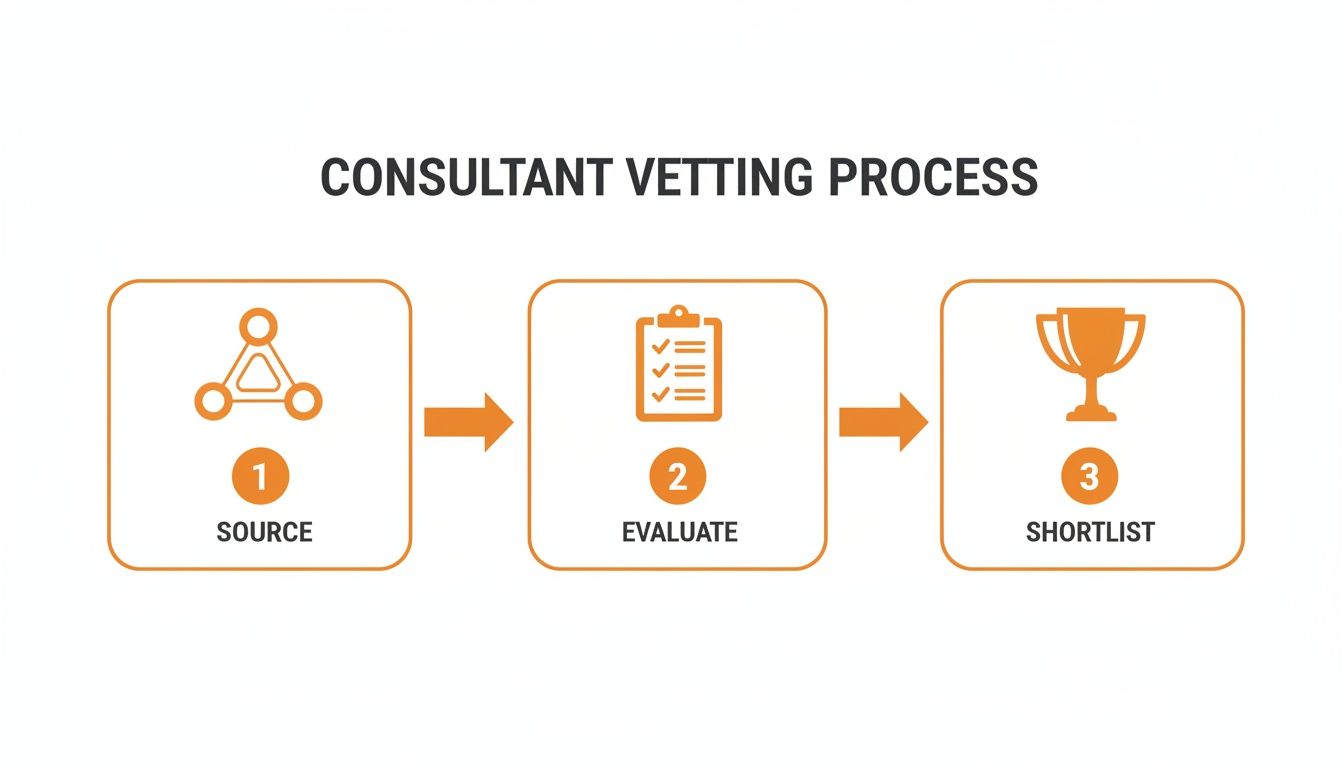
A consistent method helps you stay objective and focus on finding a partner with a proven track record.
Conducting Meaningful Reference Checks
Reference checks are where the truth comes out. This is your chance to learn what it’s like to work with this person daily. Don’t just ask if past clients were happy; dig deeper.
Prepare specific, open-ended questions before you make the calls.
Pro Tip: Ask specifically for contacts from clients who are a similar size to your company or who faced a nearly identical challenge. That context is invaluable.
Here are questions that cut through the fluff:
- What was the single most valuable impact this consultant had on your business?
- Can you describe a time they handled an unexpected roadblock or disagreement?
- Did they train your team and leave you with new skills, or did their knowledge leave with them?
- If you were to work with them again, what one piece of advice would you give yourself to improve the project?
The answers will tell you more than a proposal ever could.
Finalizing the Contract and Kickoff
Once you’ve made your choice, get a rock-solid contract in place. This document is the foundation for your project and protects both parties.
At a minimum, your contract must clearly define:
- Scope of Work: A detailed description of every task, responsibility, and objective.
- Deliverables: The specific, tangible things you will receive (e.g., reports, software configurations, a strategic plan).
- Payment Milestones: A clear schedule tying payments to the completion of specific deliverables.
- Ownership of Intellectual Property: Who owns the final work product.
- Termination Clause: The conditions under which either party can end the agreement.
The consulting world is changing, with technology making expert advice more accessible. There’s a shift from retainers toward on-demand subscriptions and specialized automation tools. For instance, some manufacturing firms have cut costs by 15% with automation consultants, while retailers have boosted sales by 25% using data-driven pricing strategies. You can read more about these consulting industry trends on expertnetworkcalls.com.
A proper onboarding process aligns everyone on goals, timelines, and communication, setting the stage for a successful partnership.
Answering Your Questions About Business Consulting
Even with a plan, questions will arise. Getting straight answers builds confidence and ensures a positive first consulting experience.
When Is the Right Time for a Small Business to Hire a Consultant?
The best time to hire a consultant is when your business hits an inflection point—a moment of change or opportunity that demands a skill set you don’t have internally. Waiting for a crisis means you’re already behind.
Look for these triggers:
- You’ve Hit a Growth Wall: Sales have flattened, and your old strategies aren’t working. A consultant can uncover new growth channels.
- You’re Facing a Technical Hurdle: You need to implement a new CRM or automation platform, but your team lacks the specialized skills.
- Operations Are Straining: Your internal processes are struggling to keep up with demand, leading to delays and errors. An operations expert can re-engineer your workflows for scalability.
View it as a strategic investment to navigate what’s next, not a desperate attempt to fix a problem.
What’s the Difference Between a Consultant, a Coach, and a Mentor?
These terms are not interchangeable. Choosing the wrong one leads to mismatched expectations.
- A consultant is a specialist hired to solve a specific business problem. They deliver a tangible result, like a go-to-market strategy. The work is project-based.
- A coach focuses on developing the skills of an individual or team over the long term, such as leadership or performance improvement. The relationship is about development.
- A mentor is a seasoned professional who offers guidance based on their own experience, typically in an informal relationship.
If you have a project with a clear scope and need a measurable result, you need a consultant. They are the problem-solvers you bring in to get a specific job done.
When your need is tactical and tied to a business challenge, a consultant is the right choice.
How Can I Make Sure I Get Value from a Consulting Engagement?
Getting value from a consultant requires active involvement. It’s a partnership where their knowledge is applied effectively within the context of your business.
Follow these four ground rules:
- Define “Success” with Real Numbers: Agree on concrete metrics before signing. Don’t say “improve sales”; say “increase lead conversion by 15%” or “cut production waste by 10%.”
- Be an Open Book: Provide full access to your data, people, and unfiltered insights. The more context you provide, the more effective their solutions will be.
- Insist on a Knowledge Handoff: A great consultant empowers your team with the skills and processes to own the solution long after they’re gone.
- Execute the Recommendations: The most brilliant strategy is useless if it isn’t implemented. You and your team must be ready to do the work.
What If I’m Unhappy with My Consultant’s Performance?
If you feel a consultant isn’t delivering, speak up immediately. Letting problems slide wastes time and money.
First, refer to the contract. A well-written agreement will outline milestones and deliverables. Schedule a frank conversation to review progress. Often, the issue is a simple miscommunication.
If things don’t improve, refer to the termination clause in your contract. This section should provide a professional off-ramp for both parties, allowing you to part ways without drama. Act decisively to get your project back on track.
Finding the right cloud consulting partner is a critical step in your business’s journey. At CloudConsultingFirms.com, we provide data-driven comparisons and verified reviews to help you make an informed decision. Explore our 2025 guide to compare top firms on everything from pricing and certifications to industry expertise, ensuring you find the perfect fit for your project.