The Top 7 AWS Migration Partners for 2026: A Technical Analysis
The AWS partner ecosystem is crowded. In 2026, a successful cloud migration hinges not on marketing claims but on verifiable technical competence, transparent pricing, and documented outcomes. This guide bypasses promotional noise, providing a structured, evidence-based framework for technical leaders—from startups to global enterprises—to evaluate and select the right AWS migration partners.
This analysis dissects the critical decision criteria:
- Matching partner scale to your project’s technical complexity.
- Decoding certifications that signal real expertise, such as the AWS Migration Competency.
- Identifying contractual and technical red flags before signing a Statement of Work (SOW).
Instead of generic advice, this roundup offers actionable data and a clear methodology to build your shortlist. You will find detailed profiles for top partners like Accenture, Deloitte, Slalom, and Mission Cloud, built for CIOs, CTOs, and engineering leaders who are skeptical of fluff and require an objective technical analysis. We will analyze these AWS migration partners through a lens of engineering reality, financial governance, and long-term operational excellence, equipping you with a precise framework to make a decision that aligns with your budget, timeline, and technical requirements.
1. CloudConsultingFirms.com
For technology leaders tasked with finding and vetting AWS migration partners, the initial discovery phase is fragmented and inefficient. CloudConsultingFirms.com (Cloud Intel) addresses this by providing an independent, data-driven buyer’s guide that functions as a shortlisting engine. It aggregates objective performance data to score and rank top-tier cloud consulting firms, saving critical time for CIOs, procurement teams, and engineering leaders who must justify vendor selections with concrete data, not marketing claims.
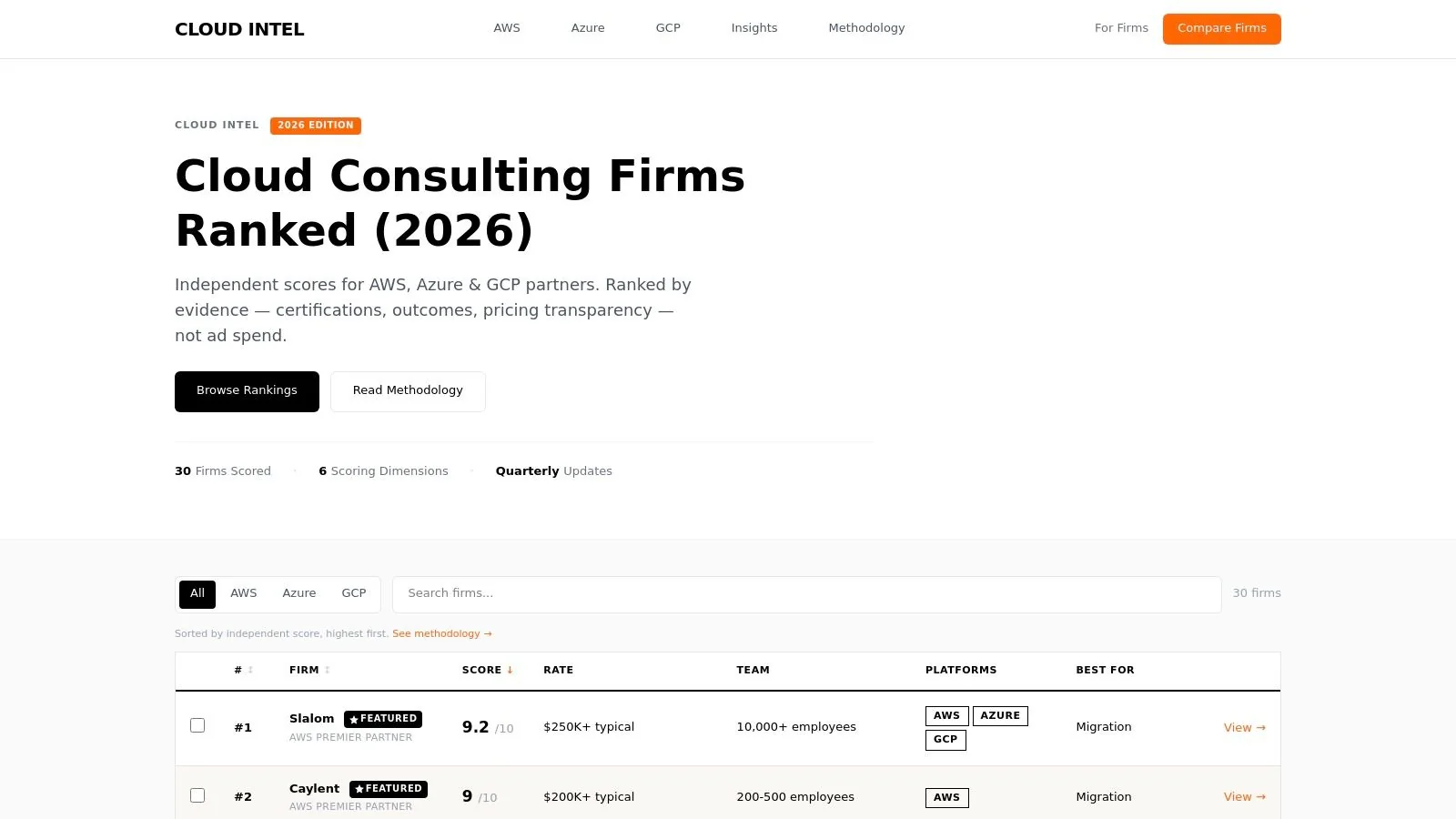
The platform’s methodology is its core differentiator. It evaluates firms across six dimensions: certifications, documented project outcomes, pricing transparency, verified client reviews, industry specialization, and responsiveness. With a dataset built from over 2,400 reviews and partner competency records, the rankings offer a credible, third-party perspective on the capabilities of prominent partners like Slalom, Caylent, Accenture, and Deloitte. This objective scoring is useful for identifying proven aws migration partners without the noise of sponsored content.
Key Features and Practical Tools
CloudConsultingFirms.com is built for action, offering several tools to move from broad research to a qualified shortlist quickly.
- Interactive Vendor Quiz: A guided questionnaire to define project requirements (e.g., complex re-architecture, cost optimization, 24/7 managed services) and match you with the top three to five ranked firms whose capabilities align with your needs.
- Platform Filters: Directly filter the ranked list by budget tier, industry specialization (e.g., FinTech, Healthcare, Public Sector), compliance needs (e.g., FedRAMP, HIPAA, PCI-DSS), and specific AWS competencies.
- ROI Calculator: A financial modeling tool to estimate the potential return on investment from a migration or optimization project, valuable for building a business case and securing stakeholder buy-in.
- Detailed Firm Profiles: Each partner profile includes typical project rates, timelines, team sizes, and clear summaries of their strengths and potential trade-offs (e.g., a boutique firm may offer lower costs but have limited geographic reach).
Pricing Transparency and Benchmarks
A significant hurdle in vendor selection is understanding market rates. The platform demystifies this by publishing aggregated pricing benchmarks, giving decision-makers an immediate sense of budget requirements.
| Service Type | Typical Cost Range |
|---|---|
| Hourly Consultant Rates | $150 – $350 / hour |
| Migration Assessments | $25,000 – $75,000 |
| Managed Services | $5,000 – $50,000 / month |
| Migration Projects | $100,000 – $2,000,000+ |
These benchmarks, combined with budget-tier classifications for each firm, help calibrate expectations and prevent budget misalignment during the RFP process.
How to Use It Effectively
CloudConsultingFirms.com is designed as a first step, not a final answer. The recommended workflow is to use the site to build an informed shortlist of two to four potential partners. After using the quiz and filters, proceed with standard due diligence, including formal RFPs, technical proof-of-concepts, and thorough reference checks. The platform’s quarterly updates and “red flag” signals (e.g., a sudden drop in review scores) provide ongoing value in monitoring the partner ecosystem.
- Pros:
- Evidence-Based Rankings: Scores are based on objective data like certifications and verified reviews, not advertising spend.
- Practical Decision Tools: The quiz, filters, and ROI calculator accelerate the shortlisting process.
- Pricing Transparency: Published benchmarks provide clear budget orientation from the start.
- Comprehensive Coverage: Includes research specific to AWS, Azure, and GCP for multi-cloud environments.
- Cons:
- Not a Replacement for Due Diligence: You must still conduct RFPs, reference checks, and legal reviews.
- Curated List: The rankings focus on the Top 30 firms, so highly specialized or smaller regional providers might not be included.
For any organization seeking a fast, credible, and data-backed method to identify and compare top aws migration partners, CloudConsultingFirms.com is an indispensable starting point that reduces vendor selection risk.
Website: https://cloudconsultingfirms.com
2. Accenture AWS Business Group (AABG)
Accenture’s AWS Business Group (AABG) is a dedicated unit focused on enterprise-scale migration and modernization, designed for large organizations executing complex, multi-year transformations. Their approach centers on establishing “migration factories,” a systematized process that uses extensive automation and proven patterns to move large application portfolios, including legacy systems like mainframes.
The core strength of AABG lies in its sheer scale and structured program governance. With over 26,000 AWS-certified professionals, they possess the talent depth to staff multiple concurrent workstreams across global regions. This makes them a candidate for businesses orchestrating a migration that involves not just IT infrastructure but also data platform modernization, AI integration, and fundamental changes to their cloud operating model.
Key Offerings and Specializations
AABG’s methodology is built on proprietary accelerators and deep industry-specific intellectual property. Instead of starting from scratch, they apply pre-built solution architectures and automation scripts tailored for specific compliance regimes (like HIPAA or FedRAMP) or industry challenges (like core banking system modernization). This reduces project risk and can shorten the time-to-value for complex migrations.
| Feature | Description | Best For |
|---|---|---|
| Migration Factories | A standardized, assembly-line approach to migrating hundreds or thousands of applications using automation. | Organizations with large, homogenous application portfolios seeking predictable and repeatable migration outcomes. |
| Mainframe Modernization | Specialized patterns and tooling to refactor or replatform legacy mainframe workloads to AWS. | Enterprises looking to exit expensive and rigid mainframe contracts without disrupting core business functions. |
| Industry IP & Accelerators | Pre-built solutions and code for specific sectors, such as financial services, healthcare, and public sector. | Companies in regulated fields needing compliant, industry-aware cloud architectures from day one. |
| End-to-End Delivery | A single engagement can cover everything from initial cloud strategy and business case development to post-migration managed services. | CIOs and CTOs who prefer a single, accountable partner for the entire cloud journey to reduce vendor management complexity. |
Decision Criteria & Red Flags
Pros:
- Program Governance: Excels at managing complex, multi-tower programs with stringent reporting and risk management.
- Deep Talent Pool: Access to a massive bench of certified experts across nearly every AWS service and discipline.
- Holistic Modernization: Capable of executing beyond a simple lift-and-shift, integrating data/AI and application modernization into the migration roadmap.
Cons:
- Budget & Timeline: Primarily structured for large, multi-million dollar enterprise engagements spanning several years.
- Engagement Complexity: Procurement and onboarding can be a lengthy process involving significant legal and commercial negotiation.
Accenture is often considered among the top AWS consulting partners for global enterprises requiring a partner that can manage both technical execution and business transformation at scale. Small to mid-sized businesses or those seeking a quick, targeted migration may find their engagement model too heavyweight.
Website: https://www.accenture.com/us-en/services/cloud/migrate-to-aws
3. Deloitte (Cloud Engineering + AWS Alliance)
Deloitte brings a finance-first and risk-aware perspective to cloud migration, making it a preferred partner for enterprises where governance, cost control, and compliance are non-negotiable. Their approach is less about pure technology execution and more about aligning cloud adoption with strategic business outcomes, particularly for organizations in highly regulated sectors. Deloitte uses a full-lifecycle model, starting with a strong business case and financial modeling before moving into technical execution using factory-based methods.
The core of their offering is the deep integration of financial operations (FinOps) and risk management into every stage of the migration. They excel at mapping the total cost of ownership (TCO) to future-state savings and articulating the cloud’s value proposition to executive stakeholders. This makes Deloitte one of the top aws migration partners for CIOs and CFOs who need a partner capable of managing the financial and operational transformation alongside the technical lift.
Key Offerings and Specializations
Deloitte’s methodology is reinforced by its ATADATA platform, an acquisition that provides tooling for automated discovery, application dependency mapping, and migration orchestration. This technology underpins their factory model, enabling them to plan and execute large-scale portfolio moves with predictable timelines and cost structures. Their alliance with AWS also facilitates joint delivery motions, bringing AWS Professional Services directly into the engagement for deep technical problem-solving.
| Feature | Description | Best For |
|---|---|---|
| ATADATA Tooling & IP | A proprietary platform for automated discovery, planning, execution, and disaster recovery integration. | Enterprises with complex, poorly documented application estates that require deep dependency mapping before migration. |
| Migration Factories | Utilizes AWS Migration Hub Journeys and factory methods to orchestrate the movement of large application portfolios. | Organizations needing to migrate hundreds of workloads with measurable KPIs and repeatable, auditable processes. |
| Industry & Public Sector Depth | Specialized programs and compliance frameworks for finance, healthcare, and government agencies. | Companies operating in regulated industries that require a partner with proven experience in security and compliance controls. |
| Joint AWS Delivery | Formalized joint delivery models that embed AWS Professional Services resources within the Deloitte project team. | Businesses undertaking migrations that involve new or complex AWS services where direct vendor expertise is critical. |
Decision Criteria & Red Flags
Pros:
- Executive Alignment: Strong capabilities in building the business case, from initial value mapping to post-migration cost-to-savings analysis.
- Robust Controls: Deep expertise in implementing and managing controls for regulated workloads in finance, healthcare, and the public sector.
- Repeatable Process: Migration factories provide a structured and measurable approach, giving stakeholders clear visibility into progress via KPIs.
Cons:
- Premium Pricing: Engagement costs are at the higher end, reflecting their enterprise focus and comprehensive governance model.
- Methodology Overhead: The structured, methodology-heavy approach may feel overly complex for smaller or more agile organizations with less stringent governance needs.
Deloitte is a strong choice for large enterprises that view cloud migration as a fundamental business transformation requiring rigorous financial and risk governance. For more insight into structuring such a project, you can review some AWS migration best practices that align with this methodology.
Website: https://www.deloitte.com/global/en/alliances/aws/about/aws-cloud-migration.html
4. Slalom
Slalom is a business and technology consulting firm that emphasizes a local, collaborative delivery model, making it well-suited for mid-market and enterprise clients who want a hands-on partner with teams embedded directly into their own engineering and operations staff. Their approach is less about massive, top-down program management and more about building momentum through structured workshops and joint execution, a strong cultural fit for organizations that value co-creation over pure outsourcing.
With over 7,500 consultants and more than 3,300 AWS certifications, Slalom brings substantial expertise to its projects. The firm is one of the premier aws migration partners for businesses that need to balance the technical aspects of migration with the operational realities of cloud governance, security, and financial management (FinOps). They often appeal to clients who find the scale and engagement model of a global system integrator (SI) to be too rigid or impersonal.
Key Offerings and Specializations
Slalom’s migration services are built around AWS Migration Acceleration Program (MAP) aligned accelerators. They start engagements with structured workshops designed to build a clear business case, migration plan, and secure landing zone before any large-scale workload movement begins. This focus on foundational planning helps de-risk projects and ensures alignment between IT and business stakeholders.
| Feature | Description | Best For |
|---|---|---|
| Embedded, Collaborative Teams | Slalom consultants work alongside client teams, facilitating knowledge transfer and co-ownership. | Organizations that want to build internal cloud skills and avoid a black-box outsourcing relationship. |
| Migration Acceleration Workshops | Structured, multi-day sessions to rapidly define scope, build a business case, and plan the migration execution. | Teams needing to quickly achieve stakeholder buy-in and create a defensible, data-driven migration roadmap. |
| Balanced Migration & Modernization | A practice that integrates FinOps, security foundations, and application modernization into the migration process. | Companies wanting to avoid a pure “lift-and-shift” and instead use the migration as a catalyst for improving operations. |
| Mainframe Modernization | A dedicated competency for assessing, planning, and executing the migration of legacy mainframe applications to AWS. | Enterprises with critical mainframe dependencies seeking a practical path to cloud-native or replatformed architectures. |
Decision Criteria & Red Flags
Pros:
- Collaborative Culture: Reputation for genuinely embedding with client engineers, which promotes better knowledge transfer and long-term success.
- Practical Governance: A balanced approach that covers not just the migration but also the crucial post-migration operational areas like FinOps and security.
- Mid-Market Agility: Offers enterprise-grade capabilities without the overhead and contractual complexity of the largest global SIs.
Cons:
- Global Bench Depth: May have a thinner bench than the largest SIs for extremely large, multi-continent portfolio moves requiring massive, simultaneous staffing.
- Opaque Pricing: Pricing is not transparent and can vary significantly by market and the specific expertise required for an engagement.
Slalom is an excellent choice for organizations seeking a highly collaborative partner for complex, multi-workload programs. Their model is particularly effective for businesses that prioritize building internal cloud capabilities and want a partner that feels like an extension of their own team.
Website: https://www.slalom.com/us/en/who-we-are/partners/aws
5. Mission Cloud (a CDW company)
Mission Cloud, now part of CDW, is a born-in-the-cloud AWS Premier Tier partner with a strong focus on execution-oriented migrations for U.S.-based customers. They specialize in projects aligned with the AWS Migration Acceleration Program (MAP), emphasizing accurate Total Cost of Ownership (TCO) forecasting and rapid landing zone deployment. Their approach is designed for mid-market and emerging enterprises that need an engineering-heavy partner to accelerate their cloud journey without the overhead of a global systems integrator.
The primary strength of Mission Cloud is its hands-on, time-to-value delivery model. They structure engagements around transparent phases: Assess, Mobilize, and Migrate/Modernize, giving clients clear visibility into progress through tools like AWS Migration Hub. This U.S.-based team is known for its deep engineering talent, particularly in database and core infrastructure migrations, and for providing meaningful knowledge transfer to upskill a client’s internal teams during the project.
Key Offerings and Specializations
Mission Cloud’s methodology is built for speed and clarity, making them one of the go-to AWS migration partners for organizations that need to move quickly and see immediate results. Their expertise in the AWS MAP framework is a key differentiator, as they have a proven record of helping customers secure funding and meet program milestones efficiently. This focus on process is paired with post-migration capabilities, ensuring that workloads are not only moved but also optimized and secured.
| Feature | Description | Best For |
|---|---|---|
| MAP Delivery Experience | Deep expertise in executing migrations within the AWS Migration Acceleration Program (MAP), noted for budgeting accuracy. | Companies seeking to use AWS funding programs to offset migration costs and need a partner to manage the process. |
| Transparent Migration Phases | A clear, three-stage process (Assess → Mobilize → Migrate/Modernize) that provides predictable project milestones. | IT leaders who require a well-defined project plan with clear deliverables and timelines from the start. |
| AWS Migration Hub Visibility | Full integration with AWS Migration Hub to provide clients with real-time tracking of migration progress and application status. | Organizations that want direct, on-demand visibility into the technical execution of their migration workstreams. |
| Integrated Managed Services | Offers a seamless transition from migration project completion to ongoing cloud management, security, and optimization. | Businesses that lack a large internal cloud operations team and need a partner for post-migration support. |
Decision Criteria & Red Flags
Pros:
- Time-to-Value: Engineering-led approach is designed for fast execution, ideal for mid-market clients who need to see returns quickly.
- U.S.-Based Delivery: Strong track record with domestic companies, offering localized support and expertise recognized by multiple AWS awards.
- Database & Infra Expertise: Proven capabilities in complex database migrations (e.g., SQL Server to Aurora) and core infrastructure re-hosting.
Cons:
- Geographic Focus: Primarily serves the U.S. market, which may not be a fit for complex, multi-continent portfolio moves.
- Opaque Pricing: Costs are project-based and determined via a Statement of Work (SOW), with no public pricing lists available.
Mission Cloud is an excellent choice for mid-market to upper mid-market companies in the U.S. looking for an agile and technically proficient partner. Their focused approach makes them less suitable for massive global enterprises needing the bench strength of a tier-one SI to manage dozens of concurrent international workstreams.
Website: https://www.missioncloud.com/solutions/aws-cloud-migration-services
6. Presidio
Presidio is a U.S.-focused systems integrator and AWS Premier Consulting Partner that offers practical, structured pathways for cloud adoption. Their approach is well-suited for mid-market and enterprise organizations seeking to build foundational cloud capabilities and execute predictable migrations, particularly for server and VMware-based workloads. They emphasize enablement through dedicated workshops and rapid migration offerings designed to de-risk the initial move to AWS.
The primary strength of Presidio is its focus on prescriptive, repeatable migration patterns. With over 1,370 AWS certifications, their team has a substantial domestic footprint, allowing them to deliver hands-on guidance for businesses that prefer a partner with deep local presence. Their offerings are geared towards establishing a solid cloud landing zone and then efficiently moving existing virtualized environments, making them a strong choice for companies prioritizing infrastructure modernization as a first step.
Key Offerings and Specializations
Presidio’s service catalog is built around creating a stable AWS foundation and then executing efficient migrations with minimal operational disruption. They provide a clear entry point for organizations that may not have deep cloud expertise in-house, guiding them from initial readiness assessments to post-migration operations. This makes them one of the go-to AWS migration partners for companies looking for a clear, step-by-step process.
| Feature | Description | Best For |
|---|---|---|
| Migration Readiness & Rapid Migration | A structured assessment followed by a streamlined offering to lift-and-shift server workloads with minimal downtime. | Organizations with a large fleet of on-premises servers or VMs needing a fast, low-risk path to the cloud. |
| VMware Cloud on AWS Advisory | Specialized guidance for integrating or migrating existing VMware environments to AWS, maintaining operational consistency. | Companies heavily invested in the VMware ecosystem seeking a hybrid cloud strategy or full data center evacuation. |
| Enablement Workshops | Focused, hands-on sessions covering landing zones, Amazon Connect, End-User Computing (EUC), and DevOps practices. | IT teams that need to build internal skills and establish best practices before or during a migration project. |
| U.S. Enterprise & Mid-Market Focus | Solutions and engagement models are designed for the scale and compliance needs of U.S.-based mid-market and enterprise clients. | CIOs and IT directors who value a partner with a strong regional presence and understanding of the domestic market. |
Decision Criteria & Red Flags
Pros:
- Prescriptive Pathways: Provides clear, practical methods for server and VM migrations, reducing project ambiguity.
- Substantial U.S. Footprint: Access to a large, certified staff located within the United States for close collaboration.
- Structured Enablement: Strong fit for teams needing foundational training and best-practice guidance through workshops.
Cons:
- Emphasis on Lift-and-Shift: The initial focus may be on infrastructure migration; clients must be proactive in planning subsequent application modernization.
- Limited Pricing Transparency: Offerings are typically custom-quoted, and workshops may have prerequisites that are not publicly listed.
Presidio is an excellent choice for U.S.-based organizations that need a partner to guide them through the foundational stages of cloud migration with proven, repeatable processes. Their model is especially effective for companies moving from a heavily virtualized on-premises environment.
Website: https://www.presidio.com/partners/aws/
7. 2nd Watch
2nd Watch is an AWS-native services partner that specializes in large-scale cloud migrations driven by a factory-based model. They are a strong choice for organizations with substantial server counts, complex database environments, and a clear mandate to control cloud spend post-migration. Their approach combines methodical, assessment-led planning with automated execution, making them one of the more predictable aws migration partners for rehosting and replatforming projects.
The company’s key differentiator is its dual focus on executing the migration and managing the resulting cloud footprint. They have deep expertise in using tools like AWS Database Migration Service (DMS) for near-zero downtime database cutovers, a critical requirement for businesses that cannot afford extended maintenance windows. This technical capability, paired with a mature FinOps practice, provides a clear path from migration to long-term cost optimization.
Key Offerings and Specializations
2nd Watch’s services are structured to de-risk complex migrations through careful upfront analysis and proven tooling. Their packaged assessments are designed to give stakeholders a clear TCO model and right-sized architectural blueprint before the full migration begins. This data-driven approach is particularly effective for organizations moving hundreds or thousands of virtual machines.
| Feature | Description | Best For |
|---|---|---|
| Migration Factory Model | An industrialized process using automation and defined workstreams to migrate large volumes of servers. | Companies with 500+ servers needing a predictable, repeatable method for rehosting and replatforming at scale. |
| DMS-Driven Database Migration | Expertise in using AWS DMS and other tools for minimal-downtime migrations of SQL Server, Oracle, and other relational databases. | Businesses with mission-critical databases where application availability during cutover is a primary concern. |
| Packaged Assessments | Fixed-scope assessments that provide a TCO analysis, rightsizing recommendations, and a detailed migration plan. | Organizations in the planning stage who need to build a solid business case and technical roadmap for their migration. |
| Managed Cloud & FinOps | Post-migration services focused on governance, security, and continuous cost optimization to manage cloud spend. | IT leaders who need to demonstrate and maintain ROI from their cloud investment long after the migration project ends. |
Decision Criteria & Red Flags
Pros:
- Database Expertise: Deep bench strength for executing complex, database-heavy migrations with minimal business disruption.
- Post-Migration Optimization: Strong managed FinOps practice helps ensure that initial TCO projections become long-term reality.
- Proven Scale: Case studies with well-known brands demonstrate their ability to handle large and complex enterprise environments.
Cons:
- Limited Pricing Transparency: Public information on packaged assessment costs is not readily available; engagements require direct scoping conversations.
- AWS-Centric Focus: As a dedicated AWS partner, their capabilities for multi-cloud or hybrid strategies may be less developed than larger, cloud-agnostic SIs.
2nd Watch is an excellent fit for mid-market and enterprise customers whose migration success is tied to moving a large server estate and complex databases efficiently, while establishing rigorous cost controls from day one. Their focus makes them a specialized and effective choice within the AWS ecosystem.
Website: https://www.2ndwatch.com
Top 7 AWS Migration Partners — Comparison
| Provider | Implementation complexity | Resource requirements | Expected outcomes | Ideal use cases | Key advantages |
|---|---|---|---|---|---|
| CloudConsultingFirms.com | Low — tool-driven shortlisting | Minimal — time for stakeholders to review | Shortlist of vetted partners, ROI estimates, risk signals | Vendor selection, RFP prep, compliance checks | Independent, evidence-based rankings; interactive filters and ROI calculator |
| Accenture AWS Business Group (AABG) | Very high — multi-year, multi-tower programs | Very large bench, significant budget and procurement overhead | Enterprise-scale migrations, modernization, operating-model change | Global enterprises, regulated industries, large portfolio moves | Extensive AWS-certified talent, migration factories, automation/accelerators |
| Deloitte (Cloud Engineering + AWS Alliance) | Very high — governance- and compliance-heavy | Large cross-functional teams, specialized tooling (e.g., ATADATA) | Controlled, auditable migrations with measurable KPIs | Regulated workloads, public sector, complex portfolio orchestration | Strong compliance/governance focus, joint AWS delivery, repeatable factories |
| Slalom | Medium — structured workshops and embedded teams | Moderate bench with strong US delivery presence | MAP-aligned migrations, modernization and FinOps improvements | Mid-market to enterprise needing collaborative, local delivery | Collaborative embedded teams, balanced migration+modernization capabilities |
| Mission Cloud (CDW) | Low–Medium — MAP-aligned, speed-focused | Mid-market engineering teams, US-based delivery | Fast, predictable migrations with TCO forecasting and knowledge transfer | U.S. mid-market/upper mid-market, database and infra migrations | Practical MAP experience, transparent phases, AWS Migration Hub visibility |
| Presidio | Low–Medium — prescriptive lift-and-shift pathways | Large U.S. footprint, many certified staff | Rapid VM/server migrations, landing zone enablement | Mid-market and enterprise, VMware-to-AWS and lift-and-shift projects | Prescriptive migration offerings, VMware Cloud on AWS expertise |
| 2nd Watch | Medium–High — factory and DB-focused migrations | Specialized AWS teams, DMS/database migration expertise | Large-scale rehosts/replatforms, near-zero downtime DB cutovers, FinOps | Database-heavy migrations, large VM counts, post-migration optimization | DMS-driven cutovers, packaged assessments, strong FinOps capabilities |
Your Action Plan: From Shortlist to Successful Migration
You have reviewed some of the most capable AWS migration partners available in 2026, from enterprise-scale integrators like Accenture and Deloitte to specialized mid-market experts like Mission Cloud and Presidio. The right choice is entirely dependent on your organization’s context: budget, compliance demands, team skill set, and long-term cloud objectives. A “best” partner does not exist in a vacuum.
The wrong choice leads to budget overruns, stalled projects, and a poorly architected AWS environment. A successful selection, however, accelerates cloud adoption, de-risks the process, and establishes a foundation for future innovation. Your goal is not just to “lift and shift” servers; it is to build a secure, cost-optimized, and operationally excellent cloud platform.
From Analysis to Action: Your Vetting Checklist
The data in this article is your starting point. Now, due diligence begins. Transitioning from a broad list to a signed Statement of Work (SOW) requires a structured, skeptical approach. Focus on verifiable technical competence and cultural fit.
Here is your five-step action plan to select the right partner:
-
Build Your Initial Shortlist (2-3 Partners):
- Action: Use the criteria from this article—budget tiers, industry specialization, and specific AWS Competencies—to select two to three partners. Use a directory like CloudConsultingFirms.com for more granular filtering.
- Why it matters: A focused shortlist allows for deeper technical discussions with a few relevant candidates.
-
Demand Technical Deep Dives, Not Sales Pitches:
- Action: Insist on speaking with the solution architects and senior engineers who would be assigned to your project. Prepare specific, challenging questions about your architecture, security, and potential migration roadblocks.
- Example Question: “We run a legacy monolithic application with a 10TB Oracle database. What specific migration patterns (e.g., re-platforming to Amazon RDS or re-architecting with the Strangler Fig pattern) have you used for a similar workload, and what were the primary challenges encountered with data synchronization?”
-
Scrutinize Verifiable Proof and Case Studies:
- Action: Request detailed, anonymized case studies that mirror your project’s scope, industry, and scale. Look for concrete metrics, not vague platitudes.
- Red Flag: A partner who only provides high-level summaries without architectural diagrams, performance metrics (e.g., latency reduction, cost savings percentage), or timelines is a cause for concern.
-
Conduct Rigorous, Unfiltered Reference Checks:
- Action: Speak directly with past clients. Go beyond the provided list if possible. Ask pointed questions about what went wrong, how conflicts were resolved, and the effectiveness of their knowledge transfer process.
- Key Question for a Reference: “Describe a moment when the project did not go according to plan. How did the partner’s team communicate the issue, and what was their process for resolving it?”
-
Define an Outcome-Based Statement of Work (SOW):
- Action: Draft an SOW that focuses on business outcomes, not just a list of activities. Clearly define what “done” looks like. This includes performance targets, security configurations, cost optimization guardrails, and your team’s ability to operate the new environment independently.
- Why it matters: An activity-based SOW means you pay for hours worked. An outcome-based SOW means you pay for results delivered. This aligns the partner’s incentives with yours.
Choosing from the top AWS migration partners is a consequential decision. The partner you select is not a temporary contractor; they are the architects of your future cloud foundation. A methodical, evidence-based selection process is your best insurance policy for a successful, on-budget migration.
Finding it difficult to narrow down the options or need a partner with a very specific skill set? The curated directory at CloudConsultingFirms.com provides advanced filters for certifications, industry experience, and company size. Use it to build your perfect shortlist and connect directly with vetted AWS migration partners that match your exact project requirements.
Peter Korpak
Chief Analyst & Founder
Data-driven market researcher with 10+ years helping software agencies and IT organizations make evidence-based decisions. Former market research analyst at Aviva Investors and Credit Suisse. Analyzed 200+ verified cloud projects (migrations, implementations, optimizations) to build Cloud Intel.
Connect on LinkedInContinue Reading
Insights
Explore our complete insights hub
AWS vs Azure vs GCP: A Strategic Comparison
Explore our strategic comparison of AWS vs Azure vs GCP. This guide provides actionable insights for choosing the right cloud platform for your business needs.
A Technical Guide to Azure Managed Services Pricing in 2026
Unlock the secrets of Azure managed services pricing. This guide covers cost models, ROI calculation, and negotiation tactics for technical leaders.
Stay ahead of cloud consulting
Quarterly rankings, pricing benchmarks, and new research — delivered to your inbox.
No spam. Unsubscribe anytime.