The Complete Guide to Vetting and Hiring IT Consulting Firms
Finding the right IT consulting firm for your cloud initiatives is a critical decision. A misstep can lead to budget overruns, security vulnerabilities, and stalled projects. This guide cuts through the noise, providing a direct path to identifying the ideal consulting partner for your specific needs, whether you’re planning a complex multi-cloud migration or optimizing a sub-$500K AWS budget.
This is a data-driven roundup of the leading platforms and partner directories where you can find and vet top-tier IT and cloud consultants. Instead of generic advice, this is a structured evaluation of each resource. You will get a clear, comparative look at the best places to find certified experts across AWS, Microsoft Azure, and Google Cloud Platform. This article moves beyond simple listings to deliver actionable intelligence.
For each platform, you will find:
- A concise profile detailing its core function and ideal use case.
- An analysis of its strengths and potential red flags for specific project types.
- Guidance on the best-fit scenarios, from enterprise-level RFPs to finding freelance talent for a specific project sprint.
- Direct links and screenshots to streamline your research process.
This resource is a practical toolkit for CIOs, CTOs, and IT leaders tasked with making high-stakes vendor decisions. The goal is to equip you with the information needed to confidently short-list and engage the most suitable IT consulting firms, ensuring your cloud projects are secure, scalable, and successful.
What is IT consulting and why do you need it?
IT consulting is the practice of advising organizations on how best to use information technology to achieve their business objectives. You need an IT consultant to provide specialized expertise, overcome critical talent gaps, and accelerate complex technological transformations.
While internal teams excel at maintaining daily operations, they often lack the specialized experience required for massive, one-off projects like a cloud migration or a complete infrastructure modernization. An experienced IT consulting firm brings a proven blueprint from hundreds of similar engagements, significantly reducing the strategic risk and execution time of your technology investments.
What are the core services offered by top IT consulting firms?
Top IT consulting firms offer a wide range of services, including cloud strategy and migration, cybersecurity assessments, data analytics implementation, and custom software development. They act as strategic partners to modernize outdated systems and drive digital innovation.
Beyond these core pillars, consultants often specialize in specific platforms (like AWS, Azure, or Google Cloud) or industry compliance standards (like HIPAA or PCI DSS). Their value lies in assessing your current technology stack, identifying inefficiencies, designing a modernized architecture, and managing the complex deployment process from start to finish.
How much do IT consulting services typically cost?
IT consulting services typically cost between $150 and $350 per hour, depending on the consultant’s expertise, location, and the project’s complexity. Enterprise-level strategic advising can exceed $400 per hour, while routine implementation work may be less expensive.
To provide a clearer picture, here is a general breakdown of IT consulting costs based on firm size and expertise level:
| Firm Category | Typical Hourly Rate | Project Minimum | Best Fit For |
|---|---|---|---|
| Independent Consultants & Freelancers | $100 - $150 | $5,000+ | Short-term fixes, specific technical audits, staff augmentation |
| Boutique / Niche Firms | $150 - $250 | $25,000+ | Specialized implementations (e.g., specific cloud migrations, security) |
| Mid-Market IT Consultancies | $200 - $300 | $50,000+ | Comprehensive digital transformations for mid-sized enterprises |
| Global Top-Tier Consultancies (Big 4, MBB) | $300 - $500+ | $250,000+ | Massive, multinational enterprise strategy and organizational change |
Key Insight: While hourly rates are important, the total cost of an engagement is determined by the firm’s efficiency. A highly specialized consultant charging $250/hour who completes a migration in three weeks is far more cost-effective than a $100/hour generalist who takes three months and requires substantial rework.
Where are the best places to find top IT consulting firms?
The best places to find top IT consulting firms are verified review platforms like Clutch and G2, or official cloud provider directories like the AWS Partner Solutions Finder. These tools provide objective data and client feedback for vendor vetting.
1. Clutch
Clutch is a go-to B2B research and reviews platform, making it an indispensable starting point for vetting it consulting firms. Its primary strength is its massive, U.S.-centric directory, powered by a unique verification process. Clutch analysts conduct live, in-depth interviews with a firm’s past clients to gather qualitative feedback on project management, results, and overall partnership quality.
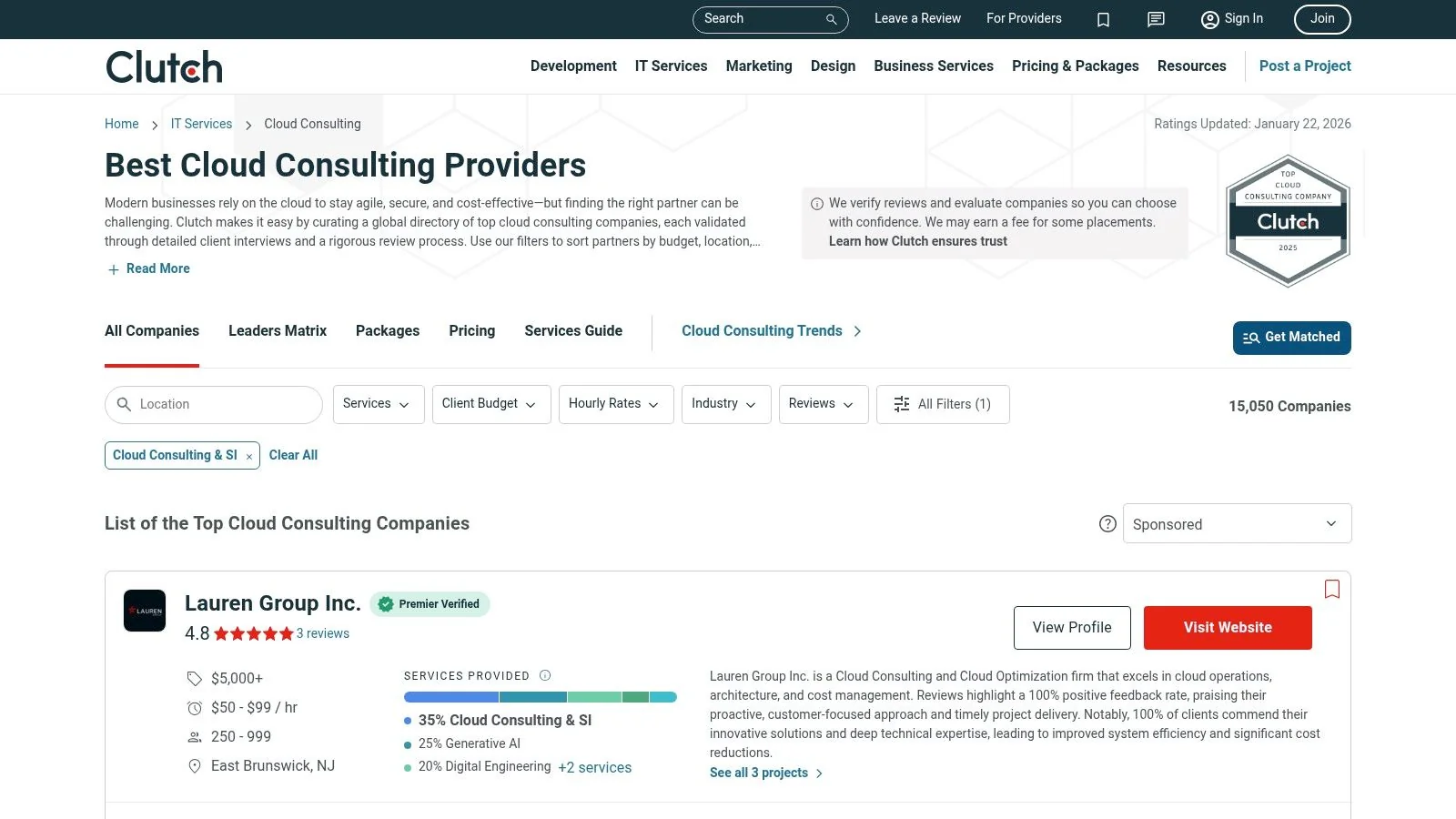
This methodology provides a layer of social proof that is difficult to find elsewhere. For procurement teams and IT leaders, this means access to verified, unbiased assessments that go beyond marketing copy. The platform is free to use for buyers; consulting firms pay for premium placement.
Key Features and User Experience
The user interface is designed for efficient filtering and comparison. You can quickly narrow down providers using highly specific criteria.
- Granular Filtering: Search by hourly rate (e.g., $100-$149/hr), minimum project size (e.g., $25,000+), specific cloud certifications (AWS, Azure, GCP), industry focus (Healthcare, FinTech), and geographic location.
- The Leaders Matrix: This proprietary tool plots firms based on their “Ability to Deliver” and “Focus” within a specific service area, like cloud consulting. It provides a visual shortcut to identify market leaders.
- Verified Reviews: Each review includes project context, costs, timelines, and direct quotes from the client, offering a comprehensive picture of a firm’s performance.
How to Use Clutch Effectively
To get the most value, ignore sponsored listings. Use filters to create a shortlist based on non-negotiable criteria first, such as compliance needs or budget constraints. Pay close attention to the recency of reviews; timestamped rankings ensure you’re evaluating firms on current performance. While Clutch excels at aggregating verified feedback, its model may underrepresent smaller boutique firms. You can see how Clutch’s rankings contribute to broader industry analysis by exploring a comprehensive ranking of top cloud consulting firms.
Pro Tip: When shortlisting candidates, look for a healthy mix of reviews across different project sizes and complexities. A firm that only has reviews for small, simple projects may not be the best fit for a complex, enterprise-level cloud migration.
2. G2 – Cloud Consulting Providers
While known for software reviews, G2 has expanded its B2B marketplace to include services, establishing a robust category for it consulting firms focused on cloud technologies. Its core value is leveraging its massive user review engine to provide data-driven insights. G2’s strength lies in its strong review authenticity process and a highly structured taxonomy, which allows for direct comparisons of providers based on verified user sentiment.
For IT leaders, G2 is a powerful tool to triangulate the data found on other platforms like Clutch. It provides a different lens on firm performance, often capturing feedback from a different user segment within a client’s organization (e.g., end-users vs. project managers). Access is free for buyers; consulting firms invest in premium profiles.
Key Features and User Experience
G2’s interface is built around its signature grid format, making side-by-side evaluation intuitive. The platform excels at translating user feedback into quantitative scores for satisfaction and quality of support.
- Comparison Grids: Instantly compare up to four firms on key metrics like user satisfaction ratings, market presence, and specific service line capabilities. This is ideal for quickly narrowing a long list of partners — similar to how you can run head-to-head firm comparisons on our own platform.
- User Review Filters: Sift through reviews based on the reviewer’s company size (SMB, Mid-Market, Enterprise), industry, and region. This helps you find feedback from companies with similar profiles and challenges.
- Structured Vendor Profiles: Profiles detail a firm’s cloud service offerings, official certifications (e.g., AWS Premier Tier), and recent case notes, offering a consolidated view of their expertise.
How to Use G2 Effectively
Use G2 to validate the shortlist you’ve built from other sources. Its strength is in confirming or challenging the marketing claims and review sentiment you’ve seen elsewhere. Pay close attention to review volume and recency; a high volume of recent, positive reviews is a strong signal of consistent performance. While its service coverage is still growing, it’s an indispensable resource for assessing buyer sentiment. You can explore their dedicated category at g2.com/categories/cloud-consulting. Be aware that some firm profiles can be sparse if they haven’t invested in the platform, so it’s best used with other research tools.
Pro Tip: Use the “Ease of Doing Business With” rating as a key indicator. A high score here often correlates with strong communication and transparent pricing, which are crucial for complex IT consulting engagements.
3. AWS Partner Solutions Finder
When your organization’s strategy is rooted in the Amazon Web Services ecosystem, the AWS Partner Solutions Finder is the most efficient path alongside our own AWS partner hub. This is Amazon’s official directory, designed to connect customers with it consulting firms that have proven, AWS-validated expertise. Its core value is its direct connection to AWS’s rigorous partner validation programs, offering a level of technical assurance that third-party platforms cannot match.
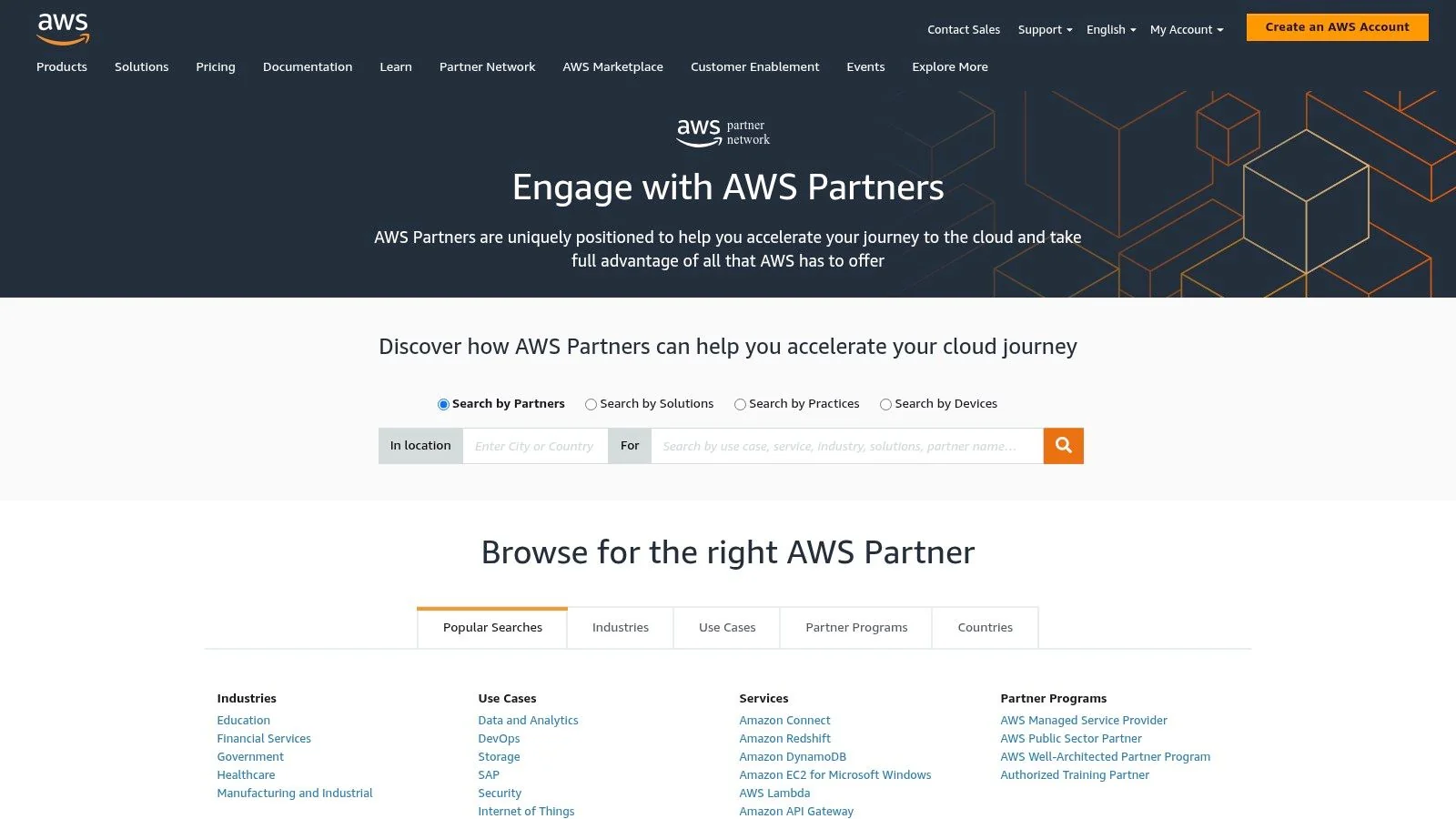
This platform is a verification engine. Partners are highlighted based on earned credentials like Competencies (e.g., Migration, Security) and Service Validations, which are awarded only after AWS audits a firm’s technical skills and customer success. For CIOs in regulated industries, this provides a critical layer of due diligence, confirming a partner’s ability to handle compliance-heavy workloads. The platform is free, and the “Contact Partner” function integrates directly into AWS’s internal lead management system.
Key Features and User Experience
The interface is built for technical decision-makers. The search functionality is aligned with AWS services and partner program designations for a precise vetting process.
- Competency and Program Filtering: Search specifically for partners holding crucial AWS badges like the Migration Competency, MSP (Managed Service Provider) Program validation, or the Well-Architected Partner Program status.
- AWS Service and Use Case Search: Narrow your search by specific AWS services (e.g., Amazon S3, AWS Lambda) or business outcomes (e.g., Application Modernization), ensuring you find a firm with relevant experience.
- Validated Credentials Display: Each partner profile prominently displays their earned AWS certifications and competencies, providing an immediate signal of their technical depth.
How to Use AWS Partner Solutions Finder Effectively
To maximize value, use the filters to pinpoint partners with the exact technical credentials your project demands. For instance, if you’re planning a complex SAP on AWS migration, filtering for the “SAP Competency” is non-negotiable. While the platform is unparalleled for verifying AWS-specific skills, be aware that details on a partner’s multi-cloud capabilities (Azure, GCP) will be limited. To understand how these official designations translate into market leadership, see this guide to top AWS consulting partners.
Pro Tip: Look beyond the top-tier “Premier” partner status. While it signifies a large-scale practice, a smaller “Advanced” partner with a specific, niche competency (like the Graviton Ready validation) may be a better and more cost-effective fit for a specialized workload.
4. Microsoft Azure – Find an Azure Partner
For organizations invested in the Microsoft ecosystem, the official Azure Partner Finder is the most authoritative resource for sourcing it consulting firms. This platform connects customers with Microsoft-vetted partners who have proven, audited expertise in deploying and managing Azure services. Its primary value is the trust instilled by Microsoft’s rigorous certification and validation processes.
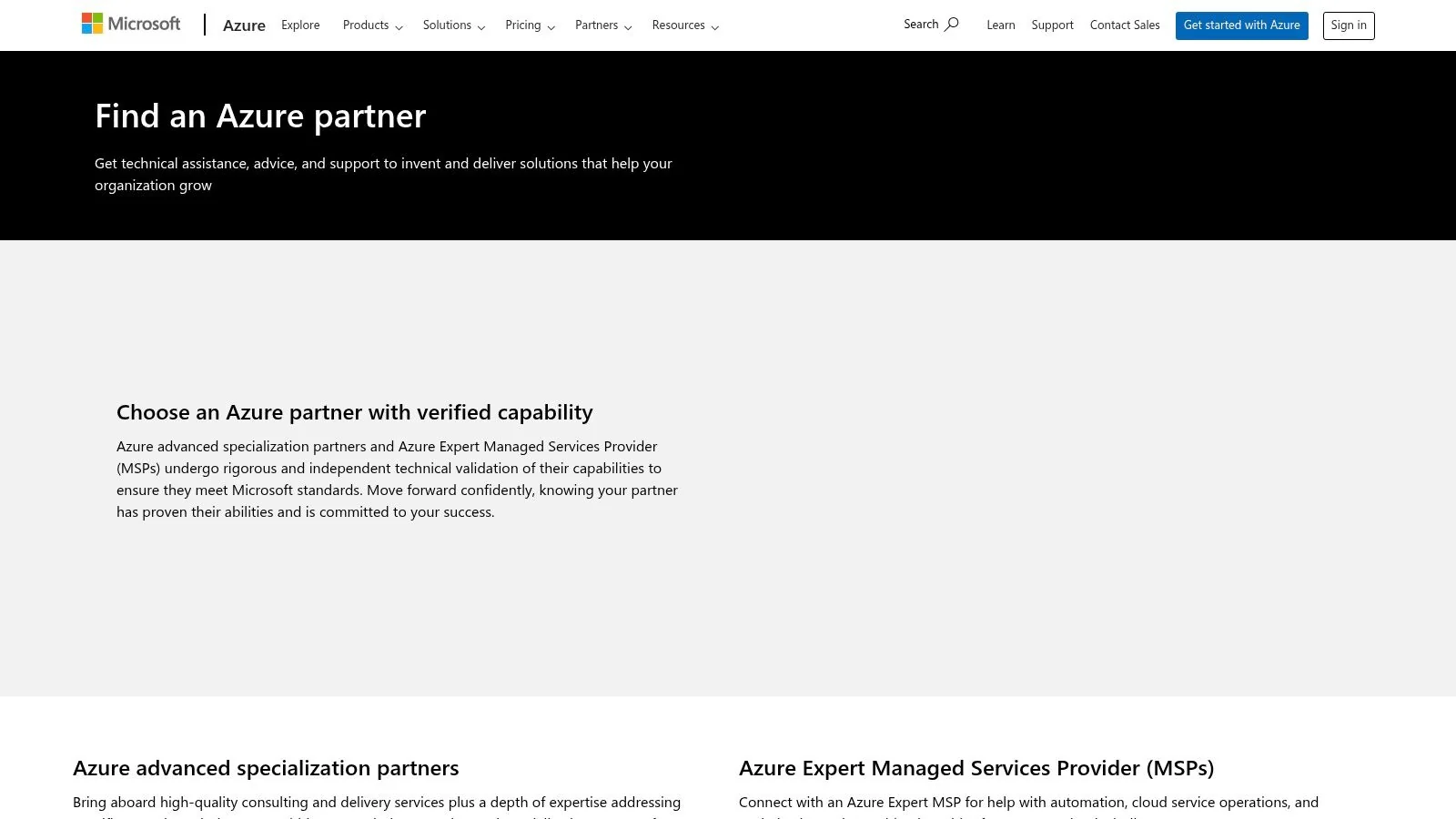
This directory acts as a stamp of approval from Microsoft, offering a level of technical assurance that third-party review sites cannot match. For CTOs planning complex hybrid-cloud strategies or modernizing .NET applications, this validation significantly de-risks the partner selection process. The platform is free for all users.
Key Features and User Experience
The experience is streamlined and focused on technical capabilities, not qualitative reviews. It helps you quickly identify partners with the specific, validated skills your project demands.
- Azure Expert MSP Badge: This is the highest tier of validation, signifying a partner has passed an exhaustive, third-party audit of their people, processes, and technology. It’s a clear signal of enterprise-grade operational excellence.
- Advanced Specializations: These badges validate deep knowledge in a specific scenario, such as “Windows Server and SQL Server Migration to Microsoft Azure” or “Kubernetes on Microsoft Azure.”
- Workload-Focused Filtering: Users can search for partners based on project needs like “Data & AI,” “App Modernization,” or “Hybrid Cloud & Infrastructure,” ensuring relevant results.
How to Use the Azure Partner Finder Effectively
Start by filtering for the non-negotiable validations your project requires. If you need a partner to manage your entire Azure environment post-migration, begin your search by exclusively selecting the “Azure Expert Managed Service Provider” filter. This single action will dramatically shorten your list to only the most capable firms. While the platform excels at verifying technical prowess, partner profiles can be light on business-centric details like pricing models.
Use this directory to build a technically qualified shortlist, then cross-reference those firms on platforms like Clutch or G2 to gather client feedback. The platform’s strength is its focus on Azure, which is also its limitation; you won’t gain insight into a partner’s multi-cloud capabilities.
Pro Tip: Look for partners holding multiple Advanced Specializations relevant to your roadmap. A firm with specializations in both “Migration” and “Modernization of Web Applications” is likely better equipped for a complex, multi-phased transformation project.
5. Google Cloud – Find a Partner
For organizations committed to the Google Cloud Platform (GCP), the official Google Cloud – Find a Partner directory is the definitive source for locating vetted it consulting firms. Its core value lies in providing a direct line to partners whose expertise has been officially validated by Google. This is crucial for businesses leveraging GCP’s advanced capabilities in data analytics, machine learning, and AI, as the directory highlights firms with proven success in these specialized domains.
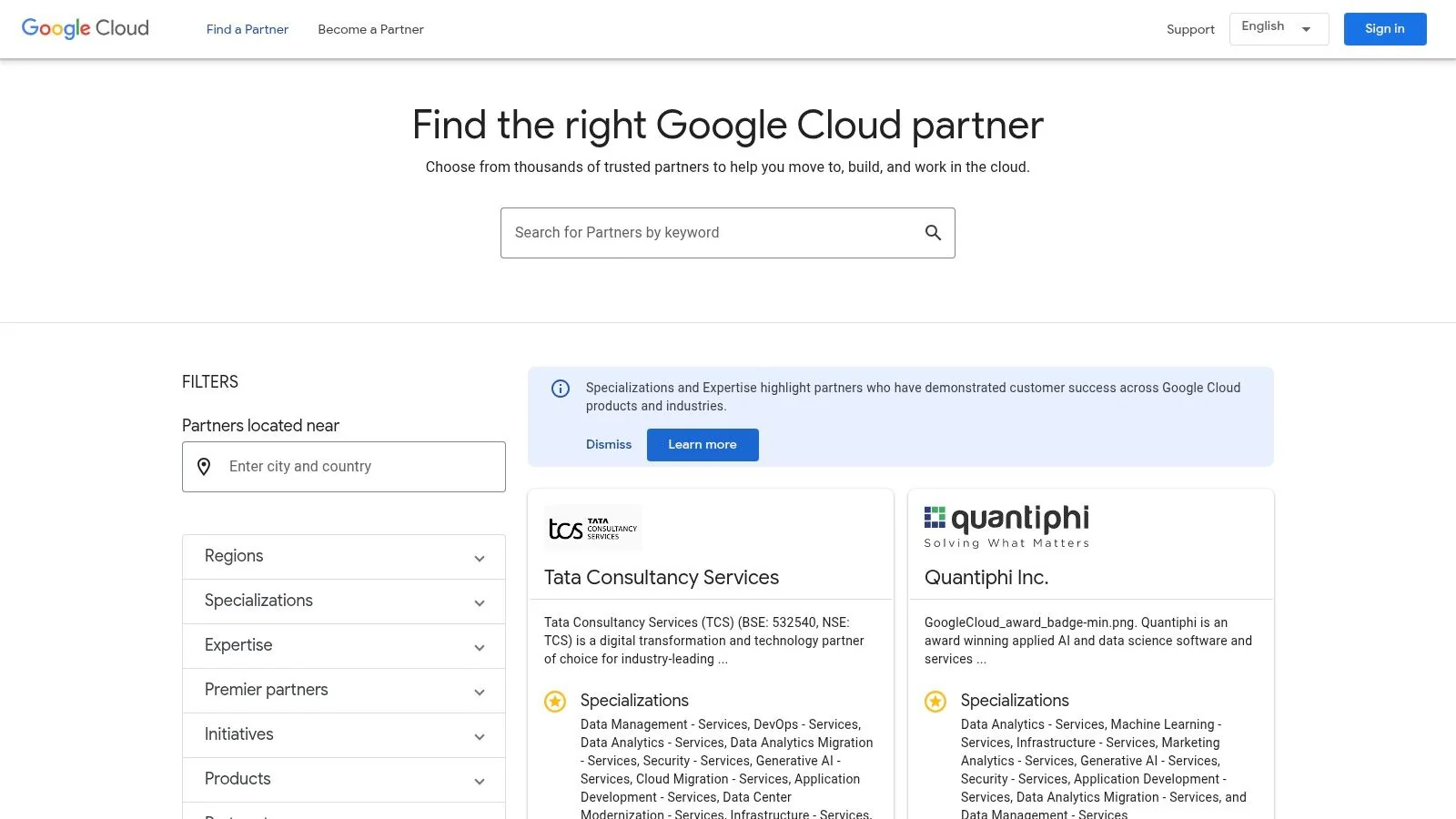
Unlike vendor-agnostic platforms, this directory offers unparalleled accuracy regarding a firm’s GCP competencies. The information comes directly from the source, ensuring that the specializations and partner tiers listed are up-to-date. For CTOs and data science leaders, this means you can confidently find a partner to architect a BigQuery data warehouse or deploy a complex AI model on Vertex AI.
Key Features and User Experience
The platform is designed for targeted discovery, allowing users to pinpoint partners that match specific technical and business needs within the GCP ecosystem. The interface is clean and functional, focused on filtering and validation.
- Expertise and Specialization Filters: Search for partners based on specific Google Cloud products (e.g., BigQuery, Looker), solutions (e.g., Data Analytics, AI & Machine Learning), or industry verticals (e.g., Retail & CPG, Financial Services).
- Partner Tiers and Badges: The directory clearly displays partner levels (Premier, Partner) and “Specialization” or “Expertise” badges. These designations are earned by demonstrating customer success and technical proficiency, serving as a powerful signal of a firm’s capabilities.
- Location-Based Search: Easily filter partners by country or region to find local experts who understand regional compliance. This is essential for projects with data residency requirements.
How to Use Google Cloud – Find a Partner Effectively
Start your search by applying filters for your most critical need, whether it’s a specific product like Google Kubernetes Engine or a solution like security. Pay close attention to partners holding “Specialization” designations, as these are the highest technical credentials and indicate deep, validated expertise. To dig deeper into how the directory works, you can explore a detailed guide on using the Google Cloud Partner directory. While the platform is excellent for validating GCP skills, it doesn’t provide the same level of qualitative client reviews as a platform like Clutch, so use it for building a technically qualified shortlist before conducting reference checks.
Pro Tip: Look for partners with multiple, complementary Specializations. A firm with both “Data Analytics” and “Machine Learning” specializations is likely better equipped to handle a sophisticated end-to-end data project than a firm with just one.
6. Upwork – IT Consulting Marketplace
Upwork has evolved from a freelance hub into a powerful marketplace for sourcing specialized it consulting firms and individual experts. It excels at connecting businesses with a global talent pool for specific, time-boxed projects or staff augmentation. Its core strength is speed and flexibility, allowing companies to engage a certified cloud architect or DevOps engineer in days, not weeks.
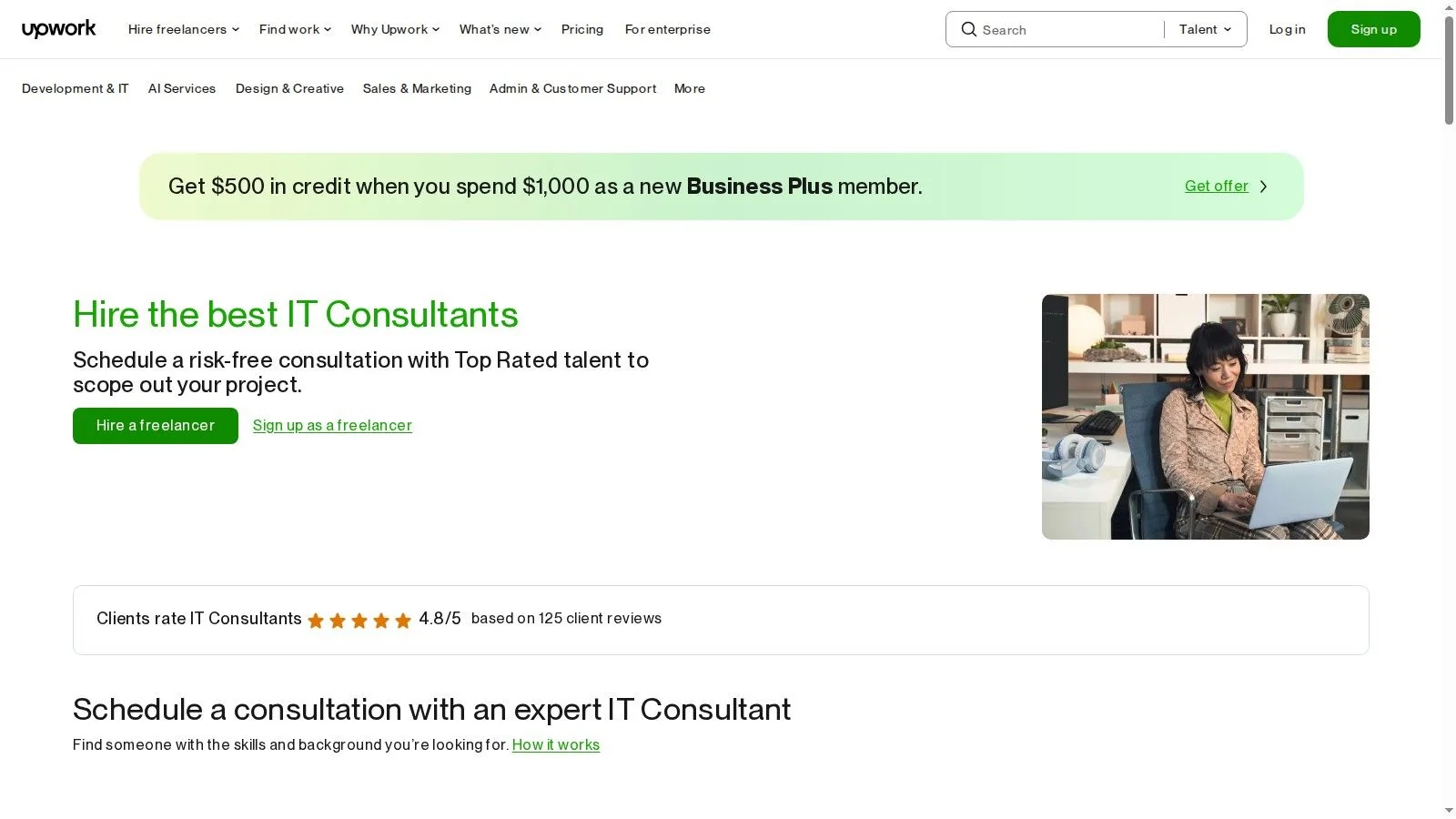
Unlike traditional procurement models, Upwork provides direct access to consultants, bypassing lengthy sales cycles. This makes it ideal for securing niche expertise quickly, such as a one-time cloud security audit or an AWS cost-optimization review. The platform manages contracts and payments, with client marketplace fees applied to engagements.
Key Features and User Experience
Upwork’s platform is designed for direct hiring and project management. Its interface allows businesses to post jobs, invite proposals from vetted talent, and manage contracts efficiently.
- Flexible Engagement Models: Hire on an hourly basis, for a fixed price, or book short, paid consultations (30-60 minutes) to vet an expert before committing to a larger project.
- Verified Talent and Reviews: Consultants often have a public “Job Success Score” based on past client feedback. You can review detailed work histories and client testimonials to gauge expertise.
- AI-Powered Matching: The platform’s AI helps shortlist the most relevant consultants or agencies based on your project description, saving time in the initial sourcing phase.
- Payment Protection: Upwork’s escrow service holds funds for fixed-price projects until milestones are approved, providing security for both clients and consultants.
How to Use Upwork Effectively
Success on Upwork hinges on a well-defined scope. For complex enterprise engagements, it is best used for augmenting an existing team or handling discrete project modules. Start by posting a detailed job description that clearly outlines deliverables and required certifications (e.g., “AWS Certified Solutions Architect - Professional”). Use the paid consultation feature to conduct a “working interview” with your top candidates. This small investment can reveal a consultant’s problem-solving approach before you commit to a full project. The platform is less suited for large-scale, RFP-driven searches that require an enterprise delivery model.
Pro Tip: Look for consultants and agencies with a “Top Rated Plus” or “Expert-Vetted” badge. These designations indicate a consistent track record of high-quality work and positive client outcomes, a crucial trust signal in a marketplace environment.
7. Toptal – Vetted Cloud/IT Consultants
Toptal operates on a different model, positioning itself as a curated network for hiring elite, pre-vetted cloud engineers, architects, and senior DevOps consultants. For organizations that need to augment their team with high-caliber talent for a specific project, Toptal offers a streamlined alternative to sifting through countless it consulting firms. Its core value is its rigorous screening process, which it claims accepts only the top 3% of applicants, ensuring clients engage with proven experts in AWS, Azure, and GCP.
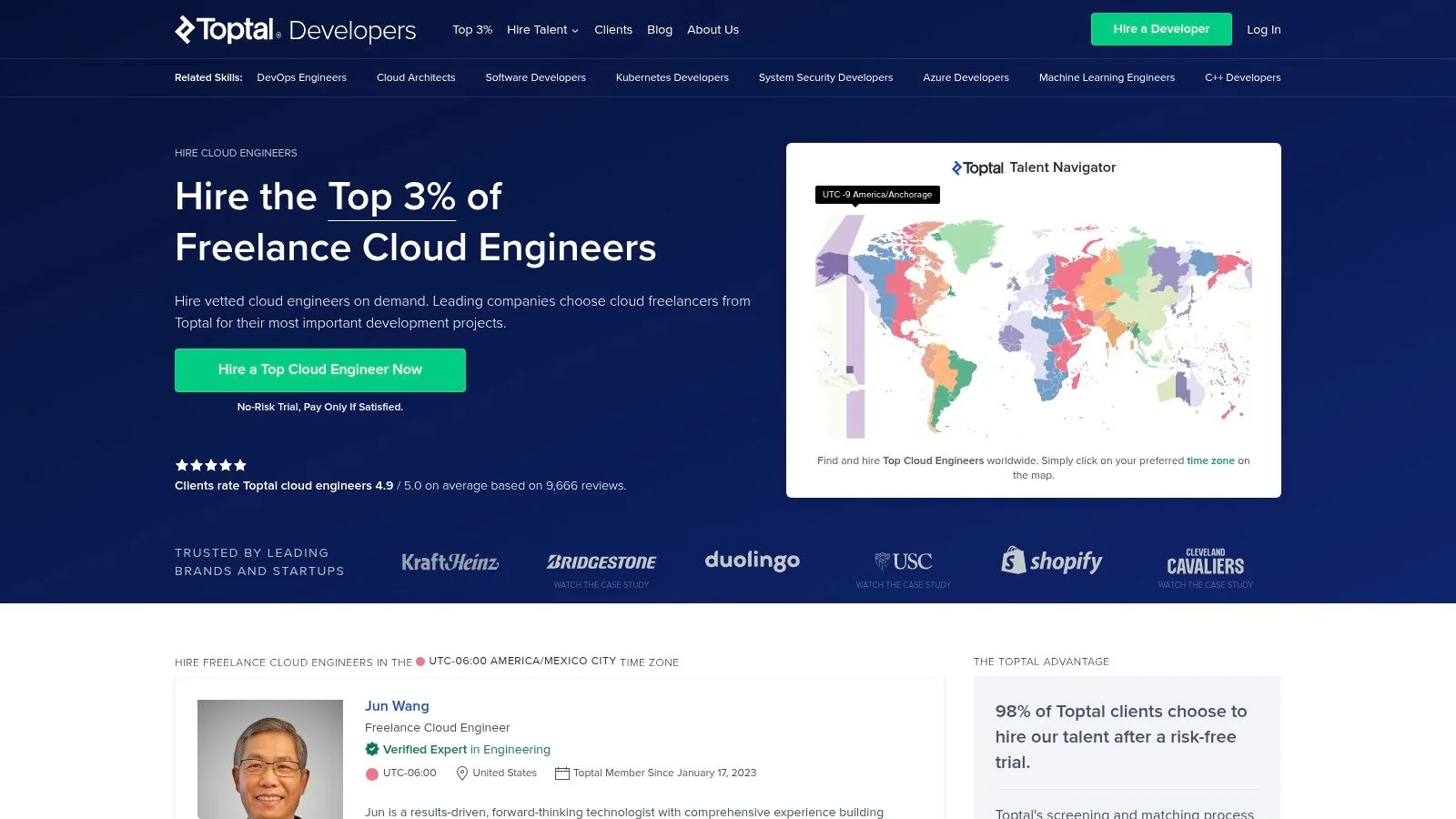
This approach is best suited for scenarios requiring specific, senior-level skill sets rather than a full-service, RFP-driven agency engagement. Toptal handles the sourcing, vetting, and matching, presenting a short list of candidates, often within 48 hours. A no-risk trial period allows companies to work with the consultant and ensure they are the right fit before the engagement officially begins, reducing hiring risk.
Key Features and User Experience
The platform is designed for speed and confidence in hiring. Instead of browsing a public directory, clients submit their requirements, and Toptal’s internal team matches them with appropriate talent from its private network.
- Rigorous Vetting Process: Candidates undergo a multi-stage screening that includes language and personality tests, skill reviews, live technical screenings, and a test project. This front-loads the qualification process.
- Rapid Matching: Toptal’s key promise is speed. The platform typically matches clients with qualified consultants in under 48 hours, a significant advantage for time-sensitive projects.
- Flexible Engagement Models: You can hire individual contractors for staff augmentation or assemble managed teams for specific project delivery, supporting both short-term and long-term engagements.
How to Use Toptal Effectively
Success on Toptal depends on providing a highly detailed and clear project brief. The more specific you are about the required technical skills (e.g., “AWS Certified Solutions Architect with experience in Terraform and Kubernetes for a FinTech PCI-DSS environment”), the better the match quality will be. While the talent pool is elite, it is a network of individuals, not a unified consulting firm. This makes it less suitable for organizations needing a single partner with broad, firm-wide accountability for a massive transformation. Explore their available experts at https://www.toptal.com/cloud.
Pro Tip: Use the trial period strategically. Prepare a small, well-defined initial task for the consultant that directly tests the core skills you need for the larger project. This provides a real-world assessment of their capabilities and working style before you commit significant budget.
Top 7 IT Consulting Platforms Comparison
| Solution | Implementation complexity | Resource requirements | Expected outcomes | Ideal use cases | Key advantages |
|---|---|---|---|---|---|
| Clutch | Low — browse, filter, shortlist | Minimal — reviewer reading and shortlist time | U.S.-focused shortlist with interview-based social proof | Procurement teams validating U.S. cloud/IT providers | Thousands of verified interview reviews; leader matrices; U.S.-centric filters |
| G2 – Cloud Consulting Providers | Low — compare grids and reviews | Minimal — review triangulation and profile review | Side-by-side comparisons and recent buyer sentiment | Cross-checking vendor sentiment and quick comparisons | Strong review authenticity processes; comparison grids and taxonomy |
| AWS Partner Solutions Finder | Medium — use filters and contact flows | Moderate — relies on AWS validations and lead workflows | AWS-validated partner shortlist with direct contact path | AWS-centric projects, compliance or security-sensitive workloads | AWS competencies, service validations, integrated partner leads |
| Microsoft Azure – Find an Azure Partner | Medium — search by specialization and badges | Moderate — depends on Microsoft specializations and audits | Azure-specialist partner shortlist with validation signals | Azure or hybrid Microsoft stack migrations and modernization | Azure Expert MSP and advanced specialization badges; audit signals |
| Google Cloud – Find a Partner | Medium — filter by use case and tier | Moderate — uses Google specializations and tiers | GCP-focused partner shortlist for data/ML and infra | Data analytics, ML/AI, and Google Cloud-native projects | Clear signals for data/analytics and ML expertise; validated capabilities |
| Upwork – IT Consulting Marketplace | Low to medium — post job or hire directly | Variable — budget, escrow, and hiring time | Fast hire of individual consultants for time-boxed work | Short projects, assessments, staff augmentation, quick fixes | Rapid sourcing, flexible contract types, large talent pool |
| Toptal – Vetted Cloud/IT Consultants | Low — managed matching and trial period | Higher — premium rates for vetted senior talent | Rapid placement of senior vetted engineers/architects | Critical projects requiring senior expertise quickly | Heavily screened senior talent, fast matching, risk-free trial |
How do you successfully evaluate and select an IT consulting firm?
Successfully evaluate and select an IT consulting firm by defining your precise business problems, mandating strict compliance requirements, and validating their technical expertise across multiple platforms. A structured selection process guarantees a partnership aligned with your strategic goals.
Navigating the landscape of IT consulting firms is a formidable task. You’re forging a strategic partnership that can reshape your technology stack and accelerate your business objectives. The tools explored—from directories like Clutch to platform-specific portals like the AWS, Azure, and Google Cloud partner finders—offer distinct pathways to identifying your ideal collaborator.
The key takeaway is that no single platform holds all the answers. Your selection process should be a multi-faceted strategy. An AWS-certified partner found through their official finder might have stellar reviews on Clutch, confirming their real-world performance. Using these tools in concert transforms your search from a shot in the dark into a data-driven, methodical evaluation.
Synthesizing Your Search Strategy
As you move forward, the most critical action is to internalize your unique business requirements. A well-defined problem statement is your most powerful filter. Before you open any of these platforms, your team should have concrete answers to these questions:
- What is the precise business problem to solve? “Migrate to the cloud” is a project; “Reduce our data warehouse operational costs by 30% while improving query speeds for our BI team by 50%” is a solvable business problem.
- What are our non-negotiable compliance and security requirements? For regulated industries like finance or healthcare, certifications like PCI DSS or HIPAA compliance are mandatory gatekeepers.
- What is our realistic budget and timeline? This dictates whether you engage an enterprise-level global system integrator or a nimble, specialized boutique firm. Knowing your constraints prevents wasted cycles.
Key Insight: The best IT consulting firms don’t just provide technical expertise; they align that expertise with your specific business outcomes. Your evaluation criteria should weigh technical certifications equally with their proven track record in your industry.
Actionable Next Steps: From List to Shortlist
Your work begins now. To translate research into a decision, follow this structured approach:
- Cross-Reference Your Findings: Start with our partner ranking table to benchmark firms, then vet them on another platform. Does their self-reported expertise on the AWS Partner Finder align with client reviews on G2 or Clutch? Discrepancies are a red flag.
- Develop a Concise RFI: Before a full RFP, send a short Request for Information (RFI) to your top 5-7 candidates. Ask for specific, relevant case studies, sample project plans, and bios for the consultants who would be assigned to your account.
- Conduct “Chemistry Check” Calls: A partnership’s success often hinges on cultural fit. Schedule 30-minute introductory calls to gauge how they listen, the quality of questions they ask, and whether their communication approach aligns with your team’s workflow.
Choosing the right partner from the vast pool of IT consulting firms is a decision that will pay dividends for years. It’s an investment in your organization’s agility, security, and innovation. By using the tools in this guide and grounding your search in a clear understanding of your needs, you can confidently select a firm that will become a catalyst for your future growth.
Finding it difficult to consolidate your research and compare top-tier candidates? CloudConsultingFirms.com offers a curated, in-depth directory designed to simplify your search. Visit CloudConsultingFirms.com to access pre-vetted profiles, detailed service comparisons, and exclusive insights to help you short-list the perfect IT consulting firm for your next project.
Peter Korpak
Chief Analyst & Founder
Data-driven market researcher with 10+ years helping software agencies and IT organizations make evidence-based decisions. Former market research analyst at Aviva Investors and Credit Suisse. Analyzed 200+ verified cloud projects (migrations, implementations, optimizations) to build Cloud Intel.
Connect on LinkedInContinue Reading
IT Consulting
The complete guide to vetting and hiring IT consultants
Cloud Consulting Hourly Rates: A 2026 Technical Benchmark Guide
Unlock the 2026 cloud consulting hourly rates. Get data-driven benchmarks for AWS, Azure, and GCP roles, plus strategies to maximize ROI beyond the rate card.
7 Vetted Marketplaces to Find Top DevOps Consulting Companies
Cut through the noise. Find the right devops consulting companies with our data-driven guide to the top 7 platforms for hiring vetted experts in 2025.
Stay ahead of cloud consulting
Quarterly rankings, pricing benchmarks, and new research — delivered to your inbox.
No spam. Unsubscribe anytime.