You’re not buying a cloud consulting firm. You’re buying the specific team that will touch your production systems, rewrite your landing zones, shape your IAM model, and make irreversible decisions about migration order, security controls, and spend. The logo on the MSA matters far less than the people in the war room.
I’ve seen this go wrong more than once. The sales team brings architects with perfect slide decks. Procurement checks certifications. References sound clean. Then the actual delivery team arrives, misses dependencies, escalates late, hides uncertainty behind jargon, and burns weeks while your internal engineers clean up the mess.
That’s why the useful question isn’t “Is this firm reputable?” It’s “Does this team have the traits of high performing teams in a cloud consulting environment, and can I verify them before and during the engagement?” If you can’t answer that, you’re guessing with budget, deadlines, and platform risk.
Your Biggest Cloud Project Risk Is Your Partner’s Team
The project looks healthy in week two. Status is green. The partner’s lead says the landing zone is on track, security is aligned, and the first migration wave is ready. By week six, your internal team is triaging broken assumptions, access gaps, and change collisions that should have been caught before build work started. That failure did not begin with Terraform. It began with the team you allowed onto the project.
Executives often overrate firm reputation and underrate delivery behavior. That is a mistake. In cloud work, the assigned team sets the pace, exposes risk early or hides it, and determines whether your platform ends up operable after handoff. If you are hiring a consulting partner for a cloud migration or operating model reset, judge the team as if they were joining your engineering org. For practical framing, the DataTeams guide is useful. The difference here is that you need signals you can observe in an external partner before they burn your budget.
The risk shows up in four places, and each one is visible early if you know what to watch:
- Architecture judgment: The team makes design choices that either reduce future toil or hard-code it into your environment.
- Delivery discipline: They either run work through version control, reviews, testing, and rollback plans, or they create manual exceptions that become your problem later.
- Escalation behavior: They raise blockers while there is still time to act, or they protect optics until recovery gets expensive.
- Handoff quality: They leave your staff with usable runbooks, clear ownership, and working knowledge, or they leave behind dependence.
Research on team performance supports the broad point that strong teams share trust, adaptability, and a mix of skills. You do not need another HR slogan. You need to see those traits expressed as concrete delivery behavior during a cloud engagement.
Use a stricter standard than certifications, partner tiers, and polished workshops.
Judge whether the team can disagree without drama, explain trade-offs in plain language, surface uncertainty early, and make progress without a single hero carrying the engagement. A weak partner can still present well in sales. A strong partner is easier to recognize in working sessions. They ask sharper questions, document decisions cleanly, identify dependencies before they become outages, and treat knowledge transfer as part of delivery rather than a closing chore. Understanding vendor lock-in risks is part of that transfer.
That is the project risk. The partner’s team will either reduce complexity or add it. Choose accordingly.
The 7 Traits of Elite Cloud Consulting Teams
Your migration is six weeks in. The partner’s slide deck still looks polished. The actual environment is a mess. IAM is inconsistent, tickets are piling up, nobody can explain the rollback plan, and every hard question gets routed to one “lead architect” who is suddenly hard to reach.
That is what poor team quality looks like in a cloud project. Not bad intent. Bad operating habits.
Technical depth that holds up under pressure
Elite teams make architecture decisions that fit your constraints, your compliance obligations, and your operating model. They do not recite vendor patterns and hope nobody notices the gaps.
Ask them why they would split accounts, subscriptions, or projects a certain way. Ask how they would structure IAM boundaries, policy enforcement, logging, and network segmentation. Strong teams answer clearly and tie each choice to cost, support load, risk, and future change. Weak teams hide behind diagrams.
Delivery discipline you can inspect
Good cloud work leaves evidence. Repos are organized. Pull requests are reviewable. Infrastructure changes are traceable. Rollback steps exist before production changes, not after.
You should be able to see how the team plans work, approves changes, records decisions, and handles exceptions. If process sounds flexible in the sales cycle, expect chaos during delivery. Use a cloud consulting vendor due diligence checklist to force proof, not promises.
Fast problem solving without theatrics
Every serious cloud engagement runs into ugly facts. Legacy dependencies surface late. Identity assumptions break. Networking collides with security policy. The issue is not whether problems appear. The issue is how the team behaves when they do.
Strong teams contain the blast radius, identify root cause, present options, and tell you what decision they need from you now. They do not waste three days protecting optics.
The partner you want brings bad news early, with a recovery path and an owner attached.
Communication that reduces decision latency
Status theater kills projects. Elite teams communicate to speed up decisions.
Their updates are short and useful. What changed. What is blocked. What they decided. What they need from your team by when. In working sessions, they answer directly and call out uncertainty before it turns into rework. You should leave meetings with fewer open questions, not better vibes.
Security and compliance built into daily work
Security is delivery work. It belongs in architecture, CI/CD, access design, secrets handling, logging, policy enforcement, and evidence collection from day one.
A weak partner treats security review as a gate near the end. That approach blows up timelines in regulated environments. A strong team can explain control ownership, exception paths, audit evidence, and how their technical choices affect your ability to pass review and operate cleanly after go-live.
Shared ownership across the team
The hero model is a risk. If one architect owns every decision, every escalation, and all client trust, your project has a staffing fragility problem.
Elite teams distribute context and responsibility. Engineers can explain the plan. The security lead knows the delivery timeline. The engagement lead understands the technical risks. Analysts at Dropbox found that collaboration quality and balanced contribution matter in strong teams, a pattern discussed in Dropbox’s study of high-performing teams. In cloud consulting, that shows up as continuity when someone is out, clean handoffs between workstreams, and fewer bottlenecks around one senior person.
Learning tied to your environment
Cloud platforms change constantly. Good teams keep up. Elite teams filter that change through your actual needs.
They know when a new managed service will reduce operational burden and when it will add unnecessary complexity. They can separate durable patterns from vendor novelty. If you want a broader management perspective on how strong teams are coached and developed, the DataTeams guide is worth reading. In a client engagement, the standard is simpler. Learning matters only if it improves decisions, delivery speed, and long-term operability in your environment.
A Checklist to Vet a Consulting Partner’s Team
Don’t interview the firm. Interview the delivery team. If the proposed architect, engagement lead, security lead, and platform engineers aren’t in the room before signature, stop the process.
Most partner failures are visible in diligence. Buyers just let them slide because the firm’s brand feels safe. Use a checklist and force specific answers. No abstractions. No “we follow best practices.”
For a broader procurement workflow, use a structured vendor due diligence checklist alongside the team review below.
Cloud Partner Team Evaluation Checklist
| Trait | Evaluation Question | Green Flag (Positive Signal) | Red Flag (Warning Sign) |
|---|---|---|---|
| Technical depth | Walk me through a recent decision involving IAM, networking, or landing zone design. What trade-off did you reject and why? | Explains options, constraints, and operational impact clearly | Hides behind vendor jargon or generic “reference architecture” language |
| Operational discipline | Show how you manage infrastructure changes, rollback, and approval paths in an active engagement. | Describes repo standards, review flow, release controls, and ownership | Treats process as flexible or says they’ll adapt later |
| Problem solving | Tell me about a migration blocker that changed the plan midstream. What did you do in the first 48 hours? | Describes triage, decision-making, communication, and revised sequencing | Blames the client, the platform, or “unexpected complexity” |
| Communication | How do you surface schedule risk, security concerns, or budget pressure before they become escalations? | Has a simple cadence and names triggers for early escalation | Relies on weekly status reports and informal updates |
| Security mindset | How do you embed security controls into delivery rather than reviewing them at the end? | Connects architecture, pipelines, access, logging, and evidence | Pushes security to a separate team or final phase |
| Shared ownership | If your lead architect disappears for two weeks, who can make decisions without stalling the project? | Names backup coverage and clear decision boundaries | Admits one person carries key client and technical knowledge |
| Learning and transfer | What do you do to ensure my internal team can operate the platform after handoff? | Includes pairing, runbooks, recorded walkthroughs, and operational ownership | Treats handoff as documentation delivered at the end |
What good answers sound like
Strong teams answer with specifics:
- Named tools: Terraform, GitHub Actions, Azure DevOps, AWS Control Tower, Microsoft Defender for Cloud, Security Command Center.
- Named decisions: account structure, policy inheritance, tagging enforcement, key management, workload sequencing.
- Named operating habits: daily risk review, architecture decision records, paired implementation, formal handoff runbooks.
Weak teams answer with polished emptiness:
- “We’re platform agnostic.” That often means they lack a strong opinion.
- “It depends on best practices.” Of course it depends. The question is what they choose when it does.
- “Our senior people will oversee quality.” If the seniors aren’t doing the work, oversight won’t save you.
Ask one more question than feels polite. “Who exactly will do this work?” is better than any capability deck.
A non-negotiable procurement stance
Insist on these terms before signature:
- Named team members in the SOW
- Approval rights for key substitutions
- Access to the delivery lead before kickoff
- Clear expectations for knowledge transfer and operating documentation
If a partner resists that level of clarity, they plan to swap talent after the deal closes.
How to Measure Team Performance During an Engagement
Week three of a migration is where weak partners start to show. The status deck stays green. The invoice climbs. Your engineers still cannot explain what changed in production, who owns the next decision, or why simple work keeps slipping.
That is the wrong scoreboard.
Measure the team by what it ships, what it breaks, what it costs, and what your staff can do without them. If you cannot see those four things clearly, you are managing optics, not delivery.
Measure delivery quality at the engineering layer
Start with signals pulled from real work. Tickets and status notes are easy to polish. Release behavior is not.
Track these every week:
- Deployment reliability: Do infrastructure and application changes pass cleanly through review, testing, and release?
- Change failure pattern: Which changes create outages, access issues, policy drift, or rework?
- Lead time for approved work: How long does it take to move from decision to validated implementation?
- Defect closure quality: Do fixes stay fixed, or do the same issues keep resurfacing in new forms?
- Review depth: Are pull requests getting real technical review, or rubber-stamp approvals from the same person every time?
A strong consulting team produces boring releases. Small batches. Clear approvals. Few surprises.
A weak team creates heroics. One architect knows the definitive design. One engineer knows the deployment path. Everyone else attends meetings and repeats talking points. That setup fails the moment one person gets pulled into another account.
Measure cost control like an operator, not a procurement team
Hours matter. Outcomes matter more.
Review spend against delivered capability, not against effort claimed in timesheets. If the burn rate rises while core decisions stay unresolved, you are paying for drift. If junior consultants are chewing through tasks that should have been templated in week one, you are funding inefficiency.
Use a short financial review set:
- Budget forecast versus completed outcomes: What shipped for the money spent?
- Rework ratio: How much of this month’s effort fixed avoidable mistakes from prior weeks?
- FinOps behavior: Are tagging, rightsizing, environment shutdowns, and waste reviews happening on schedule?
- Escalation cost: How often do blocked decisions sit until a senior partner joins late and bills premium hours to clean it up?
If you need a reality check on burn, compare the team’s pricing model against this guide to cloud consulting hourly rates. Bad rate assumptions hide weak execution for longer than they should.
Measure whether your team is getting stronger
External partners should leave your team better, not more dependent.
Watch for practical transfer of capability during the engagement. Can your engineers explain the account structure, CI/CD flow, security controls, and rollback steps without asking the partner to translate? Can they make a routine change safely? Can they join an incident call and contribute instead of observing?
This is the difference between a consulting team that builds assets and one that builds dependency. Good partners increase your options. Bad ones make themselves hard to remove.
If you want a simple benchmark for coaching and accountability rhythms, this piece on actionable performance practices for growth is useful. Apply that discipline to the engagement, not just to your internal staff.
What to review every week
| Signal | Healthy pattern | Trouble pattern |
|---|---|---|
| Release flow | Small, reviewable changes land predictably | Big bundled releases, late surprises, frequent hotfixes |
| Technical ownership | Several consultants can explain architecture and trade-offs | One person carries context and everyone else defers |
| Cost discipline | Spend is tied to shipped capability and clear decisions | Spend rises while decisions, defects, or rework pile up |
| Internal capability | Your engineers can operate routine tasks with confidence | Your team still needs the partner for basic changes |
| Issue handling | Risks are raised early with options and owners | Problems appear after deadlines slip or invoices land |
Do not wait for a formal QBR to call this out. Two bad weeks in a row is a pattern. Treat it that way.
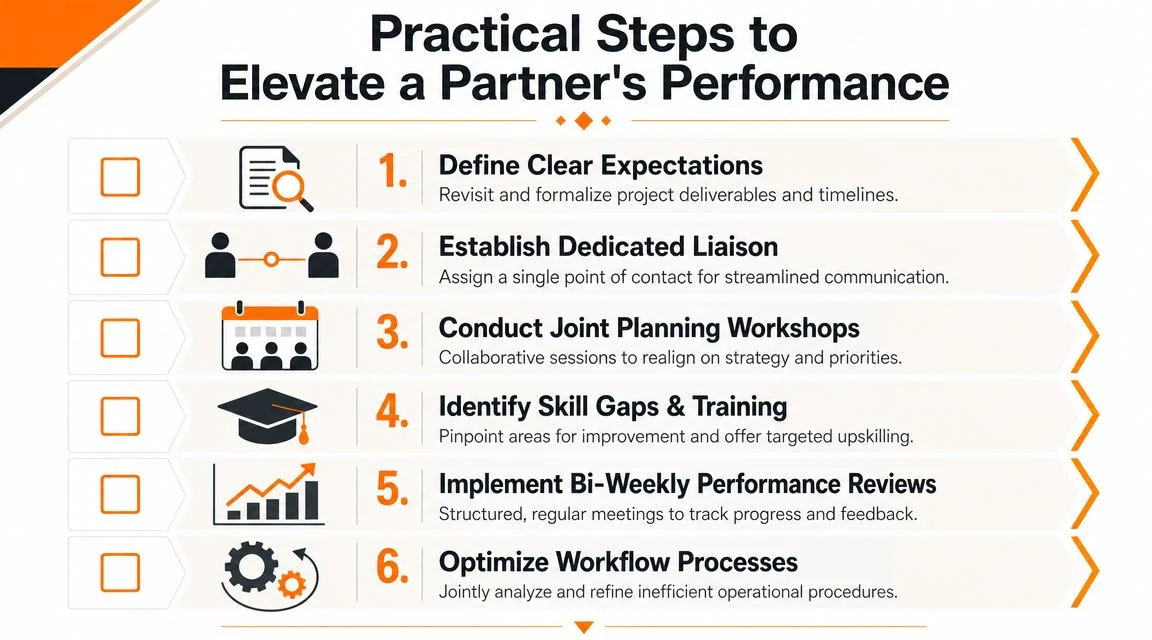
Practical Steps to Elevate a Partner’s Performance
When a partner starts slipping, most clients respond too softly. They ask for “better communication” and another status meeting. That fixes nothing. You need operating interventions.
The hard part in cloud consulting is that many teams are hybrid or distributed. Generic advice about high-performing teams often stops at trust and communication. A primary challenge is enforcement when the team isn’t in your office. That gap shows up clearly in Thomas’s discussion of high-performing team characteristics.
Force paired execution
Don’t let consultants operate as a black box. Put your engineers into design reviews, implementation sessions, and incident retrospectives.
This does three things fast. It improves knowledge transfer, exposes weak consultants early, and prevents architecture decisions from drifting away from your operational reality.
Require written architecture decisions
For major choices, require a short written record with options considered, trade-offs, security implications, cost implications, and rollback impact. Not a giant document. A usable one.
This strips away hand-waving. It also gives you a clean audit trail for platform, compliance, and budget decisions.
If a team can’t write down why it chose a design, it usually hasn’t thought hard enough about the alternatives.
Tighten the cadence around risk and accountability
Stop accepting vague weekly updates. Set a recurring format:
- What changed this week
- What slipped
- What decision is needed from the client
- What risk is growing
- Who owns each next action
For broader management discipline, this piece on actionable performance practices for growth is useful. The principle applies directly to consulting engagements. Performance improves when accountability is visible and recurring.
Reset team composition if needed
Sometimes the process isn’t the problem. The team is. Swap out weak performers fast, especially if the engagement lead can’t translate technical risk into executive decisions or if the security lead only appears when there’s a fire.
You do not owe a struggling partner endless chances at your expense.
Make handoff a live workstream
Don’t wait for the final month. Require operating runbooks, access mapping, dashboard walkthroughs, and paired support before the project closes.
The best partners want this. Weak partners delay it because dependence protects revenue.
FAQ Balancing Safety with Accountability
How do you create psychological safety without letting a consulting team off the hook?
Start with a hard rule. People must be able to raise risk early without getting punished for the message. They still own the quality of their work, the dates they committed to, and the outcomes you are paying for.
Run blameless reviews on process failures. Hold the partner to delivery commitments, defect rates, and decision quality. Those two things belong together. If your partner treats “safe to speak up” as cover for weak execution, you have a management problem, not a culture win.
What’s the clearest communication red flag in a cloud engagement?
Delayed honesty.
A strong consulting team tells you bad news while you still have options. A weak one stalls with phrases like “we’re still assessing,” “the issue is nuanced,” or “we’re aligning internally,” even after the impact is already clear. That pattern burns time first, then budget.
Watch for timing, not tone. If risks show up only after a milestone slips or after your internal team discovers the problem, trust is already gone.
When should you try to fix a partner versus replace them?
Fix the engagement when the team is candid, technically sound, and willing to work inside tighter controls. Replace the partner when you see repeated bait-and-switch staffing, dependence on one or two heroes, weak architecture judgment, or open resistance to visibility.
This decision should happen fast. External partners rarely recover after they start protecting utilization and optics over delivery. Teams that accept scrutiny can improve. Teams that dodge it usually get more expensive and less reliable.
What should you do next if you’re selecting a partner now?
Interview the people who will run the work. The sales lead is not the project.
Put named roles, substitution limits, knowledge transfer, escalation paths, and reporting cadence into the SOW. Score every finalist with the same criteria so the decision survives contact with pressure, personalities, and polished demos.
If you’re actively shortlisting partners, use CloudConsultingFirms.com to compare firms by platform focus, pricing, certifications, team quality, and engagement fit before you move into final diligence.