Cloud Consulting Hourly Rates: A 2026 Technical Benchmark Guide
In 2026, baseline cloud consulting hourly rates range from $100 to over $300. Focusing solely on this number is a tactical error. You are not procuring man-hours; you are purchasing a specific technical outcome, accelerated project velocity, and mitigation of execution risk.
Deconstructing the Cloud Consulting Hourly Rate
The hourly rate on a statement of work is a compressed representation of value, not just a labor cost. It functions as the price for a high-performance engine—the cost reflects the aggregate of precision engineering, R&D, and domain expertise. You are paying for a concentrated application of skills and battle-tested experience that would take an in-house team years to develop organically.
This investment is an operational package covering several key deliverables:
- Targeted Expertise: Immediate access to certified engineers with deep, vertical knowledge in complex domains such as Kubernetes orchestration, multi-cloud FinOps, or implementing a SOC 2 compliant infrastructure on AWS.
- Risk Mitigation: The application of proven methodologies and architectural patterns that prevent common, high-cost failures like security misconfigurations, data egress vulnerabilities, and project-derailing technical debt.
- Accelerated Time-to-Value: A significant reduction in the learning curve associated with adopting new cloud-native technologies, resulting in faster delivery of business-critical objectives.
Benchmarking Rates by Firm Size
The size of the consulting firm is a primary driver of cost structure. It is a reliable proxy for their operational overhead, resource depth, and the scope of services offered. Analysis of 2025 and early 2026 market data reveals a distinct pricing stratification.
This table provides a baseline for initial budget forecasting.
Quick Guide to Cloud Consulting Rate Benchmarks by Firm Type
| Firm Type | Typical Hourly Rate (USD) | Best For | Key Trade-off |
|---|---|---|---|
| Boutique/Small Firm (1-10 staff) | $75 – $150 | Niche expertise, project-based work, staff augmentation. | Limited bench strength and breadth of services. |
| Mid-Sized Firm (10-50 staff) | $100 – $200 | Full-scale migrations, managed services, broad technical needs. | May lack the hyper-specialization of boutiques or global reach of large firms. |
| Large/Enterprise Firm (50+ staff) | $150 – $300+ | Complex digital transformation, enterprise-wide strategy, global deployments. | Higher overhead costs and potentially less flexibility. |
This table serves as a pragmatic starting point for RFP development. For more granular data, consult these IT consulting rate benchmarks to refine budgetary models.
A higher hourly rate from a specialized firm that delivers a secure, optimized cloud environment in half the time is fundamentally cheaper than a lower rate that leads to extended timelines, rework, and security oversights.
Adopting this value-centric framework is critical. The objective is not to secure the lowest possible rate, but to optimize the ratio between expenditure, expertise, and required business outcomes. A few hours of an expert’s time can prevent an architectural blunder that would cost ten times their fee to remediate.
The Four Levers That Drive Consulting Rate Variation
When two proposals for the same cloud project exhibit a significant price disparity—one at $150/hour, another at $300/hour—the variance is not arbitrary. It is a direct result of four primary levers that consulting firms use to structure their rates. Understanding these levers is the primary defense against misaligned procurement.
Each lever adjusts the final price based on the value, risk, and overhead embedded in the engagement. Here is an analysis of each.
1. Role and Seniority
The most significant driver is the experience level and accountability of the assigned personnel. Consultants are priced based on their demonstrated expertise, strategic value, and the level of technical risk they are expected to manage.
A project team led by a Principal Cloud Architect and a Senior DevOps Engineer will have a higher blended rate than a team managed by a Project Manager with junior Cloud Engineers. The former is architecting for resilience and future-state scalability; the latter is executing against a predefined plan.
- Junior Consultant/Engineer (1-3 years): Tactical implementers for well-defined tasks, scripting, and initial setup under direct supervision. Their rate reflects a focus on execution, not strategic design.
- Senior Consultant/Architect (5-10+ years): Leads design sessions and makes critical architectural decisions. They are accountable for the project’s technical success; their higher rate is an investment in avoiding costly errors and future technical debt.
- Principal/Strategic Advisor (15+ years): Operates at the executive and systems-design level, linking cloud strategy directly to business outcomes. Their involvement is surgical, strategic, and commands the highest rates.
2. Firm Size and Overhead
The type of firm is a major cost multiplier. The rate covers not just the individual’s time but the entire operational infrastructure supporting them. This presents a trade-off between the lean agility of a boutique firm and the robust, process-driven approach of a global consultancy.
A small firm with minimal overhead can offer more competitive rates. A global firm, however, has significant investments factored into its fee structure: enterprise-grade security, deep compliance frameworks like SOC 2, dedicated legal teams, and a global talent pool.
For an enterprise in a regulated sector like finance or healthcare, the embedded compliance and risk management from a large consultancy is not overhead—it is a core feature. This justifies the premium rate.
3. Geographic Location
The physical location of the consulting team directly impacts their rate. An architect in a high-cost-of-living metro area like Silicon Valley or New York City has a higher billable rate than an equally skilled engineer in a lower-cost region.
This variable allows for cost optimization through different delivery models:
- Onshore: The team is located within your country. This model maximizes real-time collaboration but incurs the highest cost.
- Nearshore: Talent is sourced from nearby countries with similar time zones (e.g., U.S. firms leveraging teams in Latin America). This balances cost savings with synchronous communication.
- Offshore: The team is in a different global region (e.g., India, Southeast Asia). This model provides the most significant cost reduction but requires mature project management to mitigate time zone and communication gaps.
4. Specialization and Niche Expertise
Basic supply and demand mechanics are a primary factor. A generalist cloud engineer is a valuable but relatively available resource. A specialist with certified, deep expertise in a high-stakes, low-supply domain commands a premium.
Consider these use cases:
- A certified FinOps professional can justify a $250+/hour rate by demonstrating a repeatable ability to reduce monthly cloud expenditure by 20-30%, delivering a clear ROI.
- A consultant specializing in HIPAA or PCI-DSS compliance architects systems to avoid multi-million dollar regulatory fines and catastrophic data breaches. Their value is in risk mitigation.
- An expert in serverless architecture for high-frequency trading platforms possesses a rare skill set where performance gains translate directly into millions in revenue, justifying an exceptional rate.
When evaluating a proposal, analyze it against these four points. The question shifts from “Why is this so expensive?” to the more precise “Does this rate align with the seniority, firm structure, location, and specialized skills required for mission success?”
Benchmark Rates for Cloud Projects by Specialization and Region
Evaluating a “general” hourly rate for cloud consulting is an imprecise exercise. The true cost of a 2026 cloud project is determined by the specific technical competencies required and the geographic location of the talent. A generic rate is effectively meaningless in a market where enterprises pay a premium for specific, high-impact expertise.
The rate differential between a generalist and a specialist is substantial. Our data indicates that niche expertise, particularly in regulated industries like finance or healthcare, consistently commands top-tier pricing due to the high stakes of compliance and security. A general cloud consultant may bill between $80 and $150 per hour, while a specialist with verifiable domain expertise will fall in the $100 to $250+ per hour bracket.
This chart illustrates the primary drivers of the final invoiced rate.
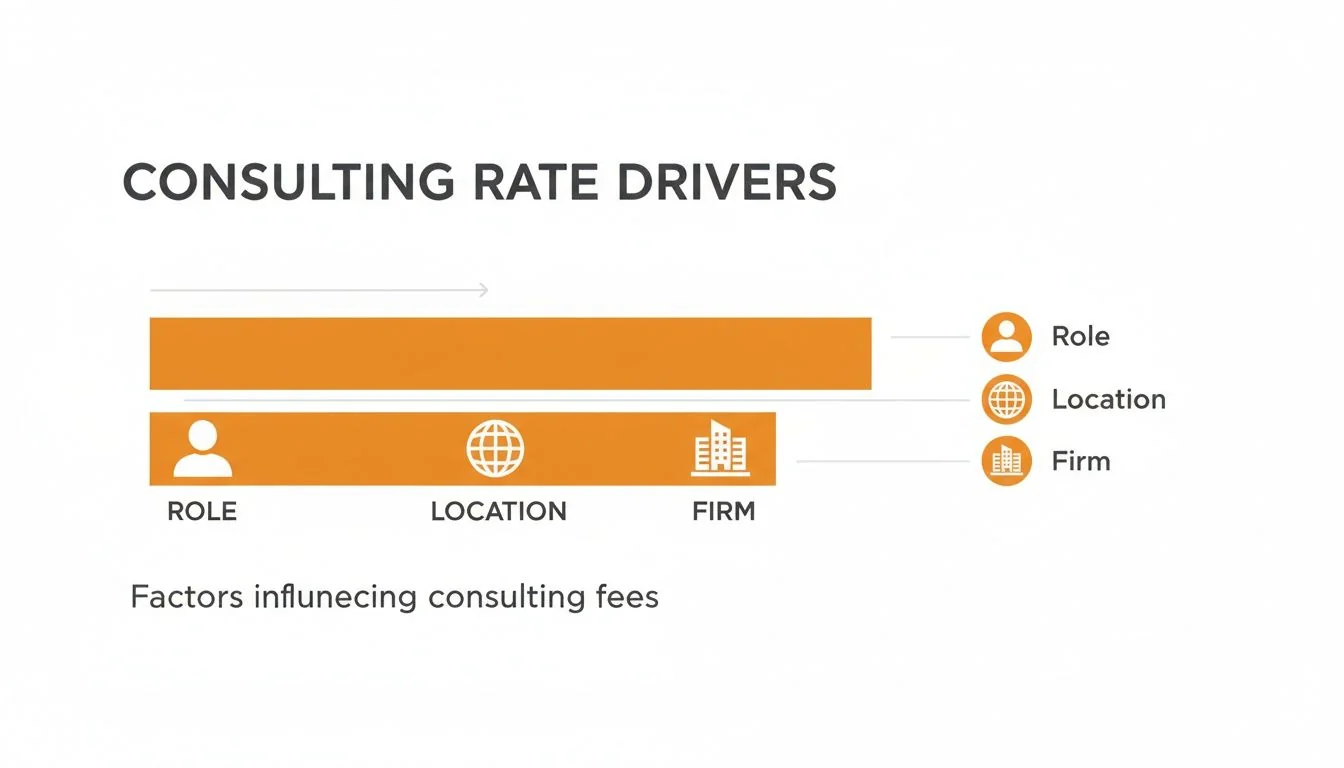
As shown, the consultant’s specific role, physical location, and the firm’s size and reputation are the three key variables that modulate the final cost.
Breaking Down Rates by Role and Platform
Not all cloud architects provide equivalent value. A certified AWS Solutions Architect with a decade of enterprise migration experience operates in a different pricing tier than a newly certified GCP professional. Market demand, platform complexity, and the available talent pool create distinct rate structures.
Key roles commanding premium pricing include:
- Cloud Security Engineer (CISSP): Responsible for defending infrastructure against sophisticated threats. Their mission-critical function places them at the top of the pay scale.
- Kubernetes Architect: Verifiable expertise in container orchestration is a scarce and high-value skill. These architects design the scalable, resilient microservice architectures that power modern applications.
- DevOps Automation Specialist: These engineers directly impact development velocity and operational stability by building robust CI/CD pipelines and infrastructure as code (IaC) modules.
- Multi-Cloud FinOps Specialist: An engineer who can demonstrably optimize spend across the complex billing systems of AWS, Azure, and GCP provides a direct and measurable ROI.
The most expensive consultant is not the one with the highest hourly rate, but the one who makes a foundational architectural error that costs millions to remediate. Paying a premium for a senior expert with a proven track record is a form of risk management.
The Impact of Geography on Cloud Consulting Rates
Geography remains a significant factor in rate setting. A consultant in a high-cost region like North America or Western Europe has a higher baseline rate than an equally skilled professional in Eastern Europe or Asia. This is driven by local cost of living, market demand, and currency valuations.
This table provides a data-driven snapshot of how rates for high-demand cloud roles vary globally.
Global Cloud Consulting Hourly Rate Matrix by Role and Region
This matrix serves as a benchmarking tool for procurement and IT leadership to validate budget assumptions.
| Specialized Role | North America (USD/hr) | Western Europe (USD/hr) | Eastern Europe (USD/hr) | Asia (USD/hr) |
|---|---|---|---|---|
| Certified Solutions Architect (AWS/Azure/GCP) | $175 - $275+ | $150 - $250 | $80 - $140 | $60 - $110 |
| Cloud Security Engineer (CISSP) | $200 - $350+ | $180 - $280 | $100 - $170 | $80 - $150 |
| Kubernetes Architect | $190 - $300+ | $170 - $260 | $90 - $160 | $75 - $130 |
| DevOps Automation Specialist | $160 - $260 | $140 - $220 | $70 - $130 | $50 - $100 |
| FinOps Specialist | $180 - $280 | $160 - $240 | $85 - $150 | $70 - $120 |
Use this matrix to sanity-check vendor proposals. Significant deviations from these benchmarks warrant further inquiry. For a more detailed analysis, review our full report on hourly IT consulting rates and trends.
Looking Beyond the Hourly Rate: Hidden Costs and True Value

Fixating on the hourly rate is a common procurement anti-pattern. A senior expert at a higher rate who delivers a correct solution in half the time is more cost-effective than a cheaper resource whose project incurs technical debt, delays, and budget overruns.
To make an informed decision, shift from evaluating the line-item rate to calculating the Total Cost of Engagement (TCE). This requires a comprehensive financial analysis that accounts for all direct and indirect costs associated with the project.
Exposing Common Hidden Costs
Many proposals omit ancillary expenses that can inflate the final invoice by 15-20%. These “pass-through” costs must be identified and capped during contract negotiation.
Key areas to scrutinize include:
- Third-Party Tool Licensing: Clarify who bears the cost of any required monitoring, security, or data platforms, both during and after the engagement.
- Travel and Expenses (T&E): For on-site engagements, establish clear policies. Is travel time billable? Are there per diems? Ambiguous T&E clauses lead to budget overruns.
- Extended Onboarding: Quantify the opportunity cost of your internal team’s time spent onboarding the consulting resources. This is a real, though often unbudgeted, project expense.
- Post-Engagement Support: Define the terms for ongoing support. A post-project retainer can be valuable, but it must be a planned, budgeted expense.
An effective procurement strategy does not just negotiate the rate; it dissects the entire cost structure. The objective is to transition from a cost-per-hour model to a value-per-outcome model, where all expenditures are tied to measurable business results.
Identifying Hidden Value Factors
Just as costs can be hidden, so can value. The most effective consulting partnerships deliver benefits that extend beyond the SOW, creating long-term ROI by increasing your team’s capabilities.
This value is not always explicitly priced but directly impacts your team’s operational efficiency and maturity:
- Institutional Knowledge Transfer: A superior partner aims to make themselves redundant. They provide comprehensive documentation, conduct training sessions, and ensure your engineers can confidently own and operate the delivered solution.
- Reusable IaC Templates: The Infrastructure as Code (IaC) modules and automation scripts developed during the project should be architected as reusable assets that accelerate future initiatives.
- Accelerated Team Learning: Pairing your engineers with senior consultants provides high-intensity, practical upskilling that is more effective than any formal training program.
Factoring in these benefits clarifies the true value of a skilled consultant. The engagement shifts from a simple transaction to a strategic investment in your organization’s technical capabilities.
Choosing the Right Pricing Model for Your Project
While consulting hourly rates are a focal point, they are a component of the pricing model, not the model itself. The hourly rate underpins a Time and Materials engagement, which is not always the optimal structure.
Selecting the correct pricing model is a strategic decision that aligns incentives. A mismatched model creates friction, scope creep, and budget instability. The appropriate contract structure depends on the clarity and stability of your project requirements.
Time and Materials: The Agile, Pay-As-You-Go Model
Time and Materials (T&M) is the most direct application of consulting hourly rates. You pay for the actual time and resources consumed. This model is ideal for projects with evolving requirements where the final solution is not fully defined at the outset. If you are building a novel serverless application and expect requirements to change based on user feedback, T&M provides the necessary flexibility to pivot without constant contract renegotiation.
- Pros: Maximum flexibility to adapt and iterate. Billing is transparent and directly tied to effort expended.
- Cons: Carries the highest budget risk for the client. Requires rigorous project management to prevent cost overruns. Incentivizes billable hours, not necessarily outcomes.
- Best For: R&D initiatives, agile development, and solving complex problems with undefined solution paths.
Suggested RFP Language: “Vendor must provide weekly detailed timesheets outlining hours worked by each resource, tasks completed, and progress against project milestones. Client reserves the right to review and approve all hours before invoicing and requires a bi-weekly budget review to forecast total engagement cost against a not-to-exceed estimate.”
Fixed Price: The Defined-Scope Model
A Fixed Price agreement establishes a single, all-inclusive cost for a meticulously defined scope of work. It is suitable for projects with clear, immutable requirements and predictable execution paths, such as a standard lift-and-shift migration of a known application stack to a public cloud. The deliverables, timeline, and cost are locked in, transferring the risk of inefficiency to the consulting firm.
- Pros: Complete budget certainty. The consultant is incentivized to work efficiently to preserve their profit margin.
- Cons: Offers zero flexibility. Any deviation from the defined scope will trigger a change order, often at a premium rate. Requires significant upfront investment in detailed requirements definition.
- Best For: Well-understood projects like standardized migrations, infrastructure audits, or implementing a known security framework.
Value-Based Pricing: The Outcome-Driven Model
Value-Based pricing decouples the fee from hours worked, basing it instead on the measurable business value created by the project. This model is best for high-impact projects where ROI can be clearly quantified. A common example is a FinOps engagement where the consultant’s fee is a percentage of the documented cloud cost savings they deliver over a specific period.
- Pros: Creates perfect incentive alignment between the consultant and the client’s primary business objectives. Focus is entirely on delivering measurable ROI.
- Cons: Can be complex to structure. Requires ironclad, mutually agreed-upon metrics to define and measure success. Not suitable for projects with intangible benefits.
- Best For: Cost optimization initiatives, application performance improvements, or any engagement where the financial impact can be directly attributed and measured.
Understanding these models is a prerequisite for effective procurement. For a deeper analysis, see this guide on pricing strategies in consultancy. The correct model does more than control costs—it ensures your partner is contractually obligated to pursue the same definition of success as your own team.
Alright, you’ve got a handle on the rates and pricing models. Now it’s time to put that knowledge to work and find the right cloud consulting partner.
This is not about finding the lowest bidder; that is a race to the bottom. It is about a methodical search to identify the firm that aligns with your technical requirements, compliance posture, and budget. The goal is to find the partner that maximizes the probability of a successful outcome.
The process begins with a realistic assessment of your project’s scope. A vague objective like “migrate to the cloud” is insufficient and will yield wildly divergent proposals. To attract expert firms, you must be specific.
Defining Your Project Scope to Filter Partners
First, classify your project by its complexity and budget. This single step will immediately filter a large segment of the market, allowing you to focus only on firms structured to operate at your project’s scale.
-
Sub-$200K Engagements: These are focused, well-scoped projects: migrating a single application, conducting a security audit, or implementing a specific CI/CD pipeline. Target boutique firms or the specialized practices of mid-sized consultancies that excel at tactical execution. You can filter firms by budget tier in our partner ranking.
-
$200K - $1M Engagements: This budget range covers more substantial initiatives, such as a full data center exit, designing a multi-account landing zone, or a significant application modernization effort. Mid-sized to larger firms with dedicated cloud practices are the appropriate targets.
-
$1M+ Transformations: These are strategic, enterprise-wide programs involving multi-region deployments, complex compliance frameworks like FedRAMP, or fundamental business process re-engineering. This scale requires the deep bench, global reach, and rigorous program management of a major enterprise consultancy.
Your budget is your most effective filtering tool. Stating the expected investment range in an RFP ensures you only engage with firms structured to deliver value at that scale, eliminating wasted proposal cycles for both parties.
Screening for Technical and Compliance Fit
After segmenting by budget, the next filter is for non-negotiable technical and industry credentials. Attractive consulting hourly rates are irrelevant if the firm lacks the specific certifications or compliance experience required for your project. A mismatch here is a primary cause of project failure.
Create a checklist of mandatory qualifications to evaluate partners on empirical data, not sales presentations.
Your checklist should include:
-
Platform Certifications: Be specific. Do not accept “AWS experience.” Require evidence that the proposed team includes individuals with professional-level certifications like AWS Solutions Architect - Professional or Azure DevOps Engineer Expert. Our platform-specific directories for AWS, Azure, and Google Cloud partners can help verify these credentials.
-
Industry Compliance Expertise: This is a critical gate for regulated industries. Demand proof of experience with frameworks like HIPAA, PCI DSS, SOC 2, or FedRAMP. Request sanitized case studies or references from clients in your sector.
-
Pricing Model Alignment: State your preferred engagement model upfront. If you require the budget predictability of a fixed-price contract, this will filter out firms that only operate on a Time and Materials basis.
Building a Basic ROI Model
To secure internal stakeholder buy-in, you must connect the consultant’s cost to a tangible business outcome. A simple Return on Investment (ROI) model shifts the conversation from “how much does this cost?” to “what value will this create?” and ties directly back to the Total Cost of Engagement.
The model should forecast the expected gains. Will the project reduce infrastructure spend? Increase developer productivity? Accelerate time-to-market?
By mapping these projected benefits against the proposed consulting fees, you build a compelling business case. The engagement is framed not as a line-item expense, but as a strategic investment with a quantifiable payback period.
Answering Your Top Questions About Cloud Consulting Rates
Here are direct answers to common questions that arise during the procurement process.
Should I Always Pick the Lowest Hourly Rate?
No. This is a common procurement error that frequently increases total cost. A low hourly rate often indicates a lack of senior-level expertise, which can lead to extended project timelines, critical architectural flaws, and expensive rework.
Evaluate proposals based on the Total Cost of Engagement (TCE), not the hourly rate. A senior architect at $250/hour who completes the project correctly in 100 hours costs $25,000. A junior consultant at $125/hour who takes 300 hours and introduces technical debt costs $37,500 and creates future liabilities.
How Can I Tell If a Firm’s Quoted Rate Is Fair?
Validate the quote against market data and through targeted diligence.
- Benchmark with Data: Use the rate tables in this guide to compare the proposal against industry averages for the required roles and your geographic region.
- Ask for Anonymized Case Studies: Request data on projects of similar scope, including team composition, duration, and final cost.
- Drill Down on Certifications: Look beyond the firm’s partner status. Verify the specific, advanced certifications (e.g., AWS Certified Solutions Architect - Professional) held by the individuals proposed for your project team.
What Is a “Blended Rate” and Is It a Good Deal?
A blended rate is a single, averaged hourly rate for a team with mixed seniority levels. For example, a firm might propose a blended rate of $200/hr for a team consisting of a principal architect ($300/hr) and two engineers ($150/hr each).
A blended rate simplifies invoicing but can obscure the true cost structure. Always require a detailed breakdown of the team composition, individual rates, and projected hours for each role. This ensures you are not overpaying for a team heavily weighted with junior resources.
Ready to put this knowledge to work? CloudConsultingFirms.com has the tools you need to go from reading about rates to finding the right partner. Our interactive quiz, ROI calculator, and in-depth firm profiles help you connect with a top-tier provider that fits your project and your budget. Find your certified cloud consulting partner today on CloudConsultingFirms.com.
Peter Korpak
Chief Analyst & Founder
Data-driven market researcher with 10+ years helping software agencies and IT organizations make evidence-based decisions. Former market research analyst at Aviva Investors and Credit Suisse. Analyzed 200+ verified cloud projects (migrations, implementations, optimizations) to build Cloud Intel.
Connect on LinkedInContinue Reading
IT Consulting
The complete guide to vetting and hiring IT consultants
7 Vetted Marketplaces to Find Top DevOps Consulting Companies
Cut through the noise. Find the right devops consulting companies with our data-driven guide to the top 7 platforms for hiring vetted experts in 2025.
The Complete Guide to Vetting and Hiring IT Consulting Firms
Finding the right IT consulting partner is critical. Explore our comprehensive guide on IT consulting services, costs, and data-driven methods for vetting top firms.
Stay ahead of cloud consulting
Quarterly rankings, pricing benchmarks, and new research — delivered to your inbox.
No spam. Unsubscribe anytime.