Your consultant says the migration is green. The weekly deck says cutover readiness is on track. Then your CISO asks one question about IAM validation, logging coverage, or PCI scope, and the room goes quiet. Suddenly “90% done” means nothing. You’re staring at a launch that isn’t ready, a budget that isn’t intact, and a partner who reported activity instead of risk.
That’s the primary problem in cloud consulting engagements. Technical risk rarely kills a migration by itself. Bad communication of risk does. The failing pattern is consistent: consultants talk in workstreams, clients think in business outcomes, and nobody translates the gap until late-stage surprises force escalation.
If you’re running an AWS, Azure, or Google Cloud migration through cloud migration consulting, this is the operating issue to fix now. Not a bigger RAID log. Not another steering committee. You need a sharper system for how your team and your consulting partner describe, route, and act on risk before it turns into rework, audit exposure, and ugly executive meetings.
The Cost of Misaligned Risk in Cloud Migrations
A common scene plays out like this. The delivery lead says the workload migration wave is almost complete. The PMO dashboard stays green. But the “green” status hides unresolved controls around encryption, identity mapping, data retention, or backup validation. The consultant thought these were technical dependencies. You thought they were launch blockers. Both sides were looking at the same project and talking about different risks.

That disconnect gets expensive fast in regulated migrations. A missed control in a HIPAA workload, an unclear shared-responsibility assumption in Azure, or a weak rollback plan in AWS doesn’t stay technical for long. It becomes delay, extra consulting hours, internal fire drills, and executive distrust. If you’re also trying to model adjacent program costs, such as understanding SharePoint migration costs, the impact compounds because hidden cloud risks distort every downstream budget assumption.
Trust breaks before the project fails
Risk communication in high-stakes programs works only when the messenger is trusted. NOAA and WHO guidance converge on a simple point: trust is “easily broken,” and transparency, empathy, and audience-specific language matter more than raw statistics alone, as summarized in NOAA’s risk communication basics.
That applies directly to client-consultant relationships. Once your team suspects that “green” means “we haven’t told you yet,” every status meeting becomes defensive.
Practical rule: If your consultant can’t explain a risk in business language your CFO, CISO, and engineering lead all understand, they aren’t managing the risk. They’re parking it.
What strong communication looks like
You don’t need more noise. You need shared visibility and a common language for exposure, decision points, and ownership. That’s the difference between a vendor-managed project and a controlled engagement.
A good starting point is formalizing secure cloud migration planning around a client-visible risk model instead of leaving risk interpretation inside the consulting team.
Defining Risk Communication for Cloud Engagements
Communication of risk in a cloud engagement isn’t a PMO ceremony. It’s the disciplined, ongoing dialogue about threats to business outcomes: delayed cutover, compliance failure, unstable performance, runaway cloud spend, weak disaster recovery, or a migration that technically completes but operationally fails.
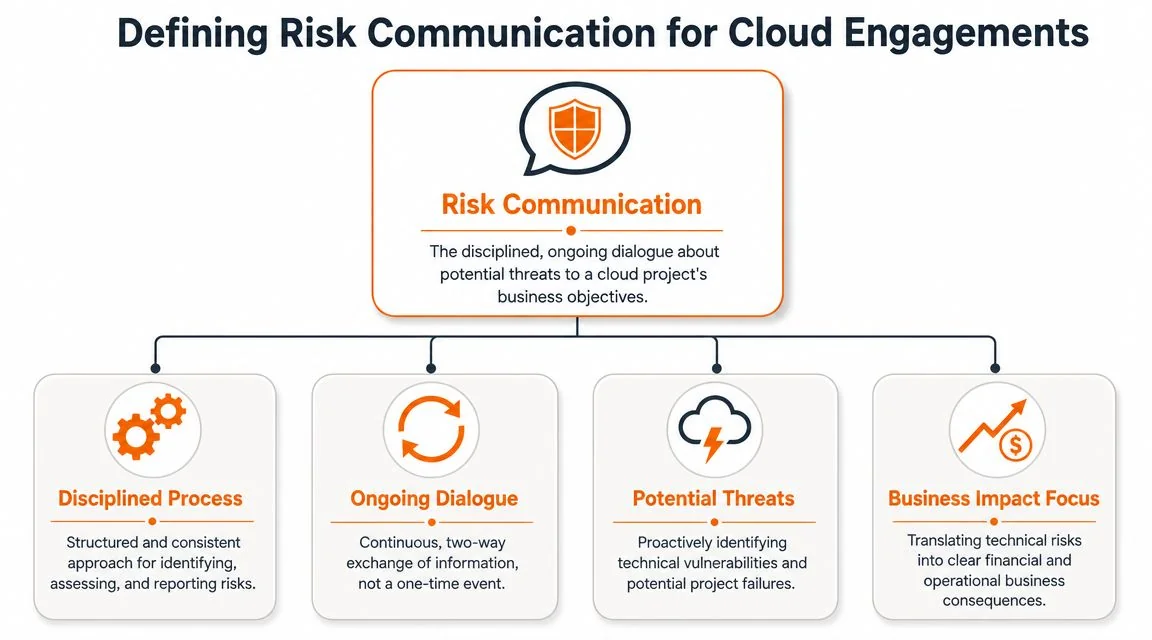
Most consulting teams maintain a risk log. That’s not enough. A risk log often captures a label. It doesn’t force clarity.
Bad entry:
- Risk: IAM policy misconfiguration
Useful communication:
- Hazard: IAM policies for migrated workloads haven’t been fully validated against production access patterns.
- Likelihood: The issue is plausible because testing is incomplete and role mappings changed during migration design.
- Impact: Incorrect access could expose sensitive data, trigger compliance review, and delay production approval.
Use hazard, likelihood, and impact every time
The FAO’s guidance is blunt and useful. Effective risk communication separates hazard, likelihood, and impact, and reporting should include both facts and uncertainties in the same message, as laid out in the FAO’s guidance on risk communication.
That structure matters in cloud consulting because vague wording lets everyone hear what they want. Executives hear confidence. Engineers hear unresolved dependencies. Consultants hear “we mentioned it already.” The framework eliminates that ambiguity.
Use this format in every steering meeting, architecture review, and weekly status report:
| Component | What your consultant should state | Example in a cloud migration |
|---|---|---|
| Hazard | What the problem is | Backup restoration process hasn’t been tested in the target cloud environment |
| Likelihood | How often or how credibly it may occur | Validation remains incomplete, so the failure path is still open |
| Impact | What happens if it occurs | Recovery objectives are unproven, go-live approval stalls, and managed service handoff gets delayed |
| Uncertainty | What isn’t known yet | Final test results and exception sign-off are pending |
| Decision | What needs approval now | Approve extra validation time, accept interim control, or move cutover |
Translate technical risk into contract-level language
The strongest cloud consulting leaders don’t stop at technical articulation. They tie risk to the terms that govern the engagement:
- Scope exposure: Is this inside current SOW assumptions or change-order territory?
- Control ownership: Is the consultant accountable, is your internal team accountable, or is it joint?
- Decision deadline: By when does an unresolved issue become a schedule problem?
- Evidence standard: What proof closes the risk? A Jira ticket doesn’t. A tested control, runbook, approval, or signed exception does.
If a consultant reports risk without naming the business decision attached to it, they’ve left the hard part for you.
That’s why communication of risk has to be treated as delivery infrastructure, not meeting etiquette.
Mapping the Risk Audience A Communication Matrix
A single risk report for everyone is lazy. Your CEO doesn’t need a subnet narrative. Your CISO doesn’t care that a workstream is “amber” without control evidence. Your CFO wants to know whether the issue creates more service overlap, more consulting burn, or a launch slip.
Use a stakeholder-specific matrix instead.
Stakeholder risk communication matrix
| Stakeholder | Primary Concern (Risk Dialect) | Key Metrics | Ideal Format & Cadence |
|---|---|---|---|
| Executive Sponsor or CEO | Business continuity, launch credibility, customer impact | Go-live readiness, critical decision blockers, business process disruption | One-page summary before steering committee, immediate escalation for launch blockers |
| CFO or FinOps lead | Budget exposure, duplicate run costs, licensing overlap, cloud spend variance | Budget against plan, unresolved cost drivers, ownership of remediation spend | Short written update tied to monthly financial review, rapid alerts on scope or cost shifts |
| Head of Engineering | Delivery velocity, architectural integrity, test readiness, operational handoff | Environment readiness, defect severity, dependency aging, rollback readiness | Weekly working session with action log and engineering-level detail |
| CISO or Security team | Control gaps, audit exposure, data protection, identity and access risk | Control validation status, exception list, evidence completeness, unresolved findings | Formal review cadence plus immediate alerts for any compliance-impacting issue |
| Consulting Partner PM | Delivery commitments, dependency removal, stakeholder alignment | Open risks by owner, decision latency, unresolved assumptions, mitigation progress | Daily internal tracking and weekly client-visible register |
| Platform or Ops lead | Stability, monitoring, support model, runbook maturity | Observability coverage, backup tests, incident path readiness, support responsibilities | Operational readiness review at each migration wave |
| Procurement or Vendor Management | Contract scope, change requests, accountability boundaries | Scope exceptions, approval history, disputed assumptions, acceptance criteria | Trigger-based updates when risks cross into commercial terms |
The most important handoff is CISO to CFO
The most fragile communication path in a cloud engagement is often between security and finance. The CISO sees a control gap. The CFO hears delay without context. The consultant often makes this worse by staying technical.
Fix that translation layer. If the issue is incomplete logging for a PCI-scoped application, the finance message isn’t “SIEM integration is pending.” It’s “production approval is blocked until evidence is complete, and the current schedule assumes approval.”
Match the format to the decision
Different stakeholders process risk differently. Some need a narrative. Some need a dashboard. Some need a direct ask with three options. Don’t force every risk through the same PowerPoint lane.
Use these rules:
- For executives: Lead with consequence and required decision.
- For security reviewers: Lead with evidence, gap, and interim control.
- For engineering: Lead with dependency, owner, and closure criteria.
- For finance: Lead with whether the issue changes spend timing, overlap, or contract scope.
The right audience doesn’t want more detail. They want the detail that changes a decision.
That’s why a shared risk register matters only if each item can be sliced by stakeholder concern. Otherwise, you’ve built a document, not a communication system.
The RACE Risk Communication Framework
You need a repeatable way to run these conversations. Use RACE: Reframe, Assign, Cadence, Escalate.
Reframe
Take technical language and convert it into decision language.
Bad example:
- Data transfer throughput is inconsistent during migration windows.
Good example:
- The current migration method is creating unstable transfer performance. If it continues, cutover sequencing breaks and the business launch date loses credibility.
When numbers are available, present them in clear frequency terms rather than abstract percentages. Research synthesized in medical literature shows people understand risk better when it’s framed as a fixed-denominator frequency such as “10 out of 100 projects” rather than “10%,” and that the same risk should be framed in multiple ways to support informed decisions, as summarized in this medical risk communication review.
In practice, ask your consultant to state risk in at least two forms:
- operational consequence
- business consequence
Assign
Every material risk needs one owner. Not a committee. Not “the project team.”
Use three ownership categories:
- Client-owned when the blocker sits with internal policy, approvals, or data classification.
- Consultant-owned when the issue comes from architecture, execution, documentation, or missed controls inside the engagement.
- Joint-owned when closure requires both technical remediation and business sign-off.
Bad example:
- Security validation remains open.
Good example:
- Consultant owns remediation of IAM role mappings. Client security lead owns approval of the revised control evidence by Friday.
Cadence
Don’t rely only on weekly meetings. Set communication triggers.
A good cadence model includes:
- Date-based updates for standing governance
- Event-based updates when a risk crosses a threshold, blocks a milestone, affects compliance, or changes commercial assumptions
- Closure-based updates when evidence is accepted and the issue is done
Many firms fail by reporting risk on a calendar instead of when the exposure changes.
Escalate
Escalation shouldn’t feel political. It should be pre-agreed.
Use a simple escalation path:
- Delivery lead to engineering owner for technical blockage
- Delivery lead to program sponsor for timeline or scope conflict
- Security lead to executive sponsor when compliance approval is at risk
- Procurement or legal when risk changes liability, acceptance criteria, or statement-of-work boundaries
Operator’s rule: If a risk is unresolved and no one knows who can force the next decision, your escalation design is broken.
RACE works because it turns hand-wavy concern into a management loop. It doesn’t eliminate risk. It stops risk from hiding.
Red Flags Common Failures in Consultant Risk Reporting
Most failed reporting doesn’t look chaotic. It looks polished. The slides are clean. The status colors are tidy. The problem is that the content avoids accountability.
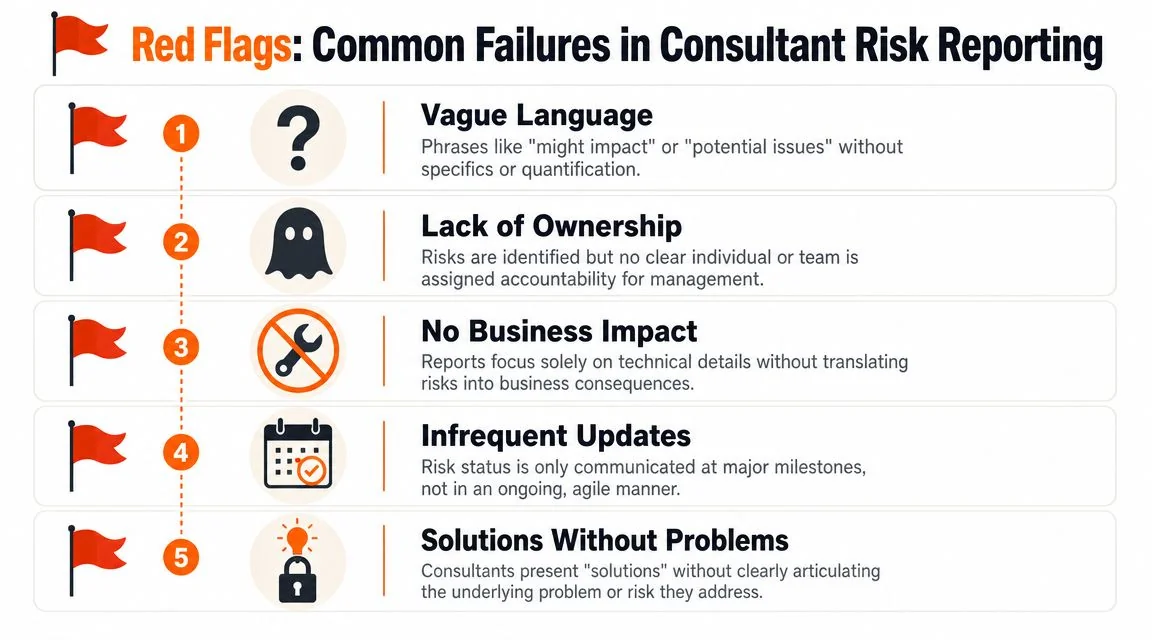
Across the 50 cloud consulting firms we profile, a client-visible risk register is a practical procurement requirement: it gives both sides a shared record of the risk, owner, decision deadline, and accepted exposure. Without that artifact, project-status language can hide unresolved tradeoffs.
Audit your consultant with these questions
- Watermelon reporting: Green on the slide, red in the working sessions. Ask, “Which risks are not reflected in the executive status color?”
- No business consequence: Technical narrative with no mention of launch, compliance, cost, or support impact. Ask, “What happens to the business if this remains unresolved for two more weeks?”
- No owner: Risks are described as general conditions. Ask, “Who owns closure, and what evidence proves closure?”
- Platform blame without mitigation: “That’s a cloud limitation” is not an answer. Ask, “What design alternative, compensating control, or acceptance path are you recommending?”
- Late disclosure: You hear about a serious issue only when the milestone is already compromised. Ask, “When did the team first identify this, and why wasn’t it escalated then?”
Pay attention to role maturity
If your partner doesn’t have someone who can translate technical exposure into control and business language, reporting quality drops immediately. That translation skill often sits with an experienced engagement lead, cloud architect, security lead, or a dedicated analyst who understands risk framing. If you want a benchmark for what that role should cover, this breakdown of the details on the cyber risk analyst position is a useful reference.
Non-negotiable reporting standards
Set these expectations in writing:
- Shared register: Client-visible, updated continuously, not just before governance meetings.
- Decision field: Every major risk includes the decision needed, deadline, and decision-maker.
- Evidence field: Closure requires proof, not verbal reassurance.
- Commercial flag: Any risk with scope or remediation-cost implications gets marked immediately.
If your consultant resists that level of visibility, assume the reporting is protecting the vendor more than the program.
Implement Your Risk Communication Plan Next Steps
You don’t need a transformation program to fix this. You need a disciplined operating rhythm.
This week
Book a 30-minute session with your consulting delivery lead, security lead, and internal engineering owner. Ask for the top three current risks in hazard, likelihood, impact format. Then ask three follow-ups:
- What decision is blocked right now
- Who owns closure
- What evidence will prove the issue is resolved
If they can’t answer cleanly, your engagement has a communication problem, not just a delivery problem.
This month
Create a stakeholder communication matrix for the next migration phase. Start with the template above and adapt it to your governance model, especially if you have separate security, procurement, and FinOps approval paths.
Then standardize your reporting package:
- Executive view: launch blockers and decisions
- Engineering view: dependencies, mitigations, and closure criteria
- Security view: control evidence, exceptions, and sign-offs
- Finance view: spend implications and scope shifts
This is also the point to connect risk reporting with your broader operating model for implementing a cloud governance strategy. Governance without risk communication turns into policy theater.
This quarter
Stand up a shared risk dashboard in Jira, Confluence, Smartsheet, or your PMO tool of choice. Keep it bi-directional. Your consultant updates it. Your internal owners update it. Everyone sees the same source of truth.
For each major risk, require these fields:
| Field | Required content |
|---|---|
| Risk statement | Plain-language description tied to business outcome |
| Owner | Client, consultant, or joint |
| Trigger | What event changes severity or requires escalation |
| Mitigation | Current action in progress |
| Decision needed | What approval or tradeoff is pending |
| Evidence to close | Artifact, test, sign-off, or accepted exception |
If you want an external reference point, one option is to review how CloudConsultingFirms.com structures cloud migration risk assessment around a client-visible dashboard and heatmap model for stakeholder communication. Use that as a benchmark, not a substitute for your own operating discipline.
The cloud migration that stays on track isn’t the one with the fewest risks. It’s the one where client and consultant describe the same risks, to the right people, early enough to act.
Your next steering meeting should sound different. Less status. More exposure, ownership, and decisions. That’s how you de-risk a cloud consulting engagement in practice.