IT services companies is a broad market label; cloud consulting firms, managed service providers (MSPs), and systems integrators (SIs) are narrower delivery models inside it. Before you compare vendors, decide whether you need to change the environment, run it under service levels, or coordinate a large multi-vendor program. The wrong model wastes budget even when the firm is competent.
This guide explains provider archetypes and procurement trade-offs. It is not a ranked shortlist. When you are ready to compare firms on published evidence, use the cloud consulting firm directory. For marketplace-style sourcing options, see IT consulting firms: how to vet and compare. For managed-cloud operating scope, see what are managed cloud services.
Four provider archetypes buyers confuse
Buyers often treat “IT services company” as one category. Procurement runs more smoothly when you separate four common archetypes:
| Archetype | Primary job | Typical engagement | What you buy | Common mismatch |
|---|---|---|---|---|
| Cloud consulting | Plan and execute change | Project or sprint-based SOW | Architecture, migration, modernization, assessments | Hiring consultants when you need 24/7 operations |
| Professional / project services | Deliver scoped build work | Milestone-based project | Implementation, integration, cutover support | Expecting ongoing SLA ownership after go-live |
| Managed services (MSP / MCSP) | Operate agreed estate | Recurring retainer or % of spend | Monitoring, patching, incidents, FinOps, security ops | Hiring an MSP for greenfield product engineering |
| Systems integrator (SI) | Orchestrate large programs | Multi-year, multi-tower contract | Strategy-through-run at enterprise scale | Using SI governance for a sub-$500K single-platform build |
A single legal entity may sell more than one model. Your RFP should name the engagement type you want, not assume the firm’s homepage category.
Industry analysts and practitioners often describe managed services as a growing share of overall IT services spend because operations work is recurring; ISM Grid’s managed vs professional services overview frames the split as steady operational ownership versus scoped project execution.
The change-vs-stabilize test
Use one question before you issue an RFP:
Are we trying to change the environment or stabilize what already runs?
| If the answer is… | Lean toward… | Examples |
|---|---|---|
| Change | Cloud consulting or professional services | Landing-zone design, workload migration, app modernization, compliance gap remediation |
| Stabilize | Managed services / MCSP | 24/7 monitoring, patch cycles, backup testing, incident response, cost reporting |
| Both, in sequence | Consulting first, managed services after cutover | Migration program followed by run-state operations under SLAs |
CloudThat’s consulting vs managed services comparison uses the same framing: consulting for strategy and execution during transformation; managed services for day-2 operations, governance, and continuous optimization.
Accountability: recommendations vs outcomes
Provider labels hide an accountability gap. Ask who owns the result if something fails at 2 a.m. on a Sunday.
| Question | Consulting / project services | Managed services |
|---|---|---|
| Primary deliverable | Plan, build artifact, or cutover event | Uptime, response time, patch compliance, ticket resolution |
| Contract shape | Milestones and acceptance criteria | SLAs, escalation paths, reporting cadence |
| Typical buyer risk | Scope creep, weak knowledge transfer | Ambiguous shared-responsibility boundaries |
| Evidence to request | Named team résumés, reference calls on similar scope | Runbooks, SLA history, incident postmortems, exclusion list |
IT Consulting Authority’s consulting vs managed services guide treats advisory and planning work as distinct from operational support—a useful lens when a vendor blurs “we advised” with “we operated.”
How cloud consulting fits inside IT services
Cloud consulting firms usually focus on hyperscaler delivery: AWS, Azure, or Google Cloud strategy, migration, security architecture, data platforms, and FinOps. They may subcontract niche work or partner with an MSP for run state.
Cloud consulting is the right lens when:
- You need a target architecture, migration sequence, or modernization plan.
- The work is bounded by deliverables and acceptance tests.
- Internal teams will own run state after handover, or you will procure managed services separately.
Cloud consulting is the wrong lens when:
- You primarily need helpdesk, endpoint, or broad corporate IT outsourcing unrelated to cloud platforms.
- You need continuous operations under SLAs without a defined transformation scope.
For pricing and engagement-model normalization before you compare proposals, see the cloud consulting pricing and engagement benchmark.
When systems integrators earn their overhead
Global and national SIs—Accenture-scale integrators, Big Four practices, and similar firms—excel when program complexity exceeds what a boutique can coordinate: multiple clouds, legacy mainframe touchpoints, regulatory programs, and dozens of workstreams.
They are harder to justify when:
- The scope is a single platform and a single migration wave.
- Decision cycles are fast and lightweight governance is an advantage.
- You need senior engineers embedded daily, not program office layers.
If you are evaluating SI-scale proposals, demand the named delivery lead, subcontractor map, and responsibility matrix—not only firm-level credentials.
Evaluation dimensions that travel across models
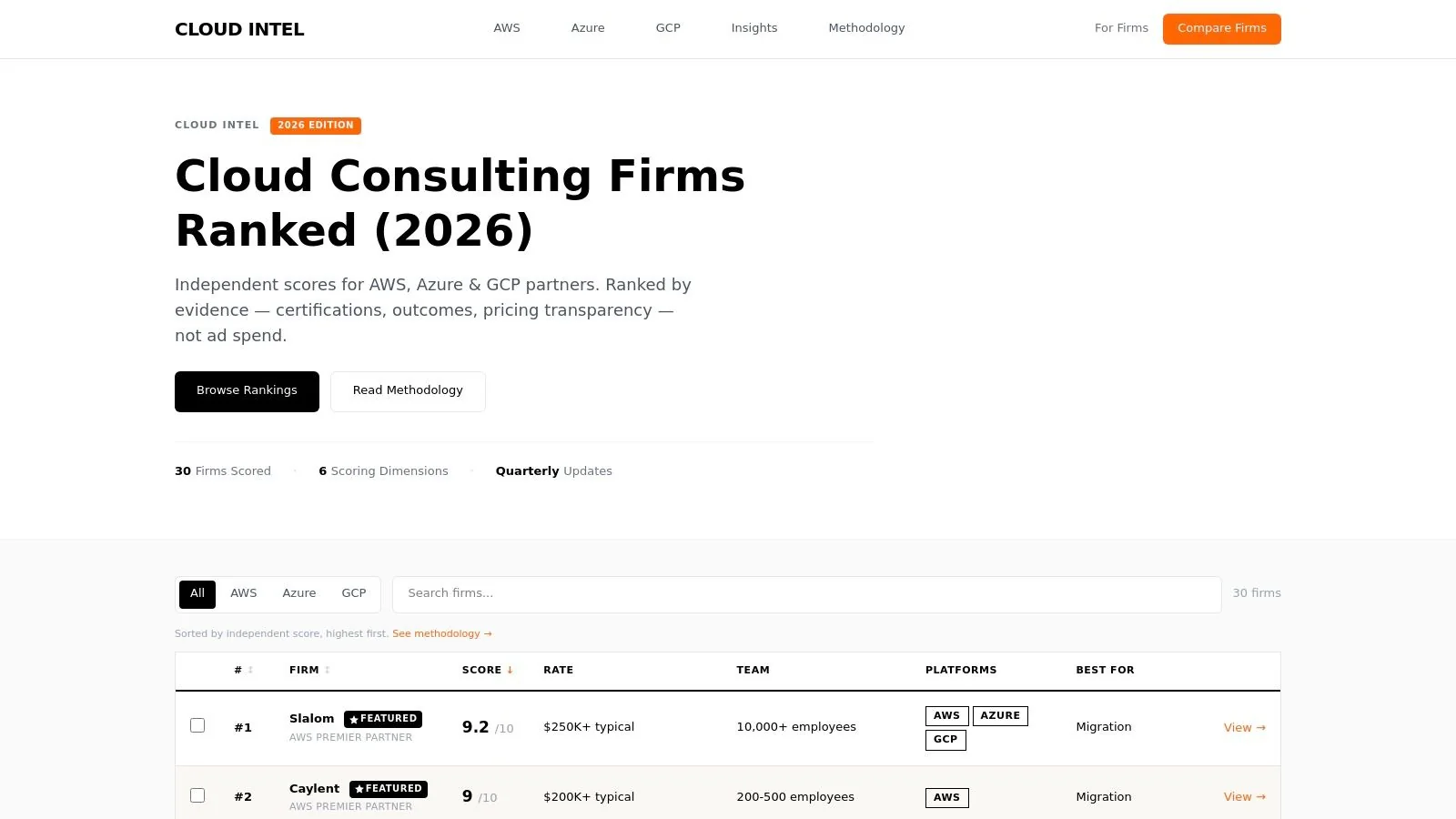
Regardless of archetype, Cloud Consulting Intel compares public profiles on the same evidence fields so buyers can normalize unlike providers:
- Certifications — Current partner designations on the relevant hyperscaler; verify in the official partner directory, not on the firm’s blog alone.
- Documented outcomes — Case studies with measurable results tied to similar scope, not generic logos.
- Pricing transparency — Published signals or proposal norms you can compare; treat unknown fields as unknown.
- Review patterns — Recency, specificity, and volume across independent sources.
- Specialization depth — Demonstrated focus on platform, industry, or workload—not a catalog of every service line.
Paid placements on this site are labeled and kept separate from editorial eligibility. Unknown normalized evidence stays unknown until review.
Build the shortlist in the right order
- Define the job — Change, run, or enterprise program coordination.
- Fix scope boundaries — Accounts, environments, applications, data classes, and exclusions.
- Choose commercial model — Fixed fee, T&M, retainer, outcome-based, or hybrid.
- Normalize proposals — Same inputs, roles, assumptions, and responsibilities for every finalist.
- Compare evidence — Use the directory for cloud consulting firms; use vendor due diligence checklist for reference calls and RFP structure.
RFP prompts that surface model mismatches
Add these questions to any IT services RFP:
- Which engagement type are you proposing—consulting, project services, managed services, or SI program—and what is out of scope?
- Who is the named delivery lead and what similar work did they deliver in the last 24 months?
- What happens at handover—documentation, runbooks, training, and residual responsibilities?
- How do you handle subcontractors and client access to their personnel?
- What is the exit plan if we terminate for convenience or fail to renew?
Practical rule: The best engagement leaves your team more capable at the end, whether the vendor consulted, built, or operated. If the contract only works when the vendor stays forever, you bought staff augmentation—not a durable outcome.
Related reading
- IT consulting firms: how to vet and compare — marketplaces and directories for sourcing candidates.
- What are managed cloud services? — MCSP scope and shared responsibility.
- Cloud consulting pricing and engagement benchmark — evidence status and proposal normalization.
- Vendor due diligence checklist — reference calls, RFP structure, and red flags.