What Is Cloud Managed Services Unlocking Cloud Efficiency

Cloud managed services are the practice of outsourcing the daily management of your cloud environment to a third-party expert, known as a Managed Service Provider (MSP). An MSP handles the technical responsibilities of running a cloud environment, from security and maintenance to performance and cost optimization. This allows your internal team to focus on core business initiatives instead of infrastructure management.
Defining Cloud Managed Services Without The Jargon

Imagine your cloud infrastructure on AWS, Azure, or Google Cloud is a high-performance race car. You own the car and set the race strategy, but you don’t have time to tune the engine, change tires, and analyze performance data mid-race. You need to focus on driving.
A cloud MSP is your dedicated pit crew, working 24/7 to keep your cloud environment running at peak condition. Their job is to ensure it’s secure, maintained, and optimized for speed and cost-efficiency. While they manage the complex mechanics, you can focus on accelerating your business.
The Core Responsibility Shift
Using a cloud managed service is a deliberate shift in responsibility. Instead of hiring, training, and retaining an expensive in-house team of cloud specialists, you delegate operational tasks to a partner with deep expertise. The MSP assumes the responsibility for keeping the environment stable and secure.
This means they handle critical, ongoing tasks:
- Proactive Monitoring: Continuously tracking performance and security to identify and resolve issues before they cause an outage.
- System Maintenance: Applying security patches, running updates, and ensuring all components are current and secure.
- Cost Optimization: Identifying and eliminating wasted cloud spend from idle or overprovisioned resources.
- Backup and Recovery: Implementing and testing robust data protection strategies to ensure business continuity.
Why This Model Is Gaining Momentum
The adoption of cloud managed services is a direct response to the increasing complexity of modern cloud environments. The global market, currently valued at USD 155.73 billion, is projected to reach USD 492.93 billion by 2034. This growth, detailed in analysis from Precedence Research, highlights a key reality: managing cloud infrastructure effectively is a significant challenge for most organizations.
By outsourcing infrastructure management, organizations free up internal talent to focus on innovation and business value. This transforms IT from a cost center into a strategic enabler for growth.
Ultimately, cloud managed services provide access to specialized expertise and constant operational vigilance that is difficult and costly to build in-house. It allows any business to operate with enterprise-grade stability and security without an enterprise-scale budget.
What Kinds of Services Are We Actually Talking About?

Partnering with a cloud Managed Service Provider (MSP) gives you access to a team with specialized skills to manage, secure, and optimize your cloud operations. An effective MSP delivers practical, day-to-day services that build resilience and allow your team to focus on strategic goals, not operational emergencies.
Here are the core services that form the foundation of a cloud managed services offering.
Proactive Infrastructure Management
An MSP’s primary role is to ensure your cloud infrastructure—virtual servers, networks, and storage—is stable and performant. This service is focused on preventing problems rather than reacting to them.
MSPs continuously oversee virtual machines, databases, and network configurations. They manage essential tasks like system updates, resource scaling, and performance tuning, freeing your team from routine maintenance and allowing them to concentrate on high-impact work.
Advanced Security and Compliance Operations
In the cloud, security is a foundational requirement. A capable MSP acts as your dedicated security operations center (SOC), implementing a multi-layered defense against evolving threats. This extends far beyond basic antivirus protection.
A comprehensive security service includes:
- Threat Detection and Response: Using advanced tools to monitor network traffic and system logs for suspicious activity 24/7. When a potential threat is detected, the MSP investigates and neutralizes it.
- Vulnerability Management: Regularly scanning systems for security weaknesses and applying patches before they can be exploited.
- Compliance Adherence: For businesses in regulated industries like healthcare or finance, an MSP can configure the environment to meet strict standards like HIPAA or GDPR, simplifying audits and reducing risk.
An effective MSP doesn’t just react to security incidents—they practice prevention. By managing access controls, implementing robust firewalls, and conducting regular security audits, they build a defensive perimeter around your data.
This constant vigilance provides a level of protection that is difficult and expensive for most companies to achieve independently.
DevOps and Automation Services
The cloud enables agility, but this is achieved through automation, not just server provisioning. An MSP can help implement CI/CD (Continuous Integration/Continuous Deployment) pipelines that automate the build, test, and deployment phases of your application lifecycle.
This automation reduces human error and significantly shortens development cycles, allowing your business to release new features faster and more reliably. Instead of risky manual deployments, an automated pipeline ensures a consistent and controlled process with built-in quality checks.
For a platform-specific example, see our guide on Azure cloud managed services.
Continuous Monitoring and Performance Tuning
An MSP implements advanced monitoring tools to provide a real-time view of your entire cloud stack’s health and performance. They track key metrics like CPU utilization, memory usage, and application response times to ensure optimal operation.
This data-driven approach enables precise performance tuning. If a database slows down or a server becomes overloaded, the MSP can identify the root cause and resolve it before it impacts users. This continuous optimization ensures your applications remain fast and reliable, which is essential for a positive user experience.
Robust Backup and Disaster Recovery
A non-negotiable service from any credible MSP is a comprehensive backup and disaster recovery (BDR) plan. This is your safety net against data loss from hardware failure, ransomware attacks, or human error.
An effective BDR strategy includes:
- Regular, Automated Backups: Establishing a reliable schedule for backing up critical data and applications to a secure, off-site location.
- Recovery Plan Testing: Periodically conducting drills to validate that systems can be restored quickly and accurately in a real disaster scenario.
- Defined Recovery Objectives: Setting clear targets for Recovery Time Objectives (RTO) and Recovery Point Objectives (RPO) to minimize downtime and data loss.
This disciplined approach ensures business continuity and resilience against unexpected events.
The Real Business Impact Of A Cloud MSP
Engaging a cloud Managed Service Provider (MSP) is a strategic business decision with measurable financial and operational benefits. The value extends beyond task delegation to include improved efficiency, enhanced security, and greater market agility.
Market forecasts consistently project double-digit growth, driven by the need for cost control and specialized security expertise. One analysis sized the market at USD 66.1 billion, projecting it to hit USD 172.1 billion by 2034. This growth reflects the reality that most companies cannot hire all the specialized cloud talent required to manage modern environments. You can see the full breakdown in the market analysis from IMARC Group.
This momentum is built on four core pillars that drive the decision to partner with an MSP.
Drastic Cost Optimization And Predictability
Cloud billing is notoriously complex and often contains hidden waste from idle resources or oversized instances. A key function of an MSP is to identify and eliminate this waste—a task internal teams are often too busy to address.
Beyond cost reduction, an MSP helps make cloud spending predictable. Instead of volatile monthly bills, you move to a stable operational expense. This model also helps avoid the significant capital investment and recurring costs associated with hiring, training, and retaining a team of certified cloud engineers. For a deeper look at controlling cloud spend, see our guide on what is cloud cost optimization.
Fortified Security And Compliance Posture
For any organization, particularly those in regulated industries, establishing an enterprise-grade security program is a significant challenge. An MSP provides immediate access to a team of security professionals who stay ahead of emerging threats and navigate complex compliance frameworks like HIPAA, PCI DSS, or GDPR.
A cloud MSP transforms security from a reactive function into a proactive discipline. They implement and manage advanced threat detection, vulnerability scanning, and incident response protocols, delivering a level of protection that would be prohibitively expensive to build in-house.
This expertise ensures your cloud environment is not only secure but also audit-ready, minimizing risk and protecting your company’s reputation.
Accelerated Innovation And Focus
When skilled engineers are occupied with routine maintenance and troubleshooting, they are not innovating. Partnering with an MSP frees your technical talent to focus on projects that drive business growth, such as developing new product features or improving the customer experience.
By outsourcing operational tasks, you create a dual-team structure:
- An external expert team maintains a stable, secure, and efficient infrastructure.
- An internal innovation team is free to build, create, and drive the company forward.
This immediate access to certified AWS, Azure, and GCP experts allows you to adopt new cloud technologies faster and more confidently, bypassing steep learning curves.
Unmatched Operational Resilience
A top-tier MSP delivers 24/7/365 proactive support. For businesses with a global customer base or zero tolerance for downtime, this is a critical advantage. Issues do not adhere to a 9-to-5 schedule. A quality MSP uses proactive monitoring to identify and resolve potential problems before they lead to an outage.
This round-the-clock vigilance ensures operational continuity, maintains customer trust, and protects revenue streams from preventable downtime.
Choosing Your Cloud Operations Model
Determining how to manage your cloud environment is a critical strategic decision that impacts your budget, security, and team productivity. There are three primary models, each with distinct trade-offs. The right choice depends on your company’s scale, technical capabilities, and business objectives.
Let’s examine what each model entails in practice.
H3: The In-House Team Approach
Maintaining a dedicated in-house team provides maximum control over your cloud environment. All decisions, from high-level architecture to specific security protocols, are managed by internal staff who have a deep understanding of your business.
This model is common in large enterprises with unique compliance requirements or highly customized technology stacks. However, this control comes at a high cost, including salaries, recruitment, continuous training, and retention of specialized cloud engineers.
H3: Partnering With a Cloud MSP
Hiring a cloud Managed Service Provider (MSP) is equivalent to integrating an expert cloud operations department into your organization. You gain immediate access to a deep bench of certified professionals for AWS, Azure, and GCP, complete with proven methodologies for security, cost optimization, and 24/7 monitoring.
This model is highly advantageous for mid-market companies and enterprises seeking to focus their internal teams on product development rather than infrastructure management. The primary trade-off is relinquishing some direct control, which is managed through a detailed Service Level Agreement (SLA).
H3: Relying on Cloud-Native Services
A third option is to leverage the managed services offered directly by cloud providers, such as Amazon RDS for databases or Azure App Service for web applications. These services are powerful, well-integrated, and simplify specific operational tasks.
This approach is suitable for smaller teams or projects where development speed is a priority. The main drawback is vendor lock-in. Building your entire operation around a single provider’s proprietary tools can make future migrations to other clouds technically complex and expensive.
The decision to partner with an MSP often occurs when cloud complexity reaches a tipping point. As an organization grows, its cloud footprint becomes exponentially more complicated, making it nearly impossible for an in-house team to maintain expertise across all domains, from container orchestration to advanced threat detection.
This is particularly true for large enterprises, which are the primary consumers of cloud managed services. Their extensive infrastructures require specialized oversight. Notably, 33% of organizations now spend over $12 million annually on public cloud. At this scale, expert management is essential to control costs and mitigate security risks, a trend detailed in cloud market insights from Fortune Business Insights.
The decision tree below illustrates how key business drivers—cost savings, growth, or security—can guide you toward the right MSP partnership.
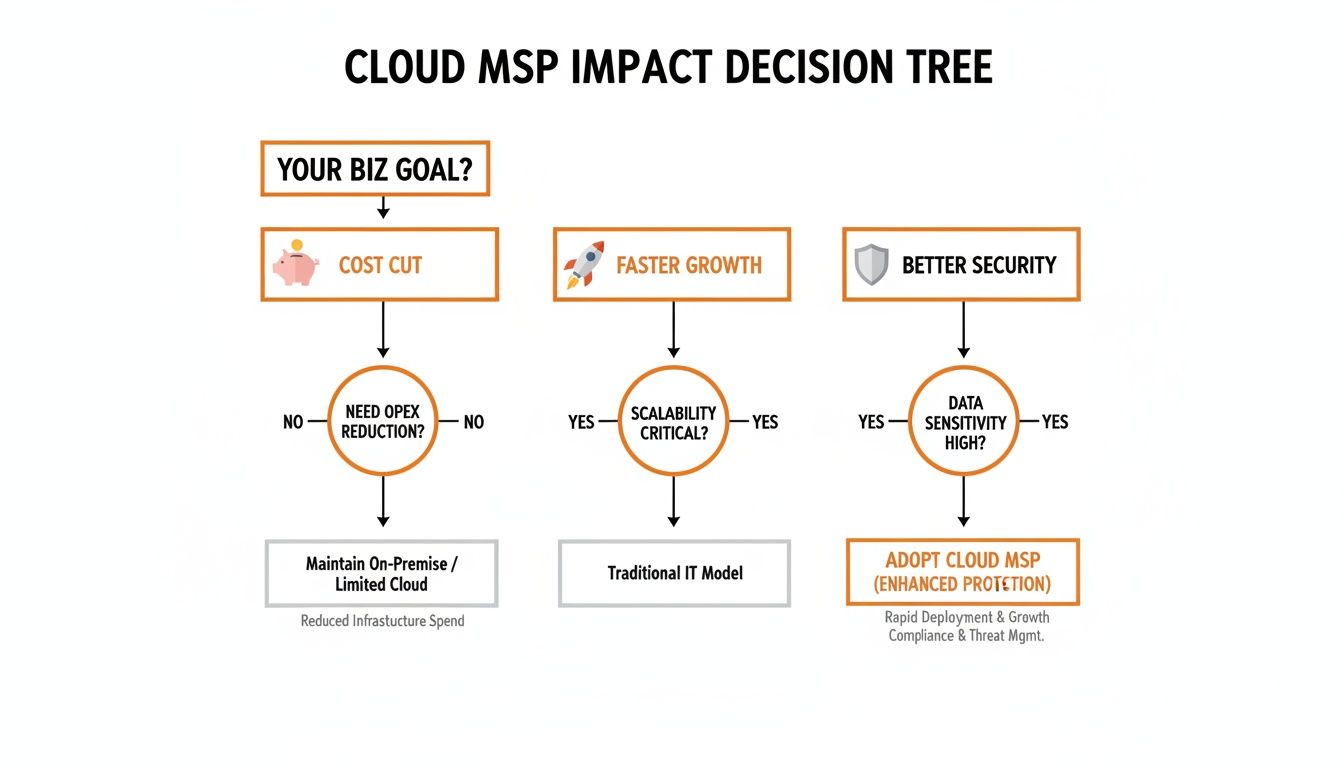
Regardless of your objective, an MSP provides a structured path to achieving it by supplying specialized skills and established operational frameworks.
H3: Making The Right Decision For Your Business
To select the right model, compare these approaches against your specific business requirements. This table provides a side-by-side comparison to help frame the decision-making process.
Decision Matrix In-House vs MSP vs Cloud-Native Services
Here is a head-to-head comparison of the three cloud management strategies across key business and technical criteria.
| Criteria | In-House Team | Cloud MSP Partner | Cloud-Native Managed Services |
|---|---|---|---|
| Total Cost of Ownership | High (Salaries, training, tools) | Medium (Predictable monthly fee) | Variable (Usage-based, can be high) |
| Level of Control | Maximum | Moderate (Defined by SLA) | Low (Abstracted by the provider) |
| Access to Expertise | Limited (To your hires) | High (Deep bench of specialists) | High (Provider’s internal teams) |
| Risk of Vendor Lock-In | Low (Can build agnostic systems) | Medium (Depends on MSP) | High (Proprietary APIs and tools) |
| Speed to Implement | Slow (Hiring and ramp-up time) | Fast (Immediate access to skills) | Fast (Built-in and ready to use) |
By evaluating these factors—cost, control, expertise, and risk—your leadership team can select a cloud operations model that aligns with your current needs and future goals. The optimal choice is one that empowers your team to focus on creating customer value.
How To Select The Right Cloud MSP Partner

Choosing a cloud Managed Service Provider (MSP) is a long-term strategic decision. The market is saturated with providers, making it essential to look beyond marketing claims and focus on verifiable capabilities. A well-chosen MSP integrates seamlessly with your team, while a poor choice can introduce risk, frustration, and budget overruns.
Use this framework to vet potential partners and identify one that aligns with your technical requirements and business objectives.
Evaluate Verifiable Technical Expertise
Begin by verifying the provider’s technical proficiency. Certifications from major cloud platforms serve as a baseline indicator that the MSP has met rigorous standards.
Look for these top-tier partner designations:
- For AWS: AWS Premier Tier Services Partner. This highest level is reserved for partners with extensive experience, a large team of certified professionals, and proven customer success.
- For Microsoft Azure: Azure Expert MSP. This elite status is awarded after a comprehensive third-party audit that validates technical skills and service delivery capabilities.
- For Google Cloud: Google Cloud Premier Partner. This designation signifies deep expertise and a proven ability to deliver complex Google Cloud solutions.
These certifications are not just marketing badges; they represent a significant investment in expertise and a documented track record of successful delivery. They are a critical first filter in your selection process.
Demand Relevant Industry Experience
General cloud expertise is not enough; you need a partner who understands your specific industry. A provider specializing in e-commerce has a different skillset than one experienced in navigating HIPAA compliance for healthcare clients. This domain-specific knowledge is crucial for security, compliance, and operational efficiency.
Request case studies and customer references from companies in your industry with similar scale and challenges. A provider with a proven track record in your vertical will bring established best practices and playbooks, avoiding a learning curve at your expense.
A partner with deep industry experience can anticipate challenges you haven’t yet considered. They bring best practices from dozens of similar deployments, helping you avoid common pitfalls and accelerate your time-to-value.
If a potential MSP cannot provide a single relevant case study, it is a significant red flag. This due diligence is critical. Find more strategies on how to compare cloud service providers in our complete guide.
Scrutinize The Service Level Agreement
The Service Level Agreement (SLA) is the most important document in your relationship with an MSP. This contract defines uptime guarantees, response times, responsibilities, and penalties for non-performance. A vague SLA is a recipe for conflict and unmet expectations.
A strong SLA must clearly define:
- Guaranteed Uptime: For critical systems, accept no less than 99.99%. Understand which services are covered and how “uptime” is calculated.
- Response and Resolution Times: Distinguish between how quickly the MSP will respond to an issue and how quickly they will resolve it. These times should be tiered by severity (e.g., critical, high, medium, low).
- Clear Responsibilities: The SLA must explicitly state what the MSP manages and what your team remains responsible for, preventing ambiguity during an incident.
- Penalties for Failure: A robust SLA outlines service credits or financial penalties if targets are missed, ensuring the provider has accountability.
Never sign a contract with a weak or ambiguous SLA. It should be a clear, enforceable document that protects your business and establishes expectations from the start.
Assess Cultural Fit And Partnership Potential
Finally, remember that you are entering a long-term partnership, not just purchasing a service. While technical excellence is essential, a poor cultural fit can undermine the relationship. This involves shared values around communication, transparency, and collaborative problem-solving.
Evaluate their communication style during the sales process. Do they listen to your needs or push a standardized solution? Are they transparent about pricing and processes? A true partner acts as a proactive advisor, offering strategic guidance to help you achieve your business goals, rather than functioning as a reactive help desk.
What’s Next on Your Path to Cloud Excellence?
Cloud managed services offer a strategic pathway to enhance growth, strengthen security, and drive innovation. The next step is to find a partner that understands your business operations and long-term goals. The right fit is the difference between a successful cloud strategy and a frustrating, costly one.
Your journey begins with a clear assessment of your own needs. Use the frameworks and checklists in this article to build a comprehensive Request for Proposal (RFP). This process forces you to define what success looks like for your organization and provides a solid foundation for a productive partnership.
Taking Action and Finding the Right Fit
As you evaluate potential partners, move beyond marketing materials and focus on the details.
- Verify their credentials: Confirm they hold the top-tier certifications relevant to your cloud platform.
- Dig into their track record: Request case studies and references from your specific industry.
- Demand clarity: Scrutinize their Service Level Agreements (SLAs) to ensure every commitment is clearly defined.
This level of due diligence is essential to ensure your cloud investment delivers long-term value.
Ultimately, you’re looking for a provider whose technical skills and company culture genuinely mesh with your own. The right partnership can transform your cloud infrastructure from a simple cost center into a powerful engine that gives you a real competitive edge.
To simplify the selection process, resources like CloudConsultingFirms.com offer data-driven comparisons of top-tier providers. Their platform allows you to filter by expertise in AWS, Azure, or GCP, helping you find a partner equipped to elevate your cloud strategy.
Frequently Asked Questions
When considering cloud managed services, several key questions consistently arise. Here are answers to the most common ones.
How Is Pricing Typically Structured?
Most managed service providers (MSPs) use a recurring subscription model, which converts unpredictable capital expenditures into a stable, predictable operational expense.
Common pricing models include:
- Per-Device or Per-User Pricing: A straightforward model where you pay a flat fee for each server, database, or user account being managed. This is simple and easy to budget.
- Tiered Pricing: Services are bundled into packages (e.g., Basic, Pro, Enterprise) with increasing levels of support and features at each tier.
- A La Carte: This model allows you to select and pay for only the specific services you need, such as security monitoring or backup management.
What Is a Service Level Agreement?
The Service Level Agreement (SLA) is the formal contract that defines the provider’s commitments and is your primary tool for accountability.
An SLA is a legally binding document, not an informal promise. It specifies metrics such as guaranteed system uptime (often 99.9% or higher) and the exact timeframes for responding to and resolving incidents. It also outlines penalties, like service credits, if the provider fails to meet these commitments.
How Do I Measure The Success Of An MSP Partnership?
Evaluating the success of an MSP partnership requires tracking a combination of financial, operational, and strategic metrics to determine the return on investment (ROI).
Key performance indicators to monitor include:
- Reduction in Cloud Spend: Measure the cost savings achieved through the MSP’s optimization efforts.
- Improved Uptime: Track the frequency and duration of unplanned outages. A successful partnership should lead to a significant reduction in downtime.
- Faster Incident Resolution: Monitor the average time to resolve support tickets, particularly for high-priority incidents.
- Internal Team Productivity: Assess whether your internal technology team is spending less time on routine maintenance and more time on strategic, value-added projects.
By focusing on these tangible outcomes, you can accurately assess the value your MSP provides and ensure the partnership is advancing your business objectives.
Finding the right partner is the most important step in your cloud journey. CloudConsultingFirms.com provides a data-driven platform to compare top-tier cloud partners, helping you vet their certifications, industry expertise, and client reviews to make a confident decision. Explore the 2025 guide and find your ideal cloud partner on CloudConsultingFirms.com.