A Practical Guide to Cloud Migration Consultants
Cloud migration consultants are technical and strategic experts who plan and execute a company’s move to the cloud. They turn a complex technical project into a strategic business initiative, ensuring the migration is efficient, secure, and aligned with long-term goals. Their involvement is often the deciding factor between a smooth transition and a costly failure.
What Cloud Migration Consultants Do
Cloud migration consultants manage the end-to-end process of moving your digital infrastructure. Their role is not a simple “lift and shift” of data; it’s a multi-stage process designed to minimize risk, optimize performance, and enable future growth.
Assessment and Strategy
Before migration, a consultant performs a thorough assessment of your existing IT environment to build a foundational strategy. This phase is critical for preventing unexpected costs and complications.
- Application Portfolio Analysis: They inventory every application to understand its function, dependencies, and business criticality.
- Infrastructure Audit: They examine current servers, databases, and network configurations to identify potential migration challenges and compatibility issues.
- Business Goal Alignment: They work with leadership to define success metrics. Key objectives often include cost reduction, performance improvement, or increased innovation agility.
This discovery phase provides the necessary data to create a realistic and effective migration plan.
Cloud Architecture and Design
With a clear understanding of your current state, the consultant designs the target cloud environment. The objective is not to replicate the old infrastructure but to optimize it using modern cloud capabilities. This is where their architectural expertise is most valuable.
A well-designed cloud architecture directly impacts long-term cost, security, performance, and scalability. It is the single most important phase managed by cloud migration consultants.
This design work involves selecting the optimal cloud platform (like Amazon Web Services (AWS), Microsoft Azure, or Google Cloud Platform (GCP)), choosing correctly sized computing resources, and engineering a secure, resilient network.
Execution and Management
Once the architecture is approved, the consultant manages the technical execution. This hands-on phase involves data transfer, application deployment, and system integration. They use proven methodologies and automation tools to minimize manual errors and ensure a smooth transition with minimal disruption to business operations. Their experience turns a complex technical challenge into a structured, predictable project.
Decoding the Three Main Cloud Migration Strategies
Cloud migration consultants use a playbook of proven strategies, each tailored to different business goals, timelines, and budgets. Understanding these options is the first step in building an effective plan.
Lift-and-Shift: Rehosting
Lift-and-Shift (Rehosting) is the process of moving applications and data to the cloud with minimal or no changes. The code and architecture remain the same; they simply run in a new environment. This approach is best for meeting tight deadlines, such as an expiring data center lease.
The primary benefit is speed. The trade-off is that it does not leverage cloud-native features like auto-scaling or serverless functions. It is often a first step, not a final destination.
Replatforming: Lift-and-Tinker
Replatforming involves making targeted optimizations during the migration process. This strategy delivers tangible cloud benefits without requiring a full application rewrite.
For example, a consultant might recommend moving an on-premise database to a managed cloud service like Amazon RDS or Azure SQL. This single change can significantly improve performance, scalability, and reliability. Replatforming provides a balanced approach, delivering measurable value faster than a complete overhaul.
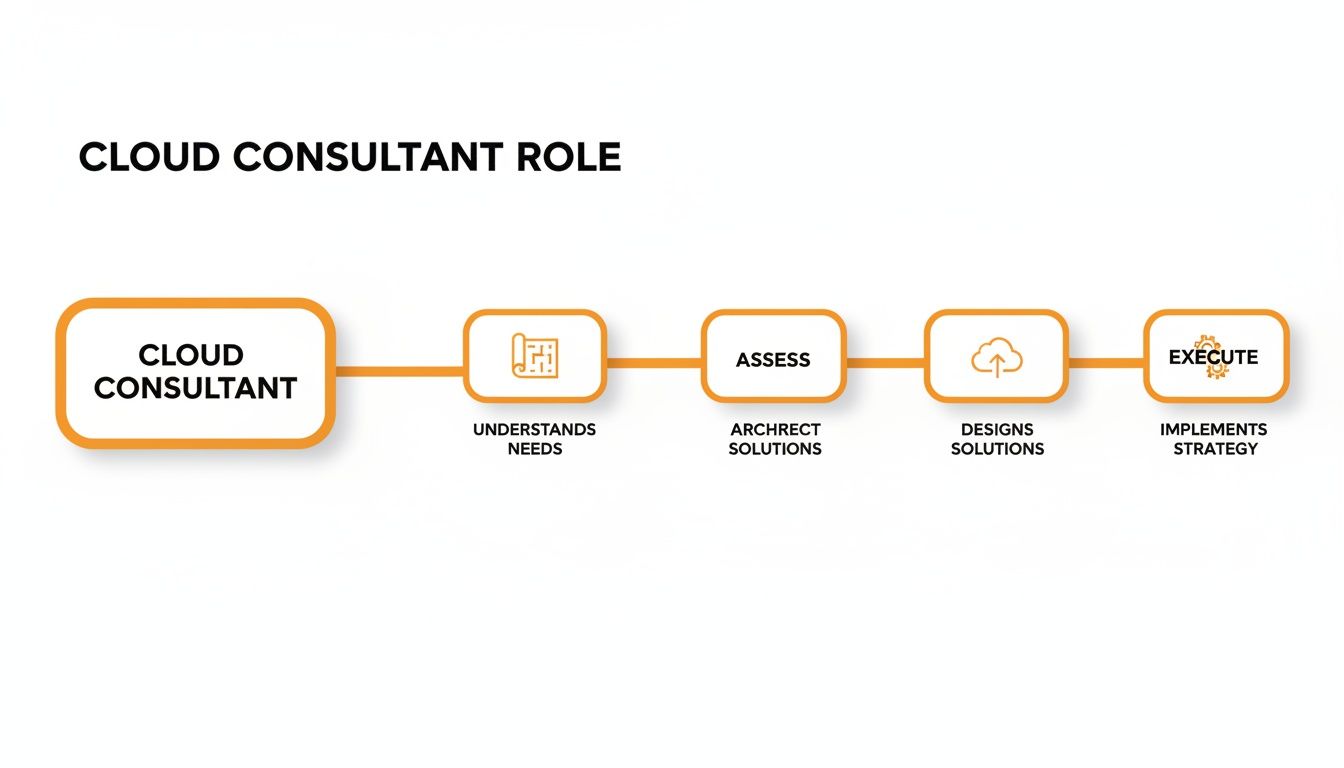
This process illustrates how a consultant guides an organization through strategic decisions—from assessment and architecture to execution—ensuring the chosen approach aligns with business needs.
Refactoring: Re-architecting
Refactoring (Re-architecting) is the most intensive strategy but offers the greatest long-term rewards. It involves redesigning an application to be fully cloud-native, maximizing the benefits of cloud services.
Refactoring is a strategic investment in future-proofing applications. It breaks down monolithic systems into agile microservices, unlocking maximum scalability, resilience, and long-term cost efficiency.
This approach allows businesses to fully harness cloud power, from advanced services and automation to modern DevOps practices. While it requires the largest upfront investment of time and resources, refactoring positions the business for maximum agility and innovation.
Comparing Cloud Migration Strategies
| Strategy | Best For | Effort & Cost | Primary Benefit |
|---|---|---|---|
| Lift-and-Shift | Speed-critical projects, expiring leases, legacy apps | Low | Speed & Simplicity |
| Replatforming | Gaining quick cloud benefits (e.g., managed services) without a full rewrite | Medium | Performance Gains & Efficiency |
| Refactoring | Core business applications, unlocking long-term scalability and innovation | High | Future-Proofing & Agility |
An effective consultant will help you evaluate the pros and cons for each application, often recommending a hybrid approach that mixes all three strategies. For a deeper look at this process, see our guide on what is a cloud migration strategy.
When to Hire a Cloud Migration Consultant
Hiring a cloud migration consultant is a strategic investment in getting the project right the first time. A full-scale cloud migration is a complex undertaking with significant business risk. Certain indicators clearly signal when it is time to engage an expert.
Engaging a consultant mitigates the risk of a poorly executed migration, which can lead to significant cost overruns, security vulnerabilities, and operational downtime.
Your Team Lacks Deep Platform Expertise
While your in-house IT team may be proficient at managing your current infrastructure, they are unlikely to be experts in AWS, Azure, or GCP. Each cloud platform has thousands of services, complex pricing structures, and unique security models.
Without specialized knowledge, a DIY migration often results in costly errors, such as misconfigured security settings that create vulnerabilities or improperly sized server instances that lead to budget overruns.
You Are Dealing with Complex Legacy Systems
Established organizations often run on a web of interconnected legacy applications built over decades. These systems frequently have tangled dependencies, poor documentation, and outdated code that is not fully understood by current staff.
Attempting to migrate such “spaghetti architecture” without a proven methodology is a primary cause of migration failure. Consultants bring systematic processes for mapping these systems, untangling their connections, and modernizing them for the cloud without disrupting the business.
You Face Strict Security and Compliance Mandates
For businesses in regulated industries like healthcare (HIPAA), finance (PCI DSS), or those handling data subject to GDPR, a migration error can have severe consequences, including major fines, legal action, and reputational damage.
An experienced cloud migration consultant acts as your compliance guide. They ensure your new cloud environment is architected from day one to meet or exceed regulatory requirements, turning a major risk into a well-managed process.
Consultants with industry-specific expertise build compliance controls directly into the cloud architecture. They manage data encryption, access policies, and audit trails, ensuring the migration is not only technically successful but also legally sound.
The demand for this expertise is reflected in market growth. The cloud migration services market is projected to expand from USD 16.90 billion to USD 70.34 billion by 2030. This trend highlights the widespread understanding that an expert-led migration is the most effective way to reduce risk, as detailed in the cloud services market report from Grand View Research.
Breaking Down Consultant Costs and Team Structures
To budget effectively for a cloud migration, it is essential to understand how consultants structure their fees. Proposals typically fall into one of three common pricing models. Matching the right model to your project ensures you pay for results, not just billable hours.
The most common model is project-based pricing. A fixed fee is agreed upon for a clearly defined scope of work, such as migrating a specific set of applications. This model is ideal for projects with clear goals and deadlines, as it provides cost certainty from the outset.
Alternatively, the time and materials (T&M) model offers flexibility. You pay an hourly or daily rate for consultant time, plus any material costs. This approach is best suited for complex projects with many unknowns, such as untangling legacy systems, where adaptability is more important than a fixed scope.
Finding the Right Fit for Your Project
A third option is the retainer model, which focuses on an ongoing partnership. You pay a recurring monthly fee for access to expert advice, continuous optimization, or security management. This is a strong choice for companies that require long-term strategic guidance after the initial migration.
The choice of model depends on your project’s predictability:
- For well-defined projects: Use a project-based fee for budget control.
- For projects with unknowns: Use time and materials for necessary flexibility.
- For long-term support: Use a retainer for continuous expert access.
For a deeper understanding of billing, explore common hourly IT consulting rates and models.
Matching the Team to the Task
Consulting firms vary in size and specialization, from small boutique shops to large global firms. The right partner depends on the scale and complexity of your migration.
Boutique consulting firms are specialists. These smaller, agile teams often possess deep expertise in a specific platform, like AWS, or an industry, like financial services. They are well-suited for mid-sized businesses or specific projects that require focused skills without the overhead of a large firm.
The goal is to align the consultant’s operating model with your own. A boutique firm offers speed and specialization for a focused project, while a global firm provides the scale and resources required for a large enterprise transformation.
Large global consultancies like Accenture or Deloitte are structured to manage massive, multi-year transformations for enterprise-level clients. They have the extensive resources, established methodologies, and global reach to handle projects spanning multiple continents and business units.
This demand for specialized skills drives a significant market. Valued at USD 5.2 billion, the global cloud migration consulting market continues to grow as organizations recognize the need for expert guidance. A market analysis from go2marketresearch.com shows that large enterprises, in particular, rely on major firms to manage their complex data and security requirements.
A Practical Checklist for Choosing Your Cloud Partner

Selecting the right cloud migration consultant is one of the most critical decisions in your cloud journey. You are not just hiring a vendor; you are choosing a strategic partner who understands your business objectives and can function as an extension of your team.
Structure your evaluation around four key pillars to move beyond price comparisons and make a value-based decision.
Pillar 1: Technical Proficiency
A consultant’s technical expertise directly impacts the security, reliability, and performance of your cloud environment. Verify their skills, don’t just accept their claims.
Begin by checking for platform-specific certifications. Look for top-tier credentials relevant to your target platform, such as AWS Certified Solutions Architect - Professional, Microsoft Certified Azure Solutions Architect Expert, or Google Professional Cloud Architect. These certifications are a baseline indicator of validated expertise.
Next, examine their track record. Request case studies and real-world examples of projects with similar complexity to yours. A firm experienced only in simple “lift-and-shift” migrations for small businesses is likely not equipped to refactor your mission-critical legacy application.
- Key Questions to Ask:
- What certifications do the team members assigned to our project hold?
- Can you provide a sanitized architectural diagram from a comparable recent migration?
- How does your team stay current with the constant release of new cloud services?
Pillar 2: Relevant Industry Experience
Technical skill alone is insufficient. Your partner must understand the operational realities and regulatory requirements of your industry. A consultant who specializes in e-commerce will lack the critical knowledge needed for a HIPAA-compliant healthcare migration.
This is especially crucial in regulated sectors like finance, healthcare, or government. A partner with deep industry experience will be fluent in your compliance landscape (PCI DSS, GDPR, FedRAMP) and will build necessary controls into the architecture from the start, which is far more effective and less costly than adding them later.
A consultant with deep industry expertise anticipates challenges you haven’t even thought of yet. They navigate compliance hurdles as a matter of course, turning a major project risk into a standard operational procedure.
Look for a documented history of success in your vertical. This ensures they understand the “why” behind your technical requirements. A structured vendor due diligence checklist can help guide this evaluation.
Pillar 3: A Proven Methodology
A consultant’s process is as important as the final technical outcome. A disorganized, poorly communicated migration can cause significant business disruption, even if the resulting cloud environment is technically sound. You need a partner with a transparent and battle-tested methodology.
Ask for a detailed walkthrough of their entire project methodology. Inquire about their project management tools, communication protocols, and the frequency and format of status updates. A clear, confident response indicates a well-organized operation.
Also, ask about their post-launch process. A successful migration does not end at go-live. A top-tier partner will have a clear plan for knowledge transfer, documentation, and ongoing optimization to empower your team to manage the new environment effectively.
Pillar 4: Cultural Alignment and Red Flags
The human element is critical. Consultants will work closely with your internal teams, so cultural fit is essential for a smooth project. This is often the most overlooked aspect of the selection process.
Arrange a meeting between their key technical staff and your own engineers. Observe the interaction. Do they communicate clearly and respectfully? Do they listen to your team’s concerns or dominate the conversation with technical jargon? When checking references, ask specifically about their collaborative style and how they handled unexpected challenges.
Be aware of these common red flags:
- The “One-Size-Fits-All” Pitch: A consultant who offers a generic solution without asking probing questions about your specific business goals is not a true partner.
- Vague Pricing: If they cannot clearly explain their pricing model or provide a detailed cost breakdown, expect hidden fees and scope creep.
- Over-reliance on Subcontractors: Ask who will perform the work. A firm that heavily outsources key technical roles may lack the cohesive, in-house expertise you are paying for.
Frequently Asked Questions About Cloud Consultants
As you consider bringing in a cloud partner, several common questions are likely to arise.
What’s the Real ROI of Hiring a Consultant?
The return on investment from hiring a cloud consultant is primarily about risk mitigation. A failed migration can result in data loss, security breaches, and extended downtime, with costs that can dwarf the consultant’s fee.
Beyond risk avoidance, the ROI is tangible. A skilled consultant will optimize your cloud environment for cost-efficiency from day one, often reducing initial monthly bills by 20-30% compared to a self-managed migration. They also accelerate the project timeline, allowing you to realize business benefits sooner. The investment pays for itself by ensuring the project is done right the first time.
Can a Small Business Afford a Cloud Migration Consultant?
Yes. The consulting market includes many boutique and mid-sized firms that specialize in working with small and medium-sized businesses. They offer flexible engagement models, including fixed-price projects, which provide cost predictability.
For a small business, a failed migration can be an existential threat, not just a technical setback.
The consultant’s fee should be viewed as an insurance policy—a calculated investment to prevent operational disruptions that could halt a growing company’s momentum.
How Long Does a Migration Project Take with a Consultant?
The timeline depends entirely on the scope and complexity. A simple “lift-and-shift” of a few applications might be completed in weeks. A complex “refactoring” of a core business system, which involves re-architecting it to be cloud-native, could take several months.
A key benefit of hiring a consultant is their ability to provide a realistic, detailed project roadmap from the outset. Their experience and specialized tools almost always accelerate the process compared to an in-house team navigating the complexities for the first time.
Will a Consultant Replace My In-House IT Team?
No. The goal is to augment your team, not replace it. The most successful cloud migrations are collaborative partnerships.
This model combines the best of both worlds:
- Your Internal Team: Possesses irreplaceable institutional knowledge of your business logic, applications, and their interdependencies.
- The Consultant: Brings specialized cloud platform expertise, a proven migration methodology, and hands-on execution skills.
This collaboration also facilitates valuable knowledge transfer. By the end of the project, your internal team gains new skills and is fully prepared to manage the new cloud environment confidently.
Ready to find a partner that fits your exact needs? The CloudConsultingFirms.com 2025 guide provides data-driven comparisons of top firms, helping you shortlist partners based on certifications, industry experience, and budget. Find your ideal cloud consulting partner today.